
AI Search Content Performance Metrics: Quick summary
- Track brand mentions, citations, share of voice, prompt coverage, average position, sentiment and accuracy, AI referral traffic, engagement, and conversions alongside traditional rankings and clicks.
- Measure mentions, citations, and recommendations separately because they reflect different levels of AI visibility and influence.
- Keep the same prompts, AI platforms, markets, languages, and competitors across reporting periods so performance changes remain comparable.
- Use AI visibility tools for mentions and citations, Google Search Console for AI Overviews and AI Mode impressions, and GA4’s AI Assistant channel for identifiable AI referral traffic.
- Use weak metrics to guide content updates, such as improving missing prompt coverage, strengthening evidence, correcting inaccurate information, or refreshing pages losing citations.
- Connect AI visibility with engagement and conversions, and count only identifiable AI referrals as confirmed AI traffic. Measure AI Overviews and AI Mode separately in Search Console.
A page can lose clicks while becoming more visible in AI search. It may earn mentions and citations in zero-click answers or attract AI referral traffic without being cited consistently. Rankings and sessions alone cannot explain these shifts.
AI search content performance metrics show how your brand and content appear and perform across AI search experiences. They cover mentions, citations, share of voice, prompt coverage, average position, cited pages, sentiment and accuracy, AI referral traffic, engagement, and conversions. In this guide, you’ll learn the 10 metrics to track, how to calculate the core KPIs, measure performance consistently, and turn weak signals into focused content updates.
What are AI search content performance metrics?
AI search content performance metrics measure how visible and influential your content is across AI-powered search platforms. Beyond clicks and rankings on Google, they track how often your brand is mentioned, cited, recommended, or featured in AI search results.
These metrics show whether AI platforms view your content as a trusted source, how your brand is framed, and where visibility gaps exist. Together, they provide a clearer picture of content performance as more users get answers directly from generative search experiences.
Why are traditional metrics alone no longer enough?
Traditional SEO metrics such as organic traffic, click-through rate, and keyword rankings assume users visit your website. AI search changes this traditional search by giving users summarized answers directly within search engines, often without a click.
Your content may still influence thousands of AI-generated answers even when traffic remains flat. To measure that impact, you need AI search metrics alongside traditional SEO metrics, including citations, mentions, visibility, and brand framing.
See how answer engine optimization extends traditional SEO to help your content earn mentions, citations, and recommendations.
What are the 10 most important AI search content performance metrics?
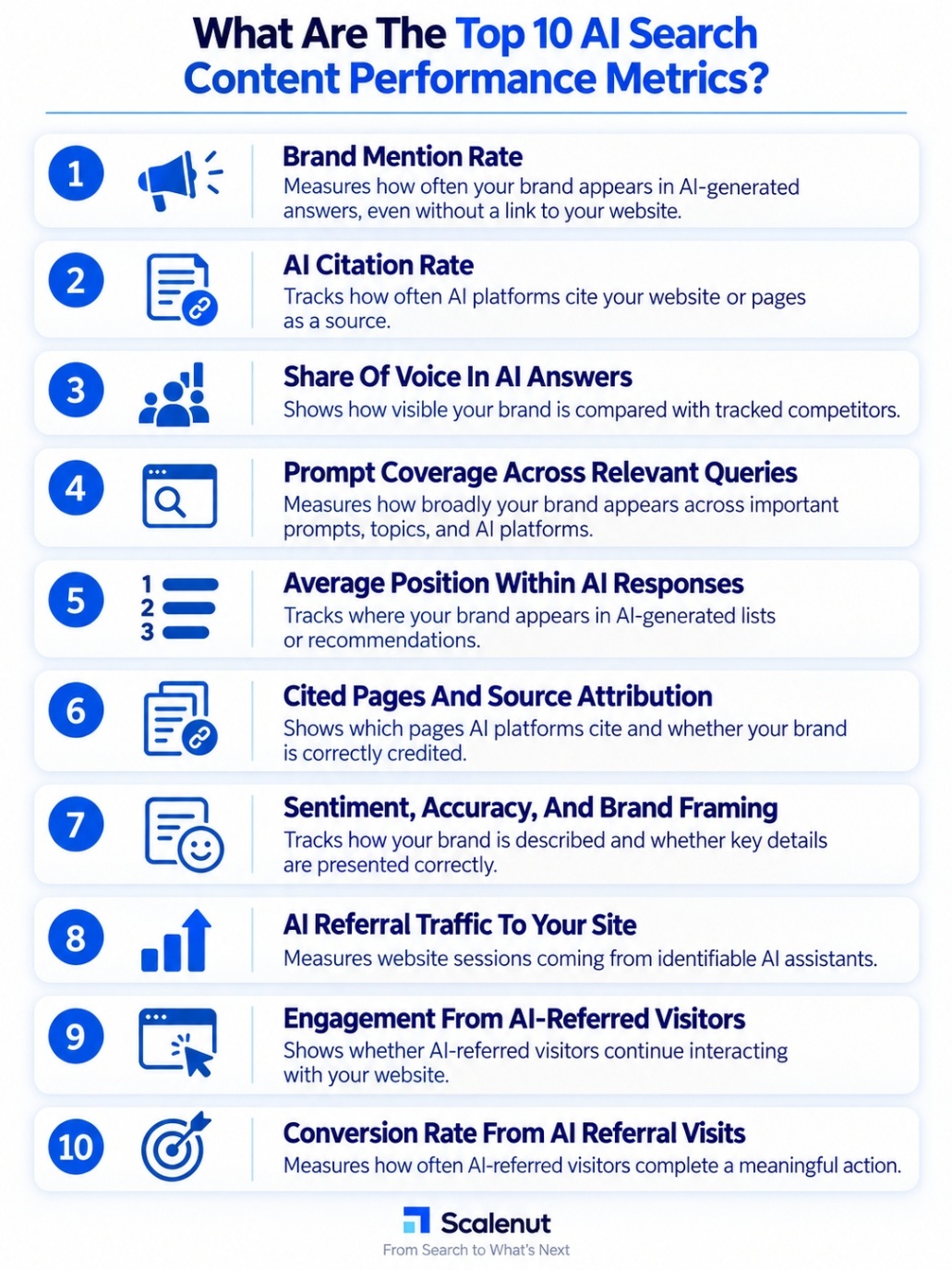
Traffic and rankings show only part of your content’s performance. AI search content performance metrics reveal whether your brand appears in AI-generated answers, how your content is used, and whether that visibility contributes to engagement and conversions.
Here are the 10 metrics you should track.
1. Brand mention rate
Brand mention rate measures how often your brand appears in AI-generated responses, even when the answer does not link to your website.
This helps you understand whether your brand is becoming part of the conversation around relevant topics. Track mentions separately from citations, and count your brand only once per response, even when it appears multiple times.
2. AI citation rate
AI citation rate tracks how frequently AI platforms cite a page from your website as a source.
A higher citation rate shows that your content is being used to support AI-generated answers. At the domain level, count your website once per response, even when several pages from your site are cited.
3. Share of voice in AI answers
AI share of voice compares your brand’s visibility with that of selected competitors across a consistent set of prompts.
It helps you see how much of the relevant AI conversation your brand captures. Keep your prompts, platforms, regions, and competitor set consistent because changing them can significantly affect the result.
4. Prompt coverage across relevant queries
Prompt coverage shows how broadly your brand or content appears across priority questions, topics, and AI platforms.
You may perform well for general prompts but remain absent from comparison, pricing, use-case, or problem-focused queries. Track each prompt and platform separately to identify the specific content gaps you need to address.
5. Average position within AI responses
Average position measures where your brand appears in an AI-generated list or recommendation.
A lower average position is generally better because position 1 is more prominent than position 3 or 4. Track this alongside mention rate to distinguish frequent visibility from prominent visibility.
6. Cited pages and source attribution
This metric shows which pages from your website AI platforms cite and whether the information is correctly credited to your brand.
Tracking cited URLs helps you identify the content formats and topics that earn the most visibility. It also shows whether citations are concentrated on a few pages or distributed across your content library.
7. Sentiment, accuracy, and brand framing in responses
Sentiment, accuracy, and brand framing show how AI platforms describe your brand when it appears in an answer.
Track whether your brand is presented positively, neutrally, negatively, or with limitations. Also check whether details such as pricing, features, capabilities, and use cases are accurate and up to date. Review the full response when automated sentiment labels miss important context.
8. AI referral traffic to your site
AI referral traffic measures website sessions coming from identifiable AI assistants.
In GA4, use the AI Assistant channel to track recognized referrals from platforms such as ChatGPT, Gemini, and Claude. You can then compare AI traffic with other acquisition channels and break it down by source.
Do not classify direct traffic as AI traffic based only on landing pages or visitor behavior because the original source cannot be confirmed.
Track Google Search Console generative AI impressions separately because they measure visibility in Google AI features, not referral sessions.
9. Engagement from AI-referred visitors
Engagement metrics show whether visitors arriving from AI assistants continue interacting with your website.
Track engagement rate, average engagement time per session, views per session, scroll events, and relevant key events. In GA4, an engaged session lasts longer than 10 seconds, includes at least one key event, or records at least two page or screen views.
10. Conversion rate from AI referral visits
AI referral conversion rate measures how often visitors from identifiable AI referrals complete a meaningful action, such as a purchase, demo request, sign-up, or download.
In GA4, track the Session key event rate for AI Assistant traffic. This measures the percentage of AI referral sessions in which at least one key event occurred, rather than counting every event occurrence separately.
Together, these AI search content performance metrics show where your content appears, how AI platforms represent and use it, and whether that visibility leads to engagement and business outcomes.
Ready to track these KPIs at scale? Compare the best AI search visibility tools for 2026.
How are the 5 core AI search content metrics calculated?

AI search performance includes several metrics, which we will cover later. These five core metrics provide a practical starting point for tracking visibility, citations, competitive presence, prompt coverage, and conversions.
- Brand mention rate
Formula: (Responses mentioning your brand ÷ Total responses analyzed) × 100
Data source: AI visibility tool
Suggested frequency: Weekly - AI citation rate
Formula: (Responses citing your domain ÷ Total responses analyzed) × 100
Data source: Citation tracker or AI visibility tool
Suggested frequency: Weekly - AI share of voice
Formula: (Your brand mentions ÷ Total mentions across your brand and tracked competitors) × 100
Data source: Competitor visibility report or AI visibility tool
Suggested frequency: Monthly - Prompt coverage rate
Formula: (Prompt-platform combinations where your brand appears ÷ Total combinations tested) × 100
Data source: Prompt-tracking or AI visibility tool
Suggested frequency: Weekly - AI referral session conversion rate
Formula: (AI referral sessions with a key event ÷ Total identifiable AI referral sessions) × 100
Data source: GA4
Suggested frequency: Monthly
Count a brand or domain only once per response for response-based rates, even if it appears multiple times. Keep the same prompts, platforms, markets, and competitor set across reporting periods so your results remain comparable.
Want to benchmark your visibility against competitors? Learn how to calculate and increase share of voice across search and AI.
How to track and measure your AI search performance?
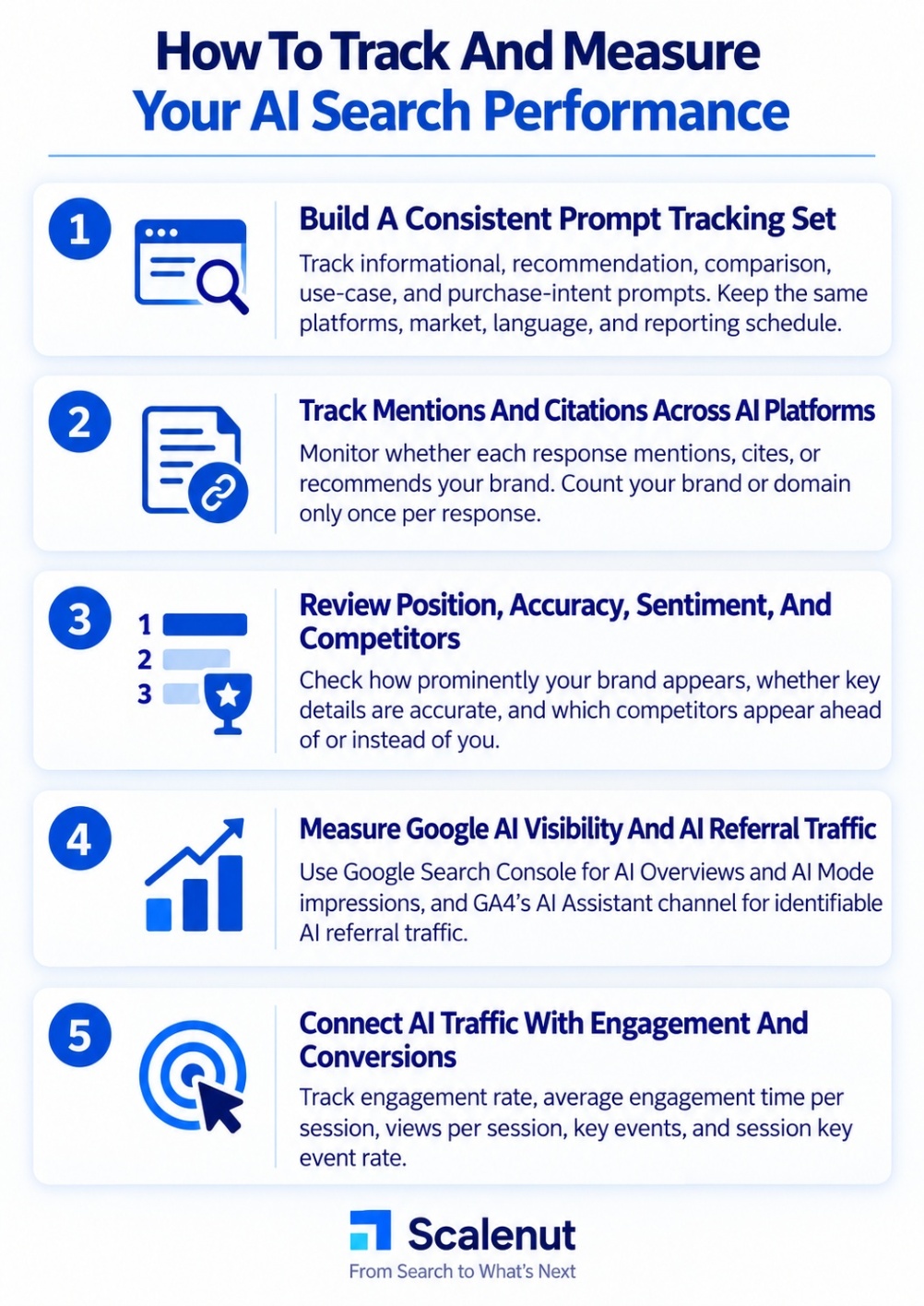
You do not need perfect data to start measuring AI search performance. The key is to keep your prompts, platforms, competitors, markets, and reporting periods consistent so you can spot meaningful changes over time.
Use AI search visibility tools with Google Search Console and GA4 to measure visibility, referrals, engagement, and conversions.
1. Build a consistent prompt tracking set
Start with prompts that reflect how your audience searches and evaluates options, including:
- Informational questions
- Product and category recommendations
- Brand comparisons
- Use-case queries
- Pricing and purchase-related questions
Test the same prompts across relevant AI platforms. Keep the location, language, competitor set, and reporting schedule consistent to maintain a reliable baseline.
2. Track mentions and citations across AI platforms
Monitor whether each response mentions your brand, cites your domain, recommends your brand, or does more than one.
Mentions show visibility, while citations show whether AI platforms use your website as a source. For larger prompt sets, use an AI visibility tool to compare platforms, track cited pages, and monitor changes over time.
For response-based rates, count your brand or domain only once per response.
3. Review position, accuracy, sentiment, and competitors
Mention and citation counts do not show the full quality of your visibility. Review:
- Whether your brand is recommended or simply mentioned
- How prominently it appears
- Whether the sentiment is positive, neutral, mixed, or negative
- Whether pricing, features, and other key details are accurate
- Which competitors appear ahead of or instead of your brand
- Which competitor pages earn citations you are missing
This helps you identify gaps in content, evidence, positioning, or product information.
4. Measure Google AI visibility and AI referral traffic
Use Google Search Console’s generative AI performance report to track impressions from AI Overviews and AI Mode. Review performance by page, country, date, and device to see where Google AI visibility is growing or declining.
In GA4, use the AI Assistant channel to track identifiable traffic from recognized AI assistants and compare it with other acquisition channels.
Do not classify direct traffic as AI traffic based only on landing pages, session length, or engagement behavior. These signals cannot confirm the original source.
5. Connect AI traffic with engagement and conversions
Compare AI-referred visitors with other traffic sources to understand the quality of the visits they generate.
Track:
- Engagement rate
- Average engagement time per session
- Views per session
- Key events
- Demo requests, sign-ups, or purchases
- Session key event rate
Use attribution reports when an AI referral touchpoint is recorded, but avoid assuming that later direct or branded-search conversions began with AI unless your analytics data supports it.
Tracking these signals together shows not only where your content appears in AI search, but whether that visibility leads to meaningful engagement and business outcomes.
How to track and measure your AI search performance?
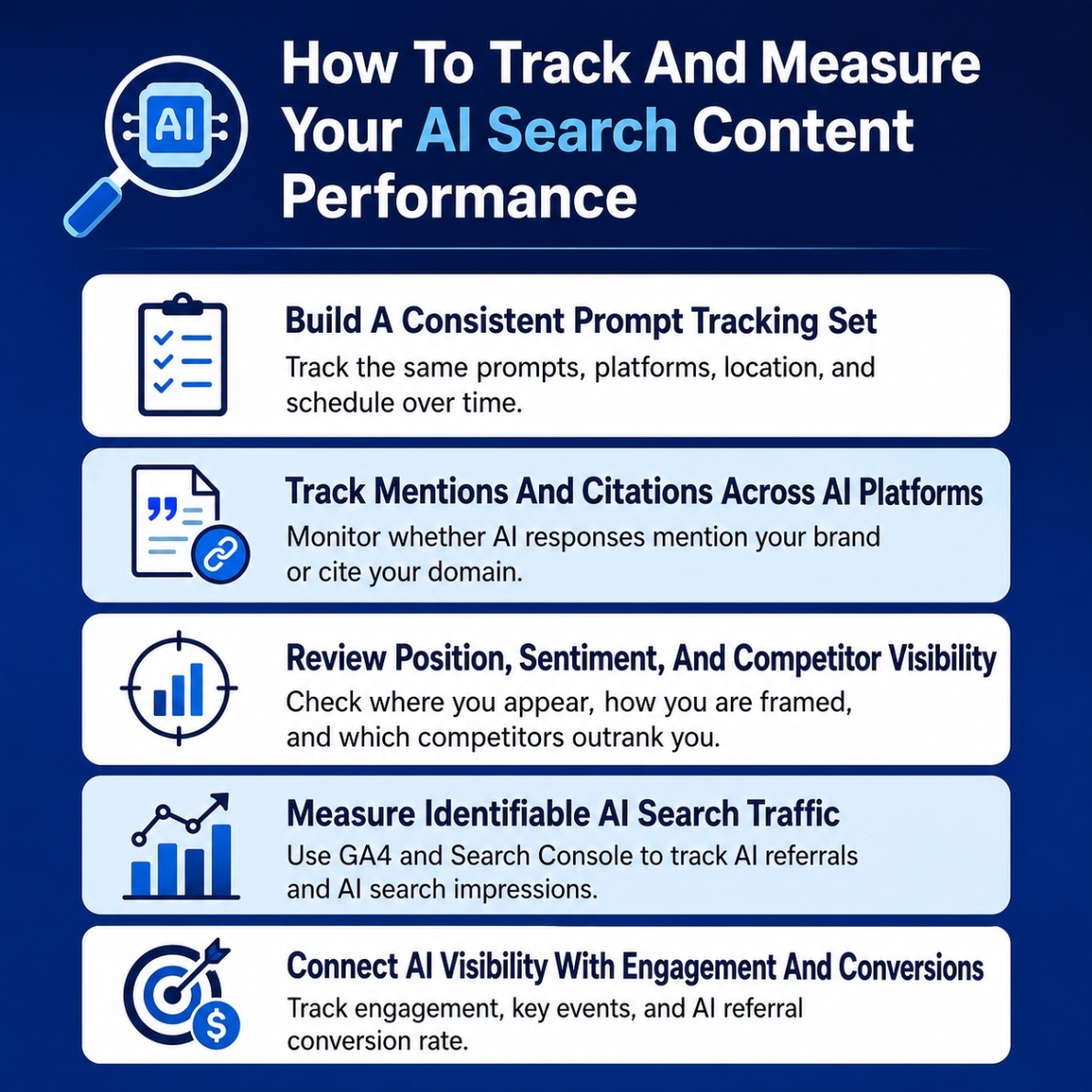
You do not need perfect data to start tracking AI search content performance. What matters is using a consistent set of prompts, platforms, competitors, and reporting periods so you can identify meaningful changes over time.
Combine AI search visibility tools with Google Search Console and GA4 to measure visibility, referral traffic, engagement, and conversions.
1. Build a consistent prompt tracking set
Start with a focused list of prompts that represent how your audience searches for information. Include different intent types, such as:
- Informational questions
- Product and category recommendations
- Brand comparisons
- Use-case queries
- Pricing and purchase-related questions
Test the same prompts across relevant AI platforms and keep the location, language, and reporting schedule consistent. This creates a reliable baseline for comparing performance over time.
2. Track mentions and citations across AI platforms
Monitor whether each AI response mentions your brand, cites your domain, or does both. Mentions show brand recognition, while citations show whether AI platforms use your content as a source.
Manual checks can work for a small prompt set. As your program grows, use an AI search monitoring tool to track hundreds of prompts, compare platforms, identify cited pages, and monitor changes automatically.
Count your brand or domain only once per response, even when it appears multiple times.
3. Review position, sentiment, and competitor visibility
Raw mention and citation counts do not reveal the full quality of your visibility. Review where your brand appears, how it is described, and which competitors appear alongside it.
Ask:
- Is your brand recommended or simply listed?
- Does it appear near the beginning or end of the response?
- Is the sentiment positive, neutral, mixed, or negative?
- Which competitors consistently outrank or replace your brand?
- Which competitor pages earn the citations you are missing?
These insights help you determine whether you need stronger topic coverage, clearer product information, better evidence, or more competitive content.
4. Measure identifiable AI search traffic
Use the Traffic acquisition report in Google Analytics to identify sessions referred by platforms such as ChatGPT and Perplexity. Review session source and medium data rather than combining AI traffic with broader referral or direct traffic.
Do not classify direct visits as AI traffic based on deep-page landings, longer sessions, or scroll behavior. These patterns may suggest research activity, but they cannot confirm where the visitor came from.
You can also review Google Search Console’s generative AI performance report when it becomes available for your property. It provides a dedicated view of impressions from Google features such as Google AI Overviews and AI Mode.
5. Connect AI visibility with engagement and conversions
Create an AI referral segment in GA4 and compare its performance with organic search and other acquisition channels.
Track metrics such as:
- Engagement rate
- Average engagement time
- Views per session
- Key events
- Demo requests, sign-ups, or purchases
- AI referral session conversion rate
Use attribution reports to evaluate longer customer journeys when the AI referral touchpoint is recorded. However, do not assume that a direct or branded search conversion began with an AI interaction unless your analytics data supports that connection.
Tracking these signals together helps you understand not only whether your content appears in AI-generated answers, but also whether that visibility contributes to meaningful website and business outcomes.
Turn these steps into a repeatable process with our 8-step guide to auditing brand visibility on LLMs.
How to improve your AI search content performance?
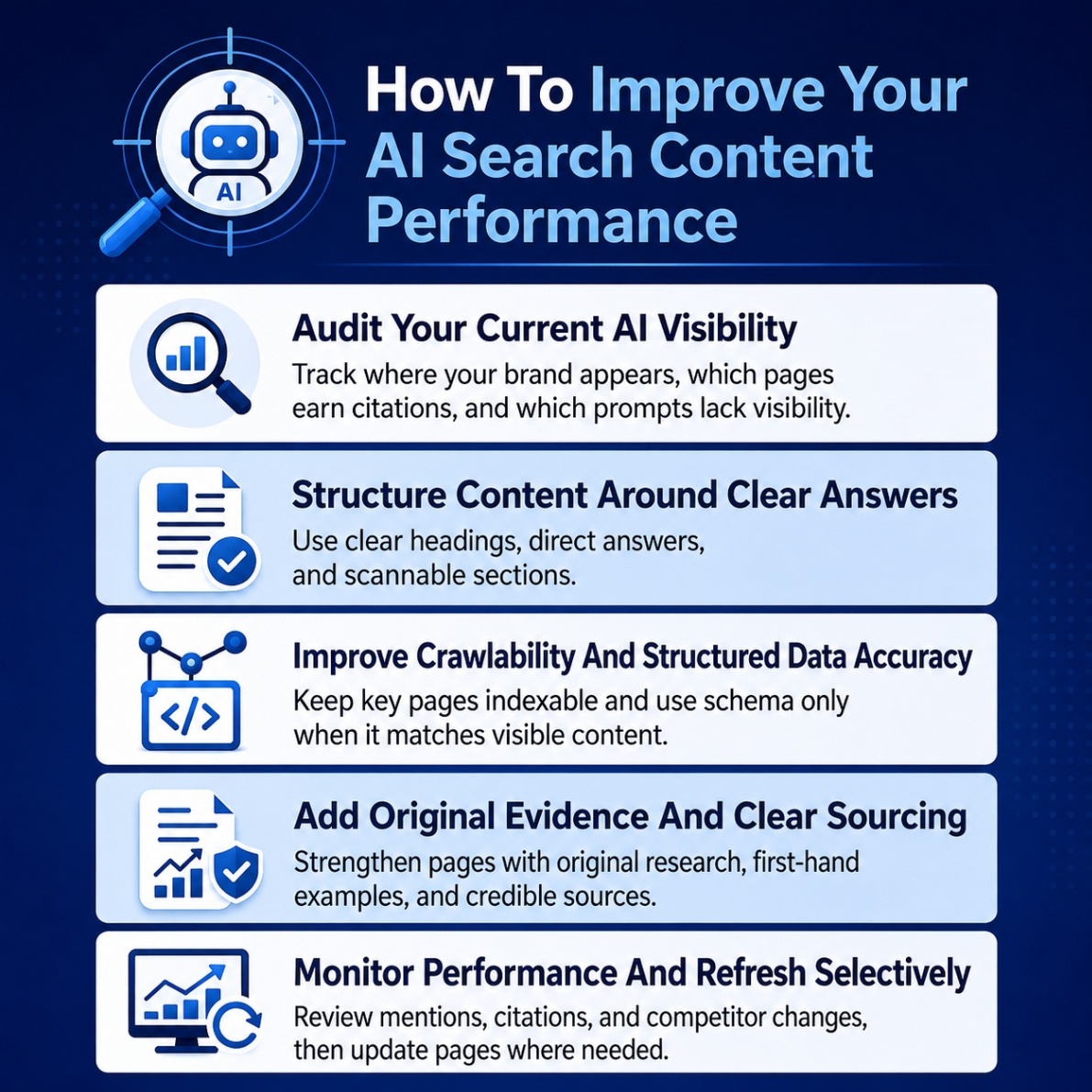
Improving AI search content performance means making your content easier to discover, understand, trust, and cite. Use your data to identify weak areas, then improve the pages and topics that matter most.
1. Audit your current AI visibility
Build a baseline using a fixed set of high-value prompts across relevant AI platforms.
Track:
- Where your brand appears
- Which pages earn citations
- How your brand is framed
- Which competitors appear instead
- Which prompts generate no visibility
Use the same prompts, platforms, and locations each time so you can compare results accurately.
2. Structure content around clear answers
Make each section easy to understand on its own.
Use descriptive headings, answer the main question early, and keep paragraphs focused. Add numbered steps, bullets, comparison sections, and clear definitions where they improve readability.
Avoid placing important information only inside images or interactive elements.
3. Improve crawlability and structured data accuracy
Make sure important pages are indexable and linked through clear internal navigation.
Use structured data only when it accurately matches the visible content. Schema markup can help search systems understand a page, but it does not guarantee AI citations.
4. Add original evidence and clear sourcing
Give readers and AI platforms a reason to reference your page.
Strengthen your content with:
- Original research
- Proprietary data
- First-hand examples
- Expert insights
- Current statistics
- Clear source attribution
Content that adds new evidence or analysis is more valuable than a summary of existing information.
5. Monitor performance and refresh selectively
Review mentions, citations, position, sentiment, and competitor visibility regularly.
When performance drops, check whether your content is outdated, unclear, incomplete, or weaker than competing pages. Refresh facts, examples, evidence, and structure where needed.
This turns generative engine optimization into a repeatable process based on performance data rather than guesswork.
Use this AI search optimization checklist to make priority pages easier to discover, understand, and cite.
How to build an AI search content performance report?
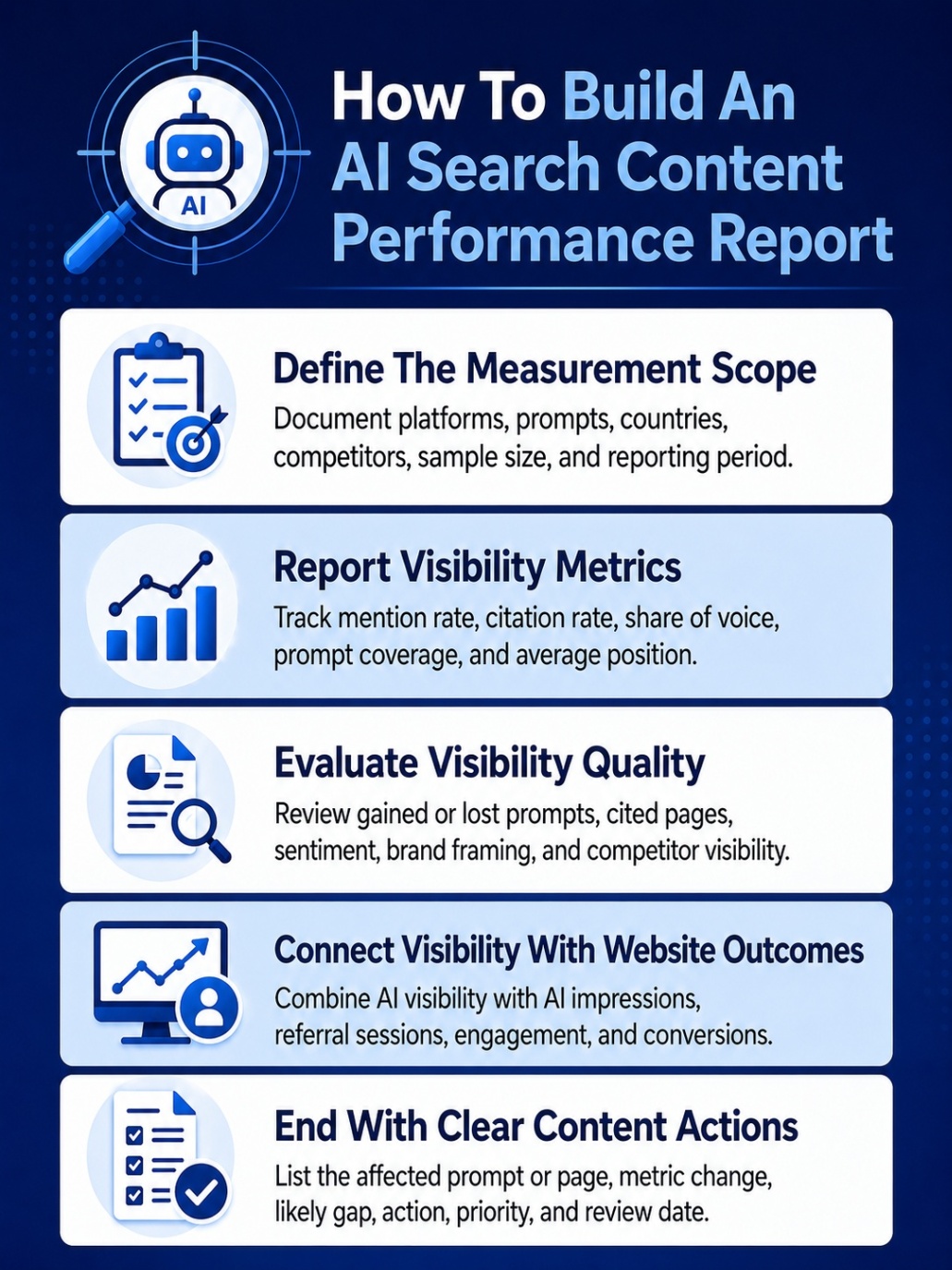
An AI search content performance report should show where your content appears, how visibility is changing, and which actions should come next. Use a consistent methodology so each reporting period remains comparable.
1. Define the measurement scope
Start every report by documenting:
- AI platforms monitored
- Prompts and prompt categories tracked
- Countries and languages included
- Competitors analyzed
- Number of responses reviewed
- Reporting period
Keep these inputs consistent. When you change the prompt set, analytics platforms, or competitor group, record the change because it can affect the results.
2. Report visibility metrics
Summarize your core AI visibility metrics, including:
- Brand mention rate
- AI citation rate
- Share of voice
- Prompt coverage
- Average position
Show the current result, the previous result, and the change between periods. Break performance down by AI platform because visibility can vary significantly across engines.
3. Evaluate visibility quality
Explain what sits behind the headline numbers.
Identify:
- Prompts where your brand gained or lost visibility
- Pages earning new or lost citations
- Whether your brand was recommended or only mentioned
- Changes in sentiment or brand framing
- Competitors replacing your brand
- Sources earning citations for competitors
This helps you determine whether a visibility change reflects stronger positioning, weaker content, or normal response variation.
4. Connect visibility with website outcomes
Combine AI visibility data with:
- Generative AI impressions from Google Search Console
- Identifiable AI referral sessions in GA4
- Engagement rate
- Average engagement time
- Session key event rate
- Leads, sign-ups, purchases, or revenue
This connects AI search visibility with measurable website and business outcomes.
5. End with clear content actions
Close the report with a prioritized action list.
For each opportunity, specify:
- The affected prompt, topic, or page
- The metric that changed
- The likely content gap
- The recommended update
- The priority level
- The next review date
Use weekly reports for prompt-level changes and sudden visibility losses. Use monthly reports for competitor trends, traffic quality, conversions, and broader content priorities.
Need the right reporting stack? Compare the best LLM SEO analysis tools for visibility tracking and execution.
What mistakes should you avoid when measuring AI search performance?
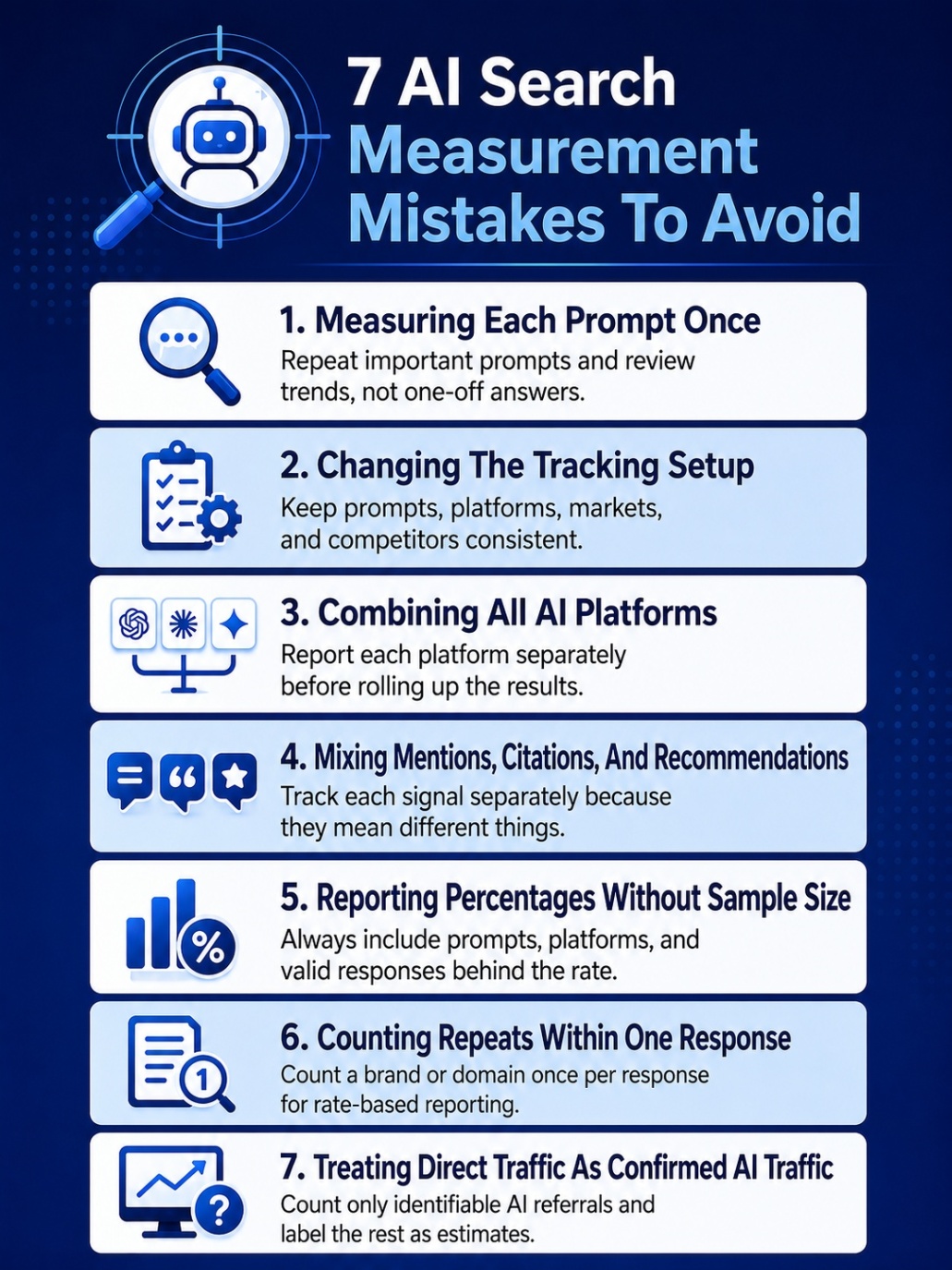
AI search metrics can become misleading when the methodology changes or the data is interpreted without enough context. Avoid these common measurement mistakes.
1. Measuring each prompt only once
AI-generated answers can change across repeated runs, platforms, and reporting periods. A single response may not accurately represent your usual visibility.
Test important prompts more than once where practical, and evaluate performance as a trend rather than treating one result as final.
2. Changing the tracking setup between reports
Adding new prompts, removing competitors, or changing locations can move your metrics even when actual performance has not changed.
Use the same prompts, platforms, markets, languages, and competitor set across reporting periods. When a change is necessary, document it and avoid directly comparing the new results with the previous baseline.
3. Combining all AI platforms into one score
ChatGPT, Gemini, Perplexity, AI Mode, and other platforms use different retrieval and citation systems. Combining them too early can hide important gains or losses.
Report each platform separately before calculating an overall result. This shows whether a change is widespread or limited to one AI engine.
4. Treating mentions, citations, and recommendations as the same metric
A brand mention does not mean your website was cited, and a mention does not always represent a recommendation.
Track each signal separately:
- Mention: Your brand appears in the response
- Citation: Your website is used as a linked source
- Recommendation: Your brand is presented as a suitable choice
5. Reporting percentages without sample size
A 50% citation rate based on 10 responses is less reliable than the same rate based on 1,000 responses.
Include the number of prompts, platforms, and valid responses behind every percentage. This gives readers enough context to judge whether a change is meaningful or based on a small sample.
6. Counting repeated appearances within one response
A brand mentioned 4 times in one answer should not automatically count as 4 separate mention observations. The same principle applies when several pages from one domain appear in a single response.
Count the brand or domain once per response for rate-based reporting. Track total mention or citation frequency separately when that additional detail is useful.
7. Treating direct traffic as confirmed AI traffic
GA4 may classify a visit as direct when it cannot identify the referral source. A deep-page landing, long session, or high scroll depth does not prove that the visitor came from an AI platform.
Report only recognizable AI referrals as identifiable AI search traffic. Keep suspected AI-influenced traffic separate and clearly labeled as an estimate.
See why platform-level reporting matters by exploring how citation patterns differ across ChatGPT, Google AI Overviews, and Perplexity.
Turn AI Search Metrics Into Growth With Scalenut
If you are measuring AI search content performance metrics, Scalenut gives you a practical way to go beyond reporting. It combines AI visibility tracking with SEO execution, helping you monitor how your brand appears across AI platforms, identify gaps in prompts and citations, track competitor presence, and act on those insights through content optimization and SEO workflows in one place.
Why Scalenut Fits This Workflow
- AI Visibility Tracking: Measure Visibility Score, Average Position, Share Of Voice, and brand presence across AI engines.
- Prompt-Level Insights: See which prompts trigger mentions, where visibility is won or lost, and which sources AI systems cite.
- Competitor Visibility Analysis: Track which competitors appear alongside your brand and spot gaps in coverage.
- AI Traffic Monitoring: Understand which AI agents interact with your site and which pages appear to attract AI-driven attention.
- SEO Execution Tools: Move from insights to action with tools for content planning, optimization, audits, and internal linking.
For readers of this blog, Scalenut is useful because it helps connect the metrics you track, like citations, share of voice, prompt coverage, and AI-driven traffic, to the content actions that can improve visibility and performance. Book a demo to see how Scalenut can help you measure, optimize, and grow your presence in AI search.
Conclusion
AI search measurement should complement traditional analytics, not replace it. By tracking AI search KPIs such as mention rate, citation rate, share of voice, referral engagement, and conversions, you can see how large language models use your content and how that visibility affects user behavior, brand awareness, and brand exposure.
Start with these next steps:
- Define a fixed set of high-value prompts and test them across major AI platforms.
- Establish a baseline for mentions, citations, position, sentiment, and competitor visibility.
- Use citation tracking to identify which pages are earning or losing visibility.
- Ensure priority pages are indexable, internally linked, and accessible to AI crawlers.
- Review performance regularly and update pages with weak evidence, outdated information, or missing intent coverage.
Your goal is not to reach the first place in every AI answer immediately. Focus on building a consistent process that reveals what is improving, where visibility is declining, and which content actions should come next.
Frequently asked questions
What metrics measure success in AI search?
Track brand mention rate, citation rate, share of voice, prompt coverage, average position, cited pages, sentiment and accuracy, AI referral traffic, engagement, and conversions. Traditional rankings and clicks still matter, but they do not capture visibility inside AI-generated answers.
How should you measure AI search success consistently?
Use the same prompts, AI platforms, markets, languages, competitors, and reporting periods. Repeat important prompts where practical and record the number of responses analyzed. Keeping the methodology consistent makes it easier to identify meaningful changes rather than normal AI response variation.
How do you optimize content using AI search performance metrics?
Use each metric to identify a specific weakness. Low citation rates may signal weak evidence or sourcing, while poor prompt coverage can reveal missing topics or intent. Also update inaccurate information, outdated facts, and pages losing visibility to stronger competitors.
How does zero-click search affect content measurement?
Zero-click AI experiences can expose users to your content or brand without generating a website visit. Track mentions, citations, share of voice, generative AI impressions, referral traffic, and conversions together rather than using organic sessions alone to judge performance.
Can Google Search Console measure AI search performance?
Yes. Search Console’s generative AI performance report tracks organic impressions from AI Overviews and AI Mode and lets you analyze performance by page, country, date, and device. It does not measure visibility across non-Google AI platforms.
How do you track AI referral traffic in GA4?
GA4 groups recognized AI-assistant referrals under the AI Assistant channel and assigns them the ai-assistant medium. This makes it easier to compare AI-driven visits with other acquisition channels and evaluate how those visitors engage and convert.
Which AI search KPIs should B2B marketers prioritize?
B2B teams should prioritize high-intent prompt visibility, citation rate, share of voice, recommendation presence, factual accuracy, AI referral traffic, and session key event rate. These old and new metrics help connect AI visibility with demo requests, sign-ups, pipeline, and revenue.
How often should you review AI search metrics?
Review relevant prompts, mentions, citations, and sudden visibility changes weekly where practical. Evaluate broader trends such as share of voice, cited pages, sentiment, referral traffic, engagement, and conversions monthly while keeping your tracking setup consistent across reporting periods.


.svg)


.webp)