

Scalenut vs Frase in 2026: Better GEO Value, Deeper Research

Scalenut vs Frase: Quick verdict
Scalenut is the better overall choice for SEO and content teams that want to connect AI visibility insights with content creation, optimization, auditing, internal linking, and AI traffic monitoring in one platform.
Frase is stronger for detailed SERP research, structured briefs, brand governance, and agent-led automation. It is a better fit for teams building customized or programmatic content workflows.
Choose Scalenut if you want:
- Deeper AI visibility and competitor intelligence
- A connected visibility-to-execution workflow
- Higher content creation and optimization limits
- AI traffic and crawler insights
- Better overall value for SEO and GEO teams
Choose Frase if you want:
- Detailed SERP research and content briefs
- Stronger brand governance
- Programmatic and agent-led workflows
- Larger prompt allowances on higher plans
- Broader AI platform coverage
You are not choosing between two simple content optimizers anymore. Both Scalenut and Frase now cover SEO, GEO, AI writing, content optimization, and AI visibility, which makes the decision harder than a basic feature comparison suggests.
The real question is how you want to work. Do you need a connected system that shows where your brand is missing in AI answers and helps you fix those gaps through content, links, and optimization? Or do you need deeper SERP research, brand governance, and agent-led automation?
That workflow difference matters more than the length of either feature list.
What is Scalenut?
Scalenut is an all-in-one SEO and GEO platform that helps teams plan, create, optimize, and monitor content across traditional and AI search. It connects AI visibility tracking, prompt intelligence, competitor analysis, content creation, optimization, and AI traffic insights in one platform.
Scalenut is trusted by more than 100,000 marketers across 150+ countries and has powered over 5 million SEO blogs. It has also earned strong user ratings across major review platforms, including 4.7/5 on G2 and 4.8/5 on Capterra and Trustpilot.
What is Frase.io?
Frase.io is an AI-powered SEO and GEO platform that helps teams research topics, create briefs and articles, optimize pages, monitor content, and track brand visibility across Google and AI search.
Its AI Agent connects research, writing, optimization, and content maintenance in one workflow. Frase is trusted by thousands of content and marketing teams and holds a 4.8/5 rating from more than 500 verified G2 and Capterra reviewers.
What do real users say about Frase vs Scalenut?
User reviews suggest that both platforms help teams create and optimize content faster, but they are appreciated for slightly different reasons.
What users say about Frase
Frase users frequently highlight its SERP research, content briefs, optimization guidance, and ability to reduce the time spent analyzing competing pages. Many also appreciate having research and recommendations available directly inside the editor.
“The SERP research feature is great and allows you to analyze competing content in the editor only. It gives you content recommendations through word count, headings, links, and images you are supposed to add.”, says Gajendra S. on G2
The broader review pattern supports this. Users often describe Frase as a time-saving platform for researching topics, creating structured outlines, and identifying ways to improve a page for search.
What users say about Scalenut
Scalenut users regularly mention its ease of use, affordability, SEO optimization features, and connected content workflow. Reviews also highlight how it brings keyword research, content planning, AI writing, and optimization into one platform.
“I like that Scalenut is extremely user-friendly and affordable. It's a scalable way of generating customized content that's searchable and discoverable by Google and AI engines. I appreciate that it actually works, giving me the ability to drive organic traffic to my website without solely relying on a website team. The initial setup was very easy, and I rate it a 10 because I talk about it all the time.”, says Clayton S. on G2
This feedback reflects Scalenut’s broader value for teams that want to move from research and planning to content creation and optimization without relying on several separate tools.
As with any AI writing platform, content generated by either tool still benefits from human review. Writers should verify facts, improve originality, add subject-matter expertise, and ensure the final article accurately reflects the intended audience and brand.
My verdict
Frase earns strong user feedback for its SERP research and in-editor optimization guidance. Scalenut stands out for ease of use, affordability, and its ability to connect research, writing, AI SEO optimization, and GEO workflows in one platform.
I would choose Scalenut for teams that want a more complete and accessible content workflow, while Frase remains a strong option for users whose main priority is detailed SERP-led research.
How does the pricing of Scalenut compare to Frase?
Scalenut has the lower entry price and higher content-production limits, while Frase offers larger AI visibility prompt allowances and broader platform coverage on higher plans.
How much does Scalenut cost?
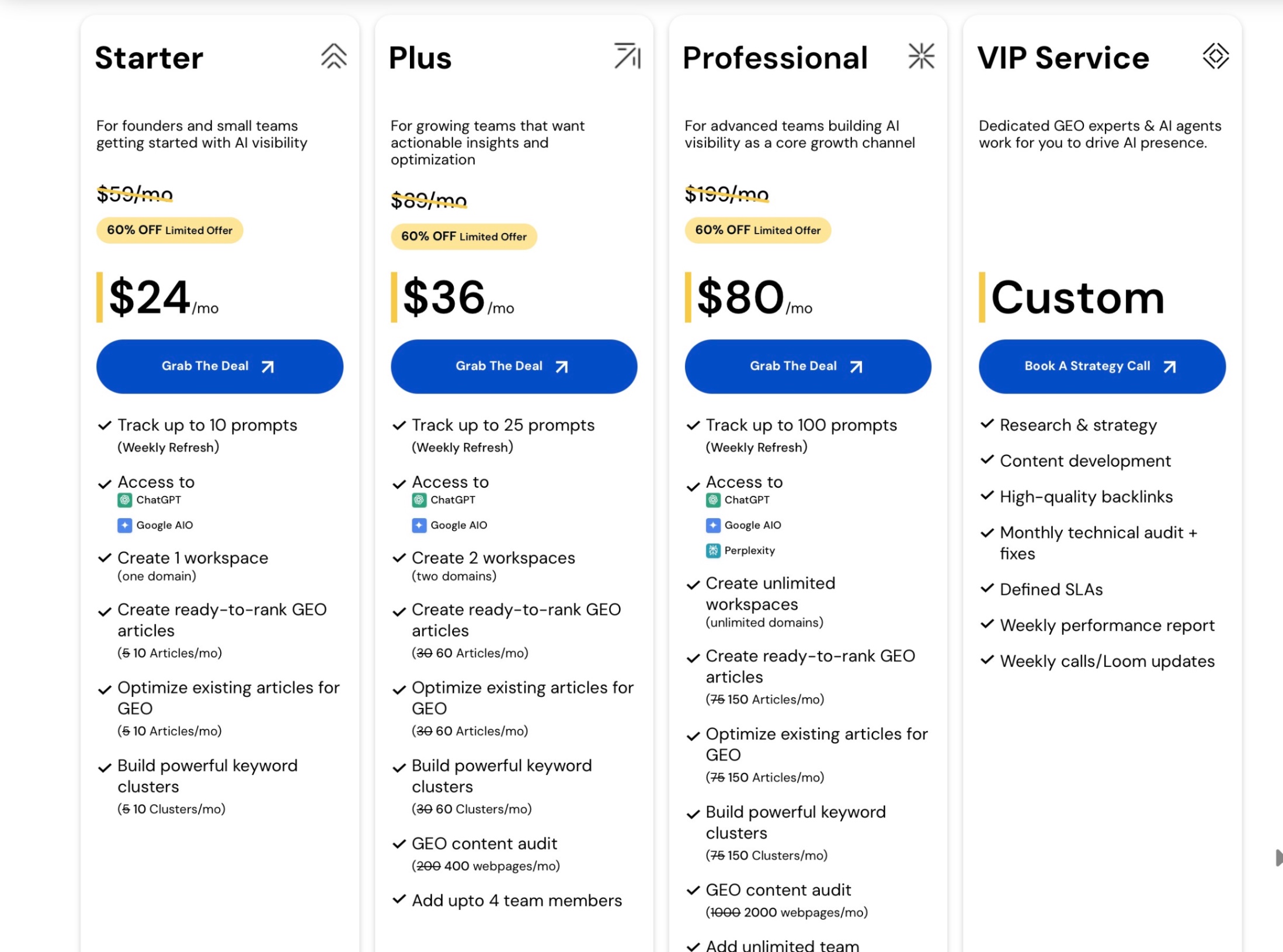
Scalenut’s standard monthly plans cost $59 for Starter, $89 for Plus, and $199 for Professional. Its current annual offer reduces these to $24, $36, and $80 per month, with a custom-priced VIP Service also available.
Annual plans include 10 to 100 tracked prompts, one to unlimited domains, up to 150 GEO articles and optimizations per month, and audits for up to 2,000 webpages. Higher plans add more AI platforms, team members, and workspaces. Scalenut also offers a 7-day free trial.
How much does Frase cost?
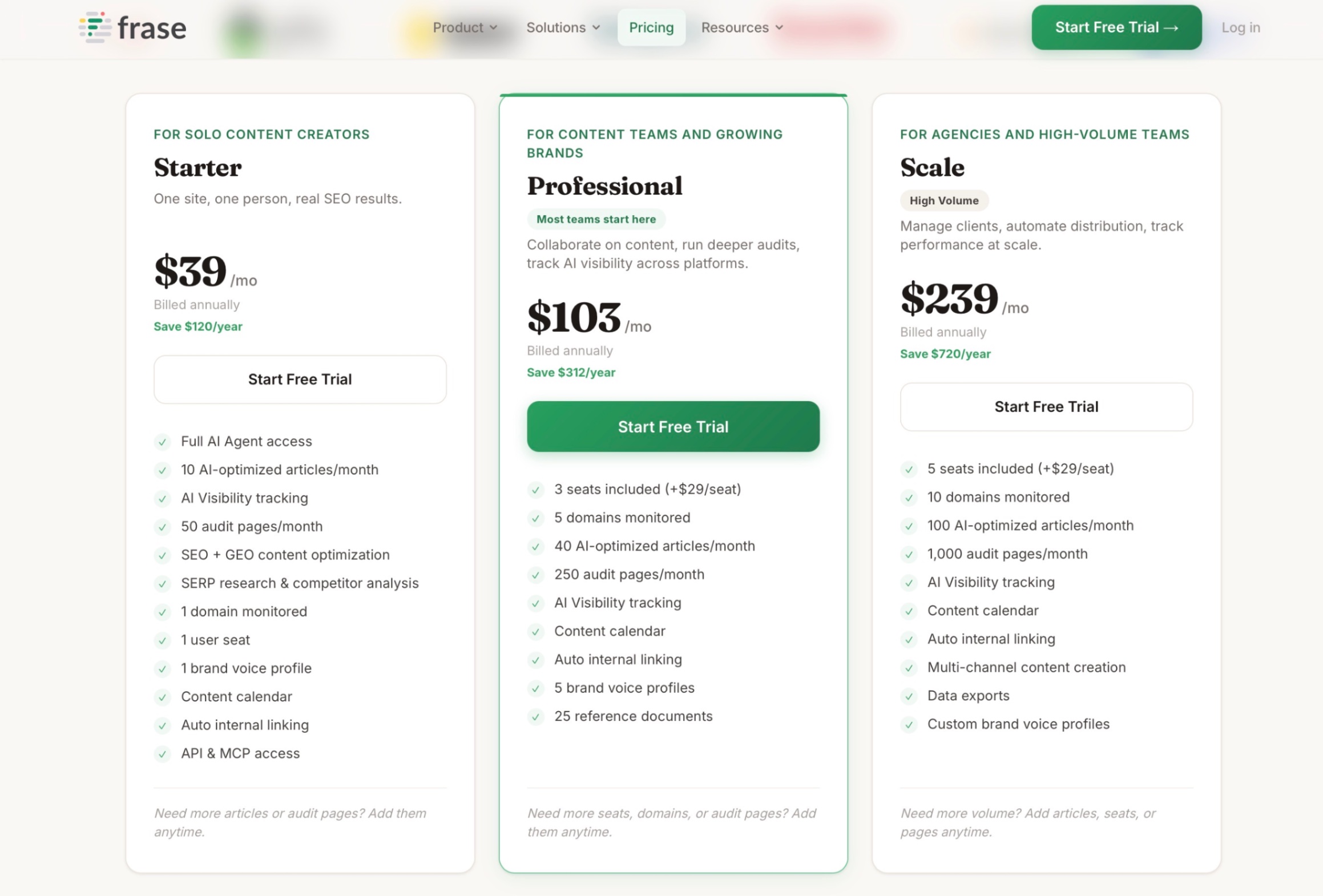
Frase costs $49, $129, and $299 per month for Starter, Professional, and Scale. Annual billing lowers these prices to $39, $103, and $239 per month.
Plans include 10 to 100 optimized articles, 50 to 500 visibility prompts, one to 10 domains, and audits for 50 to 1,000 pages. Higher tiers add more users, AI platforms, and crawler monitoring. Frase also offers a 7-day free trial.
My verdict
Scalenut offers better value for teams that want AI visibility tracking combined with high-volume content creation, optimization, keyword planning, and auditing.
Frase costs more but provides larger prompt allowances, broader AI platform coverage, and stronger automation options. For most SEO and content teams, Scalenut offers the more complete workflow at a lower price.
Read our full Frase review for a closer look at its features, pricing, strengths, and limitations.
How do Scalenut and Frase compare across their core features?
Scalenut and Frase both support SEO, GEO, content creation, optimization, and AI visibility tracking. The main difference is how each platform connects these capabilities and helps teams act on the insights they uncover.
Which tool offers better AI visibility and competitive intelligence?
AI visibility tracking shows where your brand appears in AI-generated answers, how prominently it is positioned, and how it performs against competitors.
Based on my review of their current features and documented workflows, Scalenut provides more granular prompt, source, and competitor intelligence, while Frase offers broader AI platform coverage.
How Scalenut handles AI visibility
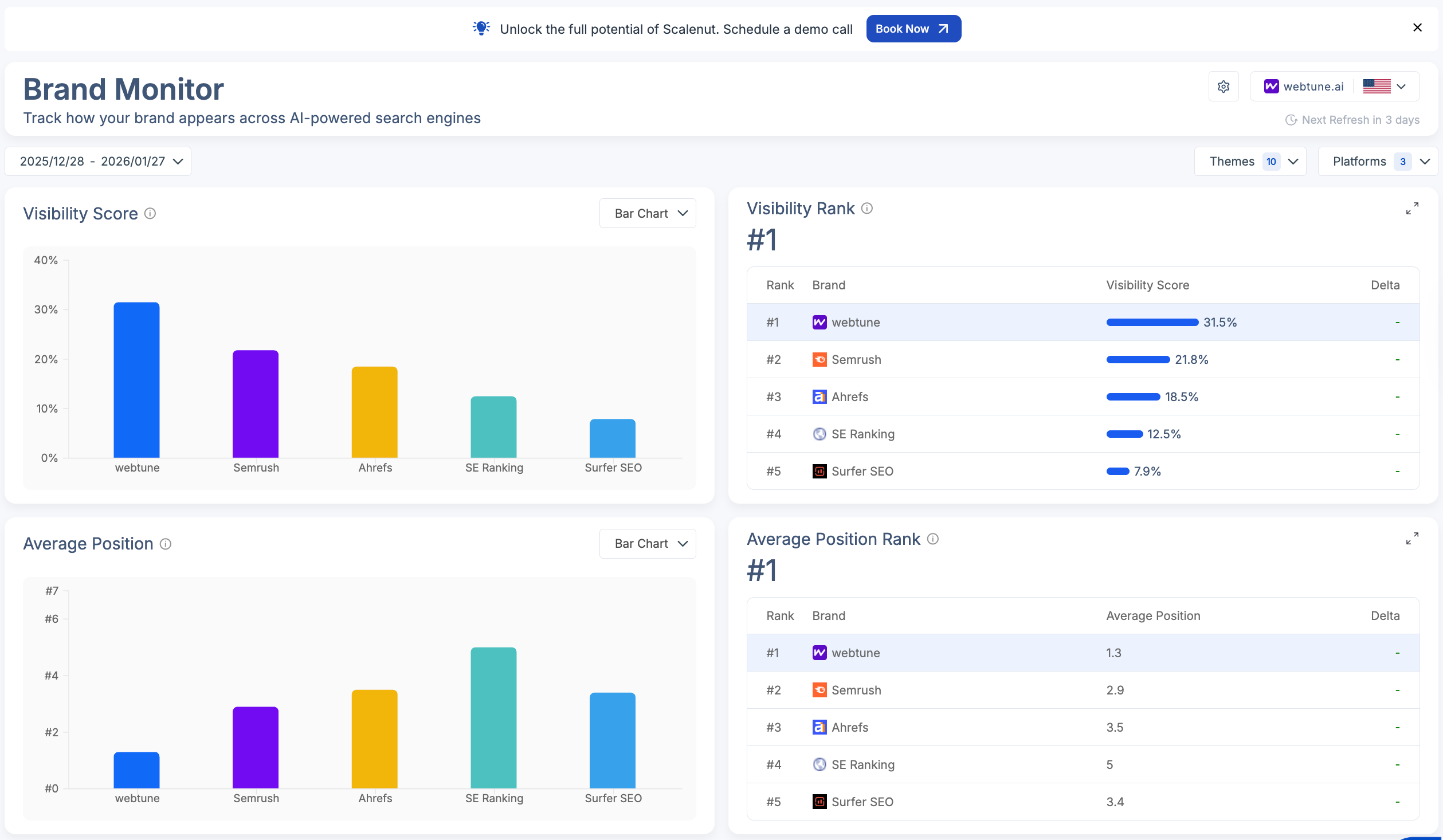
Scalenut shows how often a brand appears, where it is positioned, and how it compares with competitors.
Its Visibility Score, Share of Voice, Average Position, Brand Visibility Rank, and Visibility Heatmap make performance easier to assess across AI platforms and themes. At the prompt level, I can review mentions, direct citations, sentiment, competitors, supporting sources, complete responses, and query fan-outs.
Scalenut also highlights content gaps where competitors are cited but the tracked brand is missing. This makes it useful for understanding why another brand is gaining visibility, not simply identifying that a gap exists.
How Frase handles AI visibility
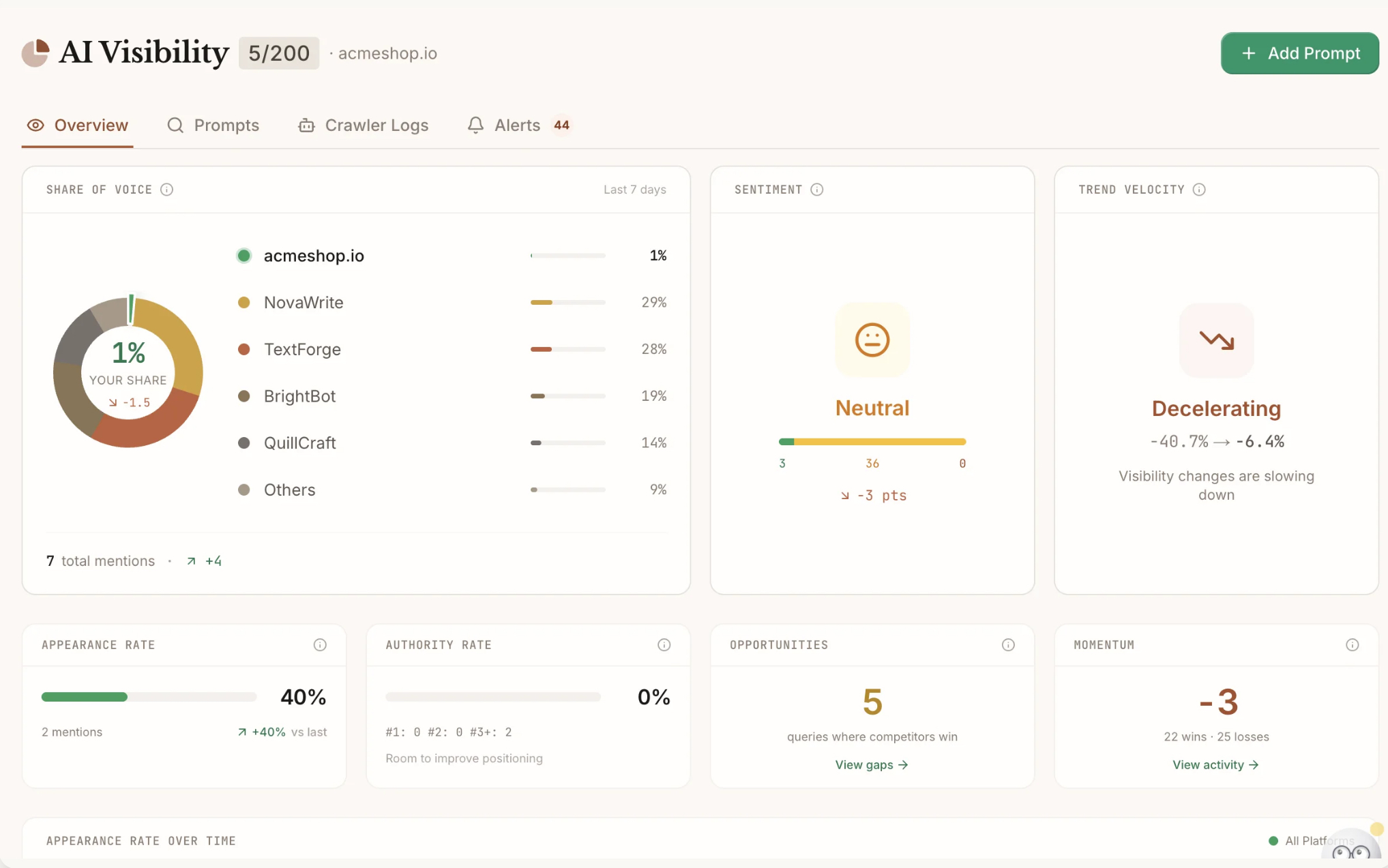
Frase’s main advantage is broader platform coverage. It tracks appearance rate, Share of Voice, sentiment, citations, competitors, and actual AI responses across major AI engines.
It also supports prompt discovery and prioritizes competitive gaps that can be turned into new content or optimization opportunities. However, Scalenut provides more detail for investigating positioning, mentions versus citations, source patterns, sentiment, and the related subqueries influencing an answer.
My verdict
Frase is stronger for platform breadth, but Scalenut offers deeper prompt and competitor intelligence. I would choose Scalenut for understanding where competitors are gaining visibility and what may be driving that advantage.
Want to stay ahead of what is changing in AI-driven discovery? Check out the top AI monitoring tools that can sharpen your AI visibility workflow in 2026.
Which tool is better for GEO content optimization?
AI visibility tracking reveals where your brand is missing. GEO content optimization helps improve the pages AI engines may discover, understand, extract, and cite.
How Scalenut approaches GEO optimization

Scalenut’s GEO Score evaluates SEO and AI-readability signals. Its optimization workflow covers prompt coverage, key terms, structure, readability, schema, internal links, and missing sections before recommending specific improvements.
Teams can optimize existing URLs and use Auto Optimizer to apply common fixes to headings, metadata, key terms, and prompt coverage. This makes the workflow more action-oriented than a score-only approach.
How Frase approaches GEO optimization
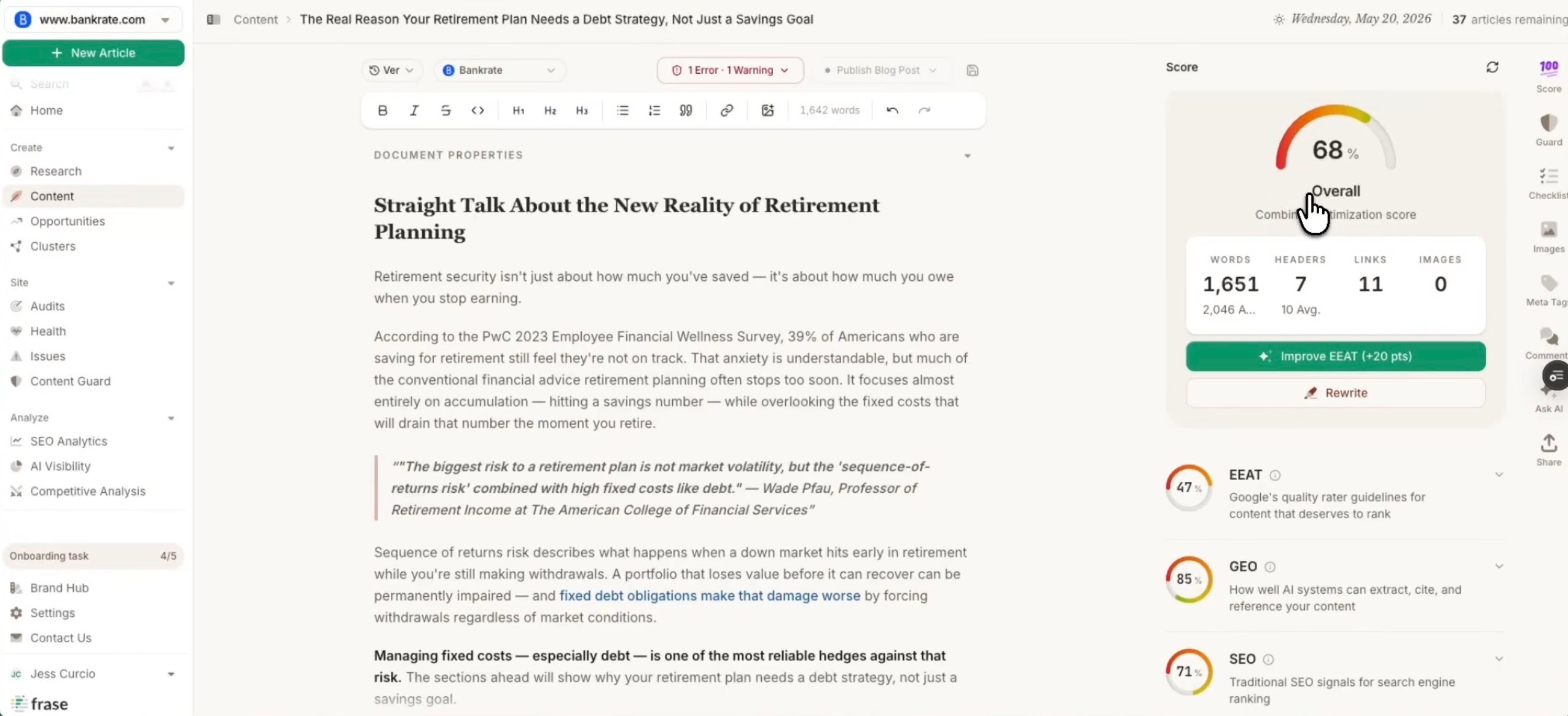
Frase displays separate SEO and GEO scores inside the editor. Its GEO guidance is divided into quotability, structure, definitions, takeaways, and citations.
It can identify passages that need clearer answers, stronger definitions, extractable statements, supporting statistics, entity coverage, or more authoritative sources. This gives writers detailed editorial guidance while they revise a page.
My verdict
Frase provides stronger passage-level guidance for clarity and citation readiness. Scalenut offers a more streamlined workflow by combining GEO scoring, specific recommendations, existing-page optimization, and one-click fixes for common issues.
I would choose Scalenut for teams that want to identify GEO gaps and act on them faster.
Want to track where your brand shows up in Google AI Overviews? Explore our list of the 10 best AI Overviews trackers to use in 2026 and find the right fit for your workflow.
Which tool is stronger for SEO research and content planning?
SEO research helps teams choose the right topics, understand what already ranks, and build a clear content plan before writing.
How Scalenut approaches research and planning
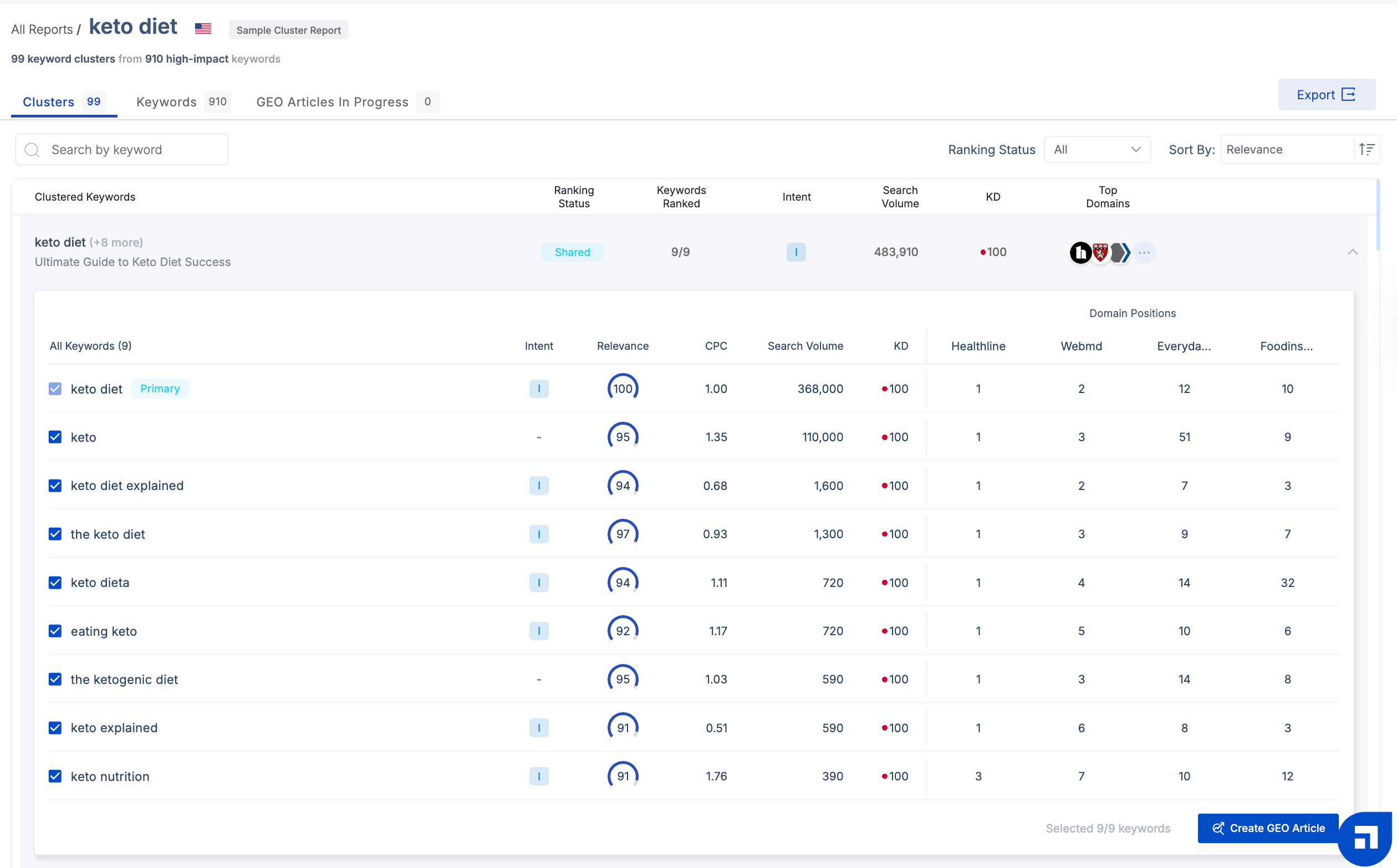
Scalenut’s Keyword Planner groups keywords into intent-based clusters, generates a relevant AI prompt for each cluster, and supports competitor, keyword-gap, and location-specific analysis.
Its Topic Research covers competitor outlines, questions, key terms, statistics, citations, and content gaps. From a selected cluster, teams can move directly into the article creation workflow.
I find Scalenut particularly useful for planning several connected pages around a topic instead of researching one keyword at a time.
How Frase approaches research and planning
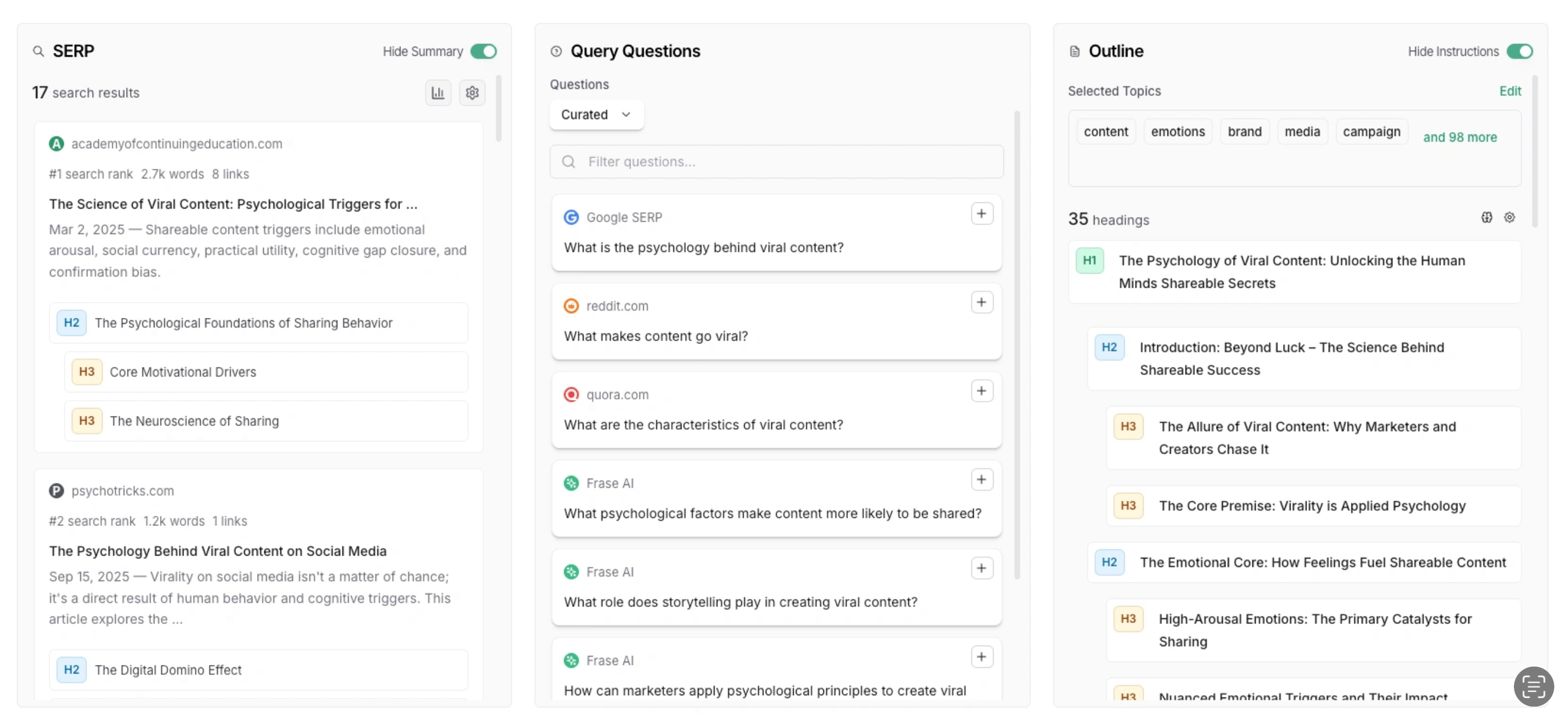
Frase provides detailed SERP-led research inside its content workflow. It analyzes ranking pages, competitor headings, questions, statistics, keyword opportunities, and search intent before generating a structured brief.
Its topic-cluster and Content Opportunities features also help teams identify missing pages, supporting topics, and internal-linking opportunities.
Frase is particularly useful when the priority is building a detailed brief for one article and reviewing the competing pages behind the recommendations.
My verdict
Frase is stronger for detailed page-level SERP research and content briefs. Scalenut provides the better planning workflow for teams that want to build keyword clusters, uncover competitive gaps, and move directly from strategy to content production.
I would choose Scalenut for scalable content planning and Frase for individual article research.
Which tool offers the better AI writing workflow?
Both platforms can generate full articles, but their workflows offer different levels of guidance, governance, and flexibility.
How Scalenut approaches AI writing
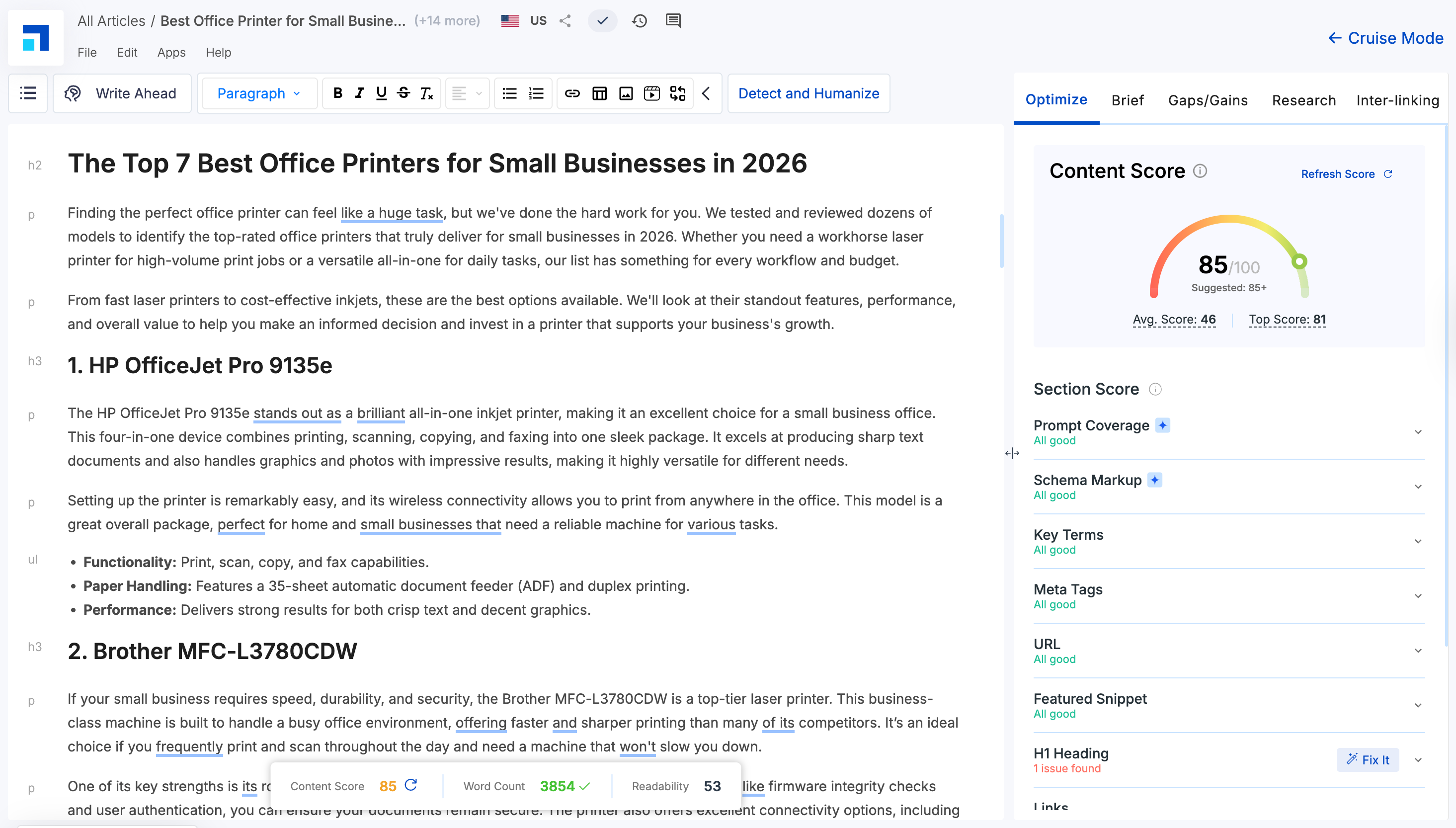
Scalenut’s Cruise Mode guides users from context and outline selection to a complete SEO and GEO-focused draft. Teams can provide custom instructions, reference articles, an article type, and Brand Kit preferences for tone, terminology, readability, and images.
The editor also supports contextual writing, rewriting, expanding, shortening, and simplifying. Its Detect and Humanize tool can refine sections that need a more natural tone before publishing.
This guided process is useful for producing structured long-form content without assembling each stage manually.
How Frase approaches AI writing
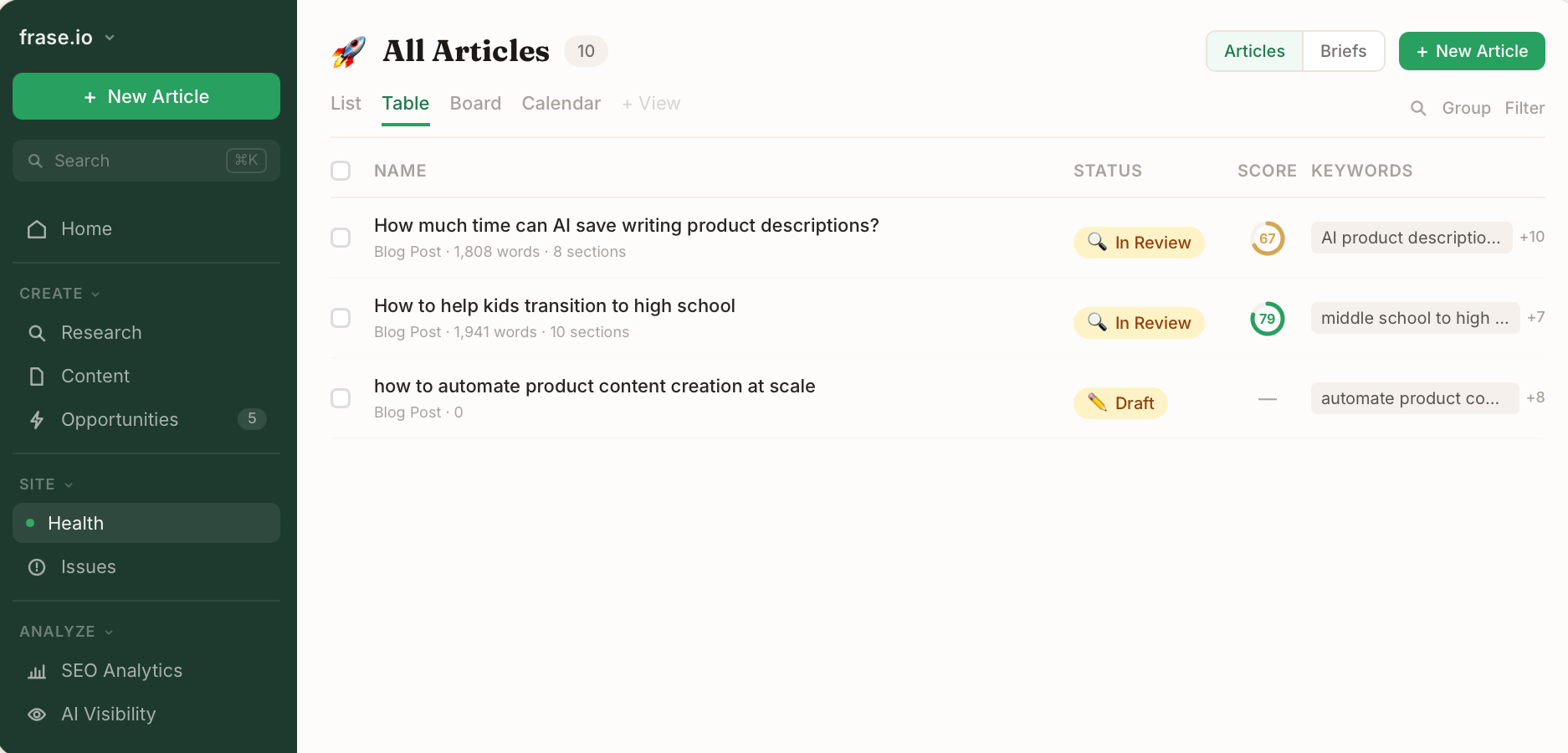
Frase can create complete Rank-Ready Documents using SERP research, SEO and GEO guidance, brand voice, target-market information, and reference documents.
Its main strength is content governance. Teams can enforce terminology, writing rules, brand voice, and internal knowledge across AI-generated content.
Frase’s AI Agent also supports custom workflows, programmatic SEO, and content atomization for repurposing articles into other formats.
My verdict
Frase is stronger for brand governance, programmatic content, and flexible agent-led workflows. Scalenut offers the more straightforward long-form writing experience by guiding users from research and context to an optimized draft inside Cruise Mode.
I would choose Scalenut for teams that want to create SEO and GEO-focused articles through a clear, repeatable workflow.
Which tool is better for optimizing and maintaining existing content?
Both platforms help teams find underperforming pages and improve them, but they approach ongoing maintenance differently.
How Scalenut handles existing content
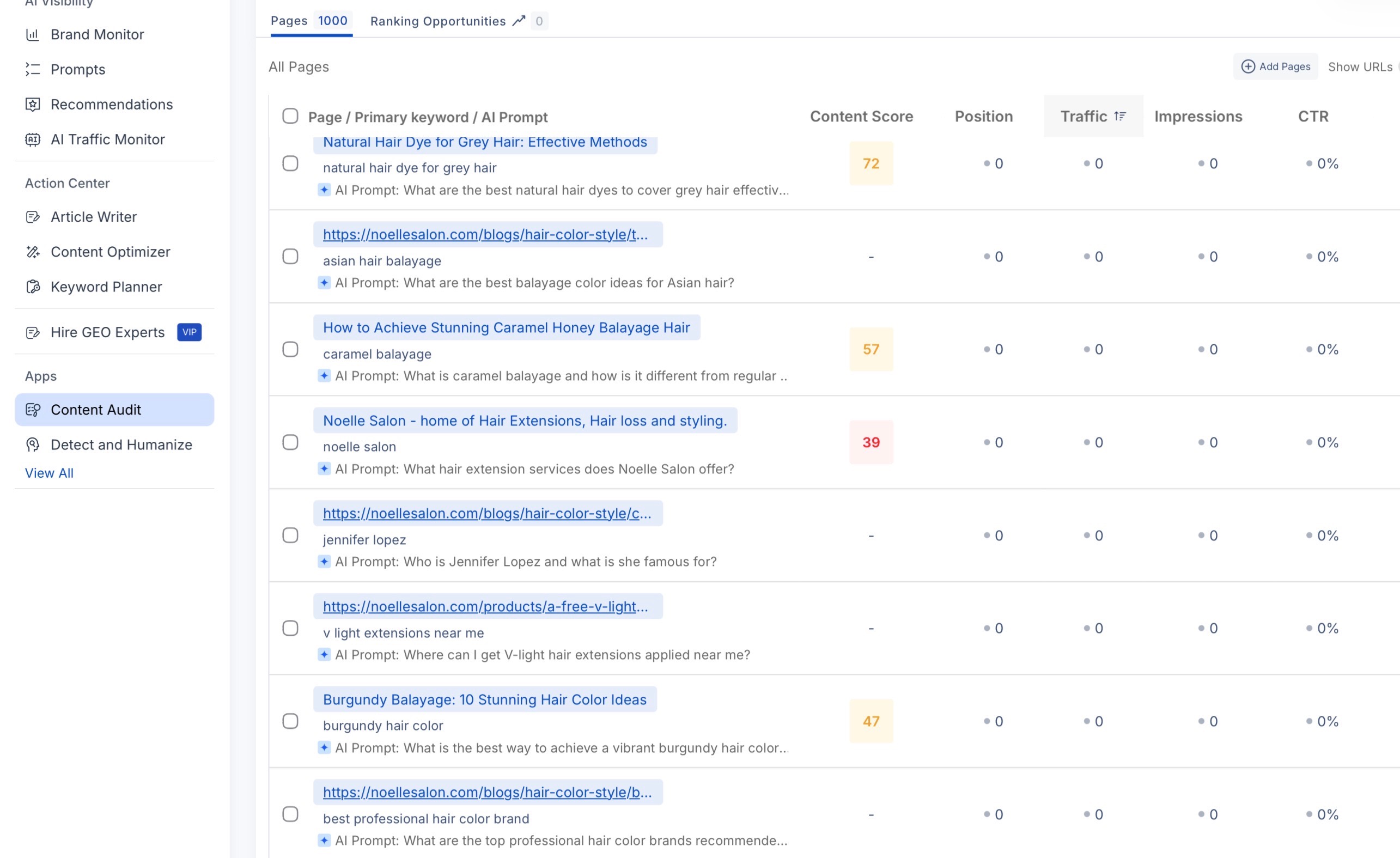
Scalenut combines Content Audit with its Google Search Console-powered Traffic Analyzer to identify declining pages, content gaps, traffic changes, and keyword cannibalization.
From there, teams can move a page into Content Optimizer, review missing SEO and GEO signals, and apply selected changes or use Auto Optimizer for common fixes.
Link Manager identifies inbound and outbound internal-linking opportunities, while OnPage Pro helps teams audit and fix metadata, canonical tags, external-link behavior, and missing image alt text.
How Frase handles existing content
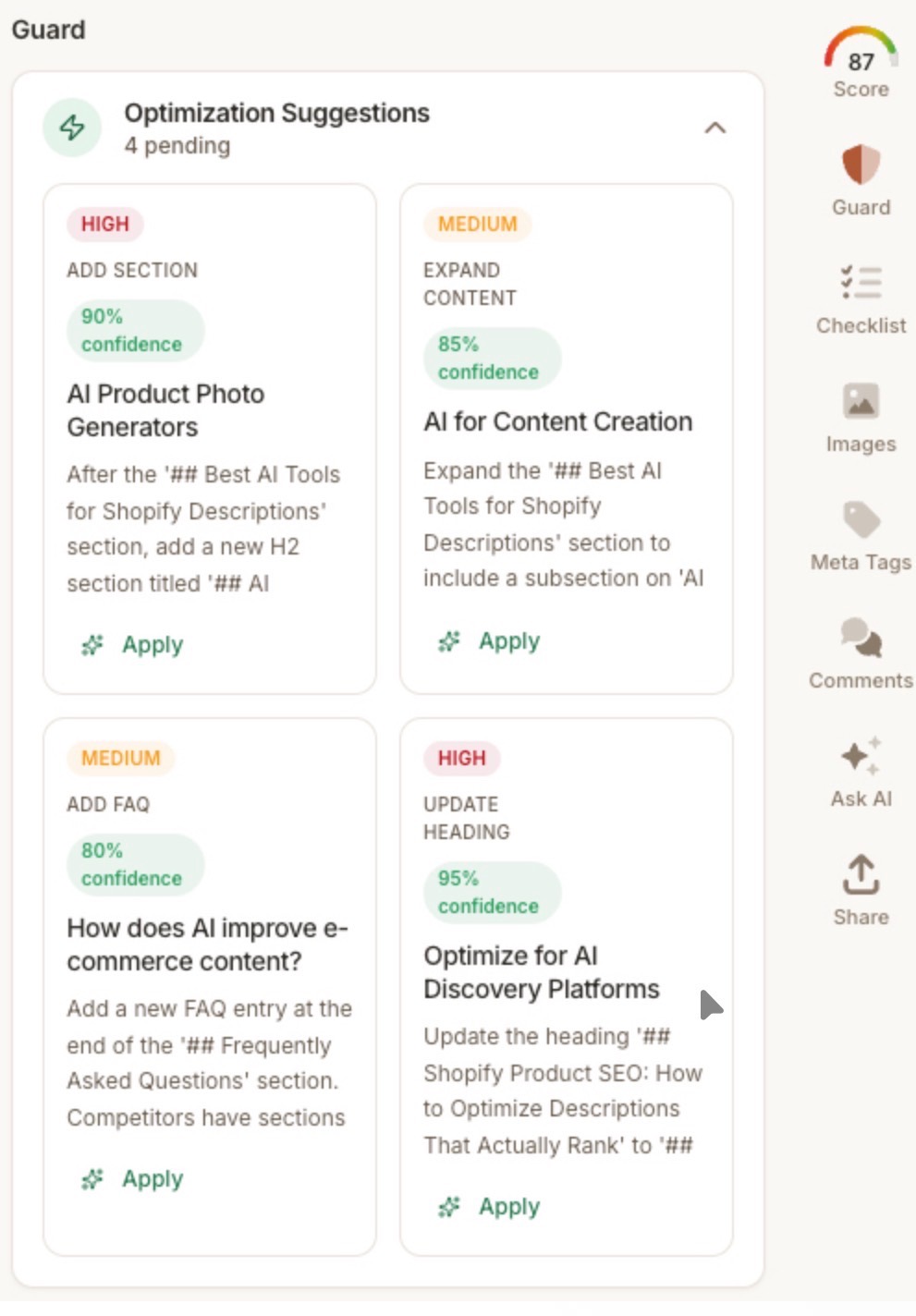
Frase’s Content Monitoring gives connected pages a health score based on factors such as content age, traffic, rankings, and competitor activity.
Its Site Auditor also identifies technical issues, cannibalization, content-quality problems, and page-level SEO and GEO weaknesses.
Content Guard then monitors protected pages for ranking or citation decline, generates fixes, applies permitted changes under approval rules, and returns an updated draft to supported CMS platforms.
My verdict
Scalenut offers a more controlled audit-to-optimization workflow for teams that want to review, prioritize, and improve pages themselves.
Frase is stronger for continuous content maintenance because its monitoring, auditing, and Content Guard workflows can automate more of the diagnosis and update process.
Which tool provides stronger AI traffic and crawler insights?
AI visibility shows what answer engines say about your brand. Traffic and crawler data show how AI systems and AI-referred users interact with your website.
How Scalenut tracks AI traffic
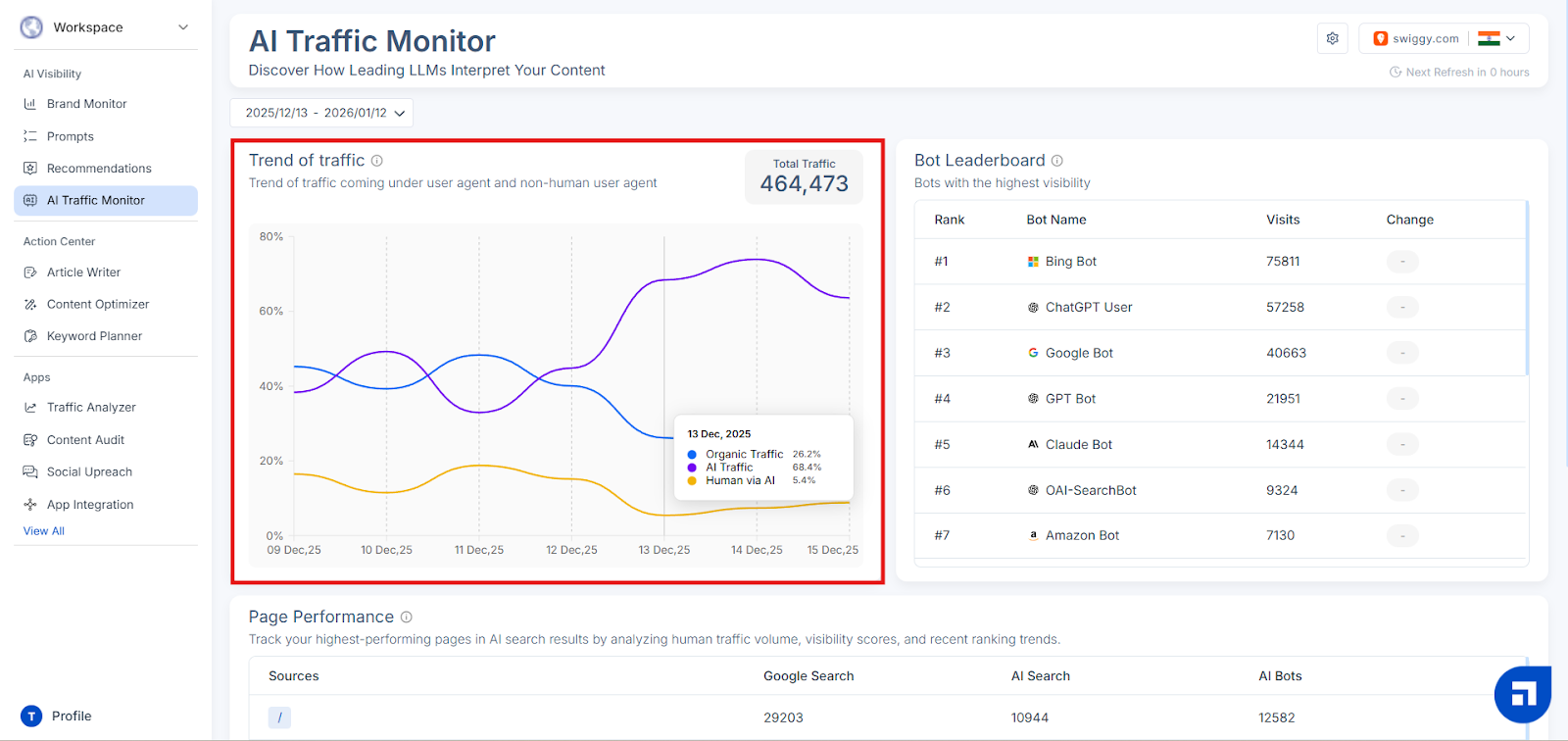
Scalenut connects with Cloudflare to collect server-side traffic data. It separates human visitors from AI user agents, identifies the most active bots, tracks crawl trends, and shows which pages receive the most AI activity.
It also distinguishes AI bot traffic from users referred by AI platforms. Page-level reporting connects visibility, human traffic, and recent performance trends, helping teams identify pages that are gaining AI exposure but not attracting clicks.
A crawler visit does not prove that a page was cited, but it does show which content AI systems are actively accessing.
How Frase tracks AI crawlers
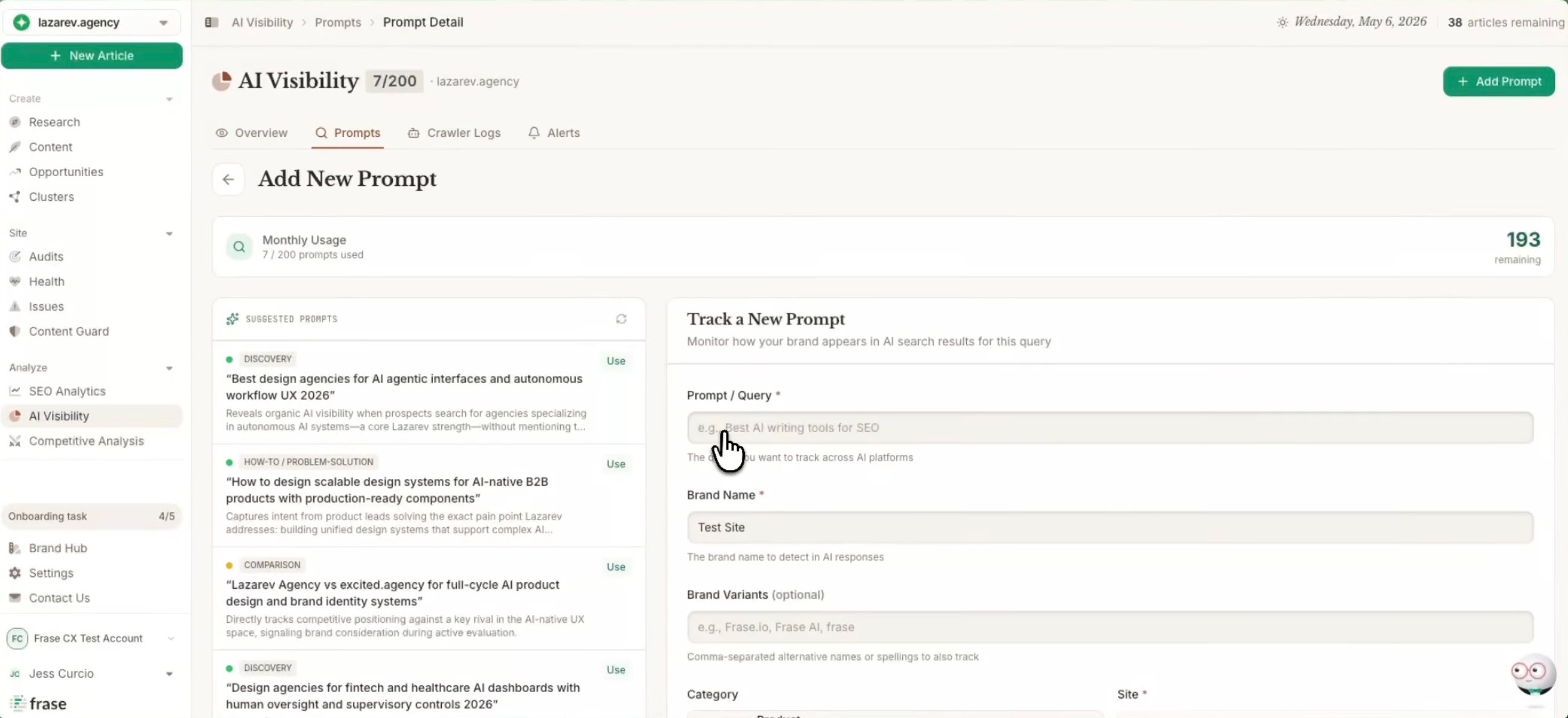
Frase provides AI crawler monitoring on eligible plans. Its bot analytics show which AI crawlers access the website and which pages they visit.
This is useful for checking whether priority pages are discoverable to major AI systems. However, crawler analytics are a smaller part of Frase’s broader content monitoring and AI visibility workflow.
My verdict
Frase provides useful crawler-level monitoring, but Scalenut offers the stronger traffic intelligence layer. Its Cloudflare integration connects AI bot activity, human referral traffic, crawl trends, and page-level visibility in one dashboard.
I would choose Scalenut for teams that want a clearer picture of how AI discovery translates into website interaction.
Which tool offers better workflow automation and execution?
The value of a GEO platform is not limited to finding visibility gaps. It should also help teams decide what to do next and complete the work.
How Scalenut supports execution
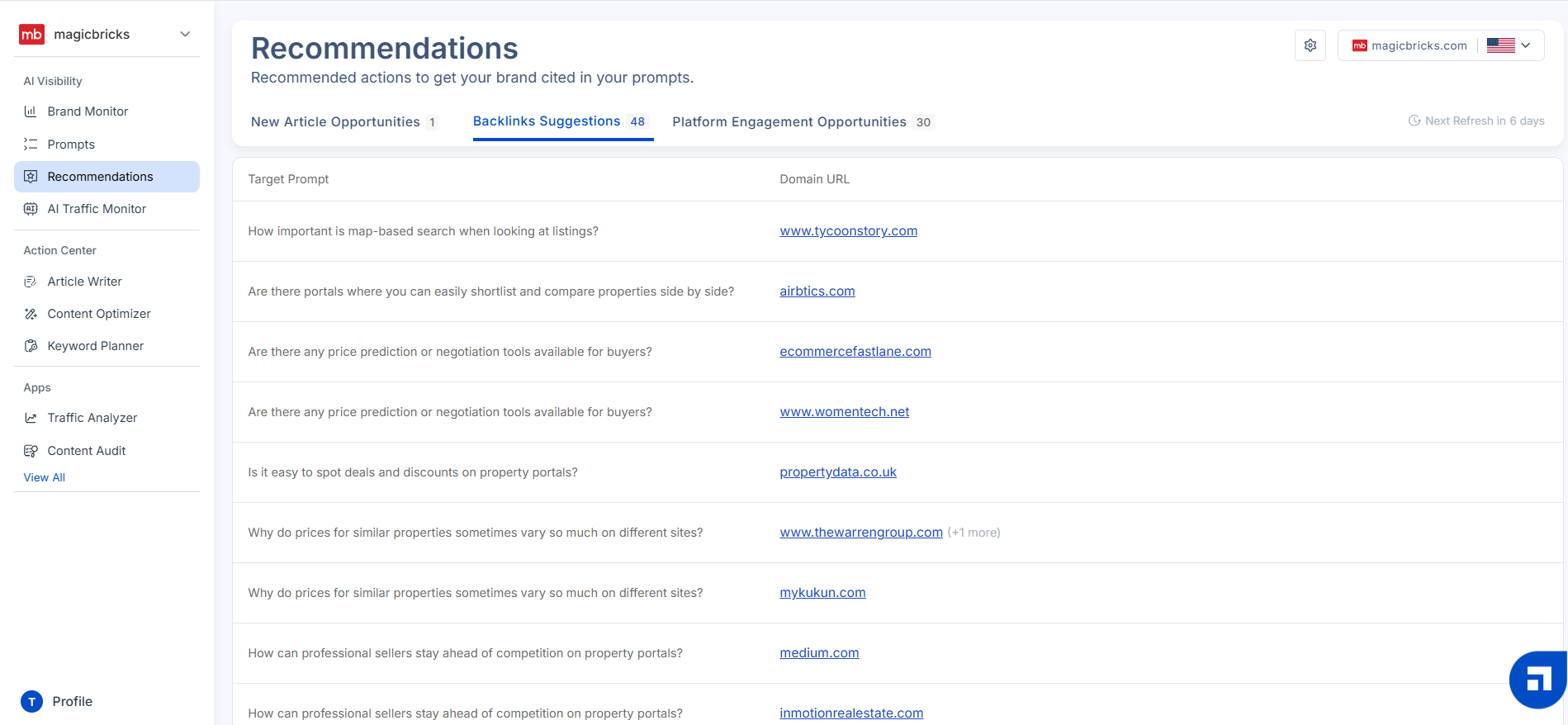
Scalenut connects AI visibility insights with prioritized recommendations and its GEO Action Center.
Recommendations can surface new article opportunities, analyze backlinks, and relevant community discussions. Teams can then create new content, optimize existing pages, improve internal links and on-page elements, secure selected backlinks through the marketplace, and publish to WordPress or Shopify.
This creates a clear path from a visibility gap to a content, authority, linking, or community action.
Want more visibility from community-driven search? Read our guide on how brands win on Reddit SEO and turn high-intent threads into discoverable traffic.
How Frase supports automation
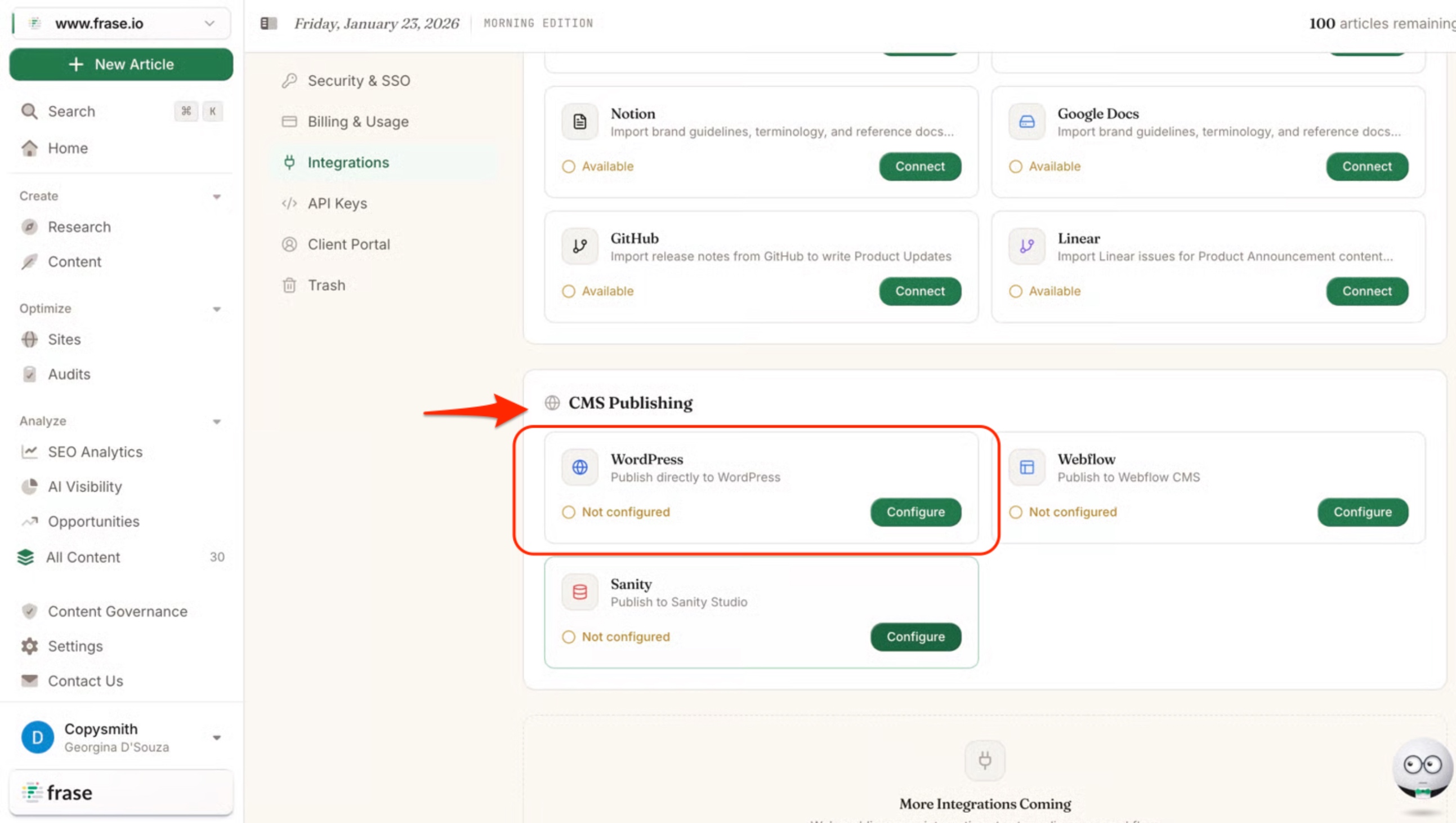
Frase offers a broader agent-led automation layer. Its AI Agent can research topics, create briefs and articles, optimize pages, audit sites, track AI visibility, and publish to supported CMS platforms through natural-language instructions.
It also supports programmatic SEO, content atomization, brand-governance rules, approval workflows, API access, and MCP connections for custom automation.
Content Guard adds another layer by monitoring declining pages, applying permitted fixes, and returning updated drafts to the CMS.
My verdict
Scalenut is stronger for turning AI visibility insights into focused GEO actions across content, backlinks, linking, and community engagement.
Frase offers the more advanced automation layer because its Agent, API, MCP, programmatic workflows, CMS integrations, and Content Guard automate more of the wider content lifecycle.
I would choose Scalenut for a clear visibility-to-action workflow and Frase when autonomous execution and custom automation are the main priorities.
Curious how Scalenut performs in real GEO and SEO workflows? Read our Scalenut review to see whether it can actually boost AI visibility and search performance.
Frase vs Scalenut: Which One Should You Choose?
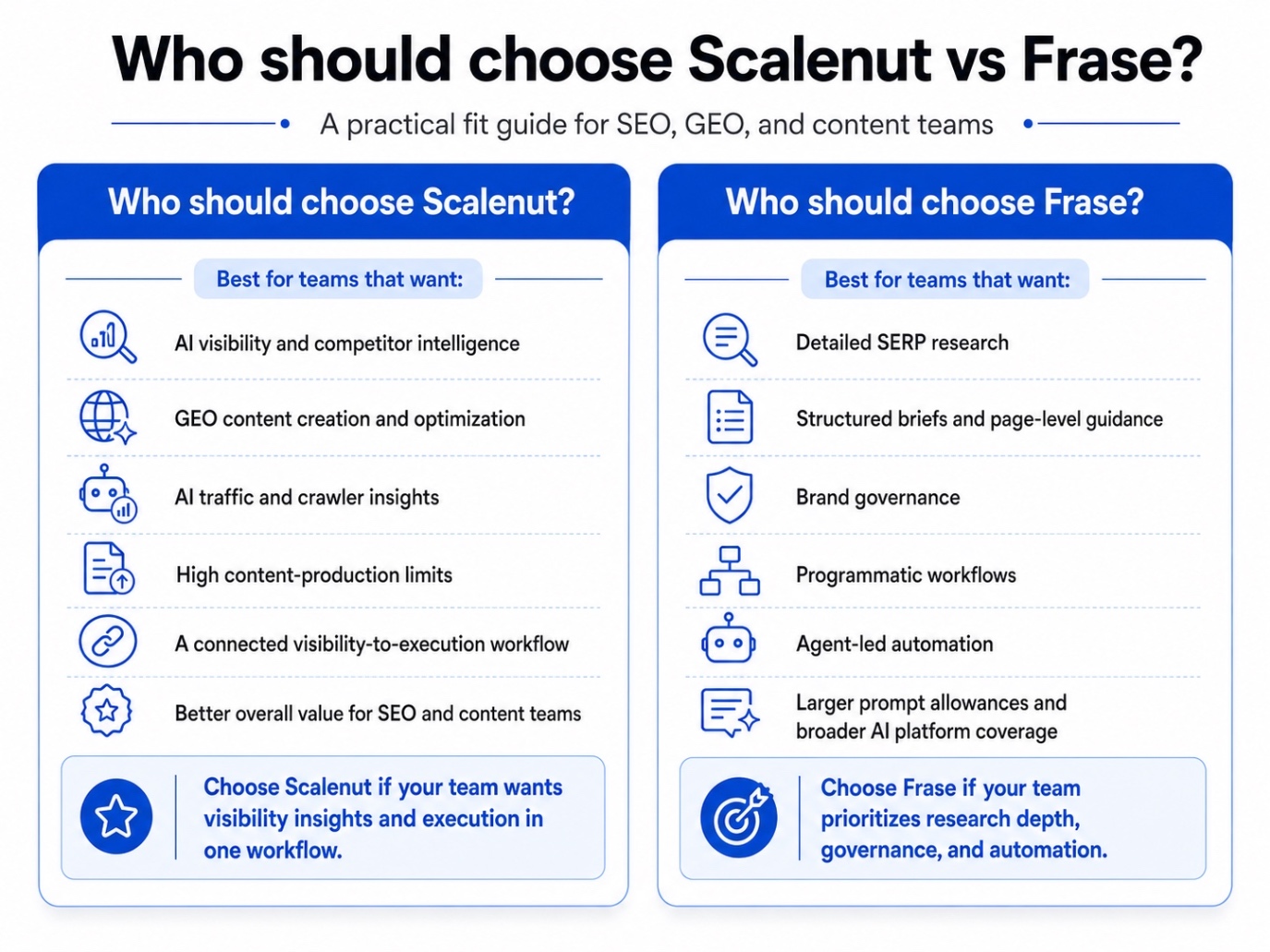
Who should choose Scalenut?
Scalenut is the stronger fit for teams that want more than visibility tracking. It works best when you need to see how your brand appears in AI answers, understand what is driving that visibility, and act on those insights inside the same platform.
Choose Scalenut if your team:
- Prioritizes AI visibility and competitor intelligence: You want prompt-level visibility data, competitor comparisons, citations, sentiment, sources, and query fan-outs in one place.
- Needs a faster GEO workflow: Scalenut makes it easier to move from visibility gaps to action through content creation, optimization, internal linking, backlink opportunities, and recommendations.
- Publishes and updates content at scale: Its plans are well suited for teams managing steady article production, optimization, keyword clustering, and page audits.
- Wants AI traffic and crawler insights: AI Traffic Monitor adds a useful layer by showing how AI systems interact with your site and which pages they access most.
- Prefers one connected SEO and GEO platform: Research, writing, optimization, audits, AI visibility, and execution tools are all tied together in one workflow.
- Wants stronger overall value: For SEO teams, content teams, agencies, and SaaS brands, Scalenut offers a practical mix of visibility tracking and hands-on execution.
Scalenut is especially useful if your goal is not just to measure AI visibility, but to improve it through a clear, end-to-end workflow.
Who should choose Frase?
Frase is a good fit for teams that lean more heavily on SERP research, editorial guidance, and automation-driven content operations. It is especially relevant when detailed briefs and workflow flexibility matter more than an all-in-one GEO execution layer.
Choose Frase if your team:
- Relies on detailed SERP research: You want to study top-ranking pages, headings, questions, and topic gaps before creating content.
- Needs structured briefs and page-level guidance: Frase is helpful for writers who want detailed optimization cues inside the editor.
- Requires stronger brand governance: It supports tighter control over terminology, style rules, and brand voice.
- Runs programmatic or repeatable workflows: Frase is better suited to teams with heavier automation or repurposing needs.
- Needs agent-led workflows and integrations: Its AI Agent, API, MCP access, and approval-based workflows support more customized operations.
- Wants broader AI platform coverage on higher plans: Frase is a stronger option if wider platform tracking and larger prompt allowances are a priority.
Frase makes more sense for teams that want a research-led and automation-heavy workflow, while Scalenut is the better choice for teams that want stronger visibility-to-execution value in one platform.
Final verdict: Scalenut or Frase?
Frase is a solid choice for teams centered on SERP research, governance, and customized automation. Scalenut is the stronger option when you want AI visibility data to lead directly into content planning, optimization, auditing, traffic monitoring, and measurable execution.
The best next step is to test the workflow against your own prompts, pages, and content goals. Start with the platform that helps your team move from insight to action with the least friction and the clearest path to growth.
Want to try Scalenut for free? Start your free trial or book a free strategy call today, and let’s discuss how to improve your SEO and AI visibility.
Frequently asked questions
What are the main differences between Scalenut and Frase?
Scalenut connects AI visibility tracking with planning, writing, optimization, auditing, internal linking, and execution. Frase places greater emphasis on content research, SERP analysis, structured briefs, brand governance, and customizable workflows through its AI Agent, API, and MCP.
Which is better for GEO, Scalenut or Frase?
Scalenut is the stronger choice for teams that want to turn generative engine optimization insights into content, linking, and authority-building actions. Frase provides detailed passage-level guidance and broader tracking across AI answer engines on higher plans.
Which is better for content optimization, Scalenut or Frase?
Frase provides editor-level guidance for structure, topic coverage, clarity, and citation readiness based on top search results. Scalenut combines SEO and GEO recommendations with existing-page optimization, Auto Optimizer, content audits, internal linking, and user intent insights.
What features does Scalenut offer that Frase does not?
Among Scalenut’s features, AI Traffic Monitor is a major differentiator. It uses Cloudflare data to track AI bot visits, AI-referred human traffic, crawl trends, and page activity while connecting various aspects of visibility with content and authority actions.
Is Scalenut or Frase easier for beginners?
Scalenut may be easier for content creators who prefer a guided path from keyword planning to writing and optimization. Its connected workflow and affordable price also make it practical for small businesses that do not want to manage several separate tools.
Can Scalenut and Frase help improve SEO rankings?
Both platforms can support stronger search engine results by improving research, topic coverage, structure, optimization, and content maintenance. Neither guarantees rankings because performance still depends on content quality, authority, technical SEO, internal linking, and consistent execution.
What do users say about Scalenut and Frase?
G2 reviewers commonly praise Scalenut for ease of use, content creation, and SEO optimization. Frase users frequently highlight its time-saving research and structured editing workflow, while reviews for both reinforce the need to check AI-generated content before publishing.
Which platform is better for agencies?
Scalenut suits agencies that need high production limits, multiple workspaces, AI visibility intelligence, and execution tools in one platform. Frase may suit agencies that prioritize standardized briefs, brand governance, API access, and advanced features for customized automation. Both platforms cover the key features agencies need, but Scalenut offers a more direct path from visibility insights to content execution.


.svg)


.webp)