.jpg)
Search Atlas Reviews: Is It Best For SEO And AI Visibility?
Key Highlights
- Search Atlas is an all-in-one SEO platform that combines automation, content workflows, technical SEO, local SEO, and reporting in one dashboard.
- Its OTTO-driven automation is built to speed up execution, but you still need governance and review for high-stakes sites.
- Search Atlas includes an LLM visibility layer to monitor how your brand appears in AI-generated answers alongside traditional SEO metrics.
- The platform is best suited for SEO agencies, multi-location brands, and teams that want centralized workflows across multiple sites or clients.
- Common strengths include ease of use, faster content production with SEO alignment, and reduced tool switching through an integrated workflow.
- Common limitations include AI output requiring editing, pricing sensitivity for smaller teams, and a platform breadth that can feel overwhelming at first.
- Scalenut is the stronger choice when AI visibility and prompt-led GEO execution are the primary goals, not just automation.
- This review also breaks down pricing tiers, trial availability, and the real situations where Search Atlas may or may not be worth it.
Search feels different now. Rankings still matter, but they are not the whole story. Pages can perform on Google and still miss AI answers, or show up in summaries without clear credit. If we are investing in an SEO platform today, we are really paying for visibility across both search and AI-driven discovery.
Search Atlas is one of the tools promising ann all-in-one fix. It bundles automation, content workflows, technical audits, local SEO, reporting, and even LLM visibility tracking. We have used it, and it can speed up execution. The question is whether that breadth and automation-first approach is always the right fit when AI visibility becomes a priority.
In this review, we will break down Search Atlas features, pricing, pros and cons, and who it is best suited for in real workflows. We will also cover what users say about the experience, so you can judge whether it matches the way your team actually works.
What Is Search Atlas?
Search Atlas is an AI-powered SEO platform from the LinkGraph team that brings core SEO workflows into one system, including keyword research, content creation and optimization, technical audits, competitor analysis, link building, local SEO, and reporting.
A major part of its value is automation. It is designed to help teams move faster using AI-driven workflows for on-page and technical execution, while also adding LLM visibility monitoring so you can track how your brand shows up inside AI-generated answers alongside traditional SEO metrics.
What Are The Main Features Of Search Atlas AI SEO Software?
Search Atlas is structured like a broad SEO execution platform, with SEO tool groups that map to the core jobs SEO teams run every week. It covers automation, local SEO, content workflows, technical SEO, agency delivery, and now an added GEO layer focused on LLM visibility.
Overall, these Search Atlas SEO features are packaged to help teams centralize execution. Let’s look at its main features in detail.
1. AI-Led Automation And Platform-Level Execution
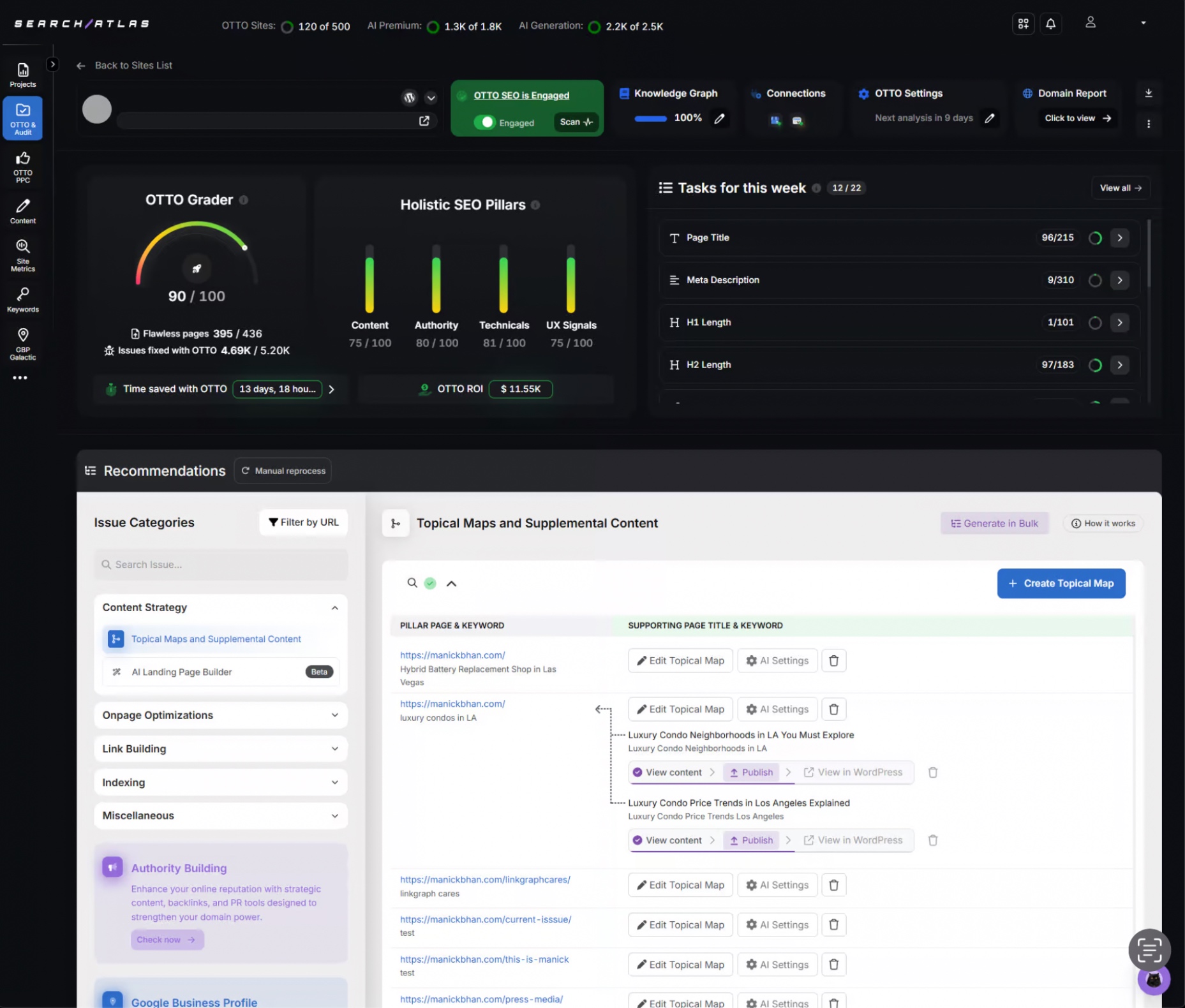
If your priority is speed and operational efficiency, this is where Search Atlas tries to reduce manual SEO work the most.
- OTTO SEO: Search Atlas OTTO SEO is an AI-powered assistant focused on automating website optimizations.
- OTTO Google Ads: AI-driven management and optimization for Google Ads campaigns.
- Enterprise SEO Software: Platform packaging for larger teams and organizations.
2. LLM Visibility Tracking And GEO Monitoring
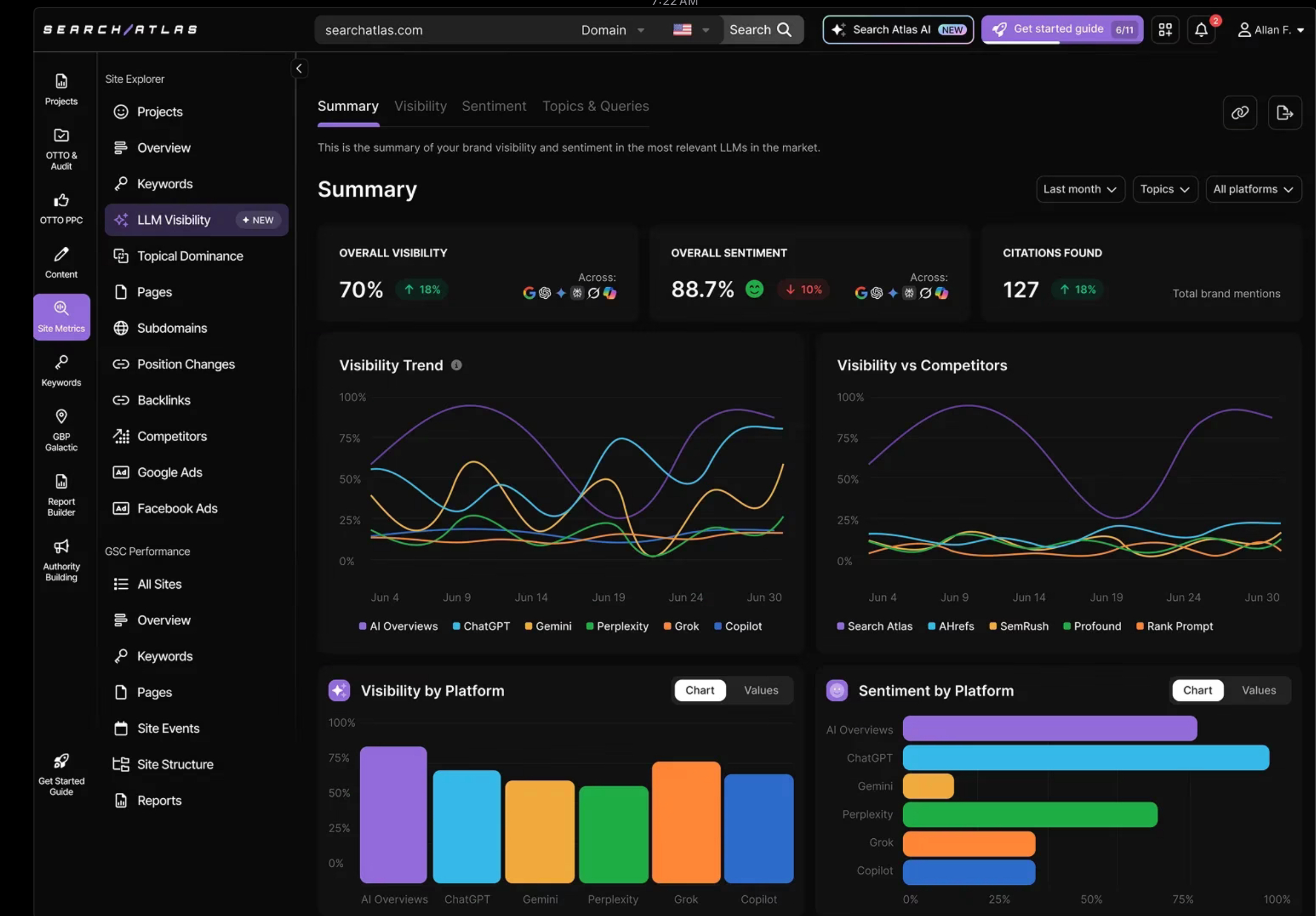
This is Search Atlas’s clearest GEO-oriented capability, focused on understanding how AI systems present your brand.
- LLM Visibility: Tracks how often your brand appears inside AI-generated answers across platforms like ChatGPT, Gemini, Perplexity, and SearchGPT, plus sentiment and competitor benchmarks.
- Sentiment Tracking: Evaluates how AI describes your brand, not just whether it appears.
- Competitive Benchmarking: Compares your visibility against competitors to show the relative share of presence in model answers.
- Visibility Trends And Reporting: Measures changes over time so you can monitor AI presence beyond classic rankings.
3. Agency Delivery And Client Management
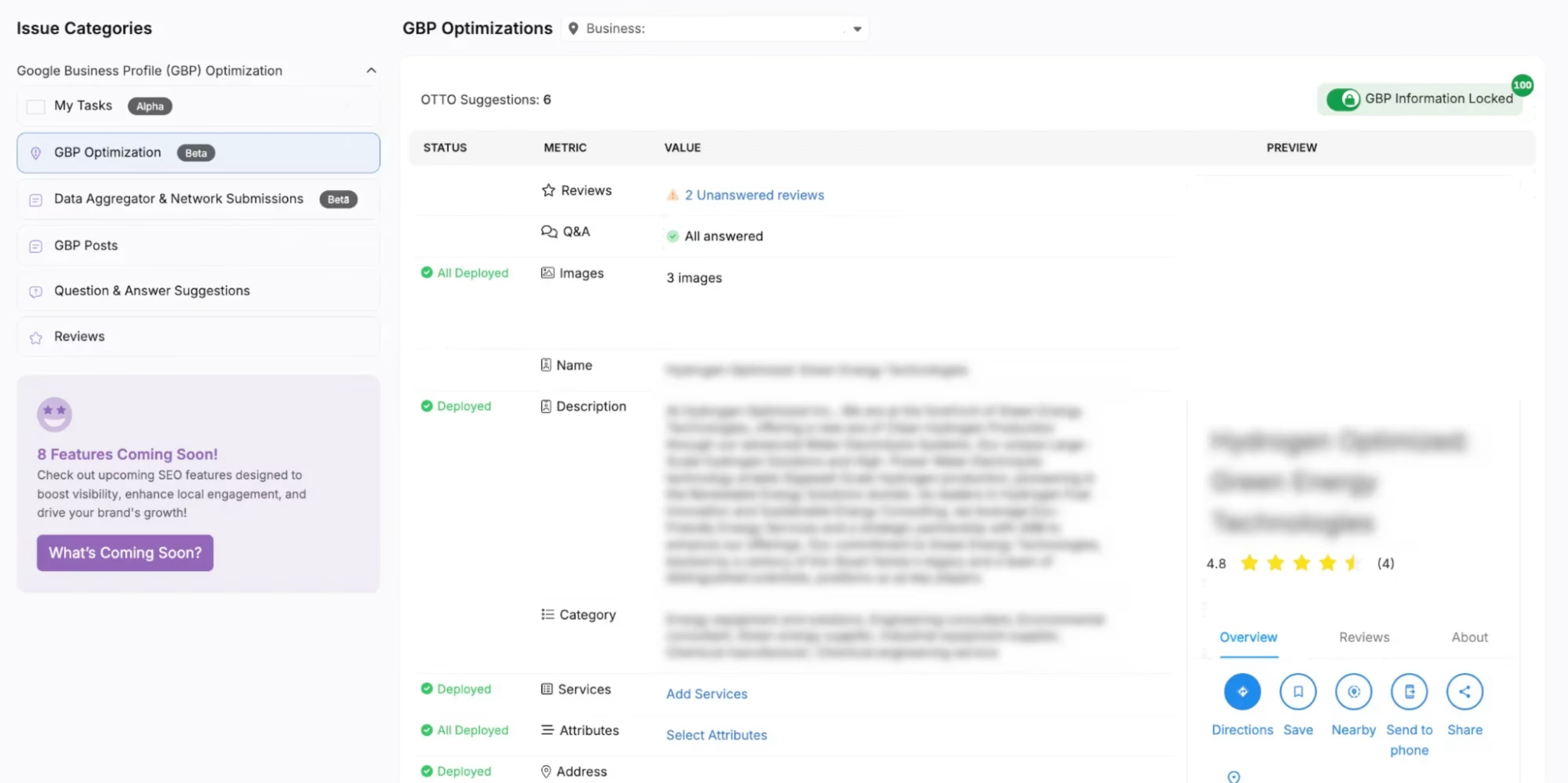
If you are managing multiple clients, this capability set is built to support packaging and delivery, not just analysis.
- White Label SEO Software: Agency-facing, customizable reporting and delivery setup.
- GBP Management Software: Google Business Profile optimization and management.
4. Local SEO Visibility And Geo-Based Tracking
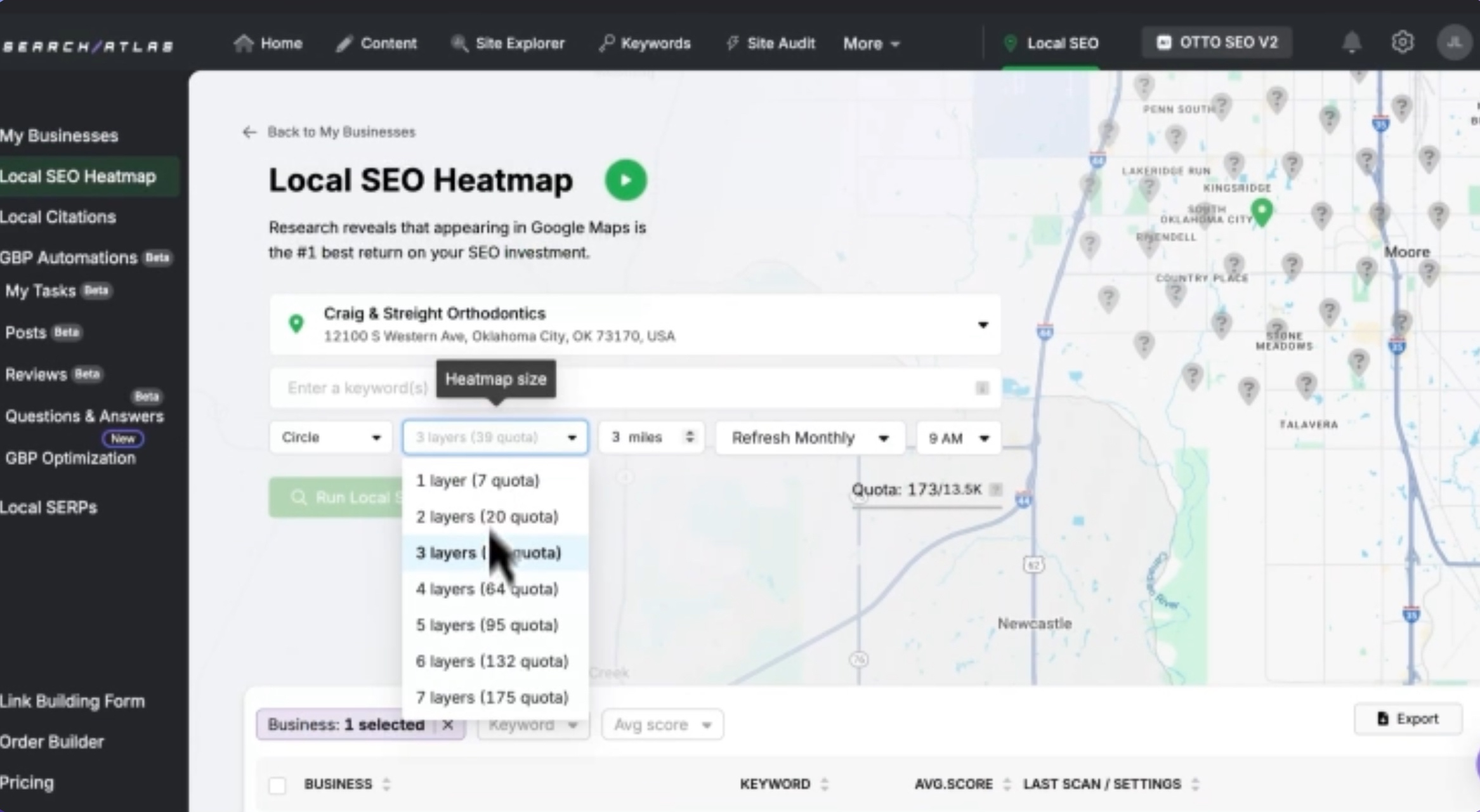
For local brands and service-area businesses, these features focus on how rankings shift by location, not just by keyword.
- Local Heatmap Tracker: Tracks local SEO keyword rankings using interactive heatmaps.
- Location Spoofing: Analyzes location-based SERP performance to inform local strategy.
- GMB Reporting: Reporting to track Google Business Profile visibility and performance.
- Local Organic Rank Tracking: Monitors local organic SERP positions by target area.
5. Content Planning And On-Page Optimization
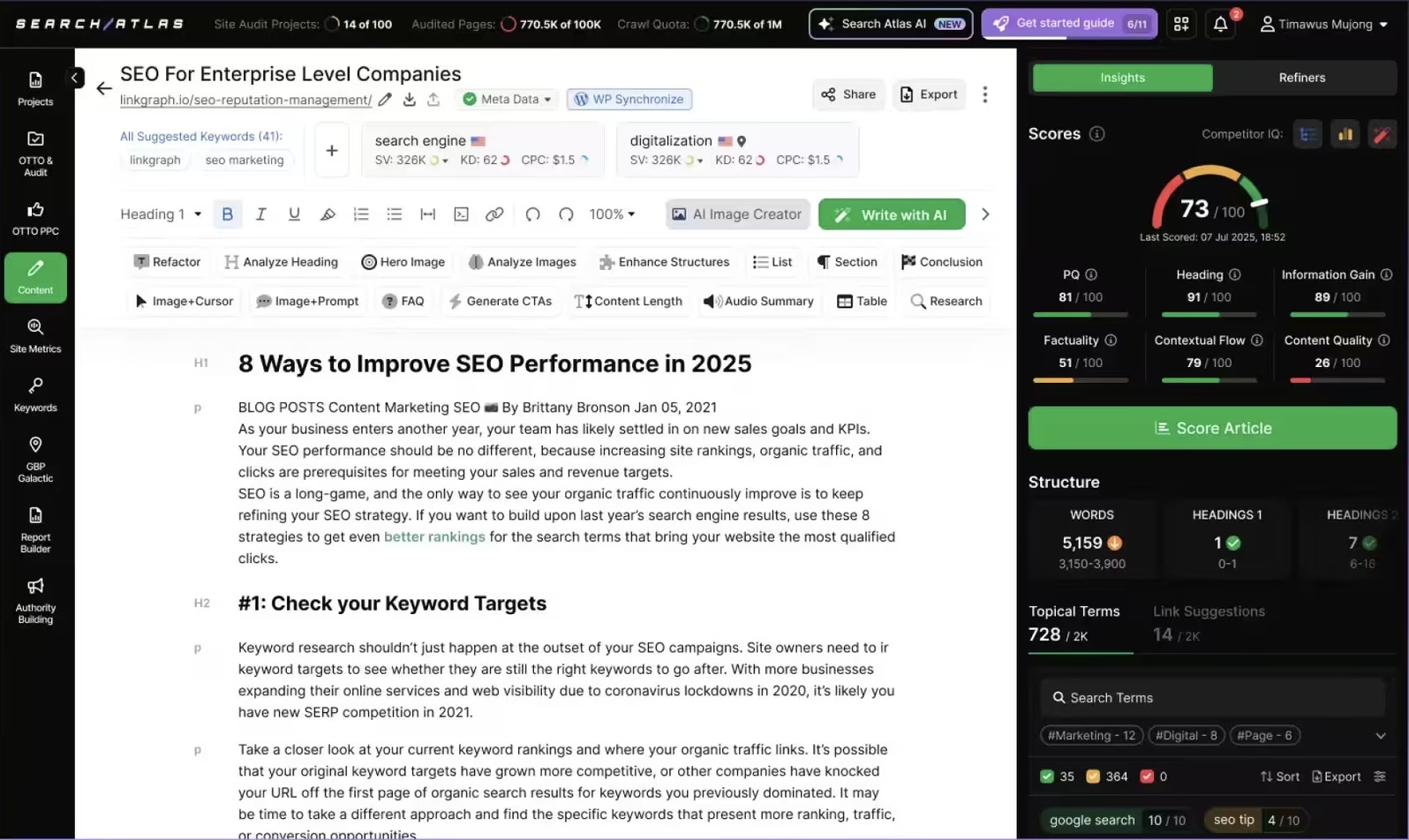
This is the content generation workflow layer that supports planning, briefing, content creation and improving pages for stronger Google search performance.
- SEO Content Assistant: Provides optimization suggestions like focus terms, word count, and heading structure to improve content scoring.
- Content Briefs: Generates SEO briefs with focus terms, suggested headings, word count guidance, and competitor inputs.
- Content Planner: Builds content plans with automated keyword clustering, topic generation, and article planning.
- Content Rewriter: The AI content writer rewrites content to refresh or improve existing pages.
- Content Optimization: AI-powered content improvement aimed at rankings and engagement.
6. Technical SEO Auditing And Site Monitoring
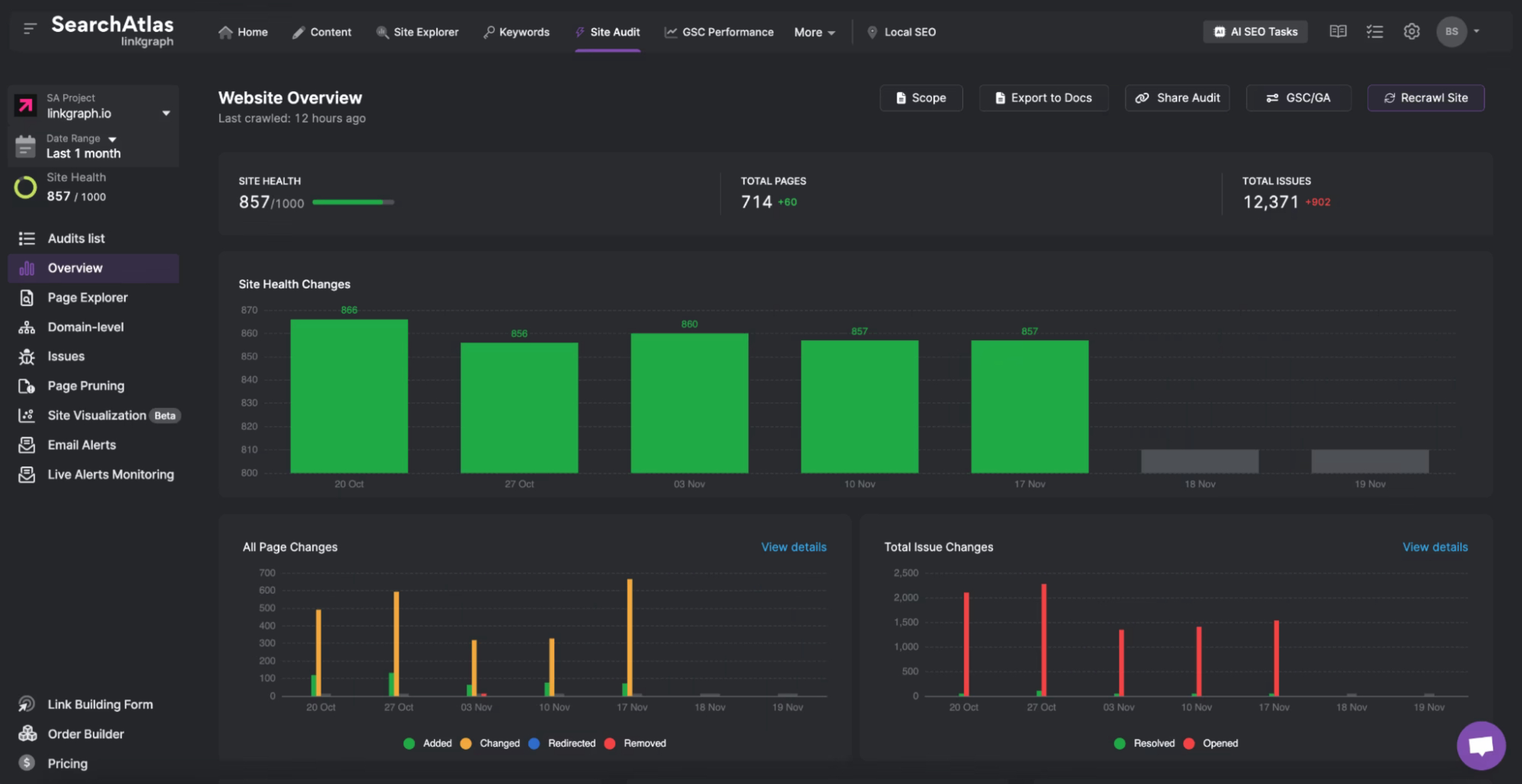
If you care about preventing technical issues from quietly suppressing visibility, this is the layer that keeps the site clean and stable.
- Site Auditor: Audits large websites for issues affecting search engine performance and provides fix guidance.
- Site Visualization: Visualizes internal linking structure and information hierarchy.
- Site Structure Analysis: Analyzes page hierarchy and internal linking profile.
- Page Pruning: Identifies low-performing pages for pruning or content improvement.
- Live Alert Monitoring: Monitors site changes and issues that can impact rankings and traffic.
- Issues Alerts: Sends notifications when SEO issues are detected so you can fix them quickly.
- Schema Creator: Creates schema markup to support richer SERP appearances.
What Do Users Say About Their Experience With Search Atlas?
“Good place to start learning SEO, I loved it at first and thought it was amazing as it covered so much. As I continuously used and relied on it I started to feel like it was really broken, features didnt work, constant credit upgrades, and the reporting always seemed off.“ - says Denis M on G2
User reviews consistently describe Search Atlas as a comprehensive platform that consolidates multiple SEO workflows into one place. The most common positives are time savings, an easy setup process, and a generally user-friendly interface, with several reviewers also calling out solid integration capabilities and dependable data accuracy for day-to-day work.
That said, not all users had a smooth journey with Search Atlas. Pricing is a recurring concern for smaller teams, and some users mention software bugs, dashboard friction, and inadequate tutorials that can slow onboarding. A smaller set of reviews also flags content-related issues and trust concerns, which suggests you should validate the workflow carefully during the trial period before scaling it across projects.
What Are The Pricing Plans For Search Atlas AI SEO Software?
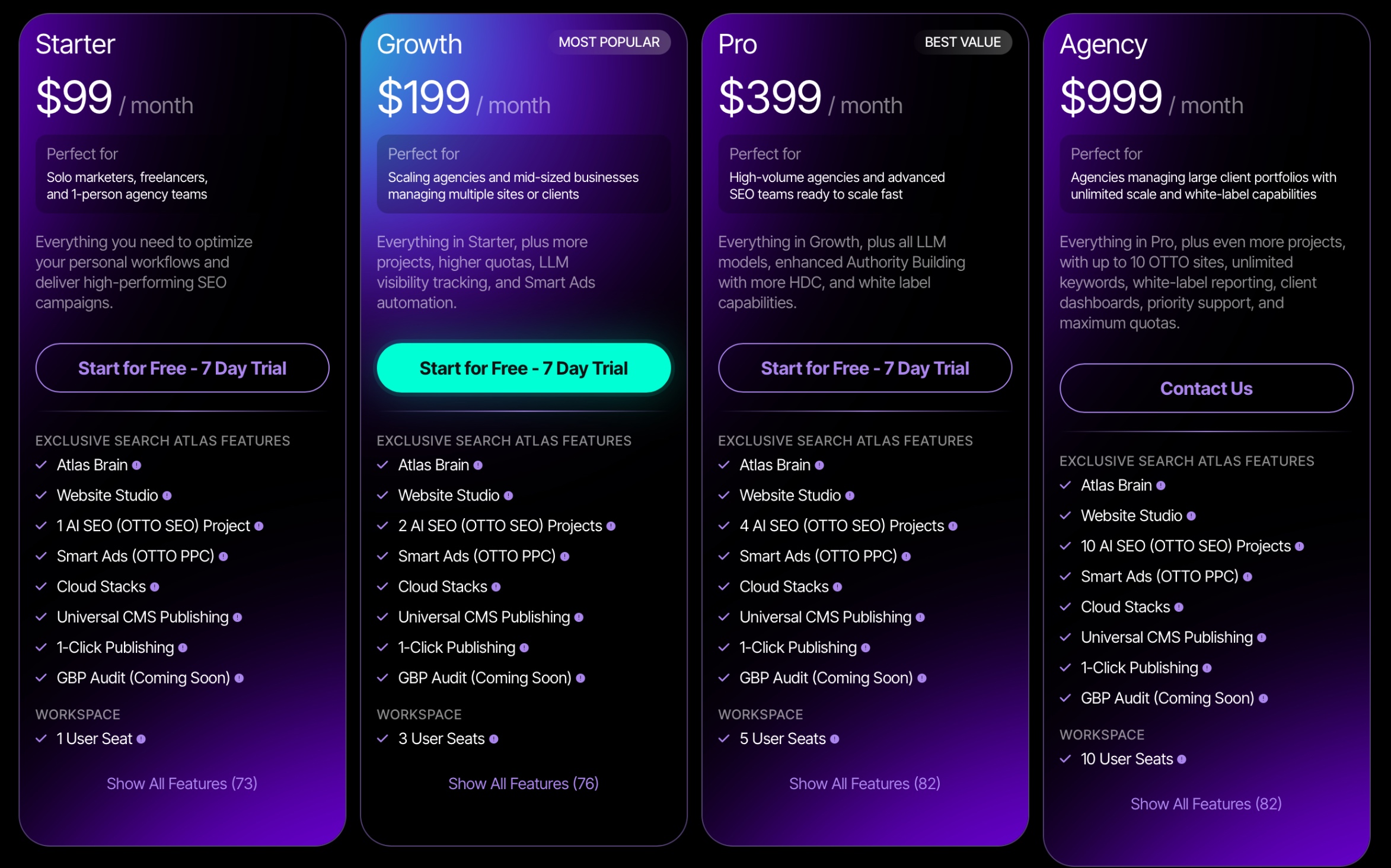
Search Atlas pricing offers four main tiers, starting with Starter ($99/month) for solo marketers and moving up through Growth($199/month) and Pro($399/month) for scaling teams. The Agency plan($999/month) is positioned for agencies managing large client portfolios, with higher limits and more advanced delivery features.
Search Atlas also offers a 7-day free trial, which is useful if you want to validate OTTO-driven workflows, LLM visibility tracking, and the core SEO toolset before committing to a monthly plan.
Who Is Search Atlas Best Suited For In Real Workflows?
Who Should Choose Search Atlas?
- SEO professionals who want one platform to run SEO execution across content, technical SEO, local visibility, and reporting without stitching together multiple tools.
- Agencies managing multiple clients and repeatable deliverables, especially when white-label reporting and standardized workflows matter.
- Local SEO teams or small businesses that need GEO-based rank visibility, GBP performance tracking, and location-level reporting for service-area or multi-location brands.
- Operators who value automation for recurring SEO tasks, including ongoing site fixes, monitoring, and workflow acceleration.
- Marketing teams that want to add LLM visibility tracking to their content marketing strategies to improve AI search visibility by understanding how their brand shows up in AI-generated answers.
- Mid-sized organizations scaling beyond one site that need centralized dashboards and ongoing monitoring can use Search Atlas to stay on top of performance.
When Search Atlas Might Not Be The Best Choice?
- Solo creators or very small teams that only need one narrow capability, such as basic rank tracking or a lightweight content optimizer.
- Teams prioritizing prompt-level GEO execution as the primary workflow, where the daily operating rhythm is built around prompts, citations, and AI answer presence.
- Organizations that require strict monitoring and multi-step approvals for every change, especially if automation-driven execution feels too operationally risky.
- Users who prefer best-in-class specialist tools for each function rather than a broader suite that covers many workflows in one platform.
- Teams that do not need local SEO, agency delivery, or enterprise packaging and may find Search Atlas SEO platform features more than they need for the budget.
What Are The Pros And Cons Of Search Atlas?
Search Atlas is built to centralize SEO execution, with automation, content workflows, local tooling, technical auditing, and LLM visibility tracking in one place. It can be a strong fit for teams that want breadth and speed, but there are a few trade-offs to weigh before you commit.
Why is Search Atlas the Best SEO Platform?
- Ease Of Use And Onboarding: The platform is relatively easy to pick up, which helps teams start running site audits, content workflows, and reporting without a long setup phase.
- Fast Content Creation With SEO Alignment: The content tools support faster drafting and rewriting while keeping optimization inputs close to the writing process.
- Integrated Workflow Across Core SEO Jobs: Planning, content, optimization, monitoring, and reporting live in one system, which reduces context switching and speeds up execution.
- Strong Agency And Multi-Client Delivery Support: White label workflows and client-ready reporting make it easier to standardize delivery across multiple accounts.
- Useful Local SEO Coverage For Multi-Location Brands: Local tracking and GBP-focused tooling help teams monitor performance by geography, not just by keyword.
- Added LLM Visibility Layer For GEO Monitoring: LLM visibility tracking helps teams measure brand presence in AI-generated answers alongside traditional SEO signals.
Are There Any Disadvantages Or Downsides To Using Search Atlas?
- AI Output Still Needs Editing: AI-assisted drafts and rewrites can feel repetitive or generic, so you still need a human pass for clarity, accuracy, and brand tone.
- Pricing And Feature Limits By Tier: Some teams will find the platform expensive, and certain features may be gated depending on the plan, which can affect scaling.
- Breadth Can Feel Overwhelming At First: Because the platform covers many SEO categories, it can take time to build a clean operating rhythm around the tools you actually need.
- Not Always Ideal For Specialist-Only Buyers: If you only want best-in-class rank tracking, only technical audits, or only content optimization, an all-in-one suite may be more than you need.
- SEO Automation Platform Requires Governance: Tools designed to automate optimizations still need review and controls, especially for regulated industries or brand-sensitive sites.
- GEO Execution May Still Require A Separate Process: LLM visibility monitoring is valuable, but turning visibility insights into consistent prompt-led content updates may require a more defined workflow than the platform provides by default.
New to GEO and not sure where to start? Check out our guide on how beginners can master GEO SEO strategies step by step.
Why Is Scalenut A Better Search Atlas Alternative?
Scalenut feels like the stronger choice when your main goal is improving AI visibility through a repeatable GEO workflow, not just adding an AI tracking layer to a broader SEO suite. In my experience, Scalenut is more GEO-native and prompt-led, meaning it is built to measure brand presence in AI answers, identify prompt coverage gaps, and benchmark visibility against competitors as a primary use case, not a side feature.
What makes that advantage practical is how Scalenut connects insights to execution. The platform maps AI prompts to page-level audits and prioritized fixes, then pushes you into optimization with a clear GEO score and improvement plan. Compared to Search Atlas’s automation-first approach, Scalenut’s workflow is easier to govern because changes are more reviewable and less dependent on auto-deployment, which reduces operational risk for teams that want control without losing speed.
Want to see Scalenut’s GEO and SEO stack in action? Read this Scalenut review to learn how it can improve visibility across traditional search and AI-generated answers.
What Are Scalenut’s Most Important GEO And SEO Features?
Scalenut combines AI visibility tracking (GEO) with hands-on SEO execution in one platform. Instead of acting like a standalone AI writer, it is designed to show how your brand appears inside AI answers, then guide you toward the specific actions that can improve visibility, rankings, and performance.
How Does Scalenut Strengthen GEO And AI Visibility?
Scalenut’s GEO layer is built around monitoring brand presence inside AI-generated responses across tools like ChatGPT and Perplexity, then translating those signals into insights you can actually use.
AI Visibility Tracking And Brand Monitoring
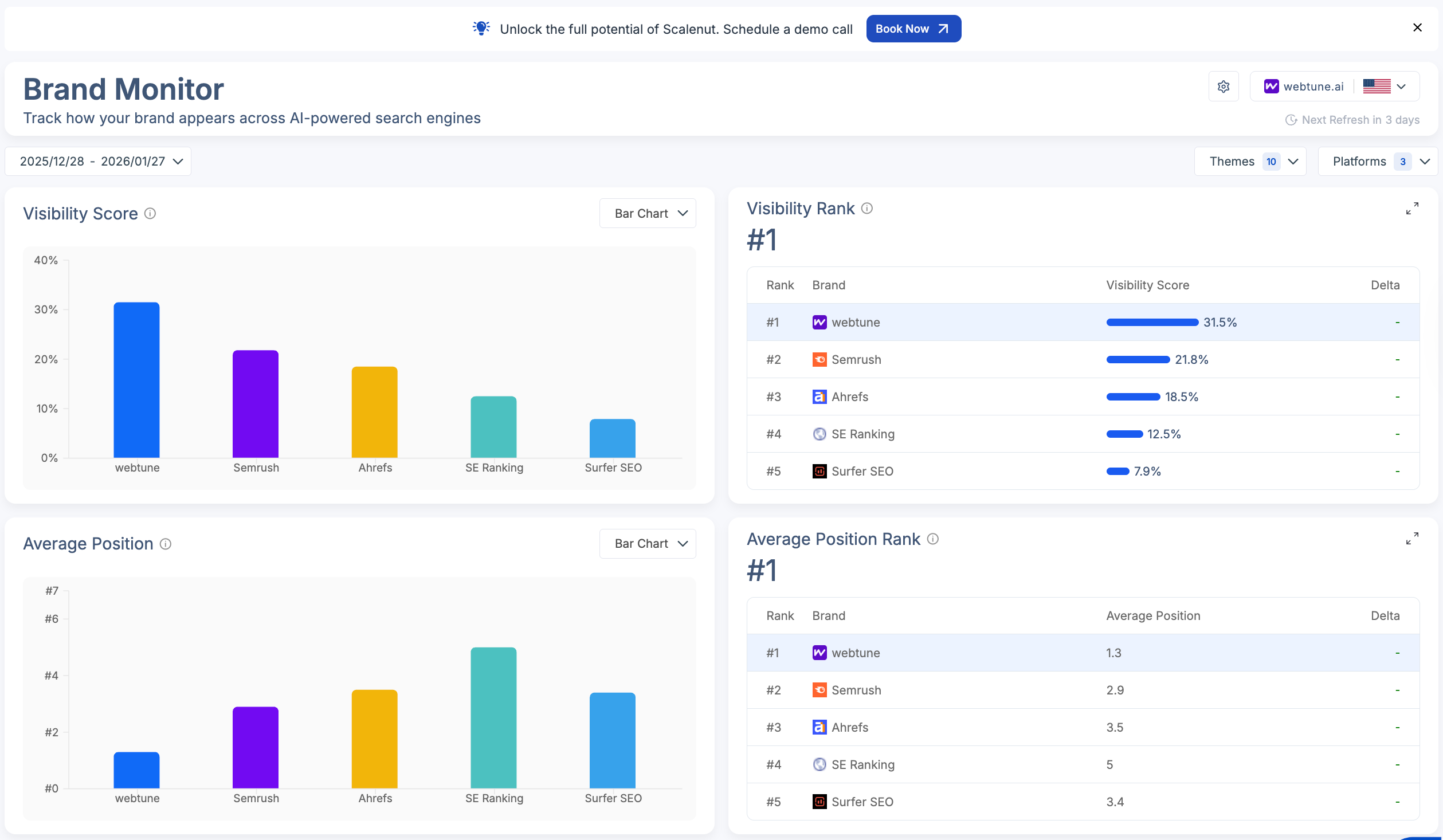
Brand-level reporting helps quantify how frequently you appear in AI answers and how that visibility stacks up against competitors across different platforms.
- Visibility Score: Provides a quick snapshot of how often the brand appears compared to competitors.
- Average Position: Indicates whether the brand shows up early in AI answers or appears further down.
- Share Of Voice: Measures how much answer space the brand captures versus competing brands.
- Visibility Heatmap: Breaks visibility out by platform so it is easier to spot strengths and gaps.
- Brand Visibility Rank: Consolidates multiple signals into one benchmark across topics and prompts.
Prompt-Level Intelligence And Competitive Insights
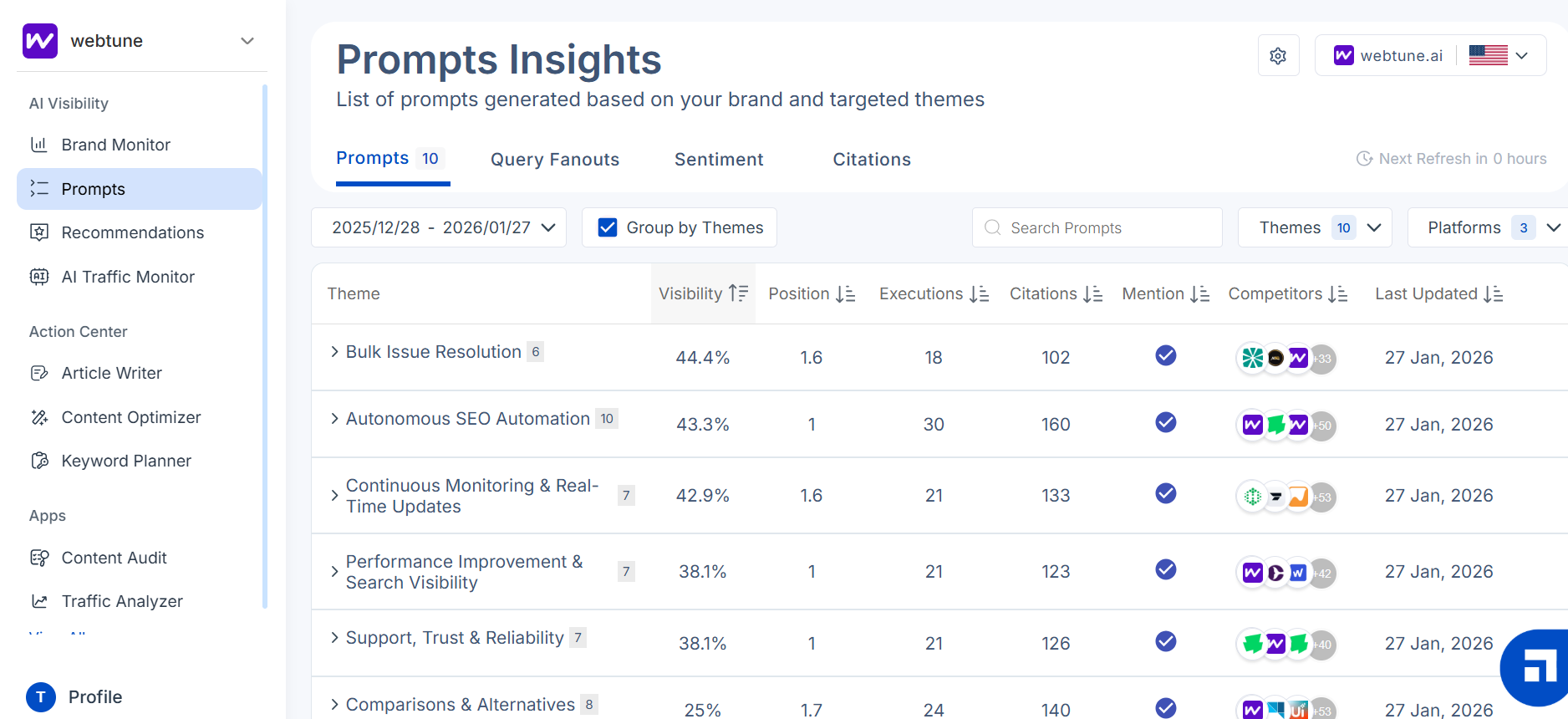
Prompt-level insights show where visibility is actually being earned, including what prompts trigger mentions and what sources AI systems rely on when forming answers.
- Prompt Tracking: Surfaces the prompts where the brand appears, along with relative positioning.
- Citation Tracking: Highlights the sources being used to support AI-generated answers.
- Competitor Visibility Insights: Shows which competing brands are most frequently mentioned alongside yours.
- Query Fanouts: Maps how a single question expands into related follow-up queries inside AI experiences.
- Sentiment Analysis: Tags mentions by tone so you can separate positive exposure from neutral or negative framing.
GEO Recommendations That Lead To Execution
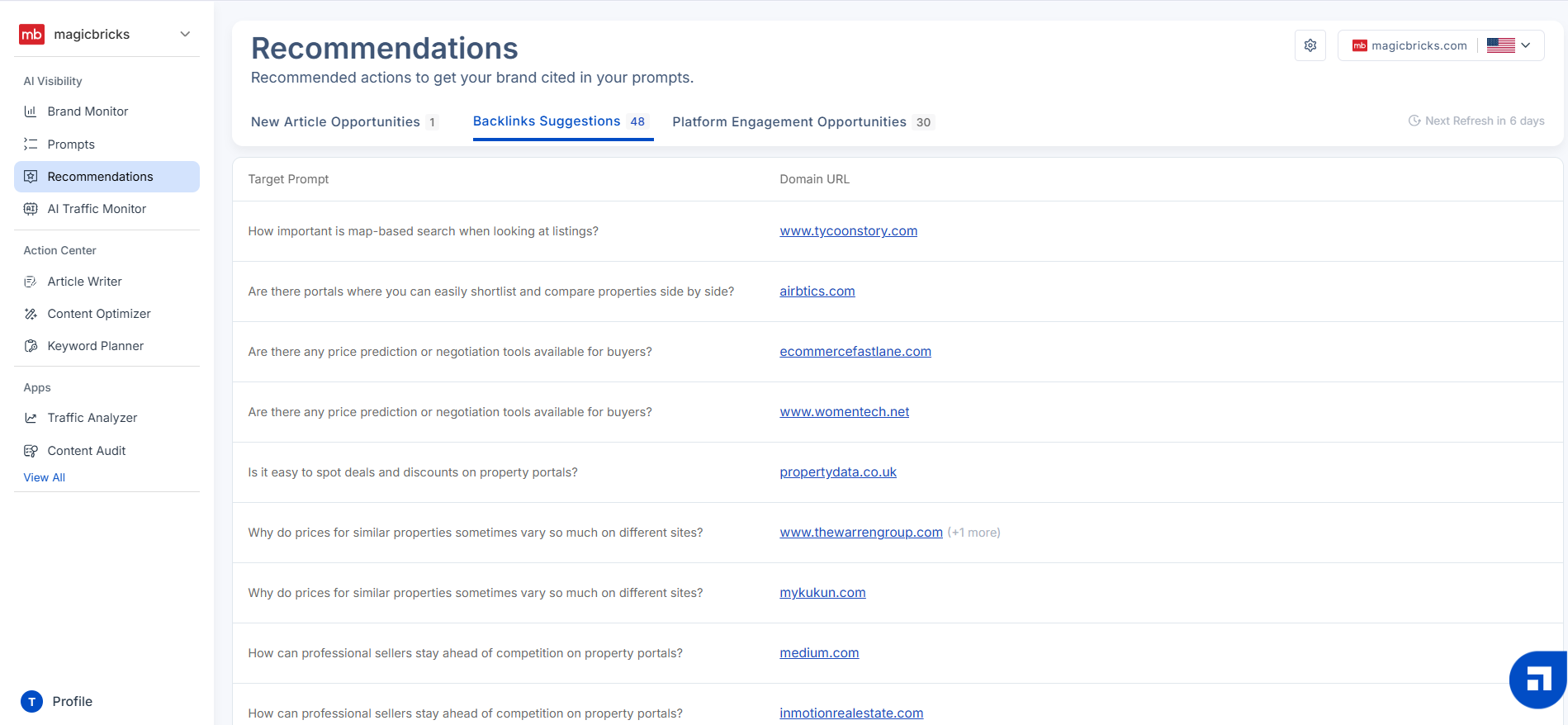
Instead of keeping insights trapped in dashboards, Scalenut’s recommendations translate visibility gaps into prioritized actions that support measurable improvement.
- AI-Led Content Ideas: Turns AI-driven questions into content opportunities worth targeting.
- Authority And Backlink Suggestions: Points to credibility-building signals that can influence AI visibility.
- Platform Engagement Opportunities: Flags relevant communities and threads where brand presence can be developed.
- Action Paths: Lays out next steps so teams know what to do first and why it matters.
AI Traffic Visibility And LLM Interaction Signals
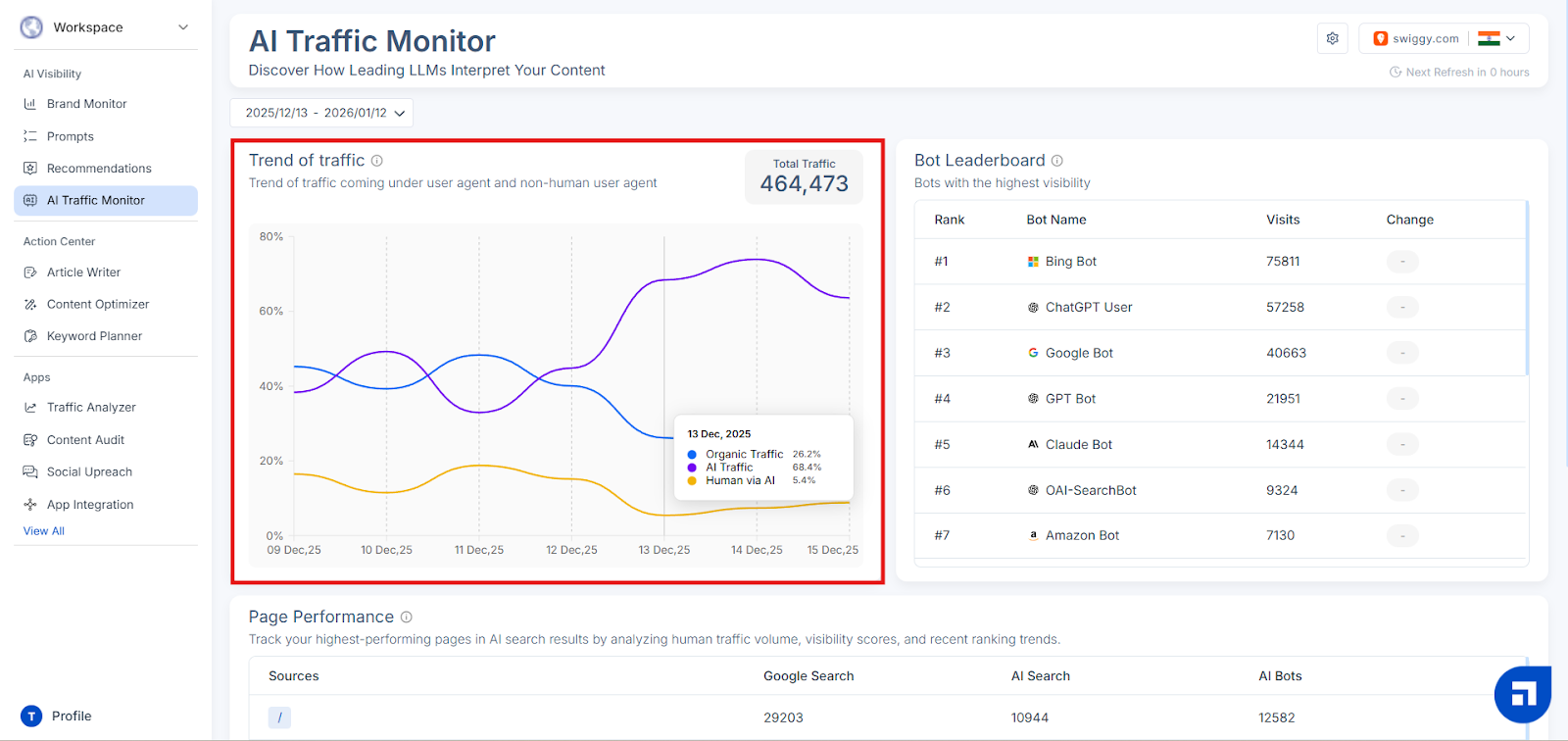
Traffic signals help connect AI visibility to site outcomes by showing how AI agents interact with your site and which pages they appear to rely on.
- AI Bot Tracking: Identifies visits attributed to AI assistants and AI search experiences.
- Cloudflare Integration: Adds deeper tracking capabilities for sites running on Cloudflare.
- Top AI Sources: Shows which AI agents interact with your site most often.
- Most Referenced Pages: Highlights pages AI systems appear to rely on most frequently.
- AI Traffic Trends: Helps you spot whether AI-driven visits are increasing, flattening, or dropping over time.
Want to stay ahead of what is changing in AI-driven discovery? Check out the top AI monitoring tools that can sharpen your AI visibility workflow in 2026.
How Does Scalenut Support SEO And Content Execution?
Alongside GEO tracking, Scalenut includes a full SEO workflow for planning, creating, optimizing, and scaling content with structured guidance.
Content Production And Optimization
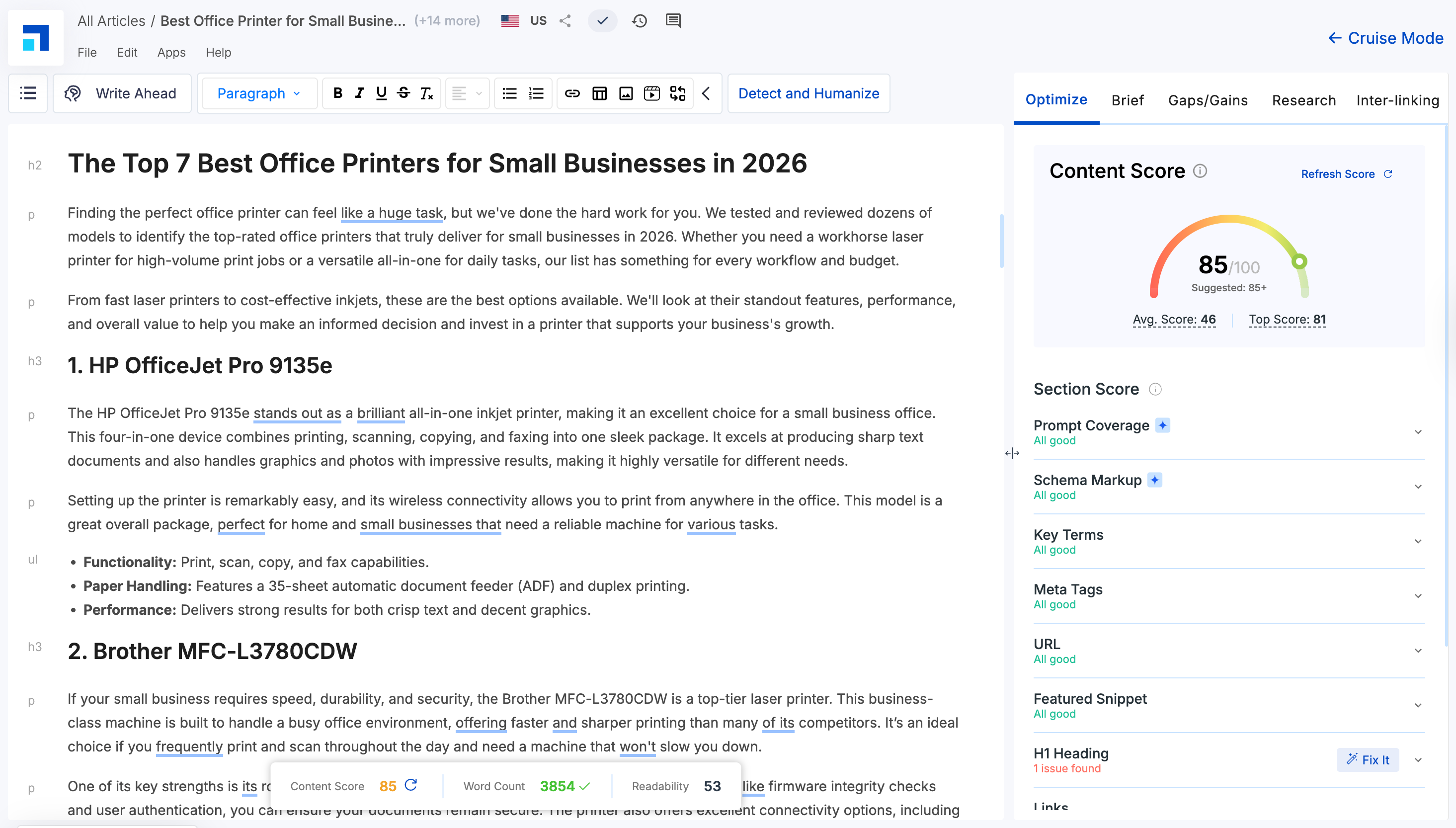
The creation and optimization workflow is built to move quickly from SERP signals to drafts, then guide improvements for intent match and on-page performance.
- Cruise Mode: Streamlines outlining and drafting with SERP-informed guidance, with GEO signals layered in where relevant.
- Content Optimizer: Highlights what to change on-page to strengthen performance signals.
- AI Humanizer: Refines AI-written sections so they read more naturally and feel more human.
- Content Scoring: Evaluates core SEO quality factors like intent alignment, depth, structure, and keyword usage.
SEO Research And Planning Tools
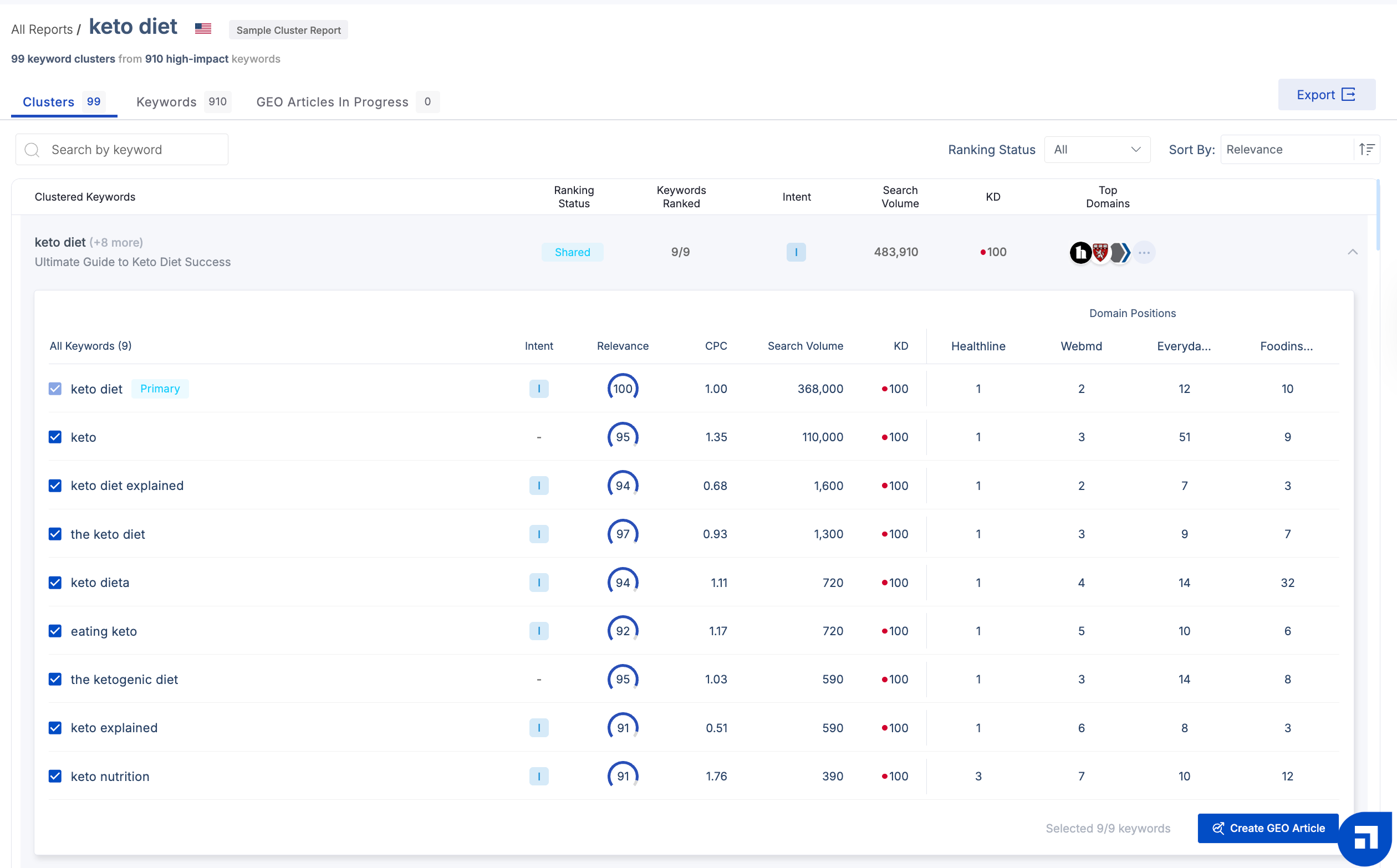
Research tools help teams pick smarter targets, cluster topics by intent, and prioritize updates based on performance opportunities.
- Keyword Planner: Groups keywords into intent-based clusters for cleaner content planning.
- Competitor Coverage Analysis: Shows how competing pages structure and cover the same topic.
- Traffic Analyzer: Surfaces top performers and highlights pages that look like quick wins.
- Content Audit: Flags pages that may need refreshes, consolidation, or deeper optimization.
Technical SEO And Linking Support
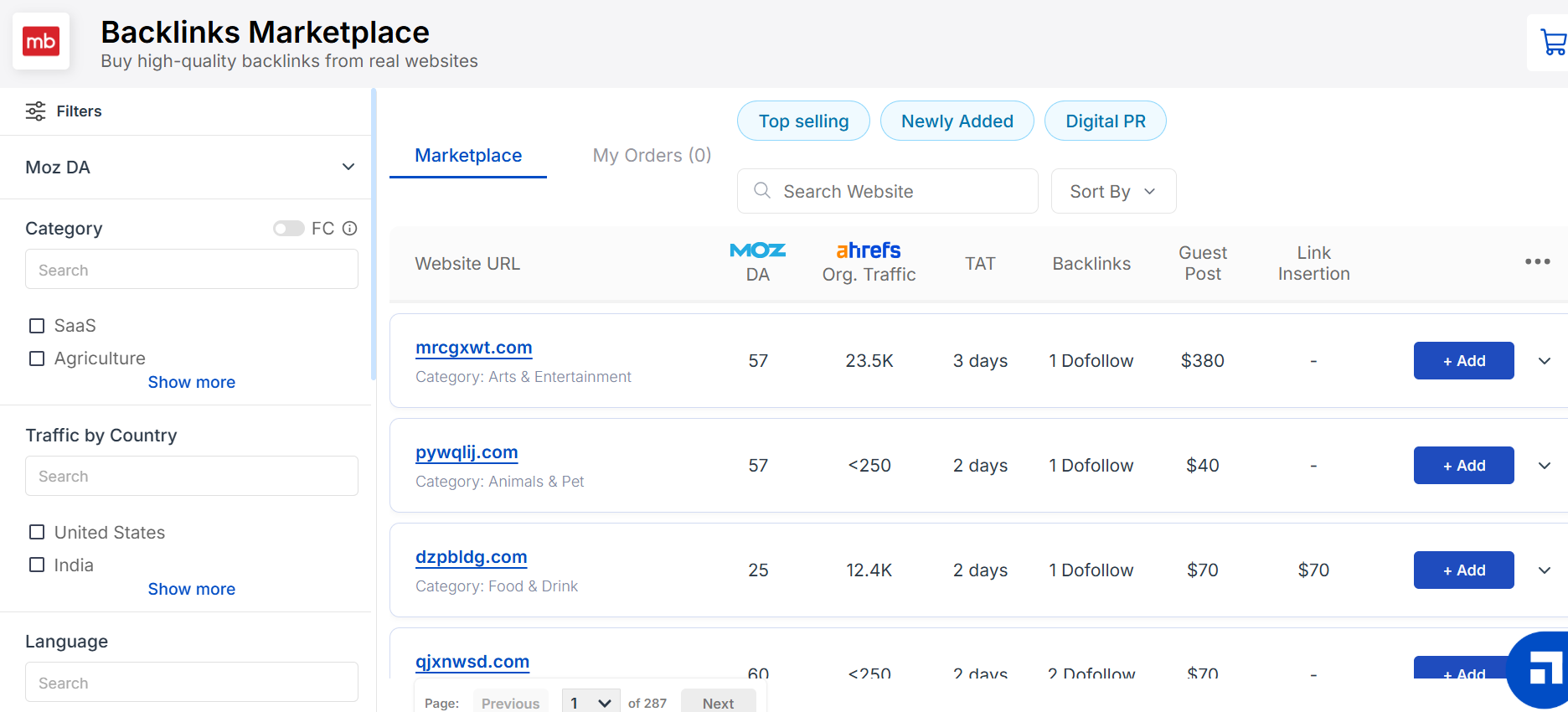
Technical and linking utilities support performance by strengthening site structure, improving metadata, and supporting authority building.
- Link Manager: Supports internal linking workflows to improve structure and distribution.
- On-Page Pro: Benchmarks titles and meta descriptions against what is working in the SERP.
- Backlinks Marketplace: Provides a way to discover and secure backlink opportunities through a marketplace model.
Why I Would Choose Scalenut Over Search Atlas?
From my perspective, the biggest reason I would choose Scalenut over Search Atlas is focus. Search Atlas is built like a broad execution suite with a lot of moving parts, which can be great for agencies, but it also means your attention gets pulled across many modules. Scalenut feels more streamlined for the work that matters most right now: building content that earns visibility in both Google and AI-driven discovery, without spending weeks stitching together a process.
“What I like best about Scalenut is how seamlessly it combines keyword research, content planning, and AI writing in one platform. It saves me hours of time and ensures my articles are fully optimized to rank. The Cruise Mode feature especially helps me go from idea to publish-ready in one sitting.” says Joey W, Director
I also prefer how Scalenut supports decision-making during real content work. It is easier to move from “what is happening” to “what I should update next” because the platform is designed around content planning, optimization, and visibility-driven prioritization. For me, that translates into faster iteration cycles, clearer content refresh decisions, and a workflow I can run consistently without needing heavy automation controls or a complex setup.
Schedule a demo today to see Scalenut’s GEO and SEO workflows in action!
Frequently Asked Questions
Is Search Atlas legit?
Yes. Search Atlas is an AI-powered platform from LinkGraph with public documentation for OTTO SEO and Content Genius. It is used by agencies and in-house teams, but you should still validate workflows during a trial, especially the learning curve and how results match your expectations.
Is Search Atlas good?
It can be strong if you want one platform for content, audits, and execution. In practice, outcomes depend on setup quality, so confirm gains in organic traffic with consistent tracking. I also recommend testing responsiveness from customer support early to avoid delays later.
Is Search Atlas suitable for SEO agencies and professionals?
Yes, particularly for agencies managing multiple accounts. The platform supports repeatable delivery through a report builder workflow and higher-tier packaging like an enterprise plan, which helps standardize processes across clients and websites without rebuilding everything from scratch.
How does Search Atlas compare to other top AI SEO tools?
Search Atlas competes as a broad suite rather than a single-purpose tool. Beyond a keyword research tool, it includes site explorer style competitive views, backlink analysis, and workflows aimed at holistic SEO. Some competitors go deeper on AI visibility, while Search Atlas emphasizes breadth.
How accurate are the SEO results generated by Search Atlas?
Accuracy depends on your data connections and verification habits. For best reliability, connect Google Search Console, review Google Search Console data, and judge recommendations by alignment with search intent. Then confirm impact with changes in real search results, not only internal scores.
Can Search Atlas integrate with platforms like Shopify?
Yes. Search Atlas is available in the Shopify App Store, and OTTO can be implemented through the OTTO pixel setup. For WordPress sites, confirm whether the WordPress plugin supports your publishing workflow, and test changes on a small set of pages before scaling.
Who are the top Search Atlas competitors?
Top alternatives typically include all-in-one SEO suites and newer AI-first platforms. When comparing, evaluate link building depth, authority metrics such as domain power, and whether the tool supports content strategy and topical dominance planning through a topical map generator. Scalenut is a strong alternative if your priority is improving AI visibility through a more structured GEO plus SEO workflow.
How much is Search Atlas?
Pricing is tiered, with the basic plan starting from $99/month to $399 for the Pro plan. The total cost depends on usage limits and how many sites or clients you manage. If you also run paid growth, check whether the platform supports ad campaigns and improves ad copy workflows, since that can change the value calculation.
Are there alternatives to SearchAtlas?
Yes. If you prefer more control, consider tools that reduce manual work through guided recommendations rather than automatic deployments. In that case, focus on platforms that prioritize reviewable technical fixes and clear implementation guidance so you can ship improvements confidently. Scalenut is one alternative worth evaluating for GEO SEO and AI visibility workflows.


.svg)


.webp)