
.jpg)
Anyword Review: Is It Worth It For SEO And AI Visibility?

Key Highlights
- Anyword is a performance-first AI writing tool designed for creating and optimizing multi-channel marketing copy at scale.
- Its Predictive Performance Score helps compare copy variations before publishing, which is most useful for campaign-driven teams.
- User feedback is largely positive for ease of use, while common concerns include pricing, tier limits, and occasional weaker suggestions.
- Anyword offers paid plans with a 7-day free trial on Starter and Data-Driven, but no permanently free plan.
- Anyword fits best for ads, landing pages, email, and website messaging workflows where testing variations is part of the process.
- For SEO plus GEO priorities, Scalenut is positioned as a stronger alternative because it focuses on AI visibility and action-oriented optimization.
- Scalenut’s advantage is connecting AI discovery insights to practical SEO execution across planning, optimization, audits, and refresh workflows.
AI search is changing the game. You can publish a well-optimized page, see it rank, and still find your brand missing from AI-generated answers, or mentioned without clear positioning. When that happens, it gets harder to link content work to real visibility and outcomes.
At the same time, AI writing tools are everywhere, and many promise “SEO content” without solving the visibility gap that matters now. Anyword can feel like a quick win for producing blogs, landing pages, and marketing copy faster, but speed does not always translate into stronger discoverability across AI-driven search.
In this blog, I review Anyword through the lens of SEO and AI visibility, focusing on whether it helps your content show up consistently in AI-generated answers, not just rank in traditional search.
What Is Anyword?
Anyword is an AI writing and optimization platform built for marketers who create high volumes of copy across channels like ads, landing pages, emails, social posts, and blog content. It is best known for its predictive scoring approach, which is designed to help teams generate variations and choose stronger options before publishing.
In practice, it helps streamline content production, maintain brand consistency, and speed up iteration when performance-focused messaging is the priority. The real consideration is whether your current challenge is primarily improving campaign copy outcomes, or whether you need a platform that goes deeper into SEO and AI-driven discovery visibility.
What Are Anyword’s Standout Features And Real-World Capabilities?
Anyword is built first and foremost for performance-driven marketing copy. It’s strongest for teams who want to generate variations quickly, stay on brand, and use a predictive scoring system to choose what to publish.
Let’s look at Anyword’s core feature set in detail:
AI Content Creation For Marketing Channels
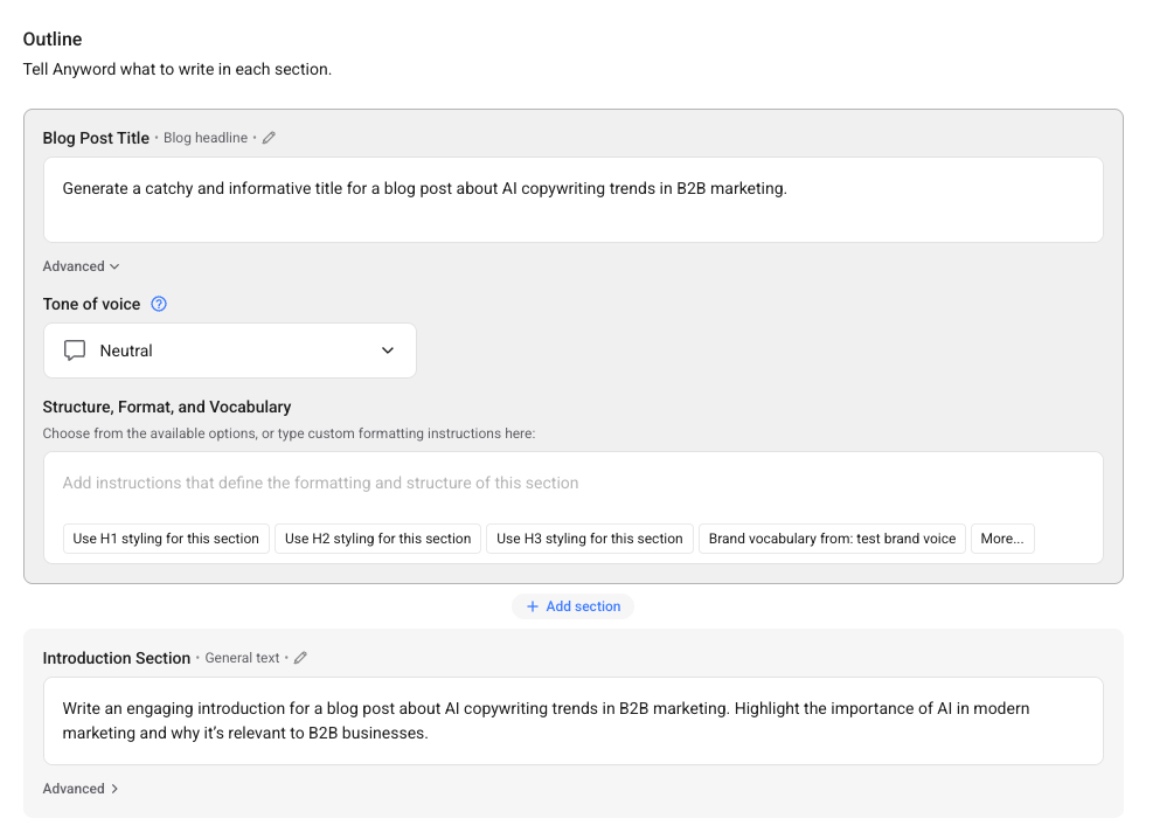
Anyword’s core workflow is designed to generate marketing copy across key channels, then refine it using performance-oriented feedback.
Multi-Channel Copy Generation
If your day-to-day work includes campaign assets across platforms, this is where Anyword feels most immediately useful.
- Generate copy for ads, landing pages, emails, and social content in one editor.
- Create multiple variations quickly to test different angles and hooks.
- Keep output aligned to the channel format instead of writing from scratch each time.
Blog And Long-Form Support
This is helpful for content creators who want speed and consistency, especially when you are producing a lot of drafts.
- Draft blog post sections faster when you already know your target angle.
- Improve readability and flow when you need quick rewrites.
- Useful for repurposing content into social captions, email intros, and ad snippets.
SEO Experts
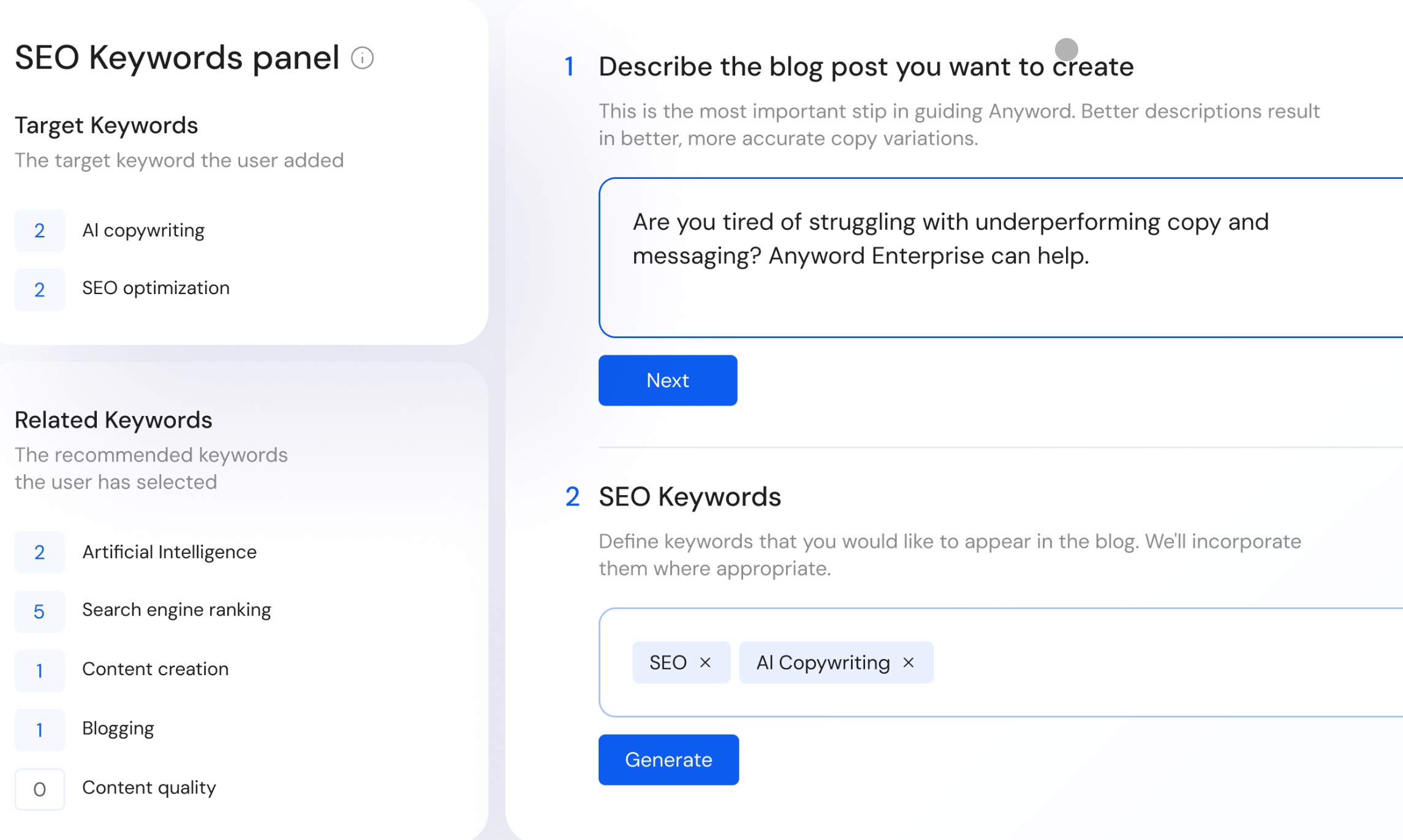
Anyword positions this as an SEO-focused workflow for teams that want to produce blog content faster while keeping output aligned to brand voice and audience intent.
SEO-Optimized Blog Creation
This is where Anyword supports SEO content production for teams that publish often and need a repeatable drafting workflow. In my experience, it fits best when the goal is speed and conversion-focused iteration, since its intelligence is geared toward copy performance prediction more than prompt-level AI answer visibility monitoring.
- Generate SEO-focused blog drafts designed to read naturally.
- Summarize an existing webpage to speed up original draft creation.
- Add relevant keywords and key talking points to reduce manual prep.
- Best suited for teams optimizing content output and on-page messaging, not teams primarily tracking visibility inside AI-generated answers.
Scaled Content Production For Content Teams
If your SEO team also supports demand gen, this workflow is designed to reduce context switching between blog writing and campaign copy, especially when speed and consistency matter.
- Create content for ads, landing pages, website copy, emails, and SEO blogs.
- Generate topic ideas and content angles to keep the pipeline moving.
- Tailor outputs for different audiences using persona-style inputs.
- Helpful for scaling production, but less oriented around monitoring AI answer surfaces, prompts, and brand presence across AI systems.
Data-Driven Editor
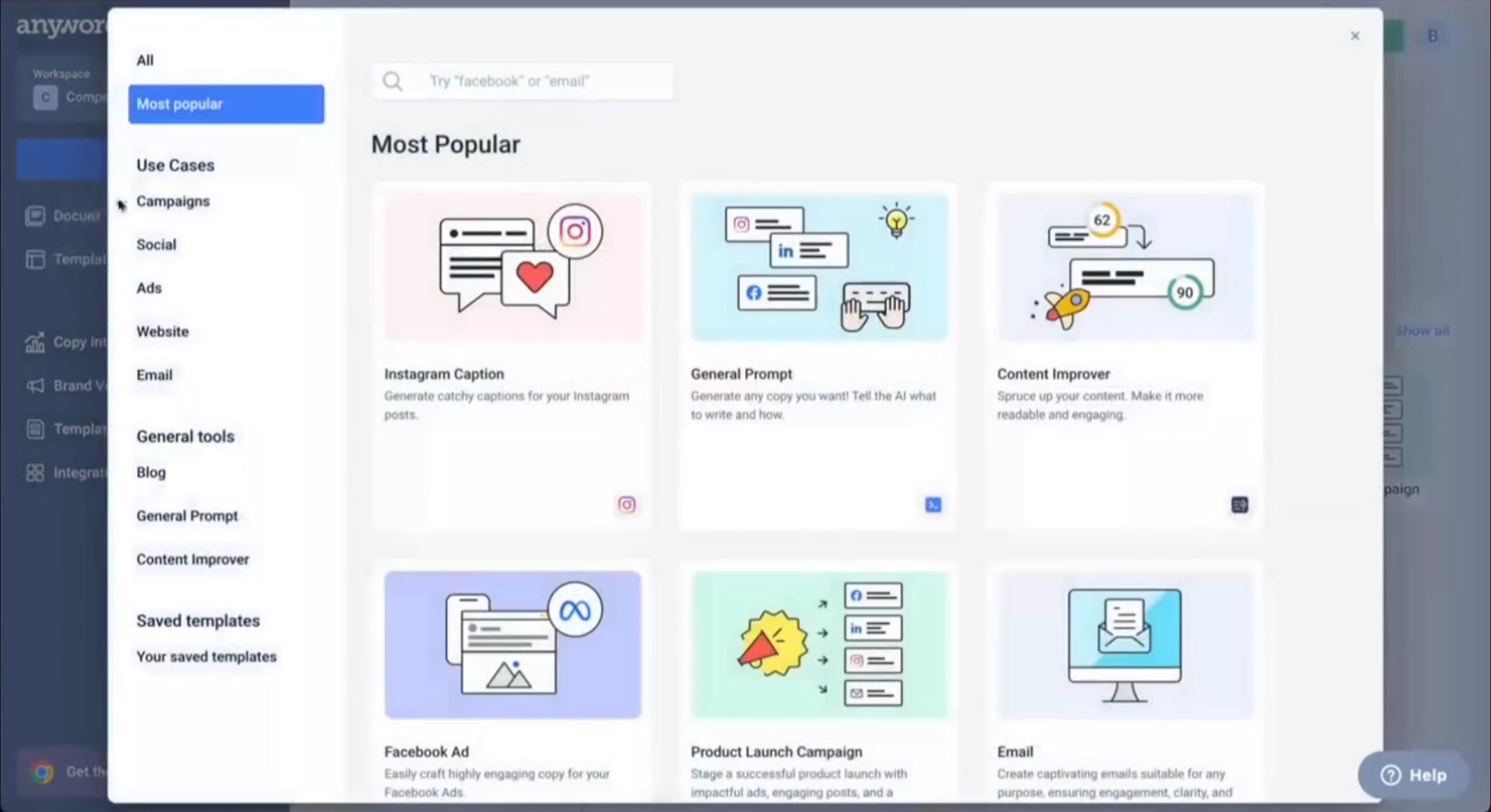
Anyword’s editor is positioned as a centralized place to create assets and use performance marketing data to choose which copy to run.
Copy Generation With Performance Context
This is where Anyword feels practical for busy marketers who need output plus decision support in the same place.
- Create multiple options for the same message and compare them quickly.
- Reduce review cycles when stakeholders want “the best version” backed by a system.
- Streamline workflows for teams producing a high volume of campaign assets.
Content Intelligence And Insights
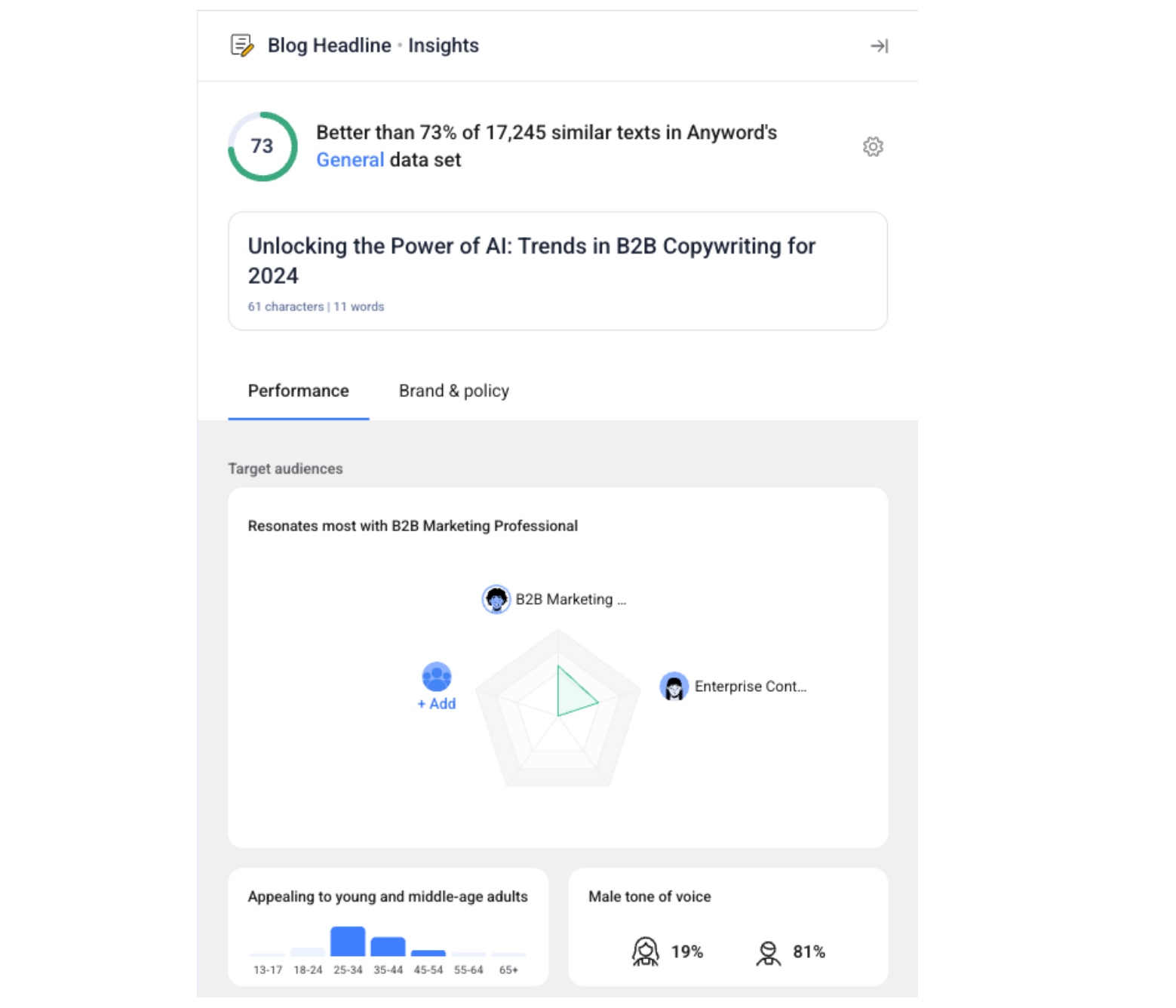
Anyword also positions “Content Intelligence” as a layer that connects to performance context and learns what works across channels.
Performance Benchmarking And Learning Loops
This is useful if you want insights to inform future copy choices, not just generate more drafts.
- Use performance data rows to connect marketing channels and learn from past campaigns.
- Track patterns across variants to identify what messaging consistently wins.
- Support a more measurable iteration cycle over time.
Website Automation And On-Site Messaging Optimization
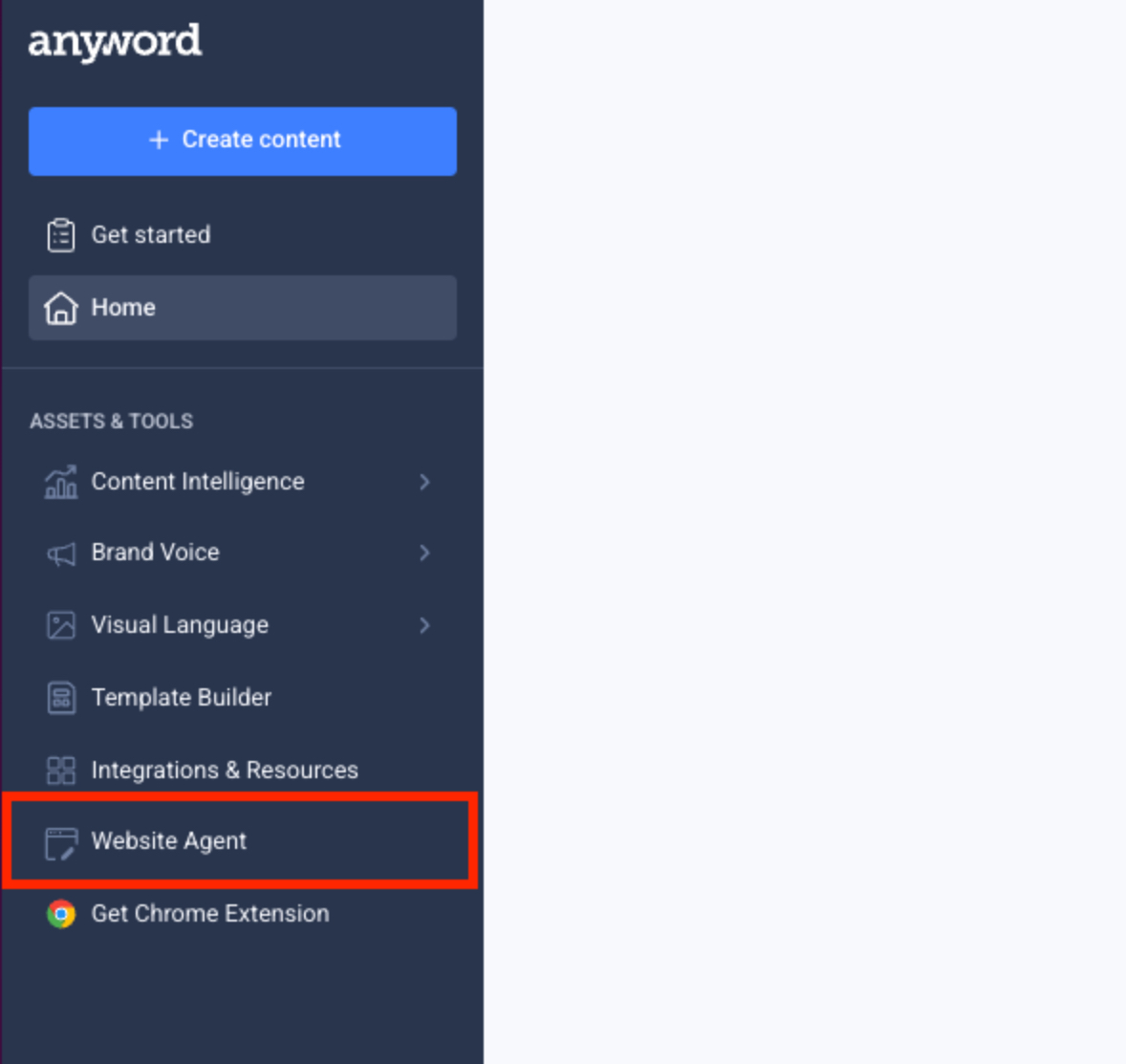
Anyword offers a website personalization and testing angle that goes beyond basic copy generation.
Website Automation
Anyword claims marketers see a 30% average increase in conversion rates through its website personalization approach.
- Personalize website messaging at scale for different visitors.
- Validate and iterate on messaging instead of relying on static pages.
- Align website copy testing with performance-oriented goals.
Website Agent Workflows
If you like experimentation, the “agent” positioning is compelling for continuous website messaging improvements.
- Test multiple variations against a baseline.
- Track performance of variants and iterate based on results.
- Reduce manual work involved in maintaining ongoing tests.
Integrations, Extension, And API
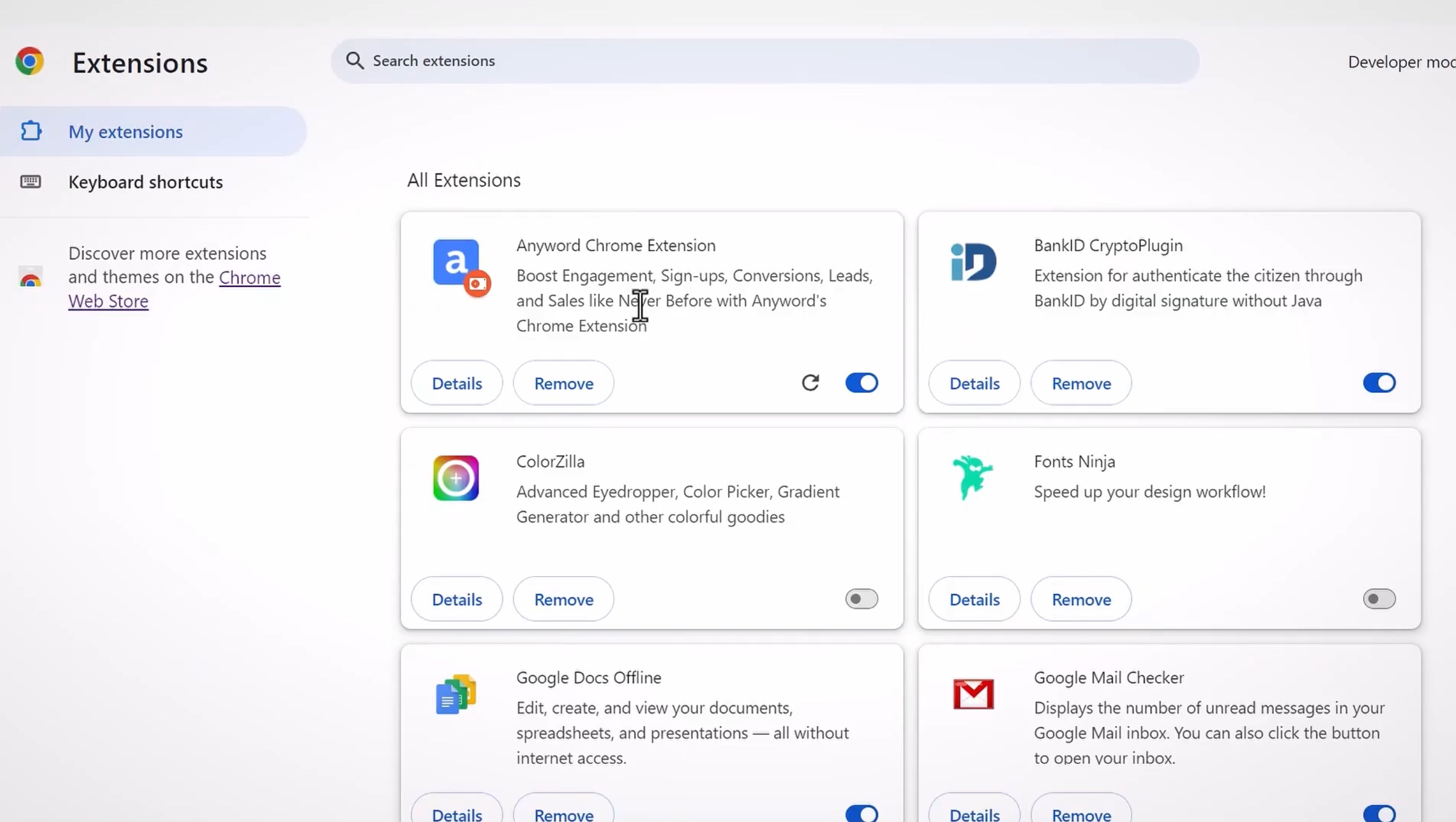
Anyword supports integrations across your stack and also offers an API for teams building more customized workflows.
Integrations Across Marketing Tools
This matters if your copy workflow touches multiple platforms and you want feedback loops tied to real channel performance.
- Integrations across CMS, CRM, and ads categories (as listed in their integrations hub).
- Tags like performance prediction and performance data training appear on connectors.
- Useful for teams that want content insights connected to distribution.
API For Performance Intelligence
For larger teams, the API positioning is about embedding predictive scoring and performance context into internal tools.
- Add predictive scoring into custom workflows and agents.
- Enrich prompts with brand and behavioral data.
- Support more advanced automation beyond the UI.
Want experts to optimize your content for ChatGPT-style discovery? Explore my list of the top 10 AI-driven SEO agencies built for ChatGPT-answer visibility.
What Do Actual Users Say About Their Experience With Anyword?
“Pricing can be a bit steep for startups or smaller businesses, as some of the advanced features are locked behind higher tiers. At times, the generated content feels slightly repetitive if you don’t experiment with prompts.”, says Sidath P., Software Engineer
User feedback on Anyword is largely positive, with an overall rating of 4.8 out of 5. The most consistent praise centers on ease of use and an intuitive interface, with many users saying it helps them create marketing copy faster and stay productive across different writing tasks.
Where users are more critical is around cost and plan-based access. Some reviews describe Anyword as expensive, and others note that certain advanced features feel limited by subscription tiers. A smaller set of comments also mentions occasional weaker suggestions, along with moments where creativity or content quality feels less consistent.
What Types Of Plans And Pricing Options Does Anyword Offer?
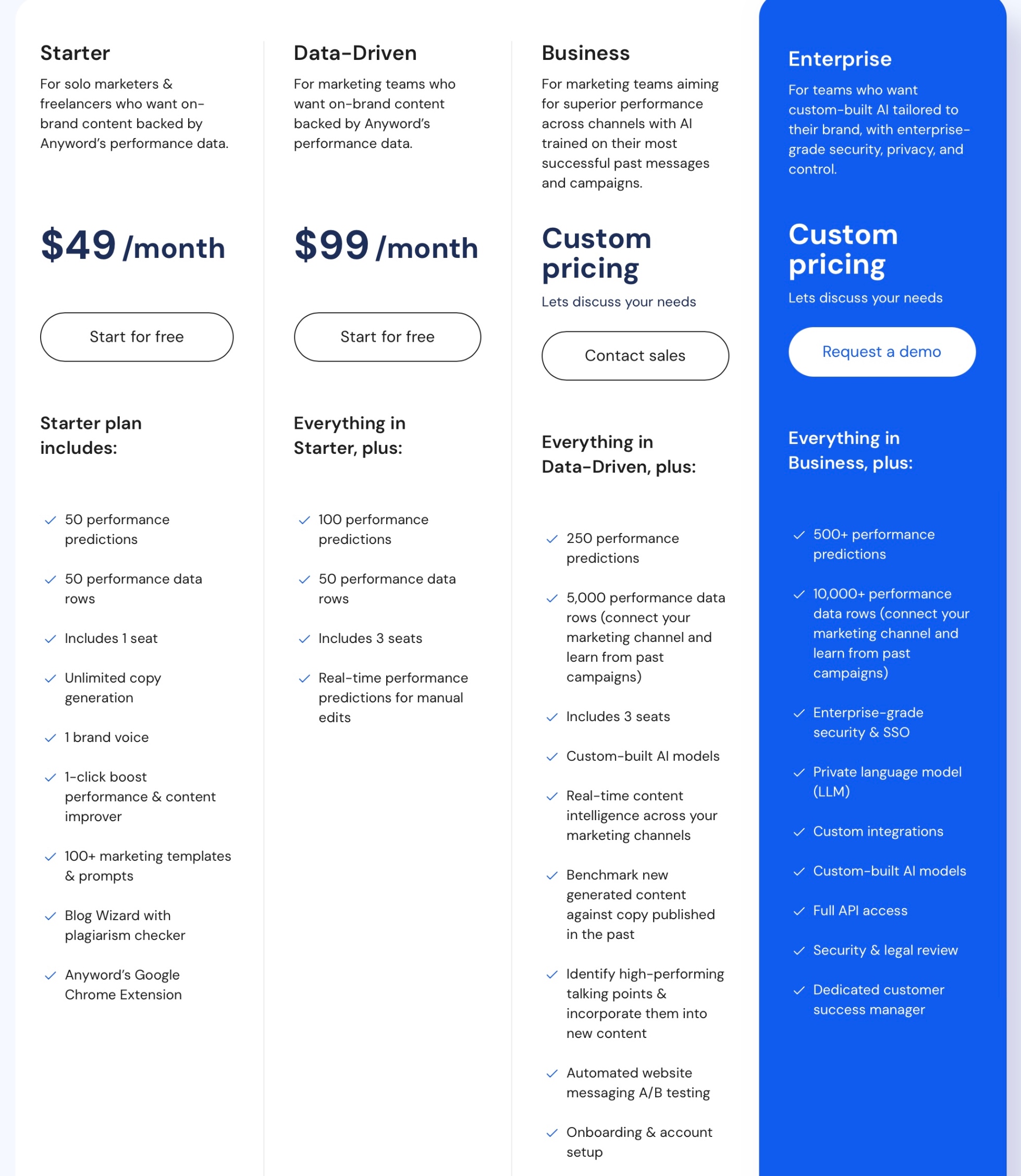
Anyword’s paid plans start at $49/month for Starter and $99/month for Data-Driven, with Business and Enterprise offered on custom pricing for teams that need deeper performance intelligence, custom models, and advanced controls.
There is no permanently free plan, but Anyword does offer a 7-day free trial on both the Starter and Data-Driven tiers, which is enough time to test the predictive scoring workflow and see whether it fits your content and campaign cadence.
Is Anyword The Right Fit For Your Team?
In my experience, Anyword is best suited for teams that treat content as a performance lever. It is strongest when you are creating multiple versions of a message and want a faster, more structured way to choose what to publish across campaign channels.
Who Will Benefit Most From Anyword?
- Performance marketers who want a repeatable workflow for writing and comparing copy variations.
- Teams producing high volumes of ads, landing pages, and email copy who need speed without losing brand consistency.
- Content teams that want faster SEO blog drafting and easier repurposing into campaign assets.
- Website teams running ongoing messaging experiments who want a more systematic way to test on-site copy changes.
- Larger organizations that need enterprise-level controls, permissions, and more structured team workflows.
When Anyword May Not Be The Right Fit?
- SEO teams focused primarily on improving AI brand visibility inside AI-generated answers rather than optimizing channel copy performance.
- Teams that rarely test variations, since the biggest value comes from generating and comparing multiple options.
- Users looking for deeper SEO planning and visibility workflows beyond content creation and copy optimization.
What Are The Pros And Cons Of Anyword for Content Writing?
Anyword can be a solid addition to a marketing stack, but the best fit depends on your goals and how your team actually works. Here are the key pros and cons. Anyword can be a solid addition to a marketing stack, but the best fit depends on your goals and how your team actually works. Here are the key pros and cons.
How Does Anyword Stand Out From Other AI Copywriting Platforms?
- Predictive performance scoring helps compare variations quickly across formats like ads, emails, landing pages, social posts, and blogs.
- The workflow is built for performance-led iteration, not just draft generation, so it supports faster refinement and decision-making.
- It supports SEO content production with structured drafting workflows that help speed up blog creation and repurposing.
- Website messaging optimization features are useful for teams that actively test and improve on-site copy.
- It scales to team and enterprise needs with collaboration and control-oriented features.
What Limitations Should You Know Before Choosing Anyword?
- Its core strengths center on copy performance prediction, which does not always align with teams focused on AI visibility inside AI-generated answers.
- You get the most value when you regularly create and compare variations, not when you publish one draft and move on.
- Website testing and automation can feel unnecessary if you are not running ongoing experiments.
- Advanced requirements can push you into higher tiers, so pricing and limits matter early in evaluation.
Why Is Scalenut A Better Alternative To Anyword?
Scalenut is the stronger choice when the goal is SEO plus GEO, especially for teams prioritizing AI visibility. Anyword performs well for performance-focused copy workflows, but Scalenut is built around measuring and improving how a brand appears inside AI-generated answers, including prompt coverage, visibility gaps, and competitive presence.
The key difference is execution depth. Scalenut connects AI visibility insights to practical SEO actions across the full content lifecycle, from planning and optimization to audits and refresh workflows. Instead of stopping at copy iteration, it is designed to help teams move from “Where are we missing in AI answers?” to “What should we update next?” which is a more direct fit for AI visibility-driven content strategies.
Want to see Scalenut’s GEO and SEO stack at work? Read this Scalenut review to see how it strengthens visibility in search and AI-generated answers.
What Are Scalenut’s Most Important GEO And SEO Features?
Scalenut brings AI visibility tracking (GEO) together with hands-on SEO execution and advanced SEO tooling inside one platform. Rather than stopping at content generation, it helps teams see how their brand is represented in AI answers and then guides the next actions that can improve both visibility and performance.
How Does Scalenut Strengthen GEO And AI Visibility?
Scalenut’s GEO layer is built to monitor brand presence across AI-generated responses on platforms such as ChatGPT and Perplexity, then convert those signals into insights that can shape SEO content priorities and authority-building decisions.
AI Visibility Tracking And Brand Monitoring
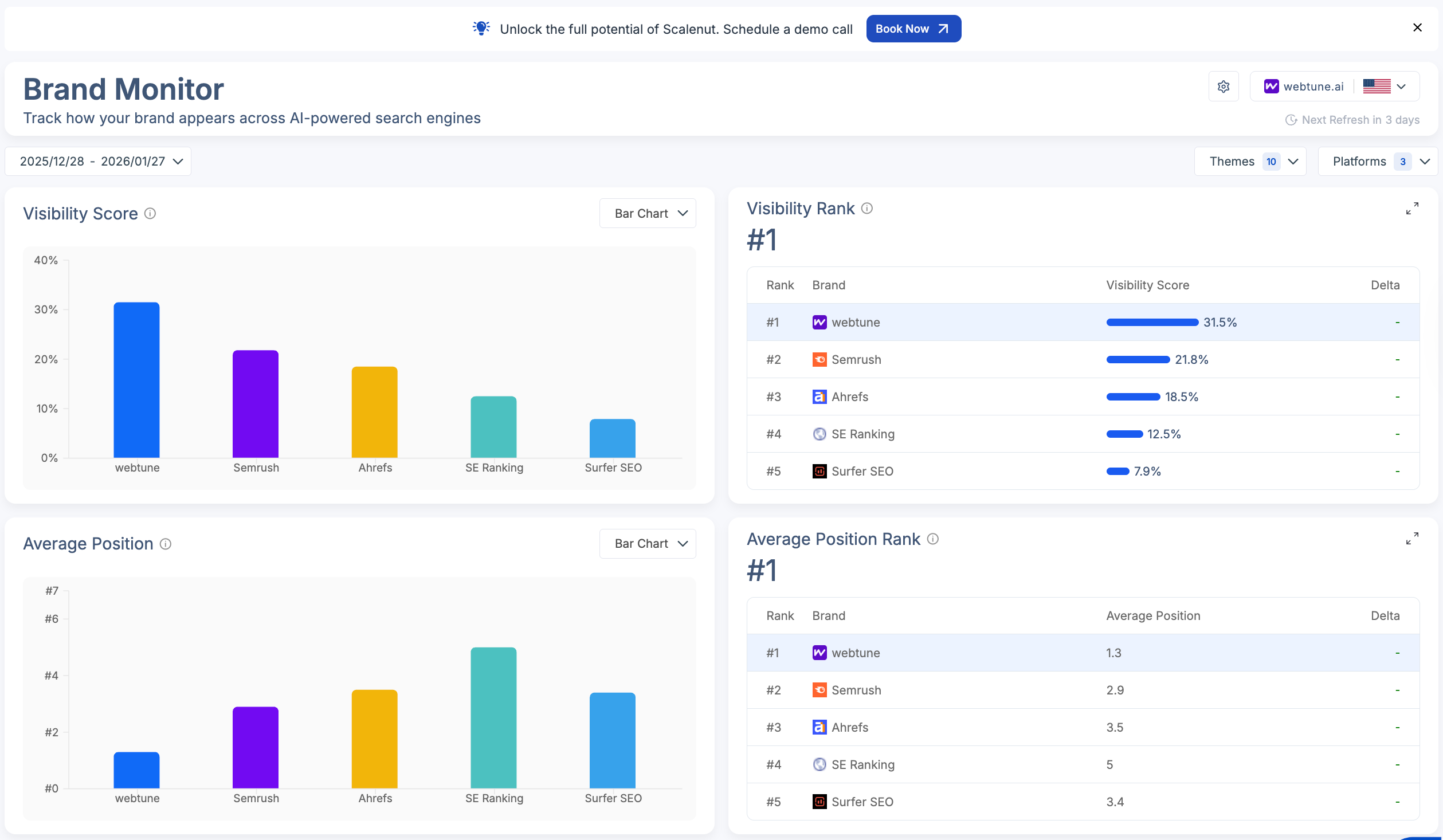
Brand-level reporting helps measure how often a brand appears in AI answers and how that presence compares against competitors across platforms.
- Visibility Score summarizes how frequently the brand appears compared to competitors.
- Average Position shows whether mentions surface near the top of AI answers or farther down.
- Share Of Voice measures how much response space the brand captures versus others.
- Visibility Heatmap breaks performance out by platform to highlight stronger and weaker channels.
- Brand Visibility Rank combines key signals into one benchmark across prompts and topics.
Prompt-Level Intelligence And Competitive Insights
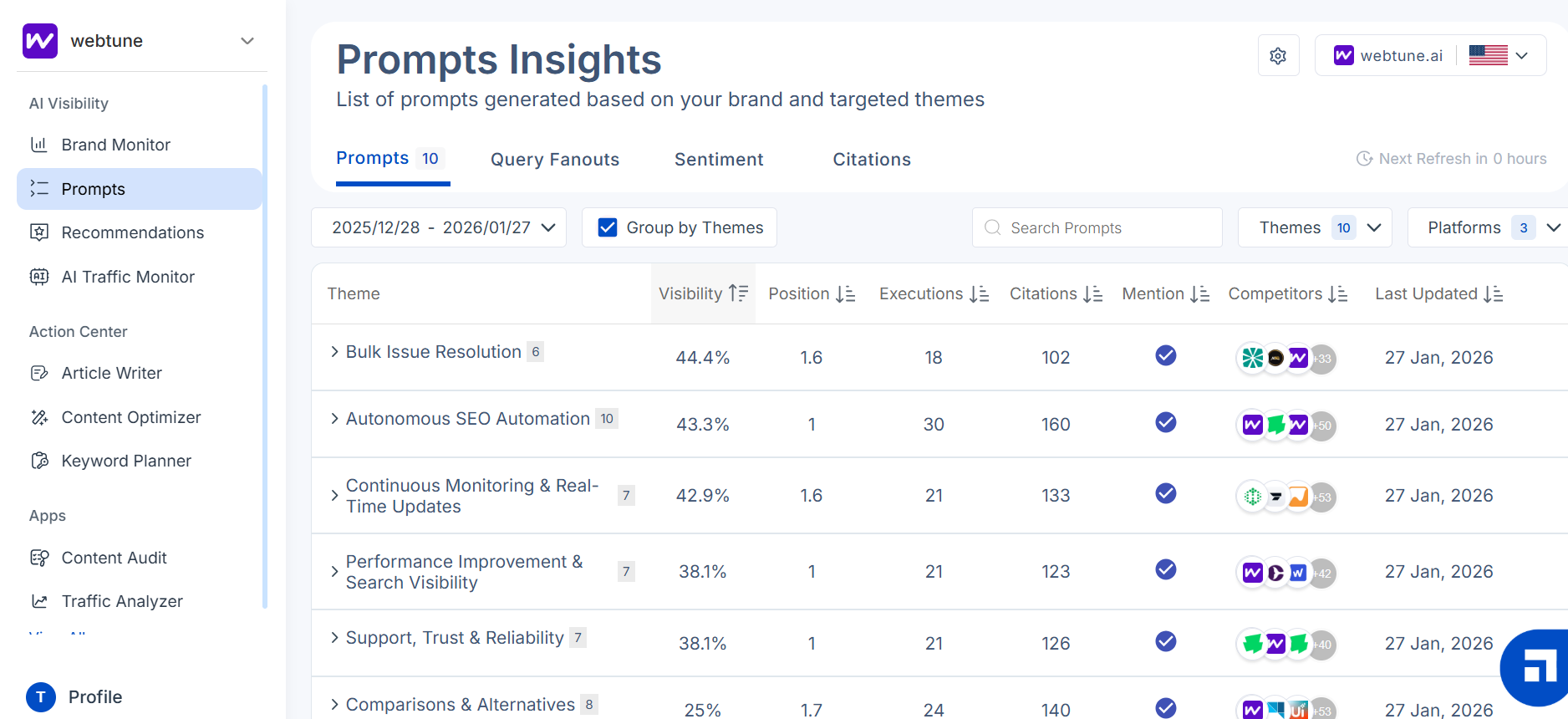
Prompt-led reporting highlights where visibility is being gained or lost by showing which prompts drive mentions and which sources AI systems rely on.
- Prompt Tracking surfaces the prompts where the brand appears, along with relative placement.
- Citation Tracking highlights the sources referenced to support AI-generated answers.
- Competitor Visibility Insights shows brands frequently mentioned alongside yours.
- Query Fanouts maps how one question expands into related follow-up queries in AI experiences.
- Sentiment Analysis tags mentions by tone to separate positive exposure from neutral or negative.
GEO Recommendations That Lead To Execution
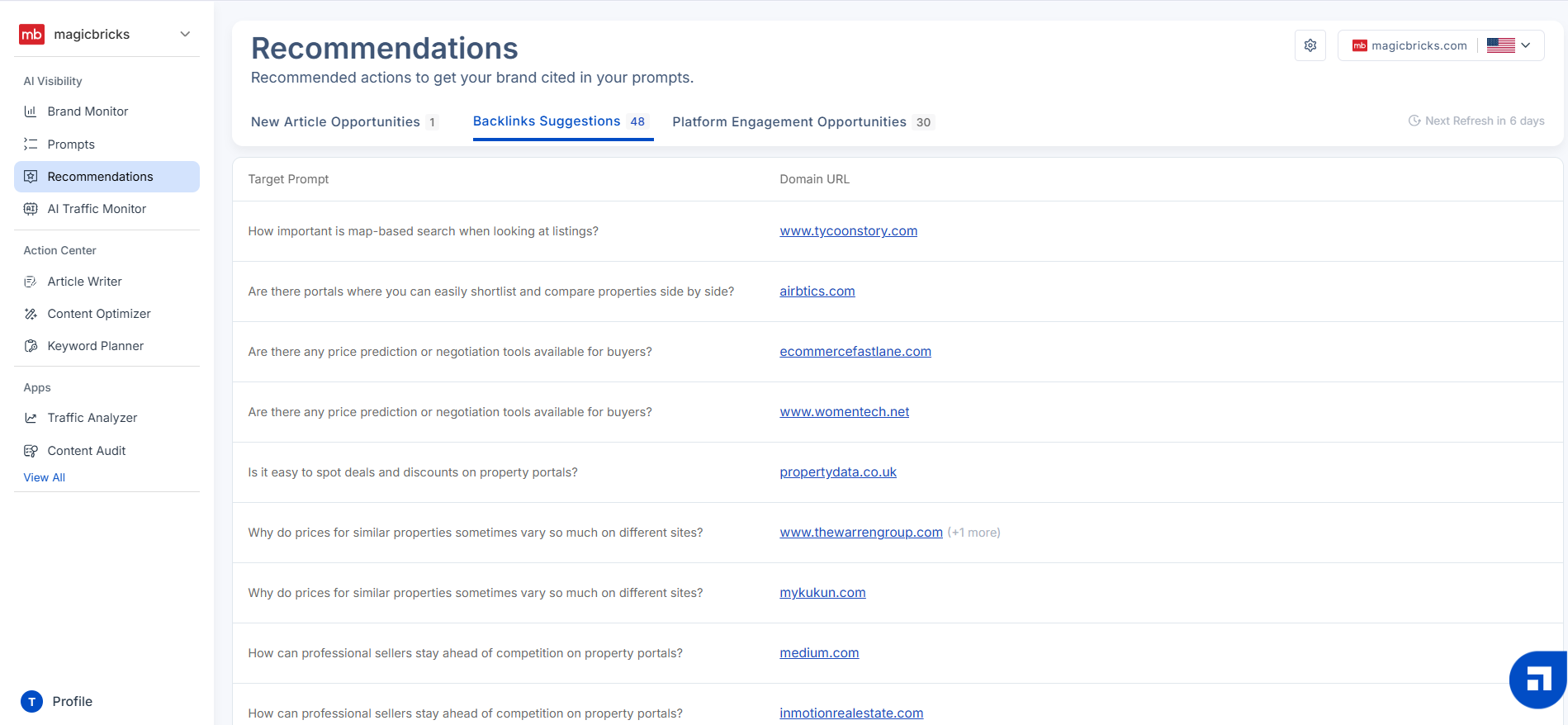
This layer aims to turn visibility gaps into practical next steps, helping marketing teams prioritize work that can drive outcomes.
- AI-Led Content Ideas turn AI-driven questions into content opportunities worth targeting.
- Authority And Backlink Suggestions point to credibility signals that can influence visibility.
- Platform Engagement Opportunities surface relevant communities and threads where presence can be built.
- Action Paths outline clear next steps so insights lead to execution.
AI Traffic Visibility And LLM Interaction Signals
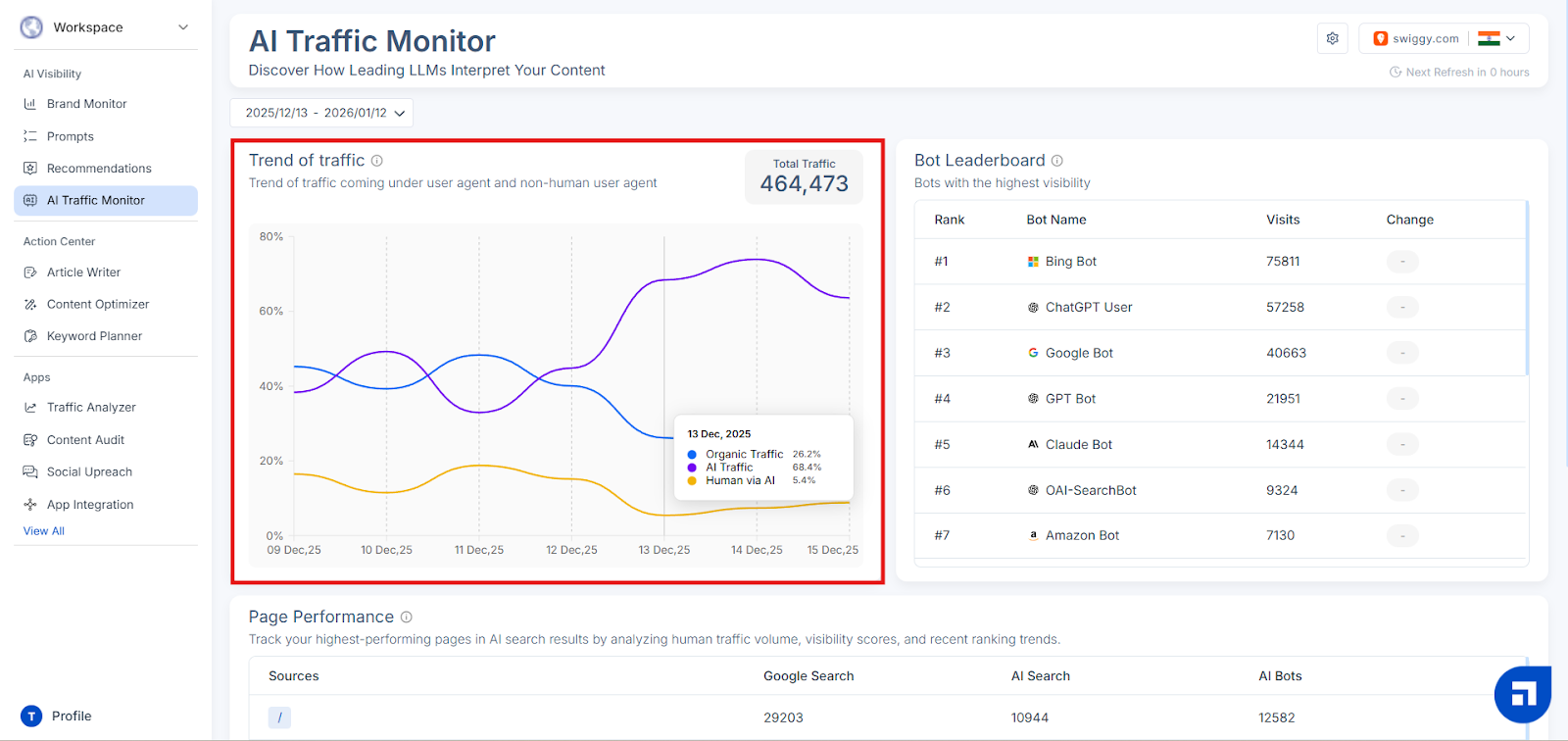
Traffic and interaction signals help connect AI visibility to site outcomes by showing how AI agents engage with content and which pages they rely on.
- AI Bot Tracking identifies visits attributed to AI assistants and AI search experiences.
- Cloudflare Integration adds deeper tracking for sites running on Cloudflare.
- Top AI Sources shows which AI agents interact with the site most often.
- Most Referenced Pages highlights pages AI systems appear to pull from frequently.
- AI Traffic Trends tracks whether AI-driven visits are rising, flattening, or dropping.
Want to track what is shifting in AI-driven discovery this year? Explore our roundup of top AI monitoring tools that can sharpen your workflow in 2026.
How Does Scalenut Support SEO And Content Execution?
Beyond GEO monitoring, Scalenut includes a full SEO workflow for planning, creating, optimizing, and scaling content with structured guidance across the content lifecycle.
Content Production And Optimization
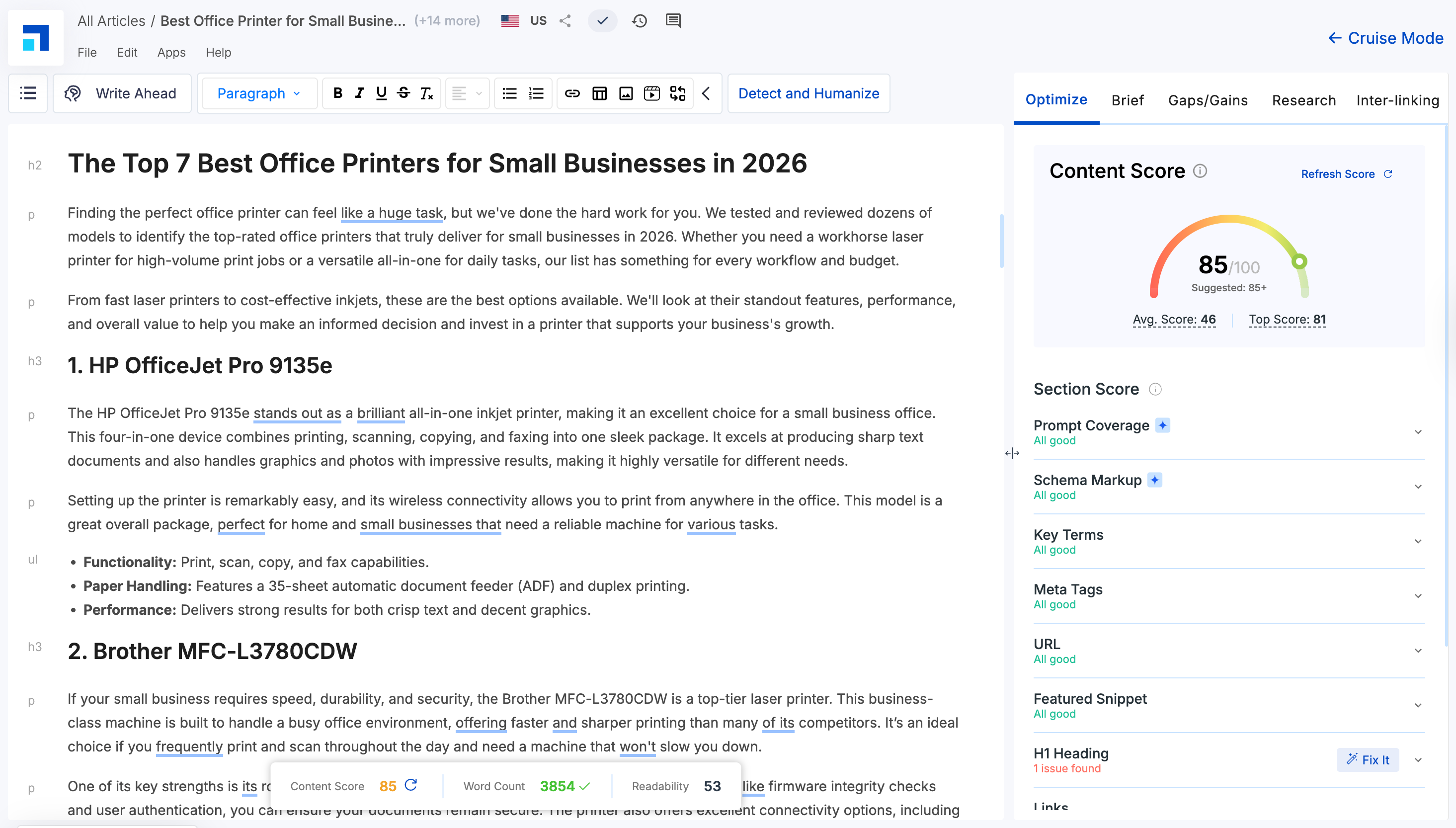
These tools keep execution moving by translating SERP signals into drafts, then guiding on-page improvements for stronger intent match and performance.
- Cruise Mode supports outlining and drafting using SERP-informed guidance, with GEO signals layered in where relevant.
- Content Optimizer highlights what to adjust on-page to strengthen performance signals.
- AI Humanizer refines AI-written sections so the output reads more natural and user-friendly.
- Content Scoring evaluates SEO quality factors such as intent alignment, coverage depth, structure, and keyword usage.
SEO Research And Planning Tools
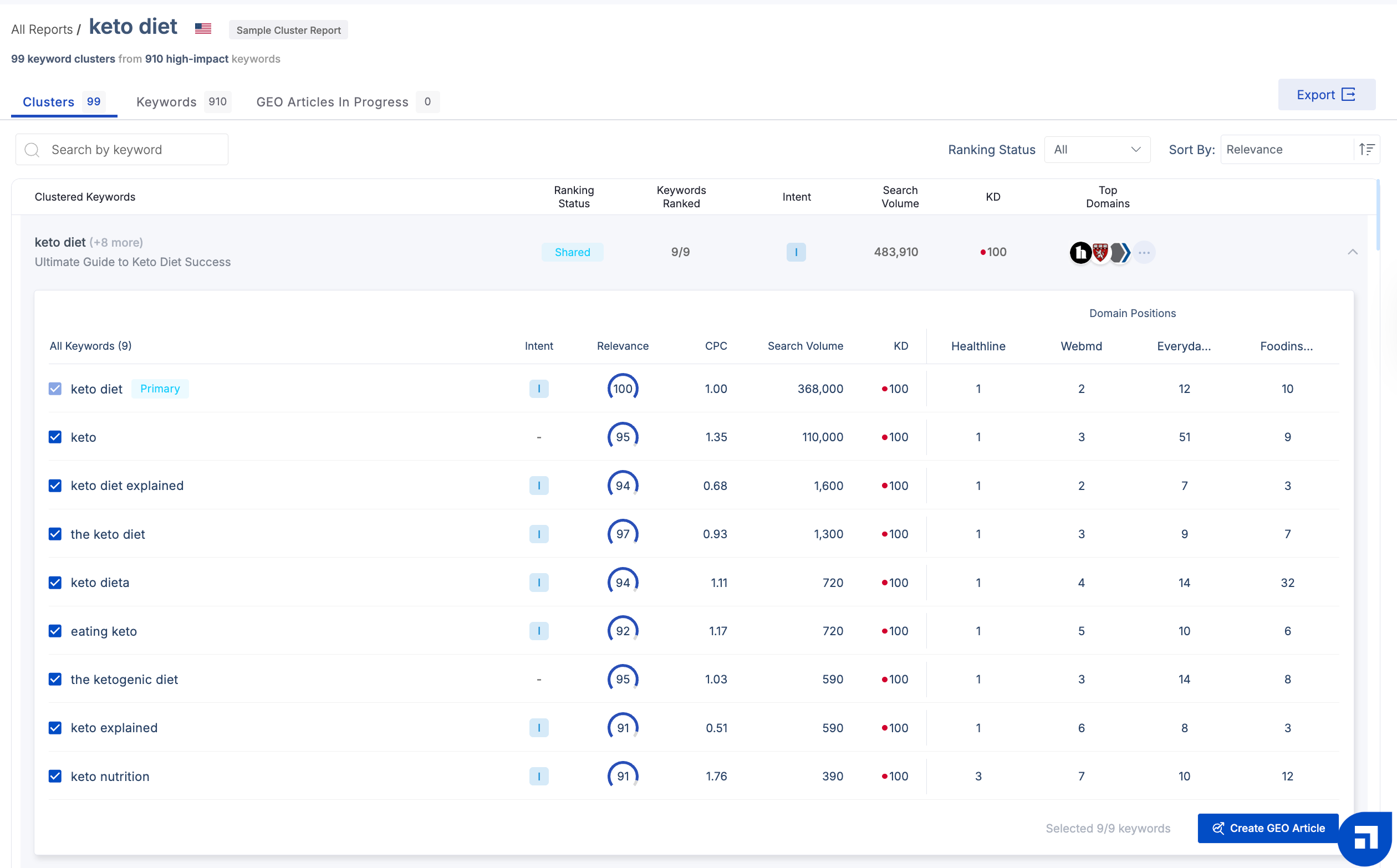
Research and planning features help teams choose targets, cluster topics by intent, and prioritize updates based on performance opportunities.
- Keyword Planner clusters keywords by intent for cleaner content planning.
- Competitor Coverage Analysis shows how competing pages structure and cover the same topics.
- Traffic Analyzer surfaces strong performers and quick-win opportunities.
- Content Audit flags pages that may need refreshes, consolidation, or deeper optimization.
Technical SEO And Linking Support
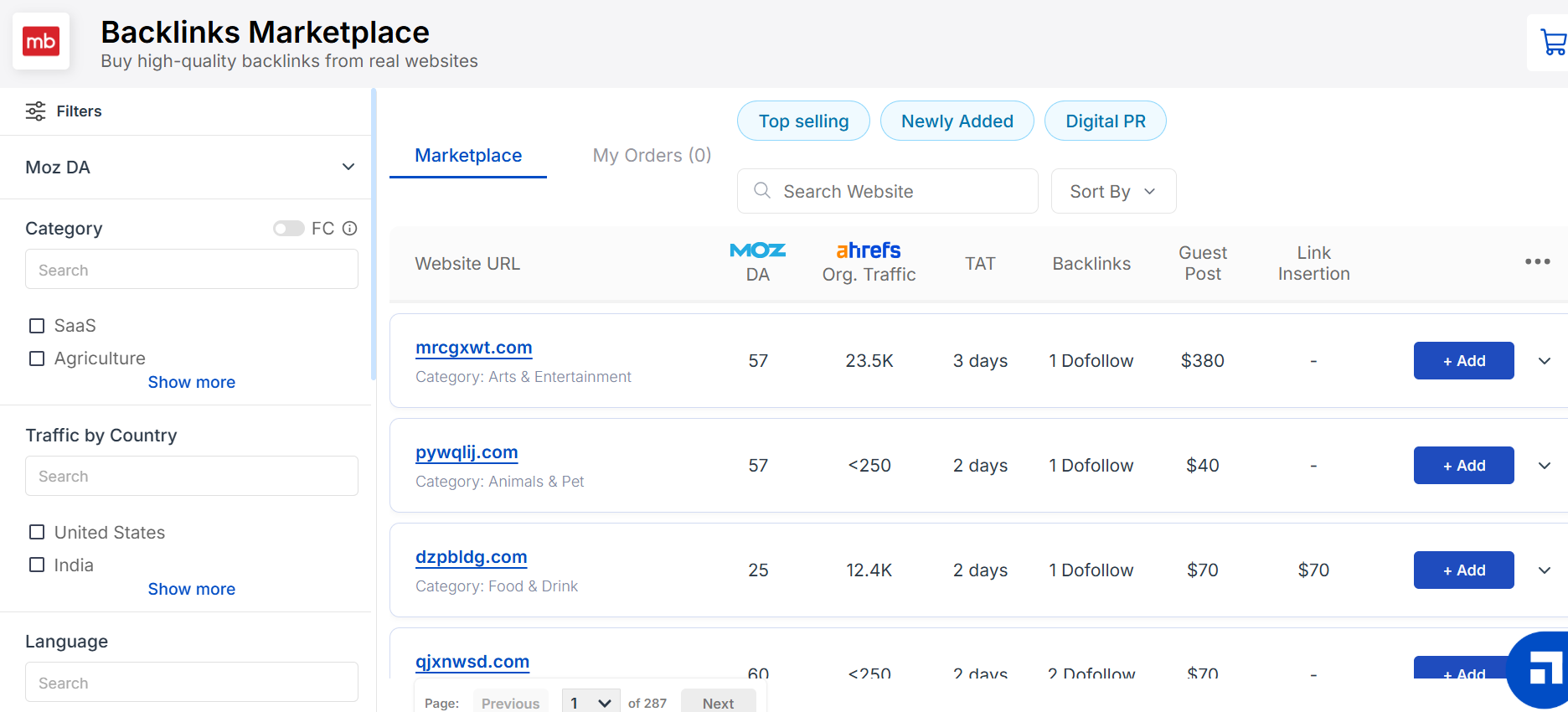
Technical and linking support reinforces internal structure and strengthens on-page fundamentals that influence rankings and AI citation potential.
- Link Manager supports internal linking workflows to improve site structure.
- On-Page Pro benchmarks titles and meta descriptions against what is working on the SERP.
- Backlinks Marketplace provides a route to discover and secure backlink opportunities through a marketplace model.
Why I Would Choose Scalenut Over Anyword?
If your goal is to improve visibility where buyers are increasingly discovering brands, Scalenut aligns better with that reality because it is built around SEO plus GEO execution. It helps connect what is happening in AI-generated answers to what should change on your site, so you can prioritize updates that strengthen discoverability instead of only improving channel copy.
Anyword still has clear value for performance marketers optimizing ads, landing pages, and email campaigns through variation testing. But when the priority is broader, long-term visibility across search and AI answers, Scalenut is better positioned to support planning, optimization, and refresh workflows that compound over time rather than focusing primarily on predicting which copy version will perform best.
Book a demo to see how Scalenut‘s GEO and SEO workflows support AI visibility in practice.
Frequently Asked Questions
Is Anyword legit?
Yes. Anyword is a legitimate AI writing platform used by marketing teams to create and optimize copy across channels. Its unique feature is predictive scoring that helps compare variations. It is a useful tool when the primary focus is performance-led messaging and measurable business results.
What is Anyword and how does it work?
Anyword generates copy options and uses feedback-style scoring to help you choose stronger variations for your target audience. The content creation process starts with your inputs, then the platform proposes outputs you refine. It works best when you test multiple versions consistently.
Is Anyword a good choice for creating marketing content?
Anyword can be a strong option for marketing professionals who need landing page content, ads, and email copy quickly. It supports content marketing workflows by producing plenty of content in less time. The right tool depends on whether your goals lean toward speed or visibility.
Is Anyword worth the price for content creators?
For creators with specific needs like fast production and structured variation testing, Anyword price may be worth it. If you mainly need a blog writer with keyword research and deeper SEO planning, you may want best AI tools built for search engines and search results improvements.
Can Anyword improve copy performance through feedback and analytics?
Yes, it can help improve copy performance by encouraging iteration through scoring and insights. You typically get better results when you compare variations, apply recommendations, and keep messaging consistent across channels. This approach supports decision-making for campaigns focused on outcomes.
Are there any good alternatives to Anyword for GEO and SEO-focused teams?
Yes. If your primary focus is GEO and SEO visibility, Scalenut is a strong option among Anyword competitors tools because it is built around AI answer presence tracking and execution-focused optimization. Compare key features to your specific needs, reporting depth, and how much detail your workflow requires.
Is Anyword a good AI tool for blogging?
Anyword can support blogging, especially when you need faster drafting and repurposing. However, it is not always ideal if your goal is to improve search results through SEO strategy depth. For best results, pair it with a dedicated SEO stack.


.svg)


.webp)