
Key Highlights
- Surfer is an SEO tool focused on content optimisation to help you rank higher.
- Its key features include a real-time Content Editor, a detailed SERP Analyser, and an Audit tool for existing pages.
- The platform uses data-driven recommendations based on top-ranking competitors.
- Surfer AI assists in content generation, though it requires human editing.
- Surfer SEO has user ratings of 4.5/5 on Trustpilot and 4.8/5 on G2.
Modern content teams face a growing challenge: traditional SEO tools are no longer enough to compete in an AI-influenced search landscape. While ranking signals still matter, teams now struggle with over-optimisation, unclear content priorities, and tools that promise results but deliver limited real-world impact.
The goal today is to create content that ranks, reads naturally, and scales efficiently. Teams want clarity on whether tools like Surfer SEO actually help improve performance or simply add another layer of optimisation complexity without addressing broader GEO or AI search needs.
In this blog, we will explore how Surfer SEO works, break down its key features and tools, and show you how it can help you create data-driven content that performs well in both traditional search and modern AI-influenced results.
What is Surfer SEO?
Surfer SEO is a content analysis and optimisation platform designed to help you create articles and blog posts that achieve high search engine rankings. At its core, Surfer SEO's purpose is to improve your content quality by analysing your page against over 500 on-page signals. It compares your work to what's already ranking for your main keyword and gives you data-driven recommendations to make your content more competitive.
How Does Surfer SEO Tool Work?
Getting started with Surfer SEO is straightforward. The process begins with keyword analysis, where you input the term you want to rank for. The tool then scans the top-ranking pages in the search results to understand what makes them successful.
From there, it provides specific recommendations within its Content Editor. You'll receive suggestions on word count, headings, and important terms to include. This guided approach to search engine optimisation helps streamline the content creation process, taking the guesswork out of what you need to write.
You can also connect your Google Search Console account for more personalised insights. This allows Surfer to analyse your site's existing authority and performance data, offering tailored suggestions for new topics and pages to optimise for the most significant potential traffic gains.
What are the main features of Surfer SEO, and how do they help with content optimisation?
The platform's key features work together to help you research, write, and refine your content. In the following sections, we'll explore the 6 primary SEO features:
1. Surfer SEO AI Visibility Tracker
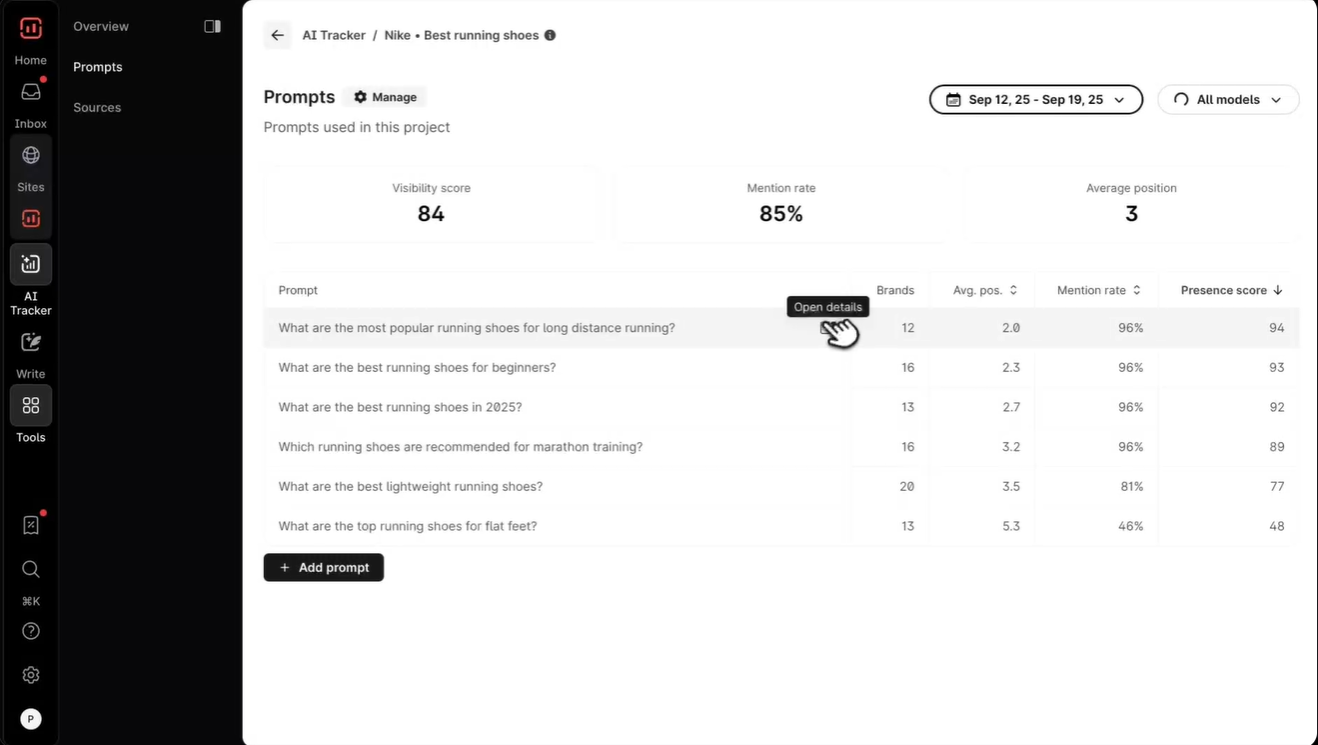
Surfer SEO’s AI Visibility Tracker helps teams understand and influence how their brand appears in AI-generated answers. It surfaces prompt-level gaps, brand framing, and source data so teams can prioritise content and outreach that actually earns AI mentions.
- Identify visibility gaps: Spot high-intent prompts where your brand is missing and create content that AI tools are more likely to cite.
- Manage brand narrative: See how AI currently describes your brand and correct misquotes, silence, or off-brand framing through optimisation.
- Measure real impact: Track AI share of voice over time and tie content, SEO, and PR efforts to measurable AI visibility gains.
- Prioritise what matters: Use prompt-level insights to focus updates and publishing on opportunities with the highest impact.
- Source-driven optimisation: Identify which sites AI pulls from, build targeted outreach lists, and create authoritative content using Surfer’s Topical Map and Content Editor.
- Competitive AI tracking: Monitor which AI models mention your brand, where competitors outperform you, and which content types perform best in AI answers.
Overall, AI Tracker shifts AI visibility from guesswork to structured monitoring, helping teams plan, execute, and report AI-focused SEO efforts with more confidence.
2. Content Editor, Content Optimisation & SERP Intelligence

Surfer SEO brings its core capabilities together into a single workflow that supports content creation, optimisation, and competitive analysis. By combining real-time writing guidance, AI-assisted drafting, and deep SERP analysis, it helps teams understand what ranks and how to align content with top-performing pages, though manual refinement is still essential.
The Surfer Content Editor is a real-time writing assistant that guides you through creating optimised content. You can write directly in the editor or paste your text, and the tool provides immediate feedback. It also integrates with tools like Google Docs, ChatGPT, WordPress, Contentful, etc., through a Chrome extension, allowing you to optimise your draft in a familiar environment.
This feature offers specific, data-backed recommendations for SEO optimisation based on top-ranking pages. It helps you ensure your article is comprehensive and competitive. Key suggestions include:
- An ideal word count for your article
- The recommended number of headlines and paragraphs
- A list of LSI keywords to include and their ideal keyword density
- A Content Score from 0-100 to gauge your optimisation level
- It also analyses top-ranking competitors with detailed data on structure, headings, and on-page factors.
- The Auto-Optimise feature helps speed up content optimisation by automatically applying SEO recommendations to both new and existing articles.
Some of the Key Features of the Content Editor and Optimiser include:
- Multi-language content writing and optimisation: Supports content creation in multiple languages with real-time SEO metrics, though effectiveness varies by language and market depth.
- Built-in outline builder: Quickly generates structured briefs and headlines, useful for speeding up planning but still reliant on editorial judgment.
- Surfy AI writing assistant: Assists with editing and rephrasing while maintaining brand voice, but outputs often require manual refinement to avoid over-optimisation.
- Humanizer: Aims to reduce AI-like patterns in generated content, though results depend heavily on input quality and editing.
3. Audit Tool: Improving Existing Pages
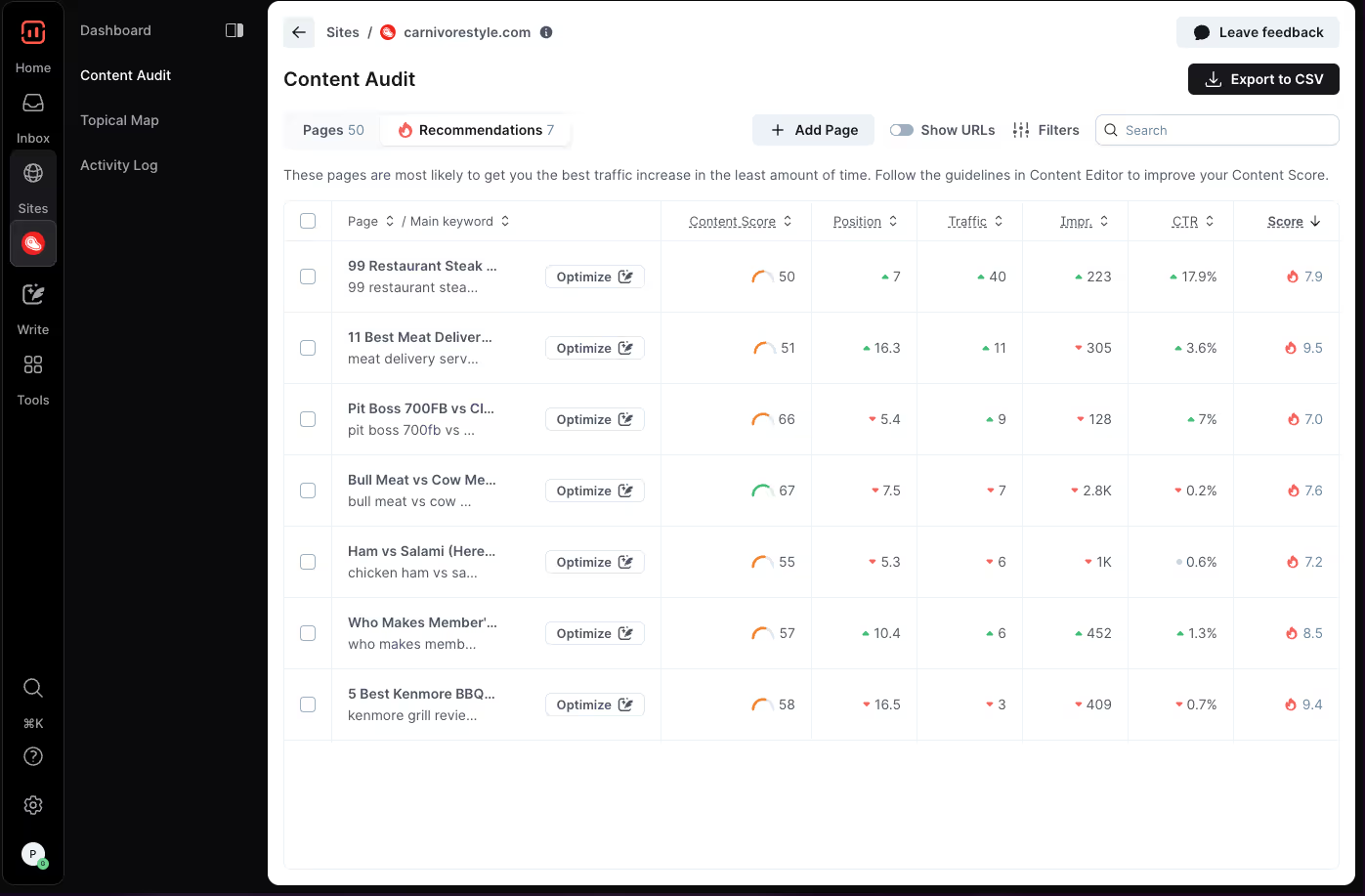
The Audit tool helps refresh your existing content. By simply entering your domain, you can perform a detailed content audit that analyses each page's SEO performance. The tool provides key metrics and identifies which pages have the most potential for a quick traffic boost.
When you connect your Google Search Console, the audit feature gives you a list of "quick win" pages to update first. The tool gives specific recommendations to improve each article's Content Score. Notable suggestions often include:
- Adding missing terms to improve topical relevance
- Identifying opportunities for internal linking
- Improving page structure and keyword usage
Having said that, the Audit tool can sometimes recommend excessive keyword usage, such as adding a term dozens of times when it's already present. It's wise to use these suggestions as a guide and prioritise readability to avoid over-optimising your content.
Also read: Best SEO Audit Tools to Improve Your Website's Performance
4. Topical Map: Identifying Content Gaps and Clusters
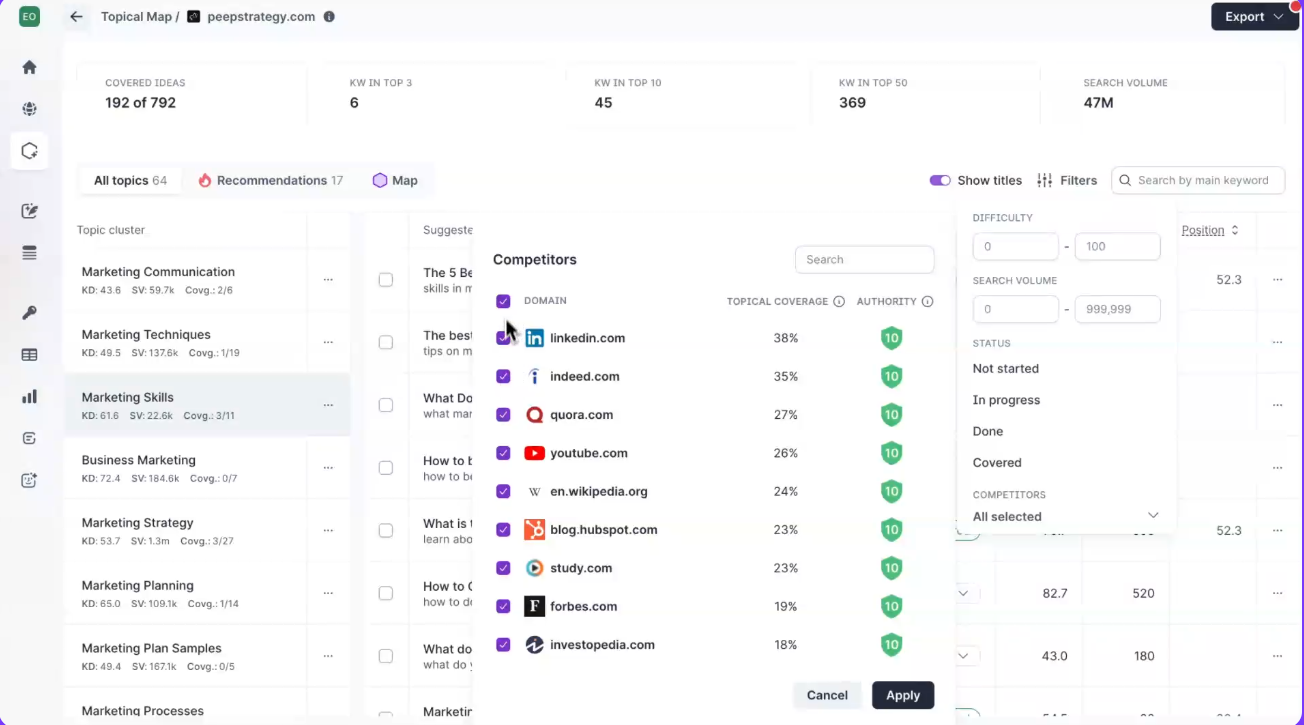
Surfer's Topical Map tool helps you with content planning by identifying content gaps on your site. By connecting your Google Search Console account, the tool analyses your existing content and authority to suggest new topic clusters you have a good chance of ranking for.
It provides strategic recommendations based on your site's performance data. Key benefits of the Topical Map include:
- Identifying topics your site is missing
- Suggesting keywords you can realistically rank for
- Streamlining the content planning process
- Visualises topic clusters to help build strong topical authority
- Compares your topical coverage against competitors to reveal gaps, overlaps, and opportunities
Once you find a topic you want to cover, you can send it directly to the Content Editor or use Surfer AI to generate a draft. It's a nice addition that helps you create an organised content strategy.
Also, read our blog on how to integrate AEO with Traditional SEO Strategies for Maximum Visibility.
5. Keyword Research Tool: Discover New SEO Opportunities
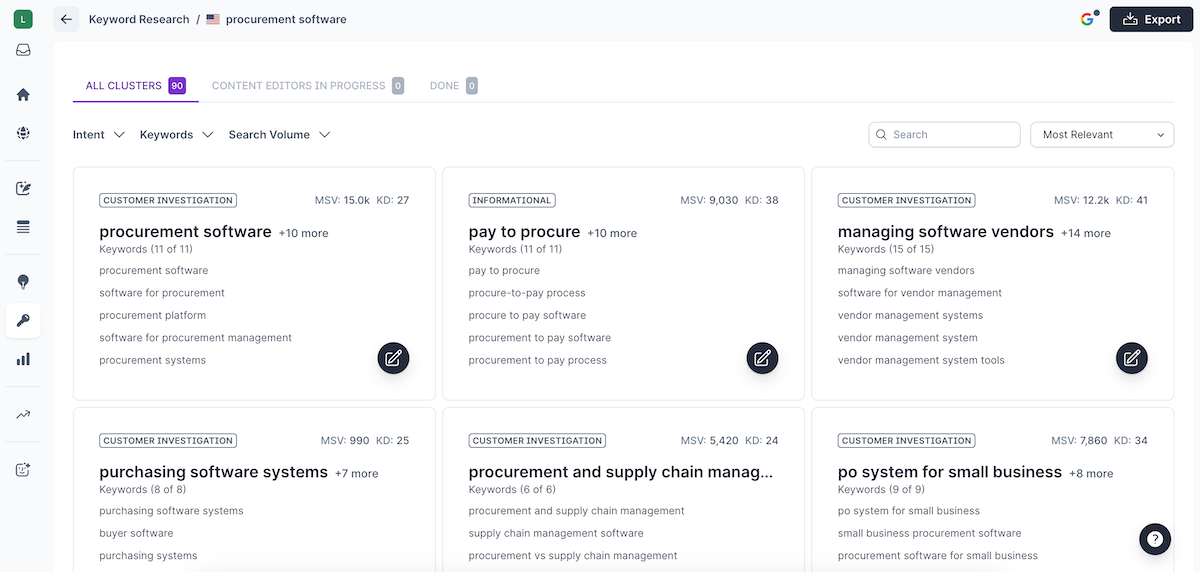
Surfer also includes its own keyword research tool to help you find new SEO opportunities. It functions like many other tools on the market: you enter a seed keyword, and it provides relevant keywords along with key metrics. It's also available as a free Chrome extension for quick lookups.
The tool provides helpful, basic information to guide your keyword ideas. When you perform a search, you'll see:
- Monthly search volume for keyword suggestions
- Keyword difficulty scores
- Search intent for each term
- Automatic grouping of keywords into content clusters
While this feature is helpful for basic research, it's not as comprehensive as dedicated tools like Scalenut, which offer more advanced filters and data points. However, Surfer's keyword research tool is great for getting a quick overview and finding related keywords without leaving the platform.
6. Reporting & Performance Tracking
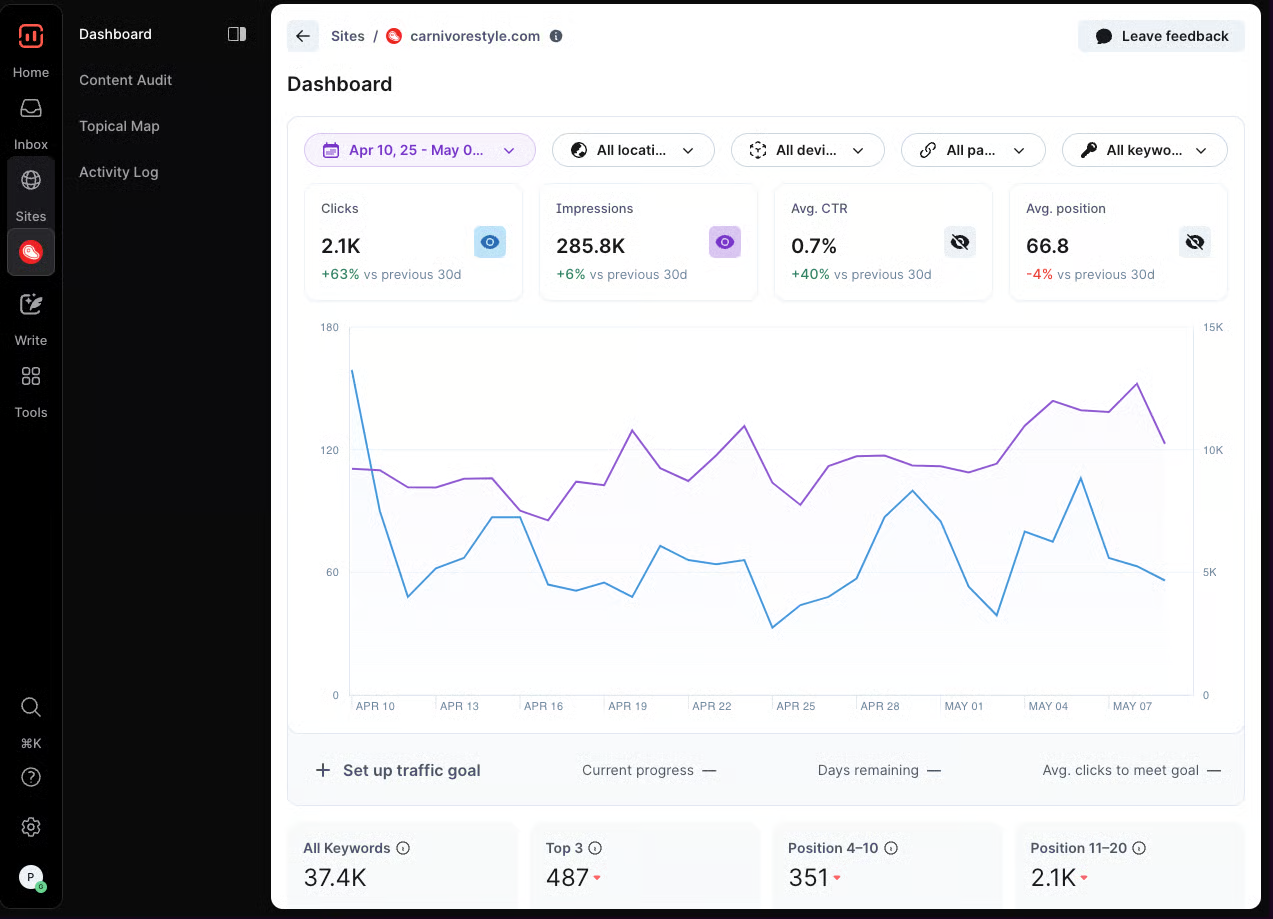
Surfer’s Site Dashboard doubles as a reporting hub, giving you a single place to monitor SEO performance without building manual reports. It tracks keyword rankings, content performance shifts, and visibility changes over time, supported by real-time alerts to flag sudden drops or gains.
- It uncovers new opportunities by continuously analysing performance data from your existing pages, evolving search trends, and emerging AI-driven queries.
- It highlights rising content opportunities, flags coverage gaps, and recommends specific URLs to refresh when pages underperform or become outdated.
- Built on real site data with no manual setup or tagging required
- Delivers weekly performance insights to highlight priority actions
Surfer SEO Pricing: How much does Surfer SEO cost?
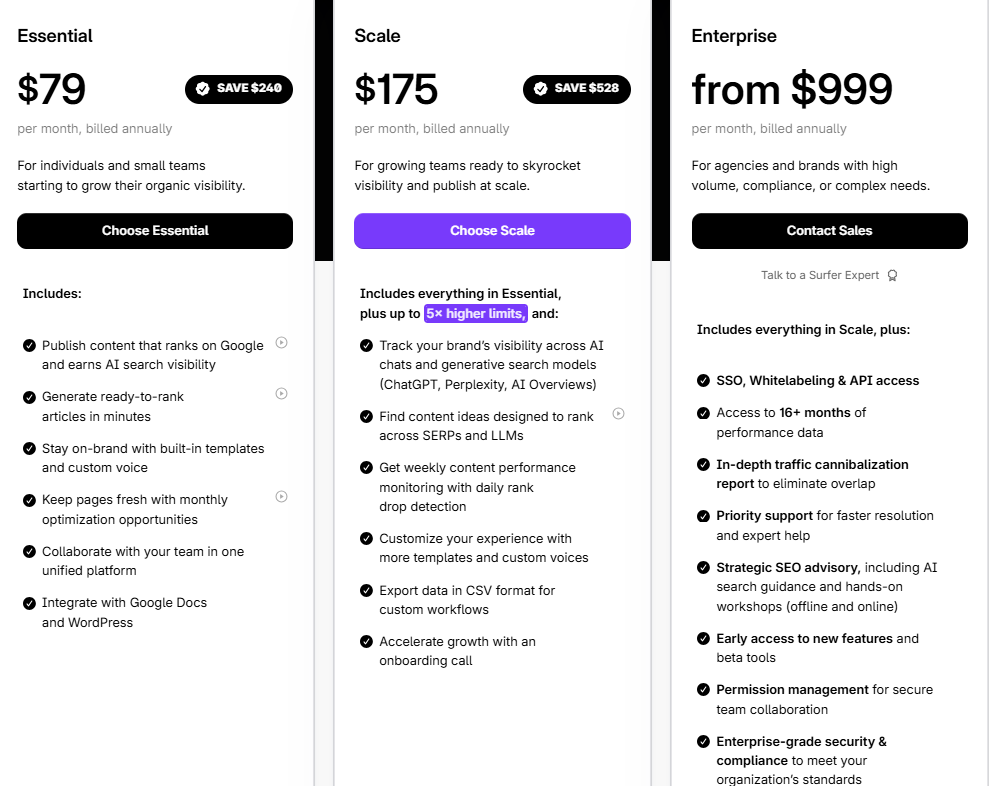
Surfer SEO offers tiered pricing to suit different needs, starting with Essential for individuals, Scale for growing teams with higher limits and AI visibility tracking, and Enterprise for large organisations needing advanced security, reporting, and strategic support.
What Do Actual Users Say About Surfer SEO in Their Reviews?
Across G2 reviews, Surfer SEO is consistently praised for being easy to use, accurate, and well supported. Users highlight its clean interface, strong UX, and gamified scoring system, which makes SEO work feel more engaging rather than mechanical. The Content Analyser is also considered accessible, enabling users to optimise content quickly without deep technical knowledge.
"...Content Editor refreshes itself every now and then, which disturbs me when I have Optimised and Partially Optimised keywords turned off..." says Bartosiewicz D., Content Specialist.
However, the limitations become clearer when viewed critically. Several users note that content writer credits are limited, with no straightforward way to scale usage as needs grow. Pricing is another recurring concern, particularly for freelancers and smaller teams, where the cost can feel disproportionate to output.
What are the pros and cons of using Surfer SEO?
Pros
- Easy-to-use interface that works well for both beginners and experienced SEO teams
- Data-driven insights that are genuinely useful for content optimisation
- Strong Content Editor that guides writing toward organic ranking potential
- Surfer AI helps generate solid first drafts and speeds up content creation
- Improves overall content quality while reducing manual SEO effort
Cons
- SERP Analyser can feel overwhelming for users looking for clear, actionable takeaways
- Keyword research features are pretty basic and limited for an advanced SEO strategy.
- Pricing can add up quickly when add-ons or extra credits are required
- Monthly credit limits may restrict scalability for high-output teams
Also, read about the top AEO Agencies that Can Boost Your AI Visibility.
Scalenut: Best Surfer SEO Alternative
Scalenut is a better fit for teams that prioritise execution over just optimisation guidance. While Surfer SEO focuses on refining content against SERP benchmarks, Scalenut takes a broader approach, covering the entire content lifecycle from keyword discovery and topic planning to writing, optimisation, and ongoing performance tracking all in one platform. One of its significant advantages is workflow efficiency, as it reduces tool switching by integrating keyword clustering, long-form content creation, optimisation, internal linking, and GEO/SEO audits into a structured system.
Additionally, Scalenut scales better for content-heavy teams, with built-in GEO capabilities that help teams optimise content for AI-driven discovery, not just rankings. This makes it easier for writers and marketers to publish consistently and improve long-term visibility compared to Surfer SEO.
My Verdict: Surfer SEO vs Scalenut for GEO
Surfer SEO is strong at SERP-based optimisation, helping refine content against ranking benchmarks, but it essentially stops there, offering only guidance.
Scalenut goes further by enabling GEO tracking with end-to-end execution, turning research and insights into content you can create, optimise, and publish at scale.
If your goal is practical Generative Engine Optimisation, not just ranking better but improving AI-driven visibility, Scalenut is the more suitable choice.
Why Scalenut Stands Out
- End-to-end GEO execution by unifying research, content creation, and optimisation in one workflow
- Reduced tool reliance, with no need for extra platforms or specialised technical expertise
- Faster adaptation to AI search changes through quick content updates and iteration.
- Practical pricing suited for growing teams, not just enterprise budgets
- Built for continuous optimisation rather than one-time visibility tracking
Key Features That Make It a Strong Choice
- GEO Watchtower to compare AI brand mentions against competitors
- Cruise Mode for rapid long-form GEO/SEO content creation
- Keyword Planner and Clusters to uncover trends and content gaps
- Content Optimiser with real-time SEO recommendations
- Content Audit to identify pages needing updates or pruning
- Traffic Analyser to track performance and keyword wins
- Link Manager for automated internal linking
- Social UpReach to monitor Reddit trends and opportunities
In summary, Scalenut offers a more complete, execution-focused alternative to Surfer SEO, especially for teams aiming to scale content efficiently. Its built-in GEO capabilities, streamlined workflows, and practical pricing make it a stronger choice for improving both search and AI-driven visibility over time.
Book a free demo and give Scalenut a try!
Frequently Asked Questions
Is Surfer SEO worth the price compared to other SEO tools?
Surfer SEO may feel expensive for small teams or solo marketers, especially given its narrow focus on on-page optimisation. In comparison, Scalenut is often a better fit, offering broader SEO and GEO capabilities at a more accessible price point.
Is a Surfer SEO free trial available before subscribing?
Surfer SEO doesn't offer a traditional free trial. Instead, its pricing plans include a 7-day money-back guarantee, letting you test all features risk-free before committing, ideal for small businesses on a budget.
Are there any good alternatives to Surfer SEO for content optimization?
Top alternatives to Surfer SEO include Scalenut, which offers complete GEO and SEO capabilities. Also, tools like Clearscope, SE Ranking, and Frase offer content optimisation, keyword research, and competitor analysis. Choose the tool that fits your budget and workflow needs.
Which is better for SEO, Surfer SEO or SEMrush?
When choosing between Surfer SEO and SEMrush, consider your needs. Surfer specialises in on-page optimisation with its content editor, while SEMrush provides extensive analytics and keyword research. Choose Surfer for content creation, or SEMrush for broader SEO strategies.
How does Surfer SEO compare to other popular SEO tools in 2026?
Surfer SEO performs well as an on-page optimisation tool, offering real-time SERP-driven content guidance. However, compared to full-stack SEO platforms or GEO-focused tools like Scalenut, it is more limited in execution, scalability, and AI search visibility workflows in 2026.
Is Surfer an effective writing assistance SEO tool?
Surfer SEO is a popular writing tool that helps users optimise content with data-driven insights. It improves keyword integration, readability, and overall SEO performance. Many users see higher search rankings after using its features.
How does Surfer SEO's Content Editor improve content?
Surfer SEO's Content Editor provides real-time content scoring, keyword recommendations, and structural guidance based on top-ranking pages. This helps writers optimise as they write, with a score above 75 generally indicating strong on-page alignment.
What are the limitations of Surfer SEO's Keyword Research tool?
Surfer SEO's keyword research is relatively basic and less precise than dedicated tools like Ahrefs. It works best as a supporting feature rather than a primary research solution, especially for a deeper keyword strategy.
Is there a cheaper alternative to Surfer SEO with similar features?
Yes. Scalenut is a cheaper alternative that offers on-page optimisation and broader GEO and SEO features, such as keyword clustering, content creation, audits, and AI visibility tracking, making it more cost-effective for small teams.
Has Surfer SEO added any new features recently?
Yes. Surfer SEO has introduced updates like improved AI-assisted writing, enhanced content scoring, and workflow refinements aimed at reducing writer’s block and speeding up optimisation. However, these updates remain focused on content optimisation rather than broader SEO or AI search workflows.
Who Should Use Surfer SEO?
Surfer SEO is best for writers and teams focused mainly on on-page content optimisation. Teams needing end-to-end GEO and SEO optimisation with content execution will find Scalenut a more complete solution.
How to Use Surfer SEO?
Surfer SEO is used by analysing SERPs, following keyword and structure recommendations, and optimising content accordingly. However, tools like Scalenut simplify this by combining research, writing, optimisation, and tracking in one workflow.
Who Are the Best Surfer SEO Competitors?
Top Surfer SEO competitors include Scalenut, Clearscope, Frase, and SE Ranking. Among these, Scalenut stands out for combining SEO, GEO, AI visibility tracking, and content execution at a lower price point.
Is Surfer SEO Good?
Surfer SEO is good for on-page optimisation, but its scope is limited. For teams wanting broader SEO coverage, AI search readiness, and better value, Scalenut is often the stronger and more future-ready choice.


.svg)


.webp)