.jpg)
Which Is The Best AI Visibility Platform For Your Brand?
Key Highlights
- Traditional SEO tools are no longer enough; AI visibility tracking is now essential for brand success as search evolves.
- Key features to look for in a platform include visibility tracking across AI engines like Google AI, citation tracking, and share of voice reporting.
- Effective platforms monitor brand mentions in AI responses and provide actionable insights to improve your content strategy.
- When choosing a tool, consider your goals, team structure, budget, and the need for in-depth analysis over simple dashboards.
- The right tool helps you understand how AI systems perceive your brand, giving you a competitive advantage in the new search landscape.
The way people use Google Search is changing. Instead of just clicking on blue links, they're getting answers directly from AI. This shift means that traditional SEO isn't telling the whole story anymore. If your brand isn't appearing in these AI-generated responses, you're becoming invisible to a growing part of your audience. This is where an AI visibility platform comes in. For SEO teams, these tools are becoming crucial for tracking and improving how a brand shows up where buying decisions are now being made.
Why Choose AI Search Visibility Monitoring Tools?
AI search visibility monitoring tools help you understand how your brand appears in AI-generated answers across platforms like ChatGPT, Perplexity, and Gemini. Instead of relying only on traditional rankings, they show where your brand is mentioned, which pages get cited, how competitors are positioned, and where visibility gaps exist.
This makes it easier to turn AI visibility data into action. Teams can identify missed opportunities, improve content that influences AI answers, strengthen brand authority, and track whether their SEO and GEO efforts are actually increasing visibility where modern discovery is happening.
What Features Matter Most In An AI Visibility Platform?
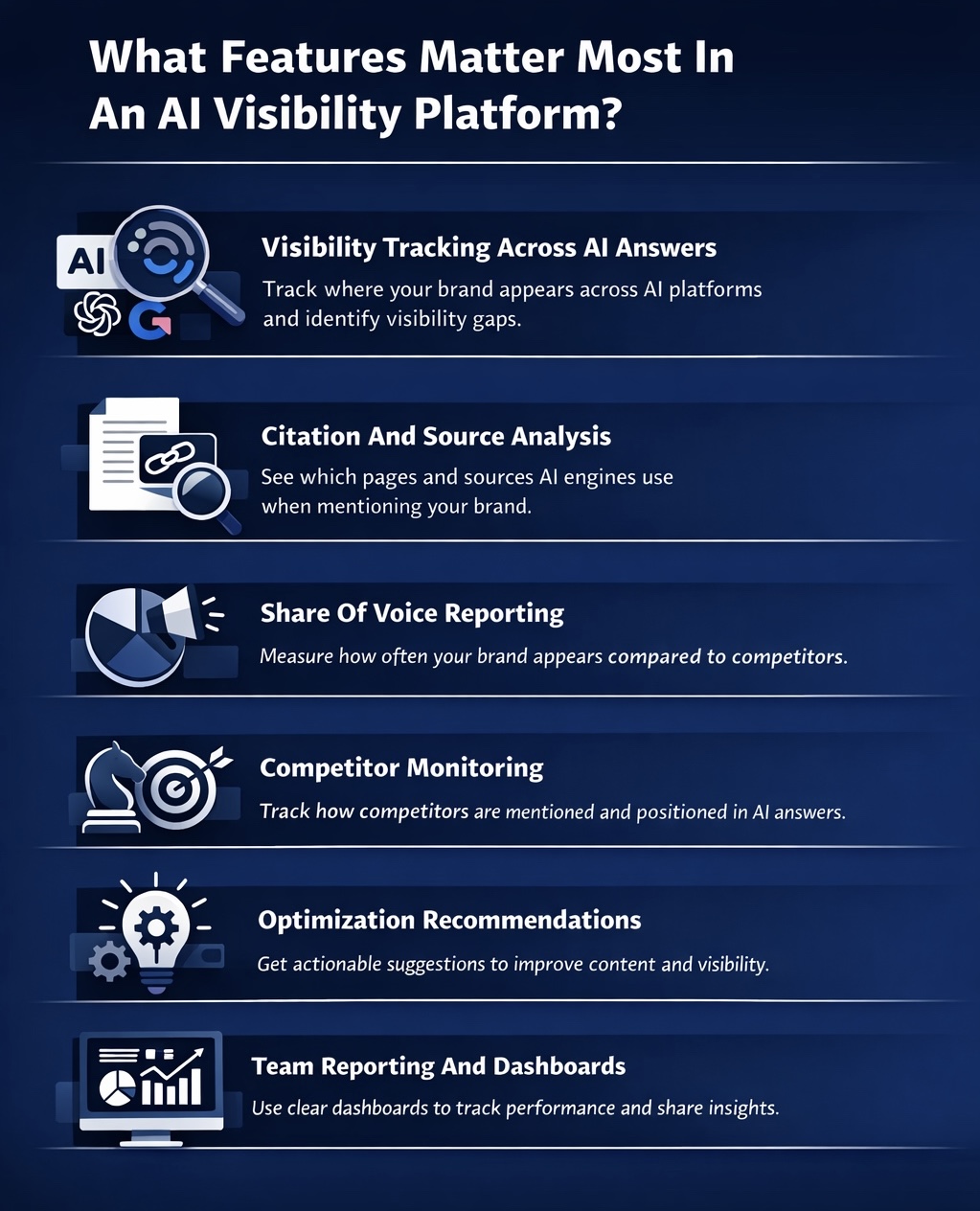
When selecting an AI visibility platform, prioritize features that offer a real competitive edge. Choose platforms with broad coverage of major AI engines and actionable insights, and not just raw data. Essential features include tracking brand mentions in AI responses, share of voice metrics, and sentiment analysis. These tools help SEO teams go beyond keyword rankings and create strategies for generative search based on clear, actionable AI visibility data.
Let’s explore the most important features in more detail.
1. Visibility Tracking Across AI Answers
The most fundamental feature of any AI visibility platform is its ability to track your presence across various AI engines. You need to know if your brand is appearing in responses from answer engines like Google Gemini, ChatGPT, and Perplexity. Without this, you have significant blind spots in your marketing efforts.
So, how do AI visibility tracking tools help monitor brand performance in search results? They run queries on these platforms and record how often, and in what context, your brand is mentioned. This visibility data is crucial because it shows you whether your generative engine optimization (GEO) efforts are paying off.
Ultimately, these tools give you a clear picture of your brand’s visibility where it matters most today. Instead of guessing, you get concrete data on how AI responses represent you, allowing you to identify gaps and opportunities to improve your presence.
2. Citation And Source Analysis
One of the main benefits of using the best AI search visibility tools is the ability to perform citation and source analysis. AI engines like Google AI don't just create answers out of thin air; they pull information from various online sources. Citation tracking helps you see which of your URLs and content pieces are being used as references.
This feature is incredibly valuable for content optimization. When you know which pages AI engines trust, you can analyze what makes that content authoritative and apply those lessons across your site. It helps you build brand authority by ensuring your best content is discoverable and citable.
Monitoring both linked and unlinked brand mentions gives you a complete view of your AI visibility metrics. It reveals which domains are influencing AI answers about your brand, guiding your strategy to become a go-to source in your industry.
3. Share Of Voice Reporting
Understanding your share of voice (SOV) in the AI landscape is critical for gaining a competitive advantage. This metric shows you what percentage of relevant AI responses mention your brand compared to your competitors. It's a direct way to measure your market share within the AI search ecosystem.
Visibility platforms calculate SOV by tracking brand mentions across thousands of prompts and queries. For SEO teams, this data is gold. It answers key questions like:
- How often does my brand appear compared to my top three competitors?
- In which topics or query types are my competitors stronger?
- Are there unbranded queries where my competitors are cited but I'm not?
By analyzing how different AI models talk about you versus others, you can refine your messaging and content strategy. Share of voice reporting moves you from simply tracking mentions to strategically positioning your brand to dominate conversations.
4. Competitor Monitoring
While traditional SEO tools offer competitor analysis based on SEO metrics, AI visibility requires a different approach. Competitor monitoring in this new context involves tracking how AI positions your rivals in relation to your own brand, often within the same AI-generated answer.
What features should I look for when choosing the best AI search monitoring platforms for this? You need a tool that allows for robust competitive benchmarking. This means you can see not just if a competitor is mentioned, but also the context and sentiment of that mention. Is the AI framing them as the market leader, a cheaper alternative, or an innovator?
This AI visibility data provides insights that influence everything from your messaging to your backlink strategy. Seeing how competitors are "gaming" the AI engines gives you a roadmap for your own efforts, helping you understand their share of voice and find opportunities to outperform them.
5. Optimization Recommendations
To maximize success with the best AI visibility optimization tools, focus on actionable insights rather than surface-level metrics. Prioritize meaningful visibility data that contributes to realistic and achievable goals within your content strategy. Implement effective SEO strategies that enhance brand authority and keyword rankings, ensuring that your team understands how to leverage this information. Regularly analyze brand mentions and sentiment analysis to clarify areas for improvement. By integrating these optimization recommendations into your approach, your marketing teams can significantly improve your share of voice and ultimately drive brand growth.
6. Team Reporting And Dashboards
Effective team reporting and dashboards are essential for turning visibility data into a shared strategy. When choosing AI platforms, look for intuitive interfaces that marketing teams and SEO teams can use without a steep learning curve. The goal is to make AI visibility tracking accessible to everyone, not just technical experts.
A good dashboard highlights key metrics at a glance, allowing you to quickly understand performance. What features should I look for when choosing an AI visibility platform in terms of reporting? Customizable reports are crucial for agencies presenting to clients, while internal teams benefit from automated alerts and shareable views.
The best platforms present data in a clean, digestible format. For example, a simple table can quickly summarize platform coverage and performance, helping your team focus on what matters.
What Are The Best AI Visibility Platforms In 2026?
Choosing the right AI visibility platform depends on how much depth, actionability, and workflow support your team needs. Some platforms focus mainly on monitoring, while others combine AI visibility insights with SEO execution and content optimization.
Here are the top AI visibility platforms to consider in 2026, starting with Scalenut.
1. Scalenut
Scalenut is a strong choice for teams that want more than just AI visibility reporting. It combines GEO monitoring with hands-on SEO execution, making it useful for brands that want to track how they appear in AI answers and act on those insights within the same platform.
Unique Scalenut features include:
- AI visibility tracking and brand monitoring with AI brand visibility checkers like Visibility Score, Average Position, Share Of Voice, Visibility Heatmap, and Brand Visibility Rank
- Prompt-level intelligence through Prompt Tracking, Citation Tracking, Competitor Visibility Insights, Query Fanouts, and Sentiment Analysis
- GEO recommendations that turn visibility gaps into actions, including AI-led content ideas, authority suggestions, engagement opportunities, and next-step action paths
- AI traffic visibility with AI Bot Tracking, Cloudflare integration, Top AI Sources, Most Referenced Pages, and AI Traffic Trends
- SEO and content execution tools such as Cruise Mode, Content Optimizer, AI Humanizer, and Content Scoring
- Research and planning features including Keyword Planner, Competitor Coverage Analysis, Traffic Analyzer, and Content Audit
- Technical SEO and linking support through Link Manager, On-Page Pro, and Backlinks Marketplace
Choose This Platform If
Choose Scalenut if you want AI visibility insights plus built-in SEO and content workflows that help your team move from monitoring to execution faster.
Do Not Choose This Platform If
Do not choose Scalenut if you only want a lightweight visibility tracker and do not need broader SEO, content, or optimization capabilities.
Book a demo to see how Scalenut helps you track AI visibility and turn insights into action.
2. Profound
Profound is designed for brands that want a more enterprise-focused approach to AI visibility. It tracks how brands appear across major AI search and answer platforms and leans heavily into strategic monitoring, structured reporting, and deeper visibility analysis. Compared with lighter tools, its positioning is better suited to larger teams that want broader oversight and more advanced optimization support.
Choose This Platform If
Choose Profound if you want enterprise-grade AI visibility tracking, deeper reporting, and a platform built for strategic monitoring across multiple AI environments.
Do Not Choose This Platform If
Do not choose Profound if you want a simpler self-serve tool for lightweight tracking and quicker setup.
3. Peec AI
Peec AI is a focused AI search analytics platform built for marketing teams. It centers on tracking and improving brand performance across AI search platforms through metrics like visibility, position, and sentiment, while also offering prompt-level views and reporting workflows. Its overall positioning feels clean and operational, making it a strong fit for teams that want dedicated AI search analytics without a heavier enterprise layer.
Choose This Platform If
Choose Peec AI if you want a clean, data-driven platform for prompt tracking, brand visibility monitoring, and AI search reporting.
Do Not Choose This Platform If
Do not choose Peec AI if you need a broader platform with built-in SEO execution or a more enterprise-style workflow.
4. Scrunch AI
Scrunch AI positions itself as more than a basic visibility tracker. Along with AI search monitoring, it includes features such as prompt management, citation tracking, page audits, agent traffic monitoring, and persona-based workflows. This makes it a better fit for brands that want AI visibility insights paired with more structured optimization and experience-focused workflows.
Choose This Platform If
Choose Scrunch AI if you want AI visibility monitoring combined with page audits, agent-focused workflows, and a stronger optimization layer.
Do Not Choose This Platform If
Do not choose Scrunch AI if you want a lower-cost tool or only need simple mention and citation tracking.
5. Otterly.AI
Otterly.AI is a straightforward AI search monitoring platform built for tracking brand mentions, website citations, and prompt visibility across major AI tools. Its feature set is easier to understand and more accessible than some enterprise-focused platforms, which makes it a good option for teams that want practical monitoring without too much complexity.
Choose This Platform If
Choose Otterly.AI if you want a simple and accessible platform for prompt monitoring, citation tracking, and competitor visibility analysis.
Do Not Choose This Platform If
Do not choose Otterly.AI if you need deeper enterprise reporting, advanced strategic analysis, or broader workflow support.
6. Waikay
Waikay focuses on how AI models understand and represent your brand, not just whether your brand appears in answers. It highlights features like prompt tracking, brand visibility monitoring, competitor comparisons, knowledge-gap detection, and action-focused reports. This gives it a slightly different angle from tools that focus mainly on raw tracking metrics.
Choose This Platform If
Choose Waikay if you want affordable AI visibility tracking with stronger emphasis on brand perception, knowledge gaps, and actionable recommendations.
Do Not Choose This Platform If
Do not choose Waikay if you want a more mature enterprise platform with heavier reporting layers and broader market adoption.
7. AthenaHQ
AthenaHQ is built for brands that want an AI visibility platform with a stronger GEO focus. It centers on tracking brand presence across major AI search environments, identifying content gaps, monitoring competitors, and turning those insights into optimization actions. Its positioning is best suited to teams that want AI visibility data tied closely to content and authority improvements.
Choose This Platform If
Choose AthenaHQ if you want AI visibility tracking with a stronger focus on GEO workflows, content gap analysis, and actionable optimization guidance.
Do Not Choose This Platform If
Do not choose AthenaHQ if you want a simpler monitoring tool or a platform centered more on lightweight tracking than structured optimization workflows.
8. Brand Radar
Ahrefs Brand Radar extends Ahrefs into AI visibility tracking by helping brands monitor how they appear across AI-generated answers. It combines AI brand visibility insights with competitor benchmarking, topic and prompt analysis, and the broader Ahrefs SEO ecosystem. That makes it a strong fit for teams that already value Ahrefs and want AI visibility tracked alongside traditional SEO data.
Choose This Platform If
Choose Ahrefs Brand Radar if you want AI visibility insights inside a broader SEO platform and value strong benchmarking and topic-level analysis.
Do Not Choose This Platform If
Do not choose Ahrefs Brand Radar if you want a standalone AI visibility platform with a more specialized GEO workflow outside a broader SEO suite.
9. Semrush AI Visibility Toolkit
Semrush AI Visibility Toolkit is designed for brands that want to track how they appear across AI search platforms while staying inside the Semrush ecosystem. It focuses on brand mentions, citations, prompt-level visibility, competitive comparisons, and AI visibility scoring, then connects those insights with the platform’s wider SEO and marketing workflows. Its positioning is strongest for teams that want AI visibility tracking integrated with a full digital marketing stack.
Choose This Platform If
Choose Semrush AI Visibility Toolkit if you want AI visibility tracking combined with a broader SEO and marketing platform.
Do Not Choose This Platform If
Do not choose Semrush AI Visibility Toolkit if you want a narrower standalone AI visibility tool without the added weight of a larger marketing suite.
10. SE Ranking AI Visibility
SE Ranking AI Visibility brings AI visibility tracking into a more traditional SEO workflow. It is positioned for teams that want to monitor brand presence in AI-generated search experiences while also using familiar SEO tools like rank tracking, site audits, and competitive analysis. Compared with more AI-native platforms, its appeal is in giving SEO teams a more familiar environment for adding AI visibility to their existing process.
Choose This Platform If
Choose SE Ranking AI Visibility if you want AI visibility tracking embedded inside an SEO-first platform and workflow.
Do Not Choose This Platform If
Do not choose SE Ranking AI Visibility if you want a more AI-native platform built primarily around deep GEO monitoring and specialized answer-engine workflows.
How Do You Choose The Right AI Visibility Platform?
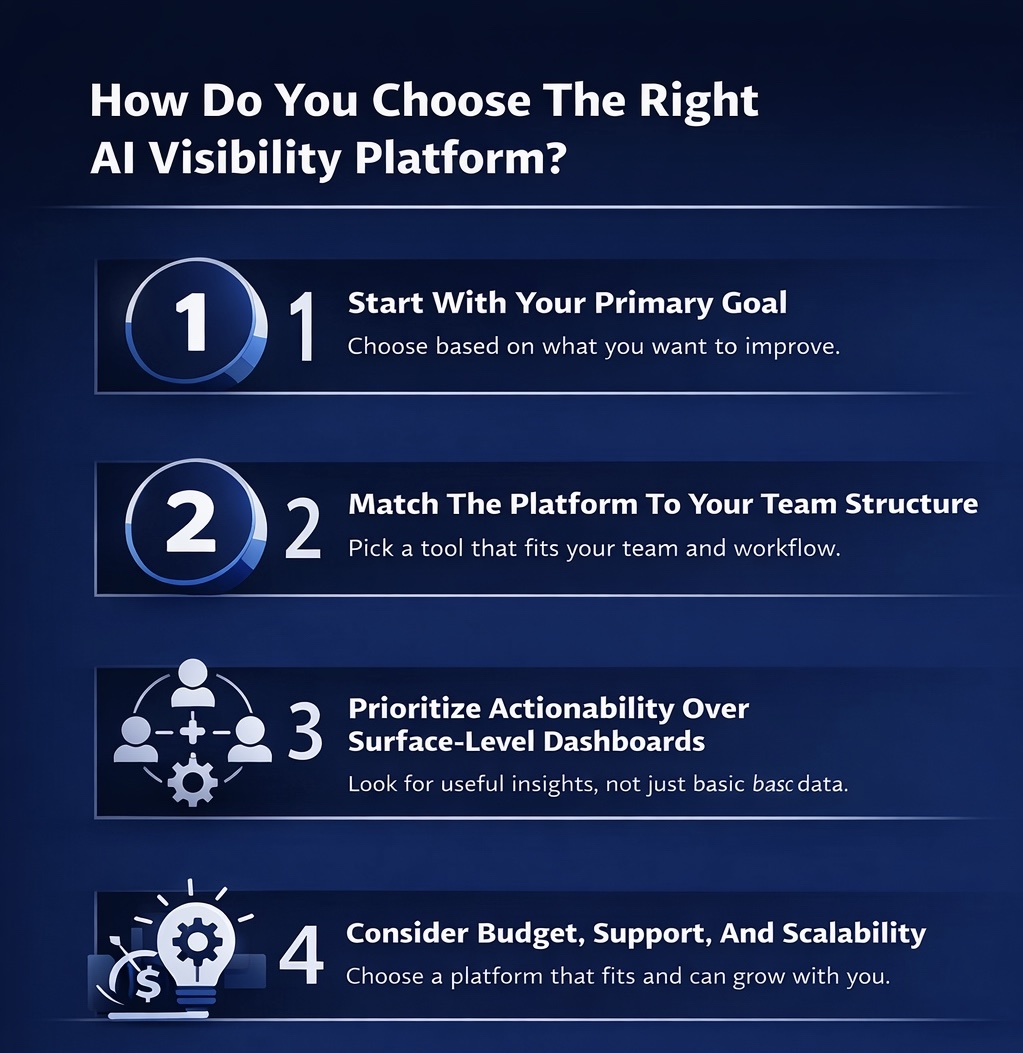
An AI visibility platform tracks your brand’s presence in answers from AI search tools like Google Gemini. To choose the best option for your needsconsider your goals, team requirements, budget, and how much detail you need. Decide if you want advanced competitive benchmarking or simple mention tracking. Also, weigh factors like coverage, ease of use, and the availability of a free trial. The right platform will deliver clear AI visibility data to help grow your brand authority.
Let’s look at the best tips for choosing AI search visibility tools:
1. Start With Your Primary Goal
Establishing a clear primary goal is the cornerstone of effective implementation within an AI visibility platform. Understanding what your brand seeks to achieve, whether it's enhancing brand authority, improving keyword rankings, or increasing share of voice, sets the direction for your strategies. Each goal informs the choice of metrics and the optimization techniques you’ll employ, ensuring your efforts resonate with target audiences. This clarity enables teams to leverage actionable insights and shape content strategies that align with broader business objectives, thus driving meaningful engagement across multiple touchpoints.
2. Match The Platform To Your Team Structure
Selecting an AI visibility platform that aligns with your team structure can significantly enhance collaboration and performance. For instance, smaller teams may benefit from user-friendly interfaces and streamlined functionalities, while larger organizations might require more advanced features to support diverse workflows. Understanding the roles within your SEO and marketing teams can guide the choice of tools, ensuring accessibility and efficiency. By matching the platform to your team dynamics, you'll maximize its potential, driving better results in brand visibility and content optimization efforts.
3. Prioritize Actionability Over Surface-Level Dashboards
Focusing on actionable insights can significantly enhance your team's effectiveness. Surface-level dashboards often provide a broad overview, but they can mask crucial details that drive performance. By prioritizing tools that emphasize visibility data, you can facilitate informed decision-making based on sentiment analysis and competitive benchmarking. Look for an AI visibility platform that offers deep dives into metrics like share of voice and brand mentions. This level of granularity allows your marketing and content teams to adapt strategies swiftly and proactively, ensuring your brand maintains a competitive advantage.
4. Consider Budget, Support, And Scalability
Evaluating budget, support, and scalability aspects is crucial when selecting an AI visibility platform. Determine how much you’re willing to invest while considering the long-term value it brings to your brand. Look for platforms that offer robust customer support and understandable tutorials to help your team navigate any learning curve associated with the new technology. Scalability is also vital; choose a solution that can grow with your brand’s evolving needs, ensuring that it can handle increased visibility tracking and data requirements without overwhelming your marketing teams.
Conclusion
In summary, selecting the best AI visibility platform for your brand is crucial for maximizing your digital presence and staying ahead of the competition. By understanding key features such as visibility tracking, citation analysis, and competitor monitoring, you can make a more informed decision. Remember to align your choice with your primary goals, team structure, and budget considerations.
The right platform will provide actionable insights that empower your team and enhance your brand’s visibility in an increasingly competitive landscape. If you’re ready to elevate your brand's visibility, let’s connect for a free demo to explore how the right AI visibility solution can make a difference!
Frequently Asked Questions
How do AI visibility tracking tools help monitor brand performance in search results?
AI visibility tracking tools monitor how often your brand appears in AI-generated answers, which prompts trigger mentions, which pages get cited, and how you compare with competitors. This helps teams measure visibility beyond traditional rankings and identify content or authority gaps.
What features should I look for when choosing an AI visibility platform?
Look for platform coverage across major AI systems, prompt tracking, citation analysis, share of voice reporting, competitor benchmarking, and actionable recommendations. The strongest AI tools for brand visibility also connect visibility data to broader SEO workflows so teams can improve performance instead of only monitoring it.
How do I compare different AI visibility providers for my business needs?
Compare providers based on your goals, team workflow, reporting depth, AI platform coverage, and whether you need monitoring alone or built-in optimization support. Also check how well each AI visibility tool fits your existing SEO stack, budget, and level of required analysis.
What are the best AI search visibility tools available in 2026?
Top AI visibility platforms in 2026 include Scalenut, Ahrefs Brand Radar, Semrush AI Visibility Toolkit, Profound, Peec AI, Scrunch AI, Otterly.AI, Waikay, AthenaHQ, and SE Ranking AI Visibility. The best choice depends on whether you need enterprise depth, affordability, or SEO workflow integration.
What are the main benefits of using an AI-powered search visibility tool?
The main benefits are clearer visibility into brand mentions, citation sources, competitor presence, and prompt-level performance across AI search platforms. These tools also help teams spot missed opportunities, track share of voice, and prioritize content actions that can strengthen AI search visibility.


.svg)


.webp)