.jpg)
Which Best AI Tools For SEO And AEO Are Worth It In 2026?
Key Highlights
- The best AI tools for SEO and AEO help teams improve visibility across Google, AI Overviews, ChatGPT, Perplexity, and other answer engines.
- Scalenut is the strongest overall choice for teams that want AI visibility tracking, SEO planning, content execution, and optimization in one platform.
- Writesonic is a good fit for teams that need AI content creation along with visibility tracking across AI search platforms.
- Goodie and Otterly AI are better suited for brands focused mainly on AI search monitoring, prompt tracking, citations, and competitor visibility.
- Surfer SEO and Clearscope work best for teams that want stronger on-page optimization, content scoring, and editorial quality.
- MarketMuse is useful for strategic planning, topical authority, content inventory, and identifying competitive content gaps.
- Frase is a strong option for answer-first SEO and GEO content, especially FAQs, comparison pages, and question-led content.
- Rankability is best suited for agencies that need SEO and AEO workflows, AI mentions, AI citations, and client reporting.
You may have strong SEO content and decent Google rankings, but your brand still might not appear when buyers ask ChatGPT, Perplexity, Gemini, or AI Overviews for recommendations. That is where traditional SEO data starts to feel incomplete.
The challenge is that most tools solve only one part of the problem. Some help you write faster, some optimize pages, and some track AI mentions, but not every platform connects SEO execution with AEO visibility.
This guide compares the best AI tools for SEO and AEO by features, pricing, ratings, pros, cons, and best-fit use cases, so you can choose the right tool for your workflow.
What Should You Look For In An AI Tool For SEO And AEO?
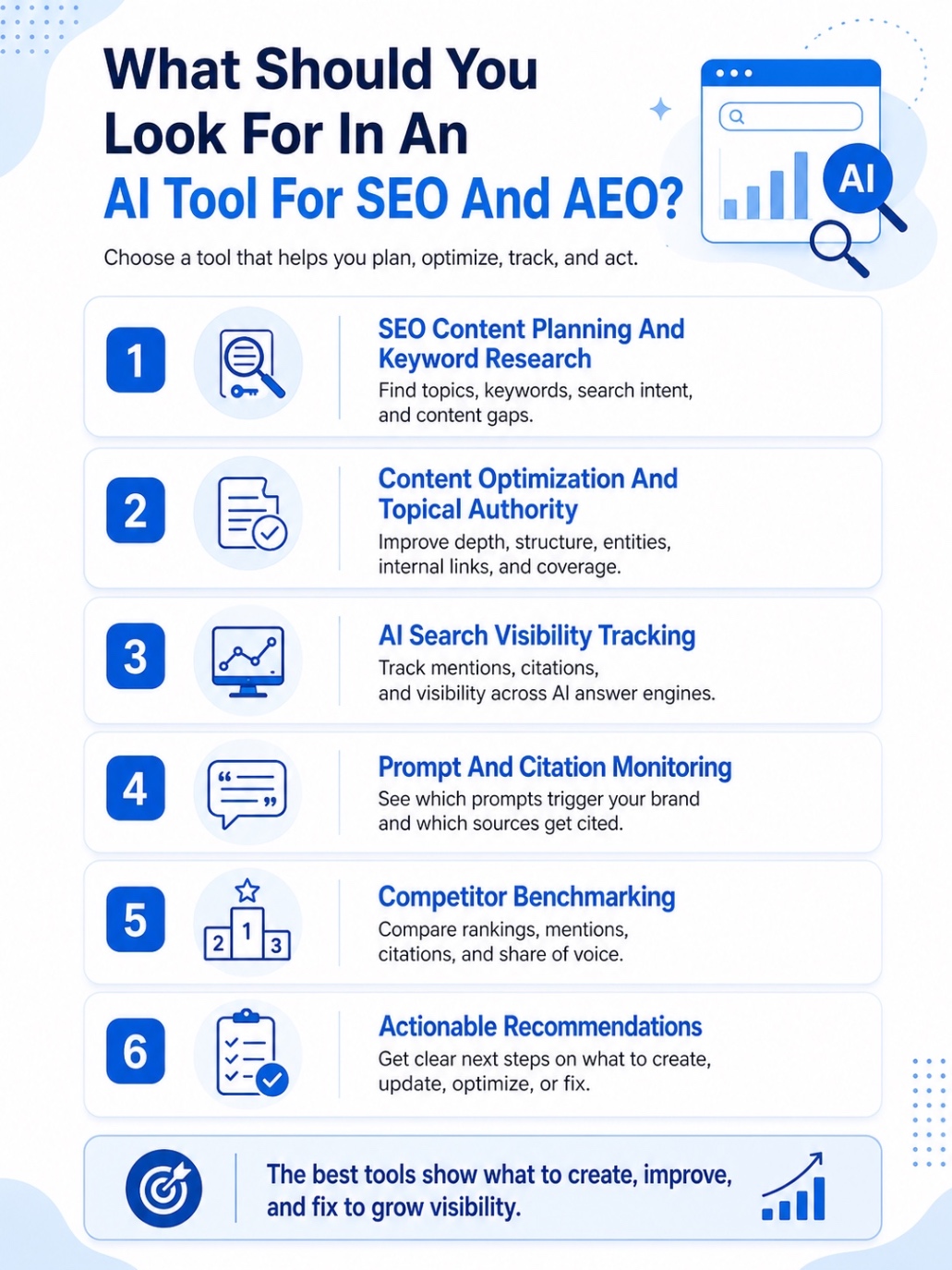
The right AI SEO and AEO tool should help you find growth opportunities, optimize content, track AI visibility, and turn insights into action.
Here are the key features to look for before choosing the best AI tools for SEO and AEO.
1. SEO Content Planning And Keyword Research
A strong tool should help you identify topics, keywords, search intent, and content gaps before you create content. This helps you target the questions, problems, and comparison queries your audience is already searching for.
Look for keyword discovery, topic clustering, SERP analysis, question research, and content gap features.
2. Content Optimization And Topical Authority
The platform should help improve content depth, structure, entity coverage, internal links, and topical relevance. This matters because both search engines and AI answer engines need clear, well-organized content to understand and surface your brand.
Look for content scoring, heading suggestions, entity recommendations, internal linking, briefs, and topical gap analysis.
3. AI Search Visibility Tracking
AEO tools should show how your brand appears across ChatGPT, Perplexity, Gemini, Google AI Overviews, and other answer engines. Traditional rank tracking only shows search performance, while AI visibility tracking shows whether your brand is being mentioned, cited, or recommended.
Look for brand mentions, website citations, share of voice, sentiment, and visibility trends across AI platforms.
4. Prompt And Citation Monitoring
Prompt tracking matters because AI users ask full, conversational questions, not just short keywords. A good tool should show which prompts trigger your brand, which competitors appear, and which sources AI platforms cite.
This helps you understand where your brand is visible and where competitors are winning the answer.
5. Competitor Benchmarking
The tool should help you compare your brand against competitors in both SEO and AI search. This is especially important for BOFU queries where AI engines often recommend a shortlist of brands.
Look for competitor tracking across rankings, AI mentions, citations, sentiment, content gaps, and share of voice.
6. Actionable Recommendations
Dashboards are not enough. The best tools should tell you what to create, update, optimize, or fix next.
Look for recommendations around missing topics, weak pages, internal links, citations, entities, content structure, and technical issues.
A good AI SEO and AEO tool should answer three questions clearly: what should you create, what should you improve, and where are competitors gaining visibility?
What Are The Top AI Tools For SEO And Answer Engine Optimization In 2026?
Choosing the right tool depends on what your team needs most: content execution, AI visibility tracking, optimization, topical authority, or client reporting. The best platforms do not just help you create content faster, they help you understand where your brand appears, where competitors are winning, and what to improve next.
Below, we’ll break down the best AI tools for SEO and AEO by features, pros, cons, pricing, ratings, and best-fit use cases.
1. Scalenut
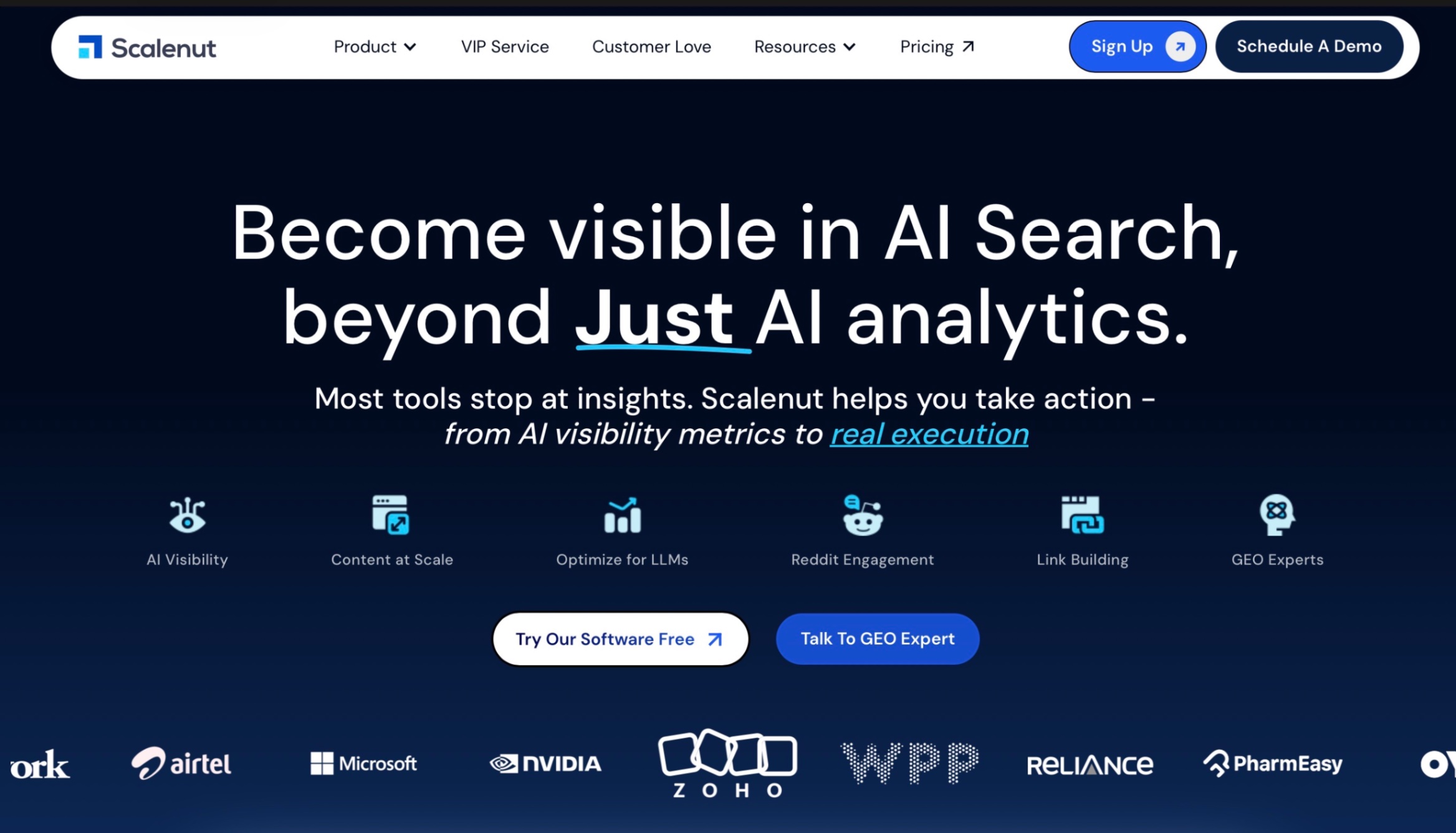
Scalenut is the strongest option for teams that want AI visibility tracking and SEO content execution in one platform.
Best For: Teams that want to track how their brand appears in AI answers, understand where competitors are winning visibility, and turn those insights into content, optimization, linking, and authority-building actions.
What Are The Key Features Of Scalenut?
1. AI Visibility Tracking And Brand Monitoring
Scalenut helps teams monitor how often their brand appears in AI-generated answers and how that visibility compares with competitors.
It tracks key signals like Visibility Score, Average Position, Share of Voice, visibility heatmaps, and Brand Visibility Rank, making it useful for teams that want more than traditional keyword rankings.
2. Prompt-Level Intelligence And Citation Tracking
Scalenut shows which prompts trigger your brand, where your brand appears in AI answers, and which sources AI platforms cite.
This helps teams understand the exact questions where they are visible, missing, or losing ground to competitors.
3. GEO Recommendations That Lead To Execution
Scalenut turns AI visibility gaps into practical next steps. It can surface content ideas, backlink opportunities, platform engagement opportunities, and action paths based on where your brand needs stronger visibility.
This is where Scalenut stands out from tools that only show dashboards.
4. AI Traffic Visibility And Bot Tracking
Scalenut helps teams understand how AI agents interact with their site. With AI bot tracking and Cloudflare integration, it can show top AI sources, most referenced pages, and AI traffic trends.
This helps connect AI visibility with real site activity.
5. SEO Content Creation And Optimization
Scalenut supports the full SEO content workflow through tools like Cruise Mode, Content Optimizer, AI Humanizer, and Content Scoring.
Teams can plan, draft, refine, and optimize content with SERP-informed guidance and GEO signals layered into the workflow.
6. SEO Research, Internal Linking, And Authority Support
Scalenut also includes keyword planning, topic clustering, competitor coverage analysis, traffic analysis, content audits, internal linking support, on-page optimization, and backlink discovery.
This makes it useful for teams that want to improve both content quality and the SEO foundations that support AI visibility.
What Are The Pros Of Scalenut?
- Visibility Plus Execution: Combines AI visibility tracking with content planning, writing, optimization, and linking.
- Strong GEO Workflow: Tracks prompts, citations, competitors, sentiment, and AI answer visibility.
- Actionable Recommendations: Shows what to create, update, optimize, or strengthen next.
- Useful For Content Refreshes: Helps improve older content for both SEO and AI visibility.
- All-In-One Platform: Reduces the need for separate tools for SEO content and AI visibility workflows.
What Are The Cons Of Scalenut?
- More Than A Basic Writing Tool: Teams that only need simple AI writing may not use the full platform.
- Prompt Limits Depend On Plan: Heavier AI visibility tracking may require a higher tier.
What Does Scalenut’s Pricing Look Like?
- Starter starts at $59/month
- Plus starts at $89/month
- Professional starts at $199/month
- VIP Service pricing is custom
How Do Users Rate Scalenut?
G2: 4.7/5
Book a free strategy call today!
2. Writesonic
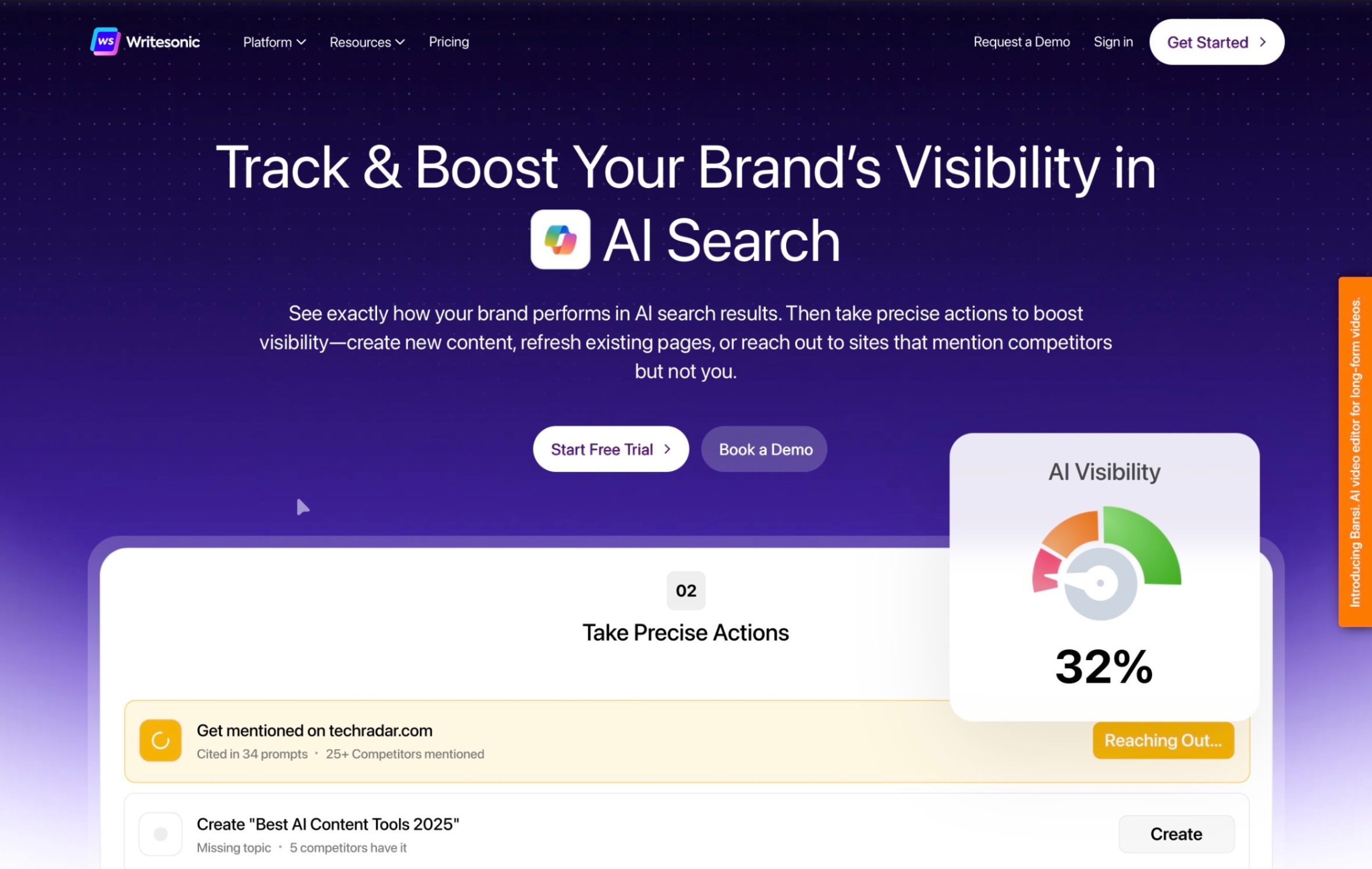
Writesonic is best suited for teams that want AI content creation and AI search visibility tracking in the same workflow.
Best For: Teams producing and refreshing content at scale while also tracking visibility across AI platforms like ChatGPT, Perplexity, Google AI Overviews, Gemini, Claude, Copilot, and Grok.
What Are The Key Features Of Writesonic?
- Content Engine: Helps create and refresh content for SEO rankings and AI search visibility.
- AI Visibility Tracking: Tracks how your brand appears across major AI platforms.
- Citation Gap Insights: Shows where competitors are being cited and where your brand is missing.
- Sentiment And Share Of Voice: Helps you understand how much of the AI conversation your brand owns.
- SEO Content Workflows: Supports keyword research, content strategy, AI article writing, content optimization, and SEO audits.
What Are The Pros Of Writesonic?
- Content Plus Tracking: Good fit if you want content creation and AI visibility tracking in one tool.
- Useful For Scaling Content: Works well for teams publishing or refreshing a lot of SEO content.
- Broad AI Platform Coverage: Tracks visibility across several major AI answer engines.
- Action-Oriented Insights: Helps teams find citation gaps and content opportunities.
What Are The Cons Of Writesonic?
- Can Be More Than Some Teams Need: If you only need basic AI writing, the visibility features may feel unnecessary.
- Advanced GEO Features May Require Higher Plans: Deeper tracking, sentiment, and visibility features can vary by plan.
- Still Needs Human Editing: AI-generated content should be reviewed for accuracy, tone, and brand fit.
What Does Writesonic’s Pricing Look Like?
- Starter starts at $99/month
- Basic starts at $249/month
- Growth starts at $499/month
- Enterprise pricing is custom
How Do Users Rate Writesonic?
G2: 4.7/5
Want to understand where AEO ends and GEO begins? Read our guide on AEO vs GEO to see how both impact AI search visibility.
3. Goodie
Goodie is built for brands that want a dedicated answer engine optimization platform, not just another SEO content tool.
Best For: Brands that want to monitor, improve, and attribute AI search visibility across multiple models, markets, and customer journeys.
What Are The Key Features Of Goodie?
- AI Search Visibility: Tracks brand mentions, citations, rankings, sentiment, and competitive positioning.
- Brand Narrative Control: Shows how AI models describe your brand compared to competitors.
- Attribution: Connects AI visibility to traffic, conversions, and revenue.
- Multi-Model Intelligence: Tracks performance across models, geographies, personas, languages, and topic categories.
- Optimization Actions: Helps teams identify gaps and take action through AEO-focused recommendations.
What Are The Pros Of Goodie?
- Purpose-Built For AEO: Strong fit if your priority is AI search visibility, not traditional SEO alone.
- Revenue-Focused Reporting: Useful for teams that need to connect AI visibility with pipeline or conversions.
- Detailed Segmentation: Breaks down visibility by model, geography, persona, language, and topic.
- Strong SaaS And Enterprise Fit: Works well for teams that need deeper AI search measurement and attribution.
What Are The Cons Of Goodie?
- Pricing Is Demo-Based: Plan details are available, but pricing is not publicly listed.
- Not A Traditional SEO Suite: Better for AEO visibility and attribution than classic keyword or backlink workflows.
What Does Goodie’s Pricing Look Like?
- Explorer pricing is demo-based
- Pro pricing is demo-based
- Enterprise pricing is demo-based
How Do Users Rate Goodie?
G2: No Public Rating Yet
4. Surfer SEO
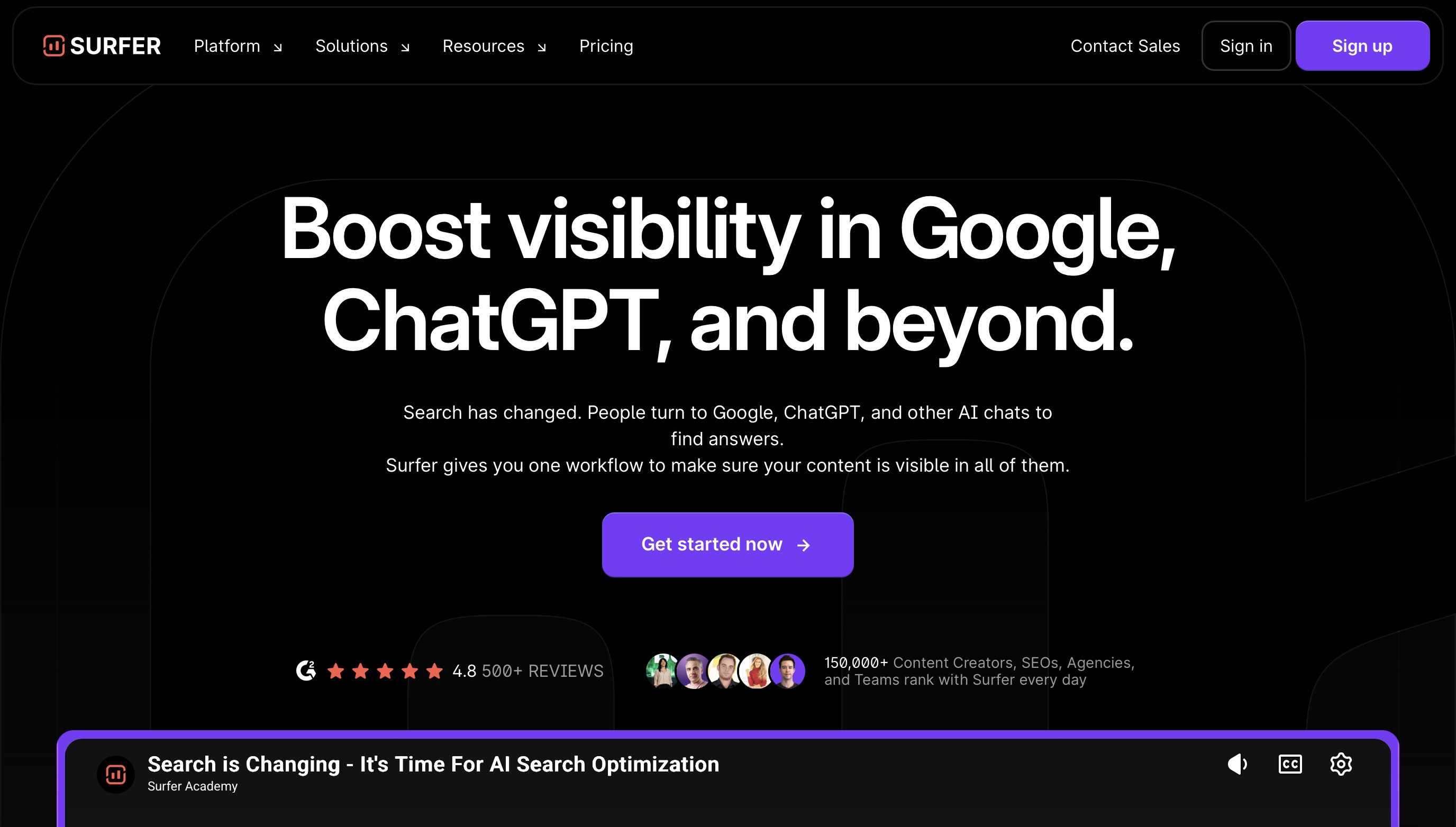
Surfer SEO is built for teams that want to optimize pages with SERP data, content scores, and AI visibility insights.
Best For: Optimization-heavy teams that want to improve existing pages, create better briefs, and track how their brand performs across Google and AI search.
What Are The Key Features Of Surfer SEO?
- Content Editor: Gives real-time content guidelines based on top-ranking pages.
- SERP-Based Recommendations: Helps improve terms, structure, length, and topical coverage.
- AI Tracker: Tracks AI visibility, mention gaps, competitor share of voice, and visibility score.
- Content Audit: Helps identify pages that need updates, optimization, or protection from ranking drops.
- One-Click Optimization: Speeds up page-level improvements for teams managing multiple content pieces.
What Are The Pros Of Surfer SEO?
- Strong On-Page Optimization: Great for improving content before and after publishing.
- Easy For Writers To Use: Content scores and suggestions make optimization simple to follow.
- AI Visibility Support: Useful for teams that want to monitor visibility beyond Google.
- Good For Content Refreshes: Works well when you have many pages that need updates.
What Are The Cons Of Surfer SEO?
- Pricing Can Be High For Smaller Teams: It may feel expensive if you only publish a few pieces per month.
- Not A Full SEO Suite: It is stronger for content optimization than backlink research or deep technical SEO.
- AI Tracking May Add To Cost: AI tracking access and limits can depend on the plan or add-on structure.
What Does Surfer SEO’s Pricing Look Like?
- Discovery starts at $49/month
- Standard starts at $99/month
- Pro starts at $182/month
- Peace of Mind starts at $299/month
- Enterprise starts at $999/month
How Do Users Rate Surfer SEO?
G2: 4.8/5
Want to future-proof your SEO strategy for AI search? Read our guide on how the latest AEO trends in 2026 are reshaping SEO.
5. Clearscope
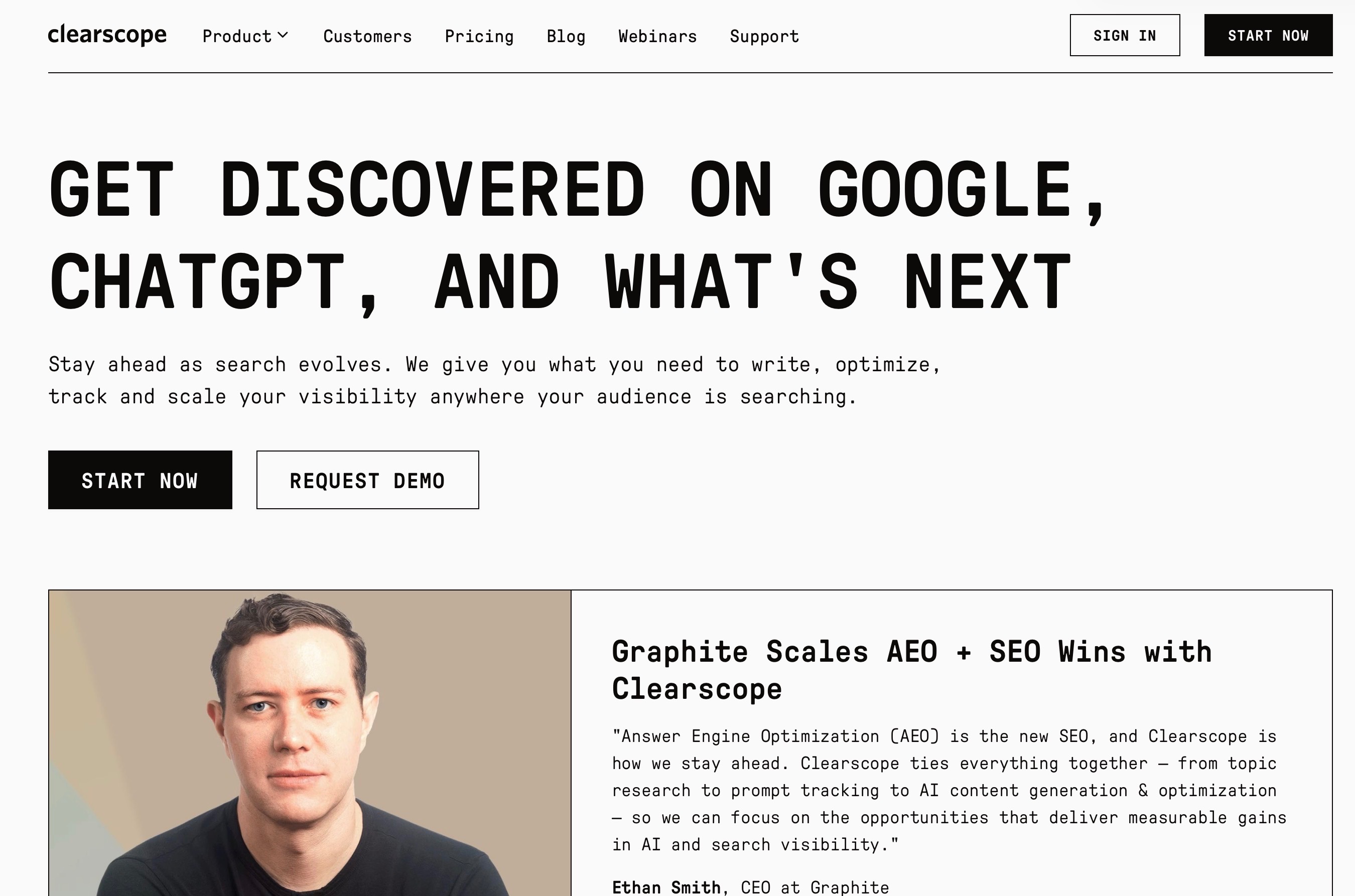
Clearscope is a strong fit for editorial teams that care about content quality, topical relevance, and AI search discoverability.
Best For: Content and editorial teams that want to create high-quality, search-intent-led content while tracking visibility across Google and AI-powered platforms.
What Are The Key Features Of Clearscope?
- Content Optimization: Gives content reports, keyword suggestions, and grading to improve relevance.
- Tracked Topics: Monitors topic visibility, prompt performance, and AI search visibility.
- Google And AI Visibility: Tracks discoverability across Google and AI platforms like ChatGPT and Gemini.
- Internal Linking: Helps teams find internal linking opportunities across their content library.
- Editorial-Friendly Workflow: Gives writers and editors clear guidance without making the process overly technical.
What Are The Pros Of Clearscope?
- Great For Editorial Quality: Helps writers improve depth, clarity, and topical coverage.
- Simple Content Reports: Easy for content teams to understand and apply.
- AI Search Visibility Features: Useful for tracking brand visibility across search and AI chatbots.
- Strong For Content Refreshes: Helps teams improve and protect existing content performance.
What Are The Cons Of Clearscope?
- Higher Starting Price: It may not be ideal for very small teams or freelancers.
- Less Focused On Content Generation: Better for optimization and briefs than full AI content production.
- Limited Traditional SEO Scope: It does not replace tools built for backlink analysis or deep technical audits.
What Does Clearscope’s Pricing Look Like?
- Essentials starts at $129/month
- Business starts at $399/month
- Enterprise pricing is custom
How Do Users Rate Clearscope?
G2: 4.9/5
6. MarketMuse
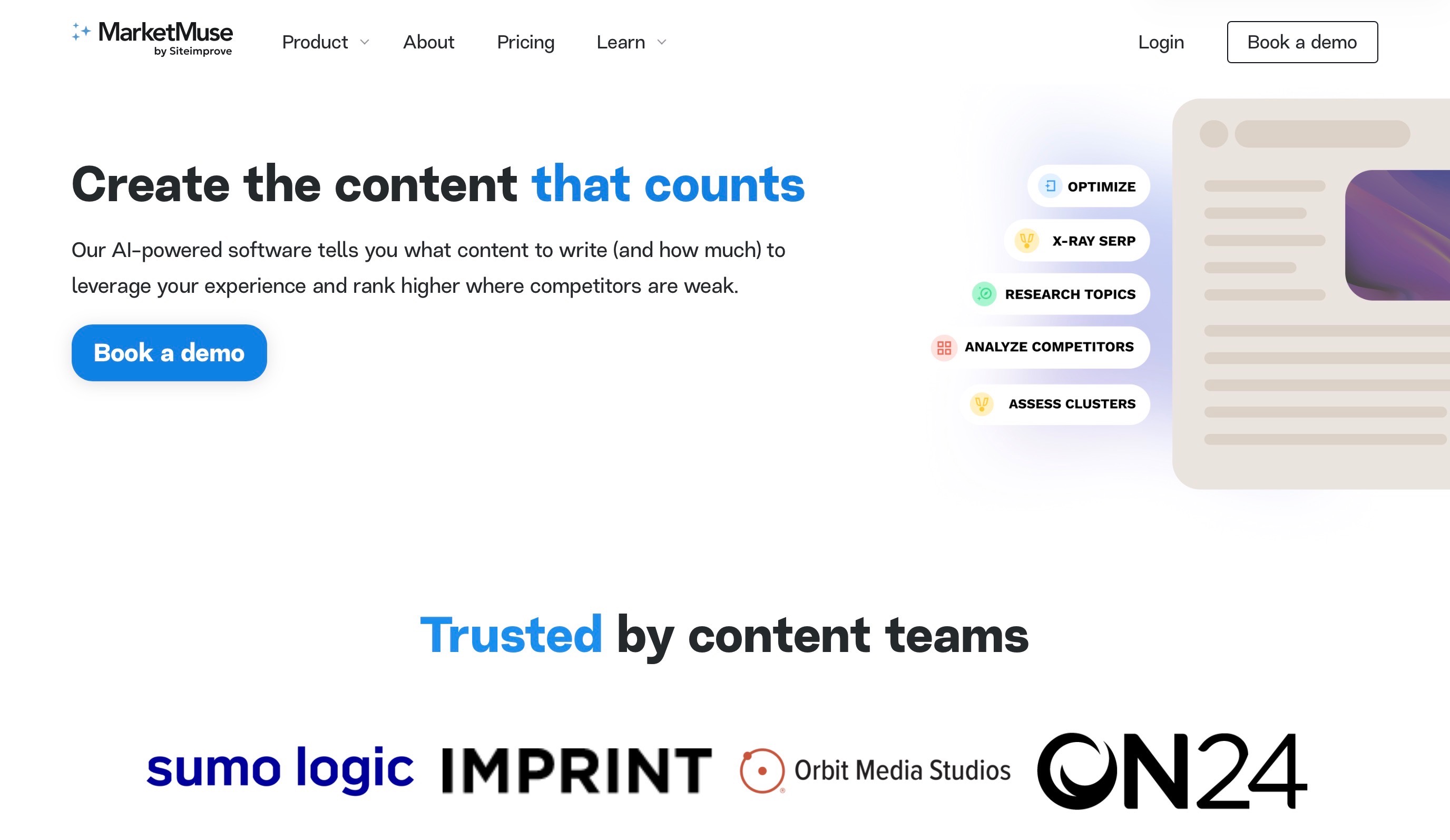
MarketMuse is built for teams that want to make smarter content strategy decisions before they start writing.
Best For: Content teams, SEO strategists, and larger brands that need help with topical authority, content inventory, competitive gaps, and strategic content planning.
What Are The Key Features Of MarketMuse?
- Topic Authority: Measures how strong your site is around a topic and where you have a better chance of ranking.
- Content Inventory: Tracks published pages, topics, and page-topic combinations so teams can spot weak areas and missed opportunities.
- Competitive Gaps: Helps identify where competitors are stronger and where your site has an advantage.
- Content Briefs: Offers brief types such as article, comparison, FAQ collection, guide, how-to, listicle, local, news/event, and product review.
- Content Score: Scores content against a topic model and compares it with competitive pages.
What Are The Pros Of MarketMuse?
- Strong For Strategic Planning: Useful when you need to decide what to create, update, or prioritize.
- Personalized Metrics: Looks at your site’s authority and coverage, instead of relying only on generic keyword difficulty.
- Good For Large Content Libraries: Helpful for teams managing many pages, topics, and content opportunities.
- Briefs Go Beyond Basic Articles: Useful if your team creates different content formats like guides, comparisons, FAQs, and product reviews.
What Are The Cons Of MarketMuse?
- Can Feel Heavy For Small Teams: It is more strategy-focused than quick content creation.
- Learning Curve: G2 reviewers mention that the platform can feel overwhelming at first because of its depth.
- Pricing Is Not Fully Transparent: Some plan details are public, but paid plan pricing often requires contacting the team.
- Not A Dedicated AEO Tracker: It is better for SEO content strategy and topical authority than AI search visibility monitoring.
What Does MarketMuse’s Pricing Look Like?
- Free plan is available
- Optimize pricing requires contacting sales
- Research pricing requires contacting sales
- Strategy pricing requires contacting sales
How Do Users Rate MarketMuse?
G2: 4.6/5
7. Frase
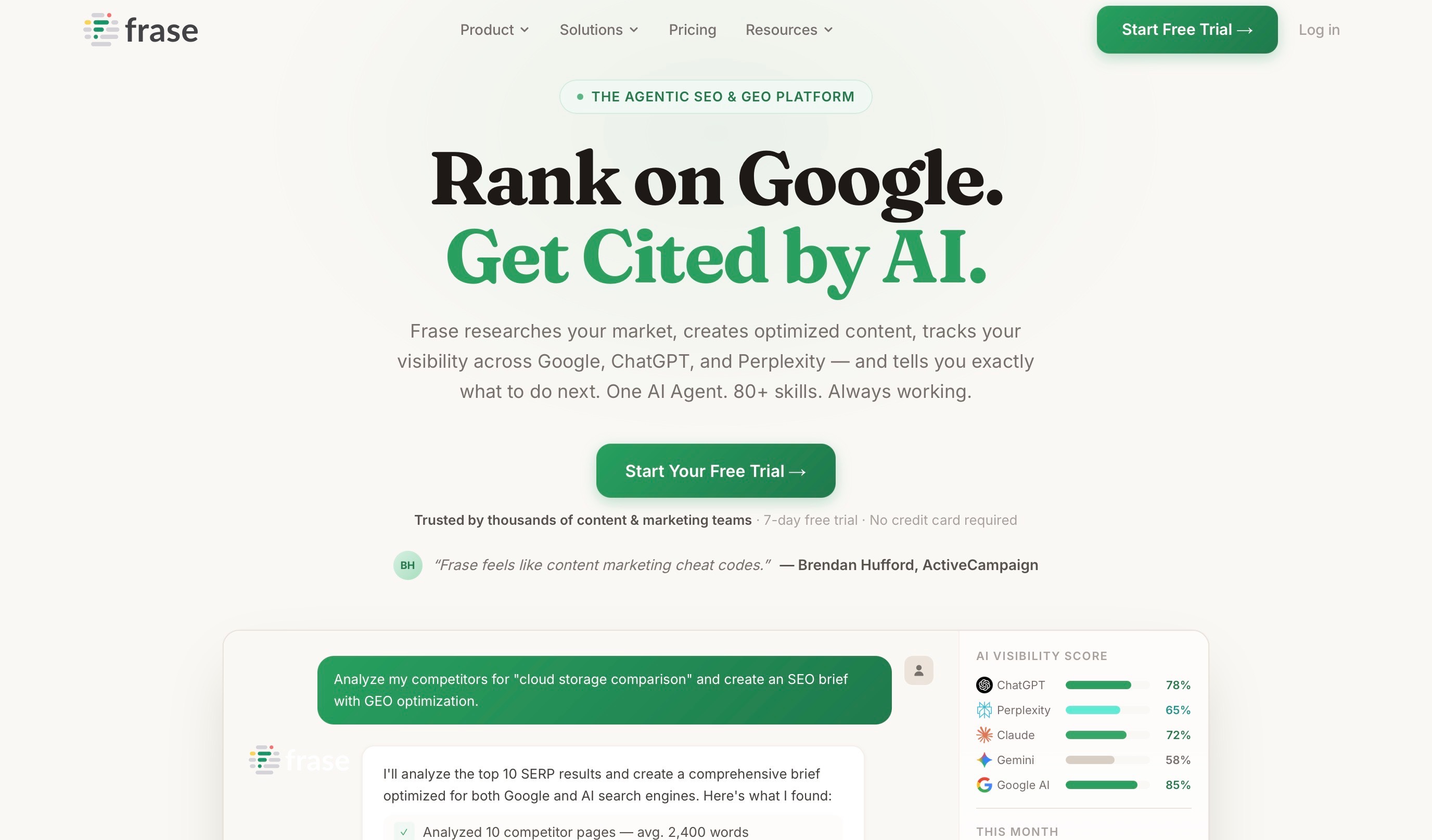
Frase is a good fit for teams that want to create answer-first content and optimize it for both Google and AI search.
Best For: Content teams that need question-led research, SEO and GEO optimization, AI visibility tracking, and content built for FAQ-style or answer-style queries.
What Are The Key Features Of Frase?
- Question-Led Research: Helps teams research search intent, SERPs, competitors, and the questions buyers are asking.
- GEO Score: Analyzes how well content is optimized for AI platforms like ChatGPT, Perplexity, Claude, and Gemini.
- AI Citation Readiness: Helps improve content structure so it is easier for AI engines to understand and cite.
- AI Tracking: Tracks brand visibility across ChatGPT, Claude, Gemini, Perplexity, Google AI Overviews, Microsoft Copilot, Grok, and DeepSeek.
- SEO And GEO Content Workflow: Combines research, writing, optimization, site audits, AI visibility tracking, and publishing support in one platform.
What Are The Pros Of Frase?
- Strong For Answer-First Content: Useful for FAQs, comparisons, explainers, and BOFU pages built around specific questions.
- Built-In GEO Features: Includes GEO optimization and AI visibility tracking across plans.
- Good Prompt-Level Tracking: Helps teams see which prompts mention their brand and where competitors are winning.
- Affordable Entry Point: Lower starting price than many enterprise SEO and AEO platforms.
What Are The Cons Of Frase?
- Plan Limits Matter: Articles, audit pages, AI platforms tracked, and visibility prompts vary by plan.
- AI Writing Still Needs Editing: Like any AI writing tool, content needs human review for accuracy, expertise, and tone.
- May Not Replace Deep SEO Suites: It is useful for SEO and GEO content workflows, but not built to replace heavy backlink or technical SEO platforms.
What Does Frase’s Pricing Look Like?
- Starter starts at $49/month
- Professional starts at $129/month
- Scale starts at $299/month
- Enterprise pricing is custom
How Do Users Rate Frase?
G2: 4.8/5
8. Otterly AI
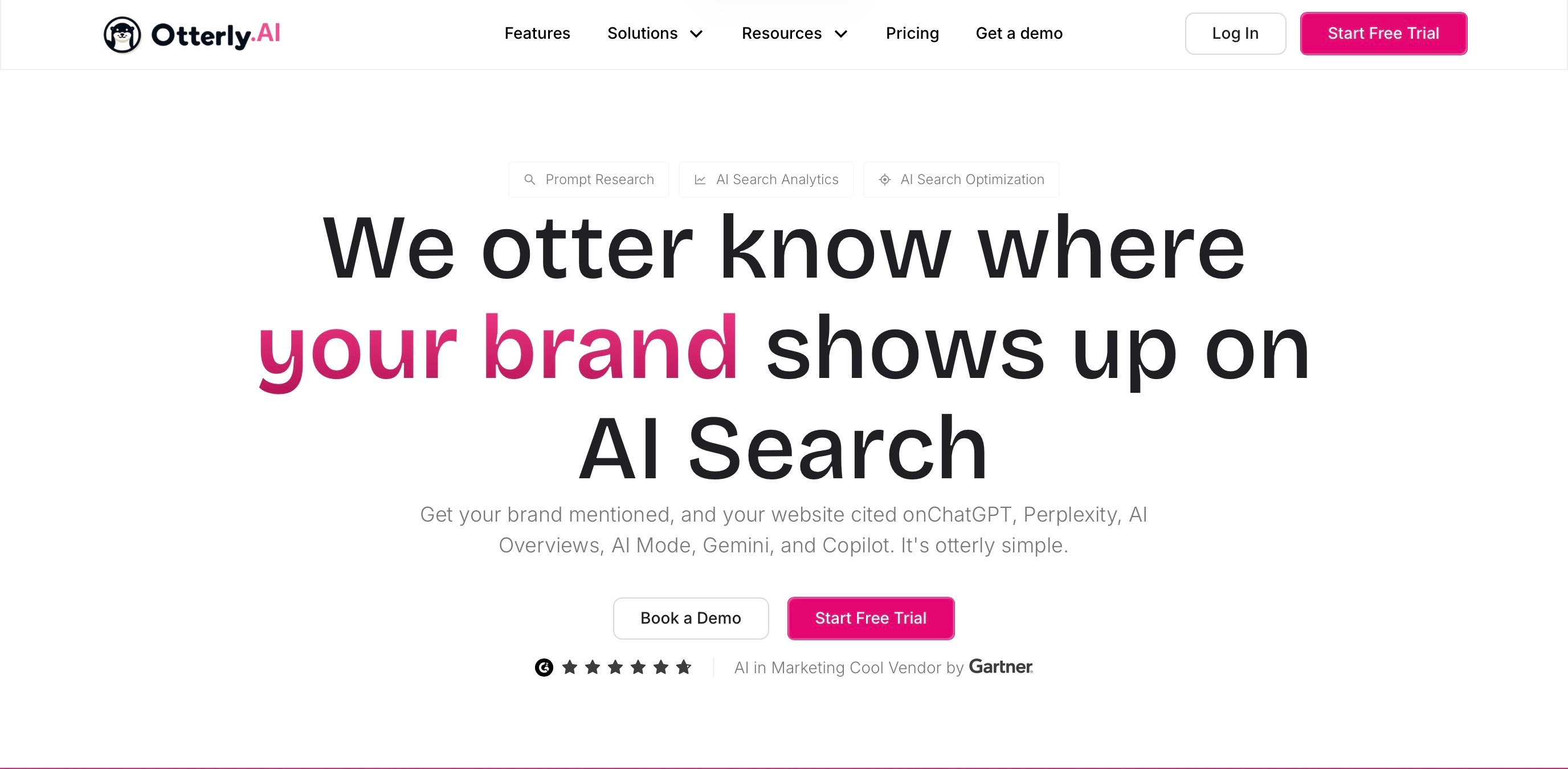
Otterly AI is built for teams that want to see where their brand shows up across AI search engines and which sources are being cited.
Best For: Teams that already have content in place and need AI search monitoring across ChatGPT, Perplexity, Google AI Overviews, Google AI Mode, Gemini, and Copilot.
What Are The Key Features Of Otterly AI?
- Brand Mentions: Tracks when your brand appears in AI-generated answers across major AI search platforms.
- Prompt Tracking: Lets you define conversational prompts and monitor which brands appear in the responses.
- Website Citations: Shows which URLs, pages, and domains AI search engines cite.
- Competitor Visibility: Benchmarks your brand against competitors using KPIs like brand mentions, brand coverage, and domain citations.
- Multi-Engine Coverage: Tracks ChatGPT, Perplexity, Google AI Overviews, Google AI Mode, Gemini, and Copilot.
What Are The Pros Of Otterly AI?
- Built For AI Search Monitoring: Strong fit if your main goal is tracking AI mentions, citations, and visibility.
- Good For Prompt-Based Reporting: Useful for teams that want to move beyond keyword tracking and monitor real buyer questions.
- Citation-Level Insights: Helps you see which pages and domains AI engines actually reference.
- Competitive Benchmarking: Makes it easier to compare your AI visibility with direct competitors.
What Are The Cons Of Otterly AI?
- Not A Traditional SEO Suite: It does not replace full keyword research, backlink analysis, or technical SEO platforms.
- Add-Ons May Increase Cost: Google AI Mode and Gemini are listed as extra add-ons on standard plans.
- Setup Can Take Time: Some users mention a learning curve, setup issues, layout concerns, and occasional slow loading.
- Best After You Have Content: It is stronger for monitoring and improving visibility than creating a full content strategy from scratch.
What Does Otterly AI’s Pricing Look Like?
- Lite starts at $29/month
- Standard starts at $189/month
- Premium starts at $489/month
- Enterprise pricing is custom
How Do Users Rate Otterly AI?
G2: 4.8/5
9. Rankability
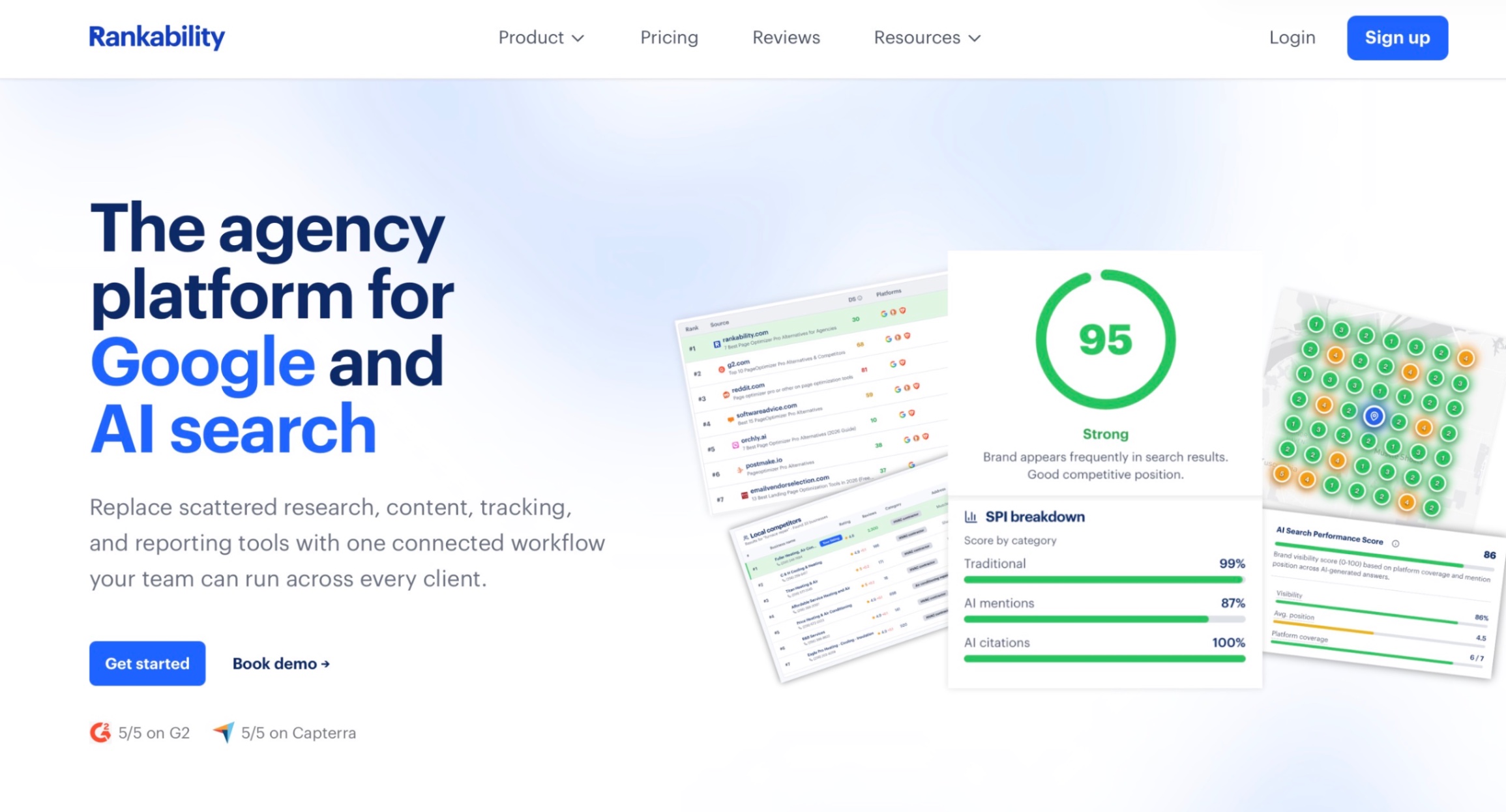
Rankability is built for agencies that want one workflow for SEO research, AI-assisted content, optimization, AI visibility tracking, and client reporting.
Best For: SEO agencies managing multiple clients that need keyword research, AI briefs, content optimization, AI mentions, AI citations, and client-friendly reporting in one platform.
What Are The Key Features Of Rankability?
- Keyword Research: Helps agencies find opportunities, uncover gaps, analyze competitors, and build keyword pipelines.
- AI Briefs: Creates briefs and drafts using Google and AI search context.
- Content Optimization: Helps improve coverage, keyword placement, and competitiveness before publishing.
- AI Mentions: Tracks how clients appear across AI platforms.
- AI Citations: Tracks AI citations and traditional rankings in one reporting view.
- Client Reporting: Offers white-label reporting, API access, and multi-client workflows.
What Are The Pros Of Rankability?
- Agency-First Workflow: Built around repeatable client delivery, not just one-off content optimization.
- SEO And AEO In One Stack: Combines research, writing, optimization, tracking, and reporting.
- Client-Friendly Reporting: Tracks rankings, AI mentions, and AI citations in a unified view.
- Good For Multi-Client Teams: Supports client-based workflows, seats, credits, and white-label reporting.
What Are The Cons Of Rankability?
- Agency-Focused: It may be more than a small in-house team needs.
- Credit-Based Usage: Plans include monthly credits, so agencies need to watch usage across clients.
- Not Just A Writing Tool: Teams looking only for simple AI content generation may find it broader than necessary.
- Newer Public Review Base: G2 review volume is still smaller compared with older SEO platforms.
What Does Rankability’s Pricing Look Like?
- Core starts at $199/month
- Team starts at $399/month
- Agency starts at $799/month
- Enterprise pricing is custom
How Do Users Rate Rankability?
G2: 5.0/5
Which AI SEO And AEO Tool Should You Choose?
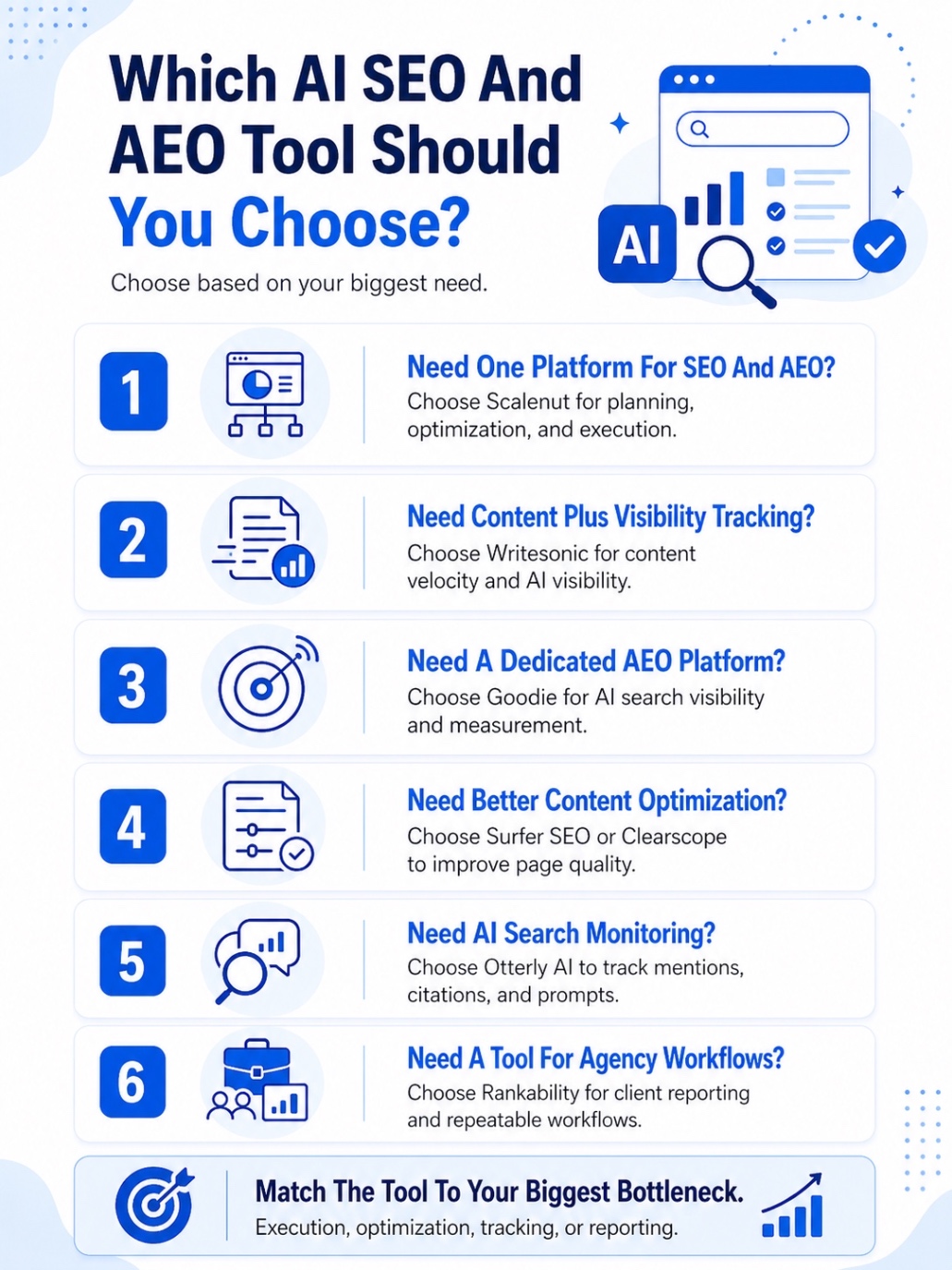
The best SEO AEO generative AI platform depends on what you need most right now: execution, content creation, AI visibility tracking, optimization, or client reporting.
Here is a simple way to choose the right tool based on your workflow.
1. What Is The Best AI Tool For SEO And AEO If I Want Execution In One Platform?
Choose Scalenut if you want one platform that supports SEO planning, content optimization, AEO workflows, and AI visibility improvement. It is the strongest fit for teams that do not just want dashboards, but need a tool that helps them find opportunities, create optimized content, improve existing pages, and act on AI visibility gaps from one workflow.
2. What Is The Best AI Tool If I Want AI Content Creation And Visibility Tracking?
Choose Writesonic if your team cares about content velocity and AI visibility. It is a good fit for brands that want to create, refresh, and optimize content while also tracking how they appear across AI search platforms.
3. What Is The Best AEO Tool If AI Search Visibility Is My Main Priority?
Choose Goodie if your main goal is to monitor and improve how your brand appears across AI answer engines. It is best for teams that want a dedicated AEO platform for brand visibility, AI search measurement, and performance tracking.
4. What Is The Best AI SEO Tool If I Mainly Need Content Optimization?
Choose Surfer SEO or Clearscope if your main priority is improving content quality before and after publishing. These tools are useful for teams that need content scoring, topic coverage, optimization suggestions, and better on-page relevance.
5. What Is The Best AI Search Monitoring Tool If I Already Have Content?
Choose Otterly AI if you already have a content library and now need to track AI mentions, citations, prompts, and competitor visibility. It is a strong fit when your main question is not “what should we write?” but “where are we showing up in AI answers?”
6. What Is The Best AI SEO And AEO Tool For Agencies?
Choose Rankability if you manage SEO and AEO workflows for multiple clients. It is useful for agencies that need repeatable content workflows, optimization, rank tracking, AI mentions, AI citations, and client-friendly reporting.
The easiest way to choose is to match the tool to your biggest bottleneck. Use Scalenut for SEO and AEO execution, Writesonic for content velocity, Goodie or Otterly AI for AI visibility tracking, Surfer SEO or Clearscope for content optimization, and Rankability for agency workflows.
Want better visibility across Google and AI answers? Read our guide on how to integrate AEO with traditional SEO strategies for a stronger search growth plan.
Final Thoughts: Which AI Tool Should You Choose For SEO And AEO?
Choose based on your biggest gap. If you are weak in traditional search or Google search, fix your search engine optimization basics first: content quality, user intent, technical issues, and organic traffic opportunities. If you already rank but do not appear in AI search results, prioritize AI search optimization, prompt tracking, citations, and content updates.
Use Scalenut for SEO strategy and AEO execution, Writesonic for content creation, Goodie or Otterly AI for AI monitoring, Surfer SEO or Clearscope for optimization, MarketMuse for topical authority, Frase for answer-first content, and Rankability for agency workflows. The goal is not more AI features, but clearer next steps on what to create, improve, and fix.
Frequently Asked Questions
Who are the best AEO and AI SEO experts for tech companies in 2026?
The best experts are teams that understand technical content, product-led search, AI visibility, and conversion-focused SEO. Scalenut is a strong option for tech companies because it combines AI visibility tracking, GEO recommendations, content execution, and authority-building workflows.
How do AI tools improve visibility in answer engine search results?
AI tools improve visibility by finding content gaps, tracking prompts, monitoring citations, and helping teams structure content around direct answers. Platforms like Scalenut also connect AI visibility insights with execution, so teams know what to create, update, or optimize next.
Which AI tools help optimize content specifically for AEO?
Scalenut, Frase, Goodie, Otterly AI, and Writesonic are useful for AEO-focused workflows. Scalenut is especially relevant if you want AI visibility tracking plus content execution, while Frase focuses on SEO and GEO scoring for answer-ready content.
What features should I look for in the best AI SEO and AEO tools?
Look for keyword planning, content optimization, AI visibility tracking, prompt monitoring, citation tracking, competitor benchmarking, and actionable recommendations. The best tools should not only show performance data, but also tell you what content to create, refresh, or strengthen.
How do AEO tracking tools differ from traditional SEO tools?
Traditional SEO tools focus on rankings, keywords, backlinks, and technical performance. AEO tracking tools focus on AI-generated answers, brand mentions, prompt performance, citations, sentiment, and competitor visibility across platforms like ChatGPT, Perplexity, and Google AI Overviews.
What benefits do LLM-powered tools bring to SEO and AEO strategies?
LLM-powered tools help teams analyze user questions, create structured briefs, improve topical coverage, and optimize content for both search engines and AI answers. They are most useful when paired with human review, brand expertise, and a clear SEO workflow.
How can AI help brands appear more in answer engine visibility searches?
AI can help brands find the prompts buyers use, identify citation gaps, improve content structure, and track competitor mentions. Scalenut supports this by monitoring AI visibility and turning those insights into GEO content, backlink, and optimization actions.
What are the best tools for automating content creation and SEO?
Scalenut, Writesonic, Frase, Surfer SEO, Clearscope, and Rankability are strong options depending on the workflow. Use Scalenut for planning, content execution, optimization, and AI visibility, Writesonic for faster content creation, and Surfer or Clearscope for on-page optimization.
What are the best SEO practices with AI?
Use AI for research, briefs, structure, optimization, and content refreshes, but do not publish generic AI output without review. Keep content helpful, accurate, original, and aligned with user intent so it supports long-term SEO and AEO performance.


.svg)


.webp)