
Key Highlights
- AthenaHQ focuses on GEO analytics and AI visibility insights, while AirOps prioritises automated execution and content workflows.
- AthenaHQ delivers stronger citation, competitor, and regional AI search tracking; AirOps offers broader but less GEO-specific visibility.
- AthenaHQ stops at insights, and AirOps assumes prior GEO expertise.
- AthenaHQ suits insight-led, client-facing teams, whereas AirOps fits large-scale, execution-heavy content operations.
- AthenaHQ leans premium, and AirOps becomes costly as usage scales.
- Scalenut stands out by unifying AI visibility, keyword research, content creation, optimisation, and audits into a single workflow.
- User ratings for AthenaHQ are 4.8/5 on G2, and for AirOps are 4.6/5.
AI search and generative engines are reshaping how brands are discovered, yet many teams struggle to convert AI visibility into measurable, actionable growth. Insights are scattered across tools, signals feel vague, and it is often unclear whether to prioritise execution, monitoring, or deeper analysis. The wrong platform can result in endless tracking without meaningful progress.
This is where tools like AirOps and AthenaHQ come into play. Both are designed to help teams understand and improve content performance across AI-driven search experiences, but they take distinctly different approaches in terms of focus, depth, and how action is taken.
In this blog, we compare AirOps and AthenaHQ side-by-side. We break down their features, use cases, pricing, and ideal audiences to help you determine which platform aligns best with your goals, workflows, and stage of growth.
AthenaHQ and AirOps Comparison: Which Tool Is Better?
AthenaHQ and AirOps both support AI-driven content marketing, but with different priorities.
AthenaHQ focuses on GEO analytics, helping teams monitor and understand brand performance across AI search engines.
AirOps emphasises execution, turning insights into automated workflows that directly power content creation and optimisation. Let's see which one is better for you
AthenaHQ Overview
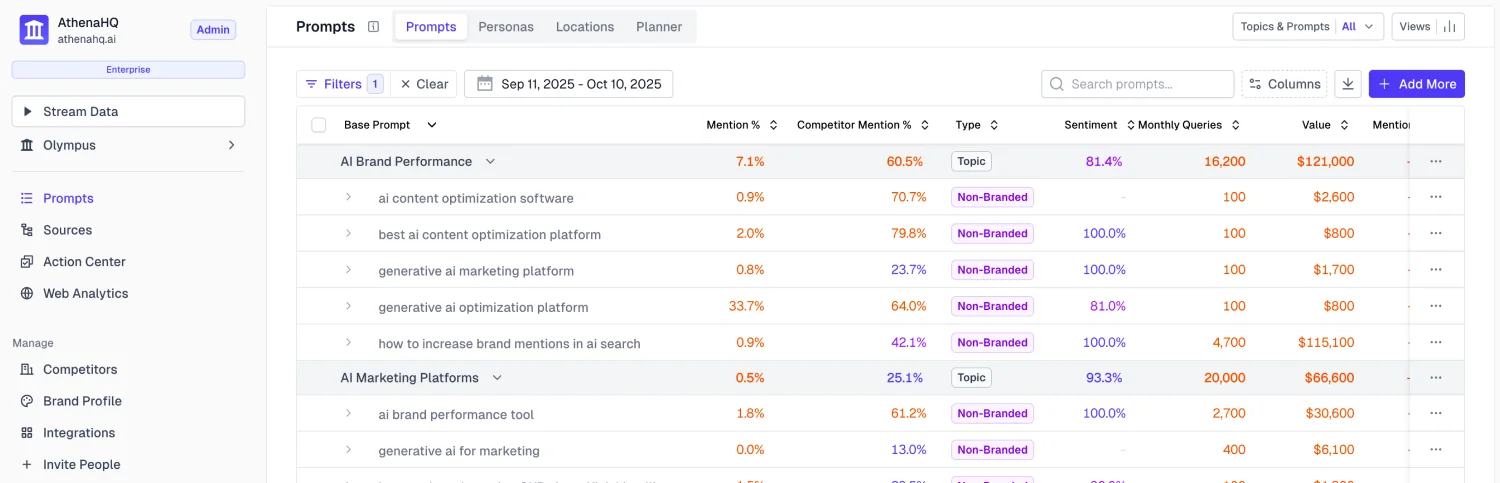
AthenaHQ is a dedicated Generative Engine Optimisation platform focused on improving how often and how accurately your brand appears in AI-generated answers from tools like ChatGPT, Gemini, and Claude.
It tracks brand mentions, sentiment, and competitive presence across AI outputs, then presents these insights in a clear dashboard. AthenaHQ also provides data-driven recommendations to help you decide what content to create, update, or refine so your brand aligns with how AI engines interpret user intent.
What are the Key Features of AthenaHQ?
- Prompt Discovery: Suggests prompts and prompt volumes that actually matter to your brand and aids in emerging prompt discovery.
- Brand Intelligence & GEO Score: Tracks brand mentions across AI search and assigns a unified GEO score to measure overall AI visibility.
- Competitor Benchmarking: Compares how often your brand and competitors are cited in AI answers to highlight gaps and opportunities.
- Source & Sentiment Tracking: Identifies cited sources, sentiment of mentions, and which references are most likely to drive clicks.
- Agency Reporting Workspace: Creates client-ready AI search reports with prompt-level insights and reusable reporting frameworks.
- Generative AI Content: Generates briefs and drafts using custom prompts.
- E-commerce AI visibility tracking: AthenaHQ shows how your products and brand appear across AI search results, helping e-commerce teams spot gaps, optimise product content, and improve visibility in AI-driven shopping and discovery journeys.
What are the User Ratings of AthenaHQ?
- G2: 4.8/5
AirOps Overview
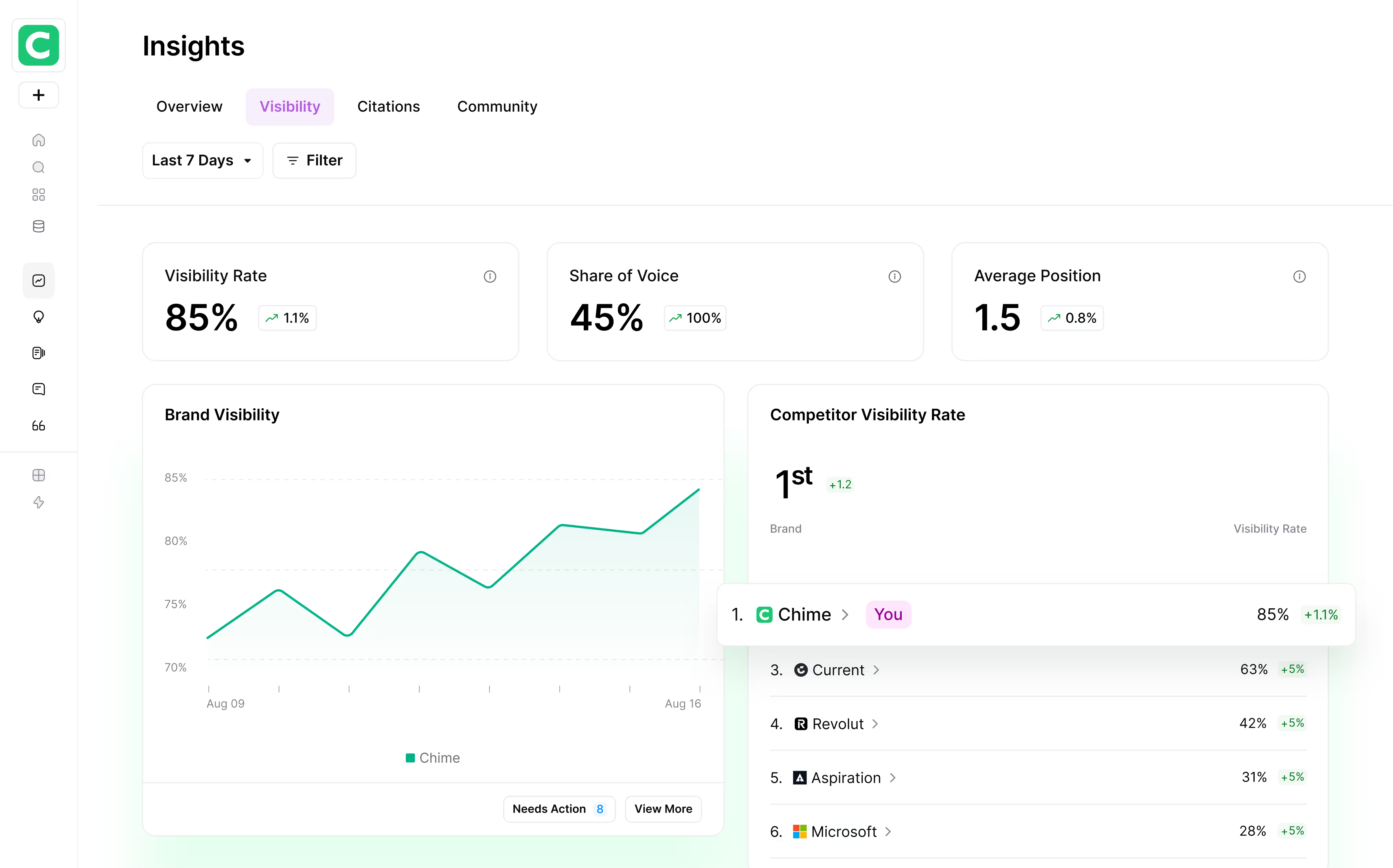
AirOps is an AI-powered SEO and content operations platform built around automated, flexible workflows. Instead of producing isolated pieces of content, it helps teams standardise research, writing, optimisation, and publishing at scale.
Built for high-volume content teams, AirOps brings together data sources, SEO tools, CMS platforms, and AI models into a single execution layer designed to turn insights into action efficiently.
What are the Key Features of AirOps?
- AI Search Insights: Monitors brand visibility across AI engines and search in one dashboard, linking AI mentions to real traffic and performance.
- AI Actions: Automates content refresh and optimisation workflows, reducing manual effort and accelerating SEO and AI visibility gains.
- Grids for Scale: Runs AI-driven workflows across hundreds of pages simultaneously, with central tracking and human review checkpoints for quality control.
- No Code Workflow Builder: Uses a drag-and-drop builder to automate research, drafting, and optimisation through reusable templates and scheduled runs.
- Deep Integrations: Connects directly with CMS platforms, SEO tools like Semrush, webflow,shopify, etc and brand knowledge bases for end-to-end execution.
What are the User Ratings of AirOps?
- G2: 4.6/5
AthenaHQ vs Airops: What are the Main Differences?
Before exploring how Athena HQ and AirOps differ, it helps to first understand where they overlap. Reviewing their shared capabilities makes it easier to assess which tool aligns better with your specific needs and use case.
Which Tool Has Better AI Search Visibility Tracking?
Athena HQ's Monitoring
Pros of Athena HQ's Monitoring
- Athena HQ lets you see how AI search engines reference your brand and content in their generated answers, helping you understand where you appear and where you don’t.
- You get a live, shareable dashboard that updates with AI visit data, making it easier for teams to stay aligned on visibility trends.
- The system tracks where your content is cited within AI responses and shows how competitor mentions compare.
- AthenaHQ’s monitoring includes geographic breakdowns, so you can see visibility patterns by region.
- Beyond just reporting, AthenaHQ ties monitoring insights into optimisation signals and recommendations you can act on.
- Monitoring covers several generative engines such as ChatGPT, Gemini, Claude, and Perplexity, giving a broad view of AI search presence.
Cons of Athena HQ's Monitoring
- While it shows “geographical data around the world,” it is not clear if it offers very fine-grained local insights (for example, city-level or language-specific performance) compared to some advanced GEO tools.
- The feature focuses on tracking and visibility reporting; execution and optimisation steps require other modules or manual interpretation.
- Competitive benchmarking and sentiment insights are useful but may feel superficial for users needing advanced, granular analytics
- The GEO monitoring features are powerful but may be more than needed for smaller teams if you need highly localised insights without enterprise costs.
Also read about AthenaHQ's replacement tools here
Airops Insights
Pros of Airops Insights
- AirOps Insights shows how you perform across both traditional search and AI search in a single dashboard, helping you diagnose overall content performance.
- The platform not only shows performance signals but also helps you prioritise what content to update or create next.
- Insights unite SEO, AI visibility, and on-site analytics to give you a fuller picture of your performance.
- The feature highlights areas where your content or brand visibility can improve, useful for strategic planning.
Cons of Airops Insights
- There are no clear Insights provides GEO-specific visibility metrics or brand visibility.
- AirOps does not highlight how performance varies by geography across different AI search regions or localised AI behaviours, which can be important for multi-region brands.
- Although AirOps shows overall visibility vs competitors, it does not appear to break that comparison out, limiting competitive GEO insights.
My verdict
LLM visibility tools like Athena HQ provide AI search visibility tracking, especially for GEO-focused teams seeking citation, competitor, and regional insights across multiple LLMs. AirOps Insights is better for workflow prioritisation, but its AI visibility remains broad and surface-level rather than truly GEO-driven.
Which Tool Has Better AI Search Optimisation Signals?
Athena HQ's Action Centre
Pros of the Action Centre
- The Action Centre translates AI visibility signals into clear actions, helping teams understand what to fix to improve presence in AI-generated answers.
- Identifies missing topics, weak coverage, and authority gaps that limit how generative engines reference your brand.
- Suggestions are tailored for how LLMs interpret, reuse, and cite content, not just traditional SEO rankings.
- Helps teams focus on high-impact actions instead of manually analysing dashboards and reports.
- Connects AI visibility data directly with optimisation tasks, closing the gap between insight and execution.
Cons of the Action Centre
- The way GEO actions are prioritised is not fully explained, which may reduce trust for advanced users.
- While actions are suggested, content creation and implementation rely on external tools or workflows.
- The Action Centre is powerful, but can be excessive if you only need lightweight GEO guidance or simple AI monitoring.
Read our beginner's guide on Mastering GEO SEO Strategies
AirOps Action
Pros of AirOps Action
- AirOps Action is built to operationalise insights by turning signals into repeatable workflows, helping teams act faster on AI visibility opportunities.
- Enables teams to automate content updates, prompt experiments, and optimisation tasks at scale, with brand voice and brand guidelines.
- Actions are closely tied to content systems and CMS workflows, reducing friction between analysis and publishing.
- Teams can design their own workflows instead of relying only on predefined recommendations.
Cons of AirOps Action
- Actions are not deeply opinionated around GEO best practices, leaving teams to decide how to optimise for AI search.
- Unlike GEO-focused platforms, AirOps does not clearly surface why a brand appears in AI answers or how to influence citations.
- Teams without a strong GEO framework may struggle, as the platform assumes you already know what actions to run.
My verdict
Athena HQ provides clearer, more opinionated AI search optimisation signals, making it easier to understand why visibility changes and what to fix. AirOps Action excels at execution and automation, but relies heavily on users already knowing GEO best practices rather than guiding them.
Which Platform Offers the Most Enterprise-ready Workflows?
Athena HQ's Agencies Feature
Pros of Athena HQ's Agencies Feature
- Built specifically for agencies managing multiple clients, with support for separate workspaces, permissions, and reporting views
- Enables client-ready reporting for AI visibility and GEO performance
- Strong focus on AI search monitoring, competitor benchmarking, and optimisation insights that agencies can turn into retainers
- Helps agencies demonstrate value in emerging AI search channels beyond traditional SEO
Cons of Athena HQ's Agencies Feature
- Limited flexibility to deeply customise enterprise workflows beyond the platform’s predefined structure
- Execution and content changes still rely on external systems, adding coordination overhead at scale
- May overlap with existing enterprise SEO and analytics stacks, creating potential redundancy rather than replacement
Also, read our blog on 10 Best Tools for Tracking Brand Visibility in AI Search Platforms
AirOps for Marketing Agencies
Pros of AirOps for marketing agencies
- Designed for agencies managing content and SEO at scale, with repeatable workflows that support multiple clients
- Strong automation capabilities help agencies speed up content production, optimisation, and updates
- Flexible workflow builder allows agencies to customise processes for different client needs and verticals
- Integrates well with CMSs and existing content stacks, reducing friction between strategy and execution
Cons of AirOps for marketing agencies
- Client-facing AI visibility reporting is relatively light compared to GEO-focused platforms
- Demonstrating AI search value to non-technical stakeholders may require additional tools or manual context
- Can feel overengineered if an agency primarily needs monitoring, insights, or strategic reporting rather than execution workflows
My verdict
AirOps offers more enterprise-ready workflows thanks to its deep automation, CMS integrations, and customisable processes, making AirOps features for digital content agencies well-suited for scale. However, it sacrifices clarity in AI visibility reporting. Athena HQ is stronger for client-facing GEO insight, but feels more rigid and less operational at enterprise scale.
Which Platform Offers the Best Value For Money?
How much does AthenaHQ cost?
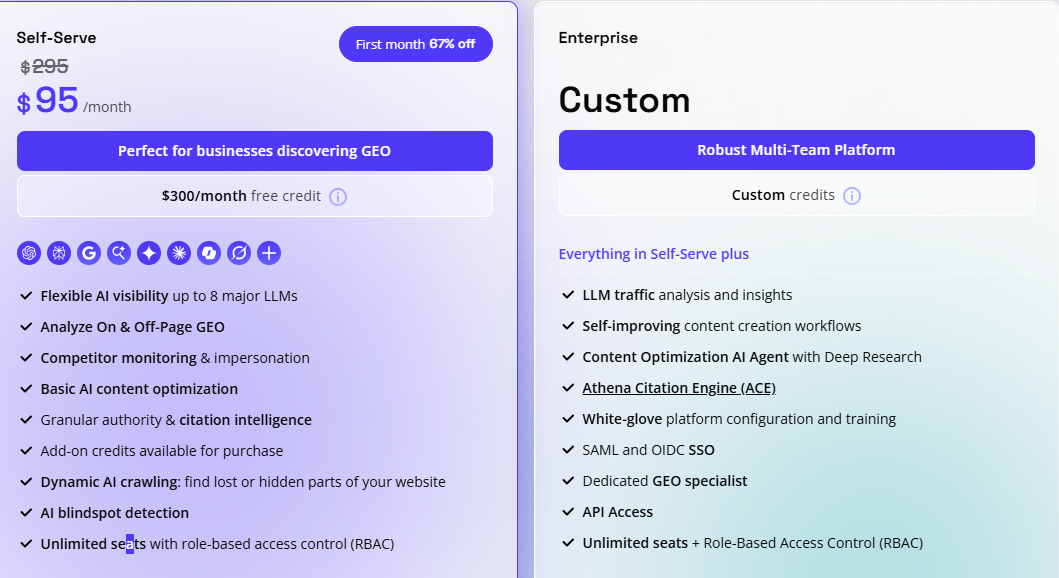
Athena HQ uses an enterprise-focused pricing model starting at $95 per month, with costs scaling based on usage, number of clients, and feature access. Higher tiers unlock advanced AI visibility monitoring, optimisation insights, and agency-ready reporting, positioning it as a premium option rather than a budget GEO tool.
How much does AirOps cost?
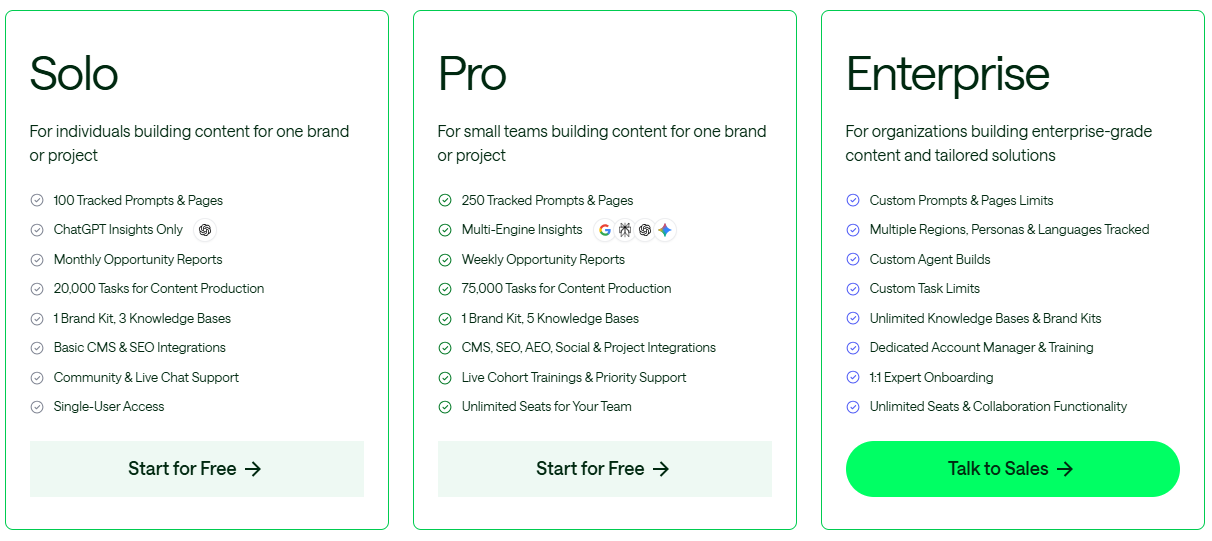
AirOps follows a tiered pricing model with a free plan for basic testing and paid plans that scale with usage and workflow complexity. Advanced features like AI search insights, automation, and team workflows are available only on higher tiers or custom plans.
My verdict
Athena HQ positions itself as a premium, insight-led platform with predictable entry pricing but rising costs as usage scales. AirOps is more flexible at the low end, yet meaningful AI visibility and automation quickly push teams toward higher, custom-priced tiers. Neither option is truly budget-friendly at scale.
Also read about 10 Must-Have AEO Tools to Boost Your Strategy here
What are the Missing Features in AthenaHQ and AirOps?
Now that we’ve covered the features both tools have in common, let’s look at where each of them falls short.
Missing Features in AthenaHQ
- Native content execution tools: AthenaHQ recommends what to fix, but does not provide built-in content creation, editing, or publishing capabilities.
- Deep workflow customisation: Enterprise and agency workflows are structured but not highly configurable for complex, bespoke processes.
- Prompt-level experimentation controls: Limited ability to actively test, iterate, or simulate prompts across AI engines to influence visibility.
- Full-stack SEO coverage: Not a replacement for traditional SEO tools like technical audits, backlink analysis, or keyword research.
Missing Features in AirOps
- Native AI visibility diagnostics: AirOps does not provide a deep explanation of why a brand appears in AI answers, lacking citations, sentiment, and source-level clarity.
- GEO-specific optimisation guidance: No prescriptive recommendations tailored specifically to generative engine behaviour or AI citations.
- Client-ready AI visibility reporting: Reporting is more operational than explanatory, making it harder to communicate AI search value to stakeholders.
- Built-in competitive AI analysis: Competitor benchmarking exists but is not deeply broken down by prompts, sources, or regions.
- Beginner-friendly GEO framework: Assumes teams already understand how to optimise for AI search, offering little strategic hand-holding.
Bottom line: AthenaHQ is strong on insight and explanation but weak on execution. AirOps excels at execution and automation but lacks native, transparent AI visibility intelligence. Choosing between them depends on whether you need clarity or operational scale.
Where do Both AthenaHQ & Airops Fall Short?
- End-to-end execution is incomplete: Neither platform fully closes the loop from insight to publishing. AthenaHQ stops at recommendations, while AirOps assumes teams already know what to execute.
- Limited deep localisation: Both lack truly granular GEO insights, such as consistent language-level or hyper-local AI behaviour analysis.
- Opaque AI decision logic: Neither clearly explains how AI engines weigh sources, citations, or signals, which limits trust for advanced users.
- Not a full SEO replacement: Core SEO capabilities like technical audits, backlink intelligence, and keyword research still require separate tools.
Bottom line: Both tools solve parts of the AI search problem, but neither delivers a complete, transparent, end-to-end GEO solution on its own.
What Do Real Users Say?
AthenaHQ Reviews
"I find that there are some features in AthenaHQ that require more work to set up, which I haven't completed yet. Additionally, I would like more visibility on prompt volume data", says Tarek E.
AthenaHQ is consistently praised for its easy setup, out-of-the-box reporting, and highly actionable GEO and prompt insights that help teams focus on what to optimise next. Users value its competitor visibility, strong analytics, and responsive support team, while downsides are occasional glitches, features that require more setup, and requests for deeper data, such as prompt volume.
Airops Reviews
"The downside is the pricing model. If you’re not careful about monitoring team usage, it’s easy to burn through your task budget faster than expected," says Lesley M., Director of Organic Growth
AirOps is praised for dramatically reducing manual SEO and content workloads through flexible, end-to-end workflows, prompt tracking, and multi-engine visibility. Users value the time savings, customisation, and training resources, but note a steep learning curve, usage-based pricing risks, and inconsistent post-sales support despite strong pre-sales engagement.
Is there a Better Alternative to AthenaHQ and AirOps?
Yes, depending on what your team needs to achieve. AthenaHQ and AirOps both solve important problems in AI search, but they focus on different parts of the workflow. AthenaHQ excels at AI visibility monitoring and diagnostics, while AirOps is built for execution through automated content workflows.
For teams that want an end-to-end solution without splitting insights and action across tools, platforms like Scalenut offer a more unified approach. By combining AI visibility insights with keyword research, content creation, optimisation, and audits into a single workflow, they enable teams to move from insight to execution faster, not just to observe performance.
Scalenut Overview: What is Scalenut?
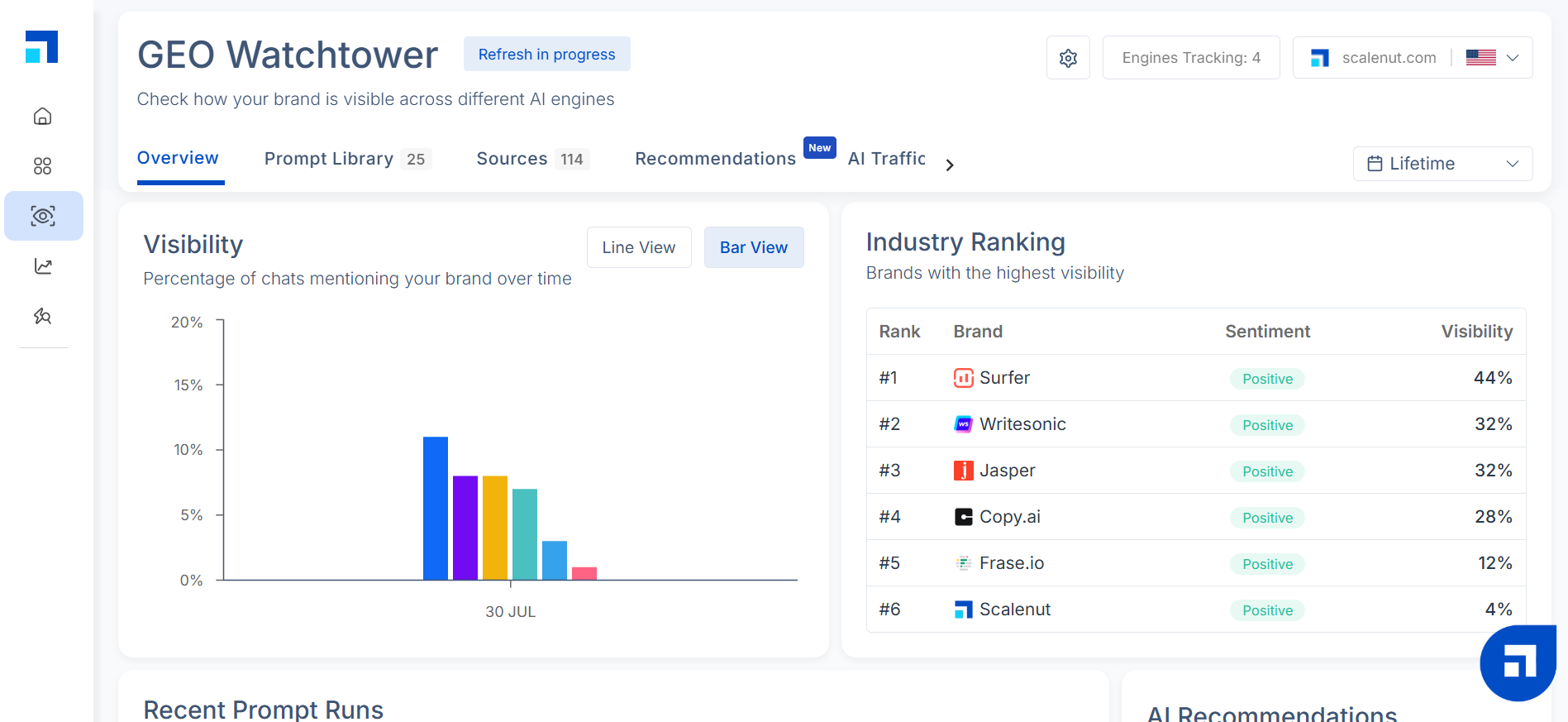
Scalenut is a unified GEO and SEO platform that enables teams to track AI visibility, plan topics, create content, and optimise pages from one dashboard. It blends AI visibility tracking with keyword and prompt intelligence, plus real-time content scoring, to help content perform across both traditional search and AI-driven discovery.
What Are the Core Features of Scalenut?
- GEO Watchtower: Monitors how often your brand is referenced by AI engines versus competitors.
- Cruise Mode: Generates a fully optimised, GEO and SEO ready blog in minutes.
- Prompt Context Tracking: Tracks up to 200 prompts to show where and why your brand appears across AI tools like ChatGPT, Perplexity, and Gemini.
- AI Visibility Tracking: Follows brand mentions, cited sources, and prompt trends over time.
- Keyword Planner and Clusters: Identifies high-intent topics and content gaps quickly.
- Content Optimiser: Delivers live GEO and SEO recommendations as you write.
- Content Audit: Highlights pages that need updating, merging, or pruning.
- Traffic Analyser: Reviews traffic patterns, top pages, and keyword performance.
- Link Manager: Surfaces internal linking opportunities instantly.
- Social UpReach: Tracks Reddit conversations to spot early demand and emerging trends.
What are Scalenut's User Reviews?
- Product Hunt: 5/5
- G2: 4.7/5
- Capterra: 4.8/5
What do the Real Users Say About Scalenut?
"Scalenut is helping me to create great, SEO optimised content in a shorter time. The features I have used are easy to get to grips with, and the content is excellent. Scalenut is very user-friendly and is an advantage in helping anyone with content creation, "says Barrie E., Business Owner
Users frequently describe Scalenut as a mature, all-in-one GEO and SEO content marketing platform that has improved steadily over time.
Reviews highlight its efficient workflows, strong impact on Google search performance, and Cruise Mode for generating quick, high-quality content drafts.
Why Choose Scalenut over Athena HQ & AirOps?
True End-to-End Execution
- AthenaHQ focuses on insights but stops short of execution
- AirOps excels at workflows but assumes you already know what to optimise
- Scalenut connects visibility insights directly to keyword planning, content creation, optimisation, audits, and updates in one flow
Built for GEO and SEO Together
- AthenaHQ is strong on AI visibility diagnostics
- AirOps is strong on automation
- Scalenut unifies AI visibility tracking with traditional SEO, so content performs across Google and AI search without tool switching
Clear, Actionable Optimisation Guidance
- Removes opaque decision-making by closing content gaps and giving optimisation recommendations
- Helps teams understand what to write, update, or prune based on real signals, not guesswork
All Core SEO Capabilities Included
- Keyword research and clustering
- Content optimisation while writing
- Content audits and internal linking
- Traffic and performance analysis
- No need to rely on multiple external SEO tools
Faster Time to Results
- Cruise Mode generates GEO and SEO ready drafts in minutes
- Prompt and AI visibility tracking shows where and why your brand appears
- Teams move from insight to execution faster, not just observation
Bottom line: If you want a single platform that explains AI visibility, guides optimisation, and lets you execute without stitching together multiple tools, Scalenut offers a more complete and practical alternative to AthenaHQ and AirOps.
Ready to move beyond AI visibility tracking and focus on execution? Try Scalenut today.
Frequently Asked Questions
How does AthenaHQ compare with AirOps and other similar AI tools?
AthenaHQ excels at AI visibility insights, while AirOps focuses on execution workflows. Compared to both, Scalenut offers an end-to-end GEO and SEO solution combining insights with content creation and optimisation.
Is AthenaHQ AI worth the investment compared to other AI visibility tools?
AthenaHQ is valuable for deep AI visibility monitoring, but teams seeking better ROI may prefer Scalenut, which delivers AI visibility, keyword research, content optimisation, and execution in one platform, reducing tool sprawl and speeding results.
How do AthenaHQ AI SEO services support brand growth?
AthenaHQ supports brand growth by tracking your ai visibility across major search engines and providing actionable recommendations. This data helps you refine your SEO optimisation strategy to get cited more frequently in AI search, increasing your brand’s presence and authority in front of a growing audience.
Is AthenaHQ or AirOps better for AI search optimisation?
It depends on your goal. AthenaHQ is better for monitoring search performance and gaining strategic insights into your brand visibility. AirOps is better for actively executing optimisations, as its SEO tools automate content creation and updates based on real-time data from generative engines.
What factors should I consider when comparing AthenaHQ AI and AirOps pricing?
When comparing pricing tiers, consider AthenaHQ's high, enterprise-focused cost structure against AirOps's flexible, usage-based model. Evaluate your team's size, budget, and whether you need a monitoring-focused platform or an execution-heavy one. The right choice depends on the value delivered for your specific business outcomes.
Are there specific SEO optimisation strategies for AthenaHQ?
Yes. AthenaHQ supports SEO optimisation through prompt discovery, AI citation tracking, competitor gap analysis, sentiment insights, and actionable recommendations. It helps teams understand what to optimise for AI search, though execution and publishing rely on external SEO tools.
What are AthenaHQ content optimization features?
AthenaHQ content optimisation features focus on improving AI search visibility through prompt insights, citation tracking, sentiment analysis, and competitor gap detection. These features help teams decide what content to update or create, rather than executing changes directly.
What are AirOps AI workflow automation features?
AirOps AI workflow automation features help teams automate content research, creation, optimisation, and updates at scale. They enable repeatable, no-code workflows connected to CMS and SEO tools, speeding execution but requiring predefined SEO or GEO strategies.
How to compare AI search optimisation tools?
Compare AI search optimisation tools based on AI visibility tracking depth, GEO insights, execution capabilities, integrations, reporting clarity, pricing, and whether they support end-to-end workflows from insight to content optimisation and publishing.


.svg)


.webp)