
.jpg)
What Are the Best Claude AI SEO Prompts to Boost Rankings?

Key Highlights
- Leverage Claude AI with specific SEO prompts to streamline keyword research and uncover valuable long-tail opportunities.
- Enhance your content creation process by using Claude to generate outlines, write optimized articles, and craft engaging introductions.
- Improve on-page SEO optimization by creating effective meta titles, descriptions, and internal linking strategies.
- Utilize Claude AI to analyze competitor content, identify content gaps, and build a robust SEO strategy.
- Boost your search engine rankings by using targeted prompts for everything from technical SEO audits to link-building outreach.
- Crafting effective prompts involves providing clear context, specifying keywords, defining output formats, and adding constraints.
In the evolving landscape of search engine optimization, AI has become an indispensable ally. For SEO professionals aiming to enhance their strategies and achieve superior search engine rankings, large language models offer powerful capabilities. Claude AI, with its advanced reasoning, is revolutionizing how we approach SEO tasks. By mastering the art of crafting specific prompts, you can unlock its potential, transforming it from a simple writing tool into a sophisticated partner for every aspect of your SEO workflow, from content creation to AI search optimization.
Why Use Claude for SEO Tasks?
Why is Claude AI becoming the go-to powerful tool for so many SEO experts? Unlike other models that simply match keywords, Claude SEO tool possesses a superior reasoning engine that understands context, nuance, and user intent. This Claude AI SEO capabilities allows you to generate content that truly satisfies what users and search engines are looking for. The best Claude prompts for improving your website's SEO ranking are those that tap into this capability, guiding the AI to produce expert insights for your specific needs.
From technical SEO analysis to broad content strategy, Claude AI and SEO can act as your specialized consultant. It helps you perform in-depth content optimization, analyze competitor strategies, and even generate schema markup. Its ability to process complex instructions and provide detailed, actionable recommendations makes it an invaluable asset for anyone serious about building a winning SEO strategy and achieving better results. The following sections will explore prompts for various SEO tasks.
How to Write Effective Claude SEO Prompts?
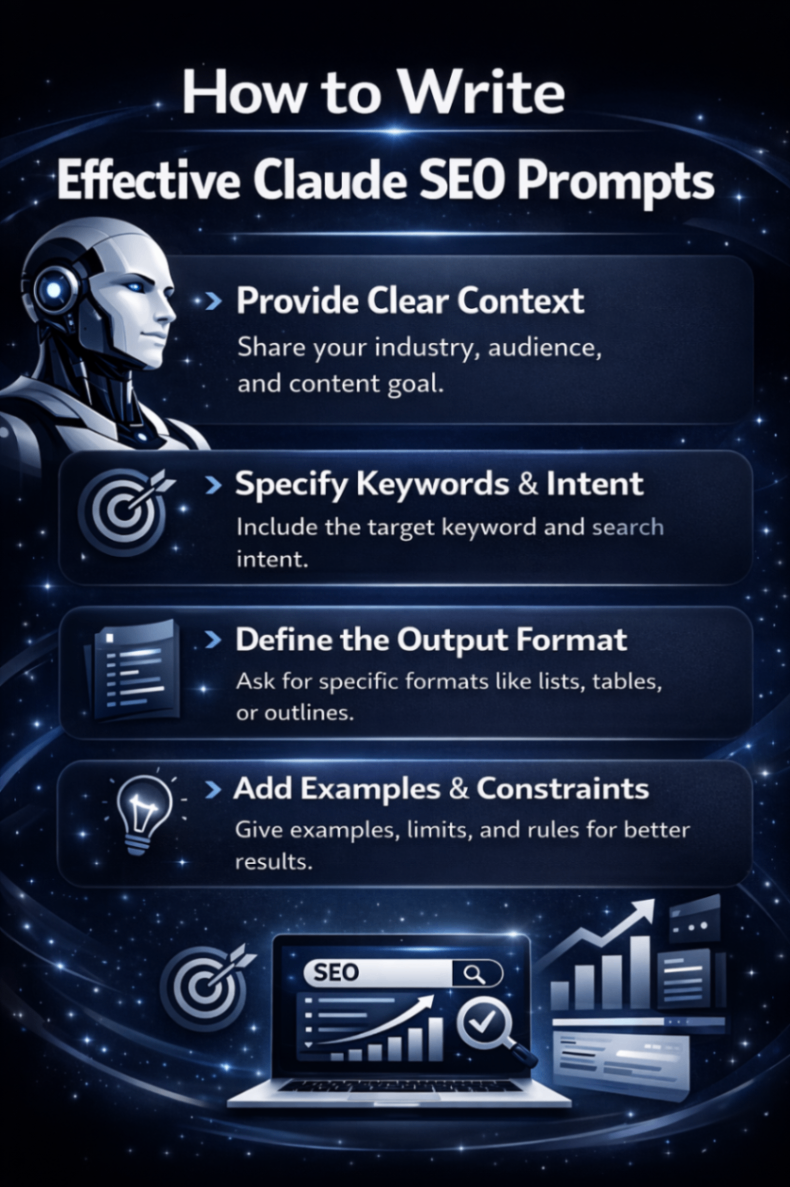
To get the most out of Claude AI, you need to move beyond simple questions and write effective Claude prompts. The quality of your input directly dictates the quality of the output. Think of it as briefing a team member; the more detailed and clear your instructions, the better the final product will be.
A well-crafted prompt should provide context, specify your goals, and define the desired format. This ensures the AI delivers targeted, actionable insights that align with your keyword strategy and desired content structure, making it one of the most efficient SEO tools in your arsenal. Let's look at the key elements of a great prompt.
1. Provide Clear Context
Providing clear context is the foundation of a successful Claude prompt. The AI needs to understand the "why" behind your request. This means giving it background information about your business, your target audience, and your overall content strategy. Claude's large context window allows it to remember these details throughout your conversation, leading to more relevant and consistent outputs.
When you set the stage properly, the AI can better grasp the specific user intent you're trying to satisfy. For instance, instead of just asking for keywords, you should specify the industry you're in and the type of customer you're targeting. This small step makes a huge difference.
Here's what you should include to provide sufficient context:
- Your industry or niche (e.g., B2B SaaS, local HVAC services).
- A brief description of your target audience and their pain points.
- The primary goal of the content (e.g., drive conversions, build topical authority).
2. Specify Keywords and Search Intent
After setting the context, your next step is to be explicit about your keyword targets and the associated search intent. Simply providing a keyword isn't enough. You need to guide Claude on how to use it and what user goal the content should fulfill. This is a critical part of content optimization and effective keyword research.
Are you targeting users looking for information, comparing products, or ready to make a purchase? Specifying the search intent—be it informational, commercial, or transactional—helps Claude tailor the tone, structure, and call-to-action of the generated content. This ensures the output aligns perfectly with the user's position in the sales funnel.
To do this effectively, your prompt should:
- Clearly state the primary keyword and any secondary or long-tail keywords.
- Define the search intent (e.g., informational, transactional).
- Mention any keywords you want to avoid, such as competitor brand names.
3. Define Output Format
How you want the information presented is just as important as the information itself. Defining the output format in your prompt ensures you receive SEO content that is structured, easy to use, and fits your specific needs without requiring extensive reformatting. Without this guidance, the AI might produce a solid block of text when you needed a list or a table.
Whether you need a blog post outline, a set of meta descriptions, or a JSON-LD schema, being precise about the content structure is key. You can also specify the desired tone of voice (e.g., professional, conversational) and the target word count to control the depth and detail of the response.
Specify your desired output format by including instructions like:
- "Generate a list of H2 and H3 headings."
- "Write the output in a table with columns for 'Keyword' and 'Search Intent'."
- "Create a JSON-LD schema for an FAQ section."
4. Add Examples and Constraints
To further refine Claude's output, it's helpful to provide examples and constraints. Including an example of what you're looking for gives the AI a clear model to follow, whether it's a certain writing style, a specific format for case studies, or the way you want data points presented. This is one of the most effective ways to improve the quality of your SEO prompts.
Constraints are equally important. These are the "dos and don'ts" of your request. For instance, you might instruct Claude to keep meta descriptions under 155 characters or to avoid mentioning specific topics. Adding constraints helps prevent generic responses and guides the AI toward filling specific content gaps you've identified.
Effective examples and constraints include:
- Providing a sample meta description to emulate.
- Setting a character limit for title tags or a word count for an article.
- Instructing the AI to "not include information about [competitor name]."
Got it. I’ll format the prompts as plain text, not in code boxes.
Here’s the section rewritten in that style:
What Are The Best AI SEO Claude Prompts For Keyword Research?
Keyword research works much better when Claude gets specific instructions instead of broad requests. The goal is to guide it toward search intent, topic depth, and realistic keyword opportunities you can actually turn into content.
Keyword Expansion Prompt
This prompt helps you grow one seed keyword into a wider set of related opportunities. It is useful when you want to build a stronger keyword list before outlining content.
Prompt:
Act as an SEO strategist. I want to expand the seed keyword: [PRIMARY KEYWORD].
Generate a keyword list grouped into these categories:
- Primary keyword variations
- Related semantic keywords
- Question-based keywords
- Commercial intent keywords
- Informational intent keywords
For each keyword, include:
- Estimated search intent
- Why it matters for SEO
- Suggested content type such as blog post, landing page, comparison page, or FAQ
Keep the output organized in a table and avoid duplicate terms.
Search Intent Analysis Prompt
Search intent determines what kind of page has the best chance to rank. This prompt helps Claude break down what users are really looking for when they type in a keyword.
Prompt:
Act as an SEO expert. Analyze the search intent for the keyword: [KEYWORD].
Break the intent into:
- Primary intent
- Secondary intent
- Likely user goals
- Content format most likely to rank
- Recommended page structure
Then explain whether this keyword is best suited for a blog post, service page, product page, category page, or FAQ page.
Make the explanation practical and focused on ranking potential.
Long-Tail Keyword Discovery Prompt
Long-tail keywords are often easier to rank for and usually attract more qualified traffic. This prompt helps Claude uncover specific keyword variations around a topic.
Prompt:
Act as an SEO keyword researcher. Using the main topic [TOPIC], generate 30 long-tail keywords that are highly relevant and realistic for organic search.
Group them by:
- Beginner-focused queries
- Problem-solving queries
- Comparison queries
- Purchase-intent queries
- Location-based queries if relevant
For each keyword, include:
- Search intent
- Level of specificity
- Suggested article or page angle
Prioritize keywords that are clear, natural, and useful for content planning.
Competitor Keyword Gap Prompt
A competitor keyword gap prompt helps you spot content and keyword opportunities your site may be missing. It is especially useful during content planning and content audits.
Prompt:
Act as an SEO competitor analyst. Compare my website [YOUR WEBSITE] with these competitors: [COMPETITOR 1], [COMPETITOR 2], [COMPETITOR 3].
Identify likely keyword gaps by listing:
- Topics competitors are targeting that my site may be missing
- High-value informational keywords
- Commercial keywords with conversion potential
- Supporting blog topics that could strengthen topical authority
For each gap, explain:
- Why it matters
- What type of page should target it
- Which stage of the funnel it supports
Present the findings in a clear table.
What Are The Best Claude Prompts For SEO Content Creation?
Claude can speed up content creation when you give it strong direction. The best prompts tell it what to write, who the audience is, what keywords matter, and how the output should be structured.
Blog Post Outline Generator Prompt
A solid outline makes the writing process faster and helps ensure the article covers the topic thoroughly. This prompt is great for building structure before drafting.
Prompt:
Act as an SEO content strategist. Create a detailed blog post outline for the keyword: [PRIMARY KEYWORD].
Include:
- A compelling H1
- SEO-friendly H2s and H3s
- Key points to cover under each heading
- Frequently asked questions to include
- Suggested internal linking opportunities
- Search intent behind the topic
The target audience is [TARGET AUDIENCE], and the tone should be [TONE].
Make the outline comprehensive, non-repetitive, and optimized for organic search.
SEO-Optimized Article Writer Prompt
This prompt helps Claude turn a content brief into a draft that is both readable and SEO-friendly. It works best when you define the audience, structure, and keyword priorities.
Prompt:
Act as an SEO blog writer. Write a high-quality article targeting the keyword: [PRIMARY KEYWORD].
Requirements:
- Target audience: [AUDIENCE]
- Tone: [TONE]
- Word count: [WORD COUNT]
- Include the primary keyword naturally in the introduction, subheadings, and conclusion
- Use these secondary keywords where relevant: [SECONDARY KEYWORDS]
- Add a strong introduction and conclusion
- Include H2 and H3 headings
- Keep paragraphs concise and easy to read
- Optimize for search intent and user engagement
Make the article original, conversational, and useful.
Introduction Hook Generator Prompt
Introductions matter because they decide whether readers keep going. This prompt helps Claude generate opening paragraphs that pull readers in while staying relevant to the keyword and search intent.
Prompt:
Act as an SEO copywriter. Write 3 alternative blog introductions for the topic: [TOPIC].
Each introduction should:
- Hook the reader in the first sentence
- Clearly reflect the search intent
- Naturally include the primary keyword: [PRIMARY KEYWORD]
- Build curiosity and relevance
- Lead smoothly into the rest of the article
Keep each version engaging, natural, and written for [TARGET AUDIENCE].
SEO Subheading Generator Prompt
Subheadings shape the flow of an article and make it easier to scan. This prompt helps Claude generate headings that improve both readability and keyword coverage.
Prompt:
Act as an SEO editor. Generate optimized H2 and H3 subheadings for a blog post targeting the keyword: [PRIMARY KEYWORD].
The article topic is: [TOPIC]
The audience is: [AUDIENCE]
Make sure the subheadings:
- Match search intent
- Cover important related subtopics
- Avoid repetition
- Sound natural and reader-friendly
- Include variations of the target keyword where appropriate
Organize the output into a logical article structure.
What Are The Best Claude Prompts For On-Page SEO Optimization?
On-page SEO is where content gets refined for both search engines and real readers. Claude can be useful here if you clearly tell it what page element or draft section needs improvement.
Meta Title & Description Generator
This prompt helps Claude create title tags and meta descriptions that are optimized for clicks as well as relevance. It is especially useful when you want multiple variations to choose from.
Prompt:
Act as an SEO specialist. Generate 10 meta title options and 10 meta description options for a page targeting the keyword: [PRIMARY KEYWORD].
Requirements:
- Meta titles should stay within recommended character limits
- Meta descriptions should stay within recommended character limits
- Include the primary keyword naturally
- Make them compelling and click-worthy
- Match the search intent of the keyword
- Avoid generic phrasing
Also label which options are best for informational intent and which are best for commercial intent.
Internal Linking Suggestions Prompt
Internal links improve site structure, user navigation, and topical authority. This prompt helps Claude suggest smart internal link opportunities across your site.
Prompt:
Act as an SEO strategist. Review this page topic: [PAGE TOPIC] and suggest internal linking opportunities.
Use these existing site pages:
[LIST OF URLS OR PAGE TITLES]
For each suggestion, include:
- Source page
- Target page
- Recommended anchor text
- Why the link makes sense for users
- Why it supports SEO
Prioritize links that improve topical authority, crawlability, and user flow.
SEO Content Optimization Prompt
If you already have a draft, this prompt helps Claude improve it for SEO without making it sound robotic. It is ideal for polishing pages before publishing or updating older content.
Prompt:
Act as an SEO content optimizer. Review the following draft and suggest improvements for on-page SEO.
Focus on:
- Keyword placement
- Missing subtopics
- Readability
- Heading structure
- Internal linking opportunities
- Opportunities to improve relevance and depth
- Featured snippet potential
Here is the draft:
[PASTE CONTENT]
Provide:
- A summary of weaknesses
- Specific recommendations
- A revised version of any weak section if needed
Featured Snippet Optimization Prompt
Featured snippets usually reward content that answers questions clearly and directly. This prompt helps Claude rewrite parts of your content into snippet-friendly formats.
Prompt:
Act as an SEO content editor. Optimize the following content for featured snippets targeting the keyword: [KEYWORD].
Review the content and rewrite key sections into formats that are more likely to win snippets, such as:
- Short paragraph answers
- Numbered lists
- Bullet lists
- Definitions
- Step-by-step explanations
Here is the content:
[PASTE CONTENT]
Explain which snippet format fits each section best and why.
What Are The Best Claude Prompts For SERP Features & People Also Ask?
SERP features can expand your visibility beyond standard rankings. Claude can help you uncover question opportunities, create sharper answers, and build FAQ content that aligns with how people search.
People Also Ask Question Generator
People Also Ask questions reveal what users commonly want to know around a topic. This prompt helps Claude generate those question angles for better content coverage.
Prompt:
Act as an SEO researcher. Generate a list of People Also Ask style questions related to the keyword: [PRIMARY KEYWORD].
Group the questions by:
- Basic definitions
- How-to queries
- Comparison queries
- Problem-solving queries
- Advanced or expert-level questions
Make the questions realistic, natural-sounding, and aligned with what users are likely to search.
PAA Answer Optimization Prompt
Once you have the questions, you need answers that are concise and useful. This prompt helps Claude create responses suited for FAQ sections and direct-answer visibility.
Prompt:
Act as an SEO copywriter. Write concise, search-friendly answers to these People Also Ask questions:
[PASTE QUESTIONS]
Requirements:
- Each answer should be clear and direct
- Keep each answer between 40 and 60 words unless the question needs more context
- Use simple language
- Include the target keyword naturally where relevant
- Make the answers suitable for FAQ sections and snippet optimization
Format the output with each question followed by its answer.
FAQ Schema Generator Prompt
FAQ sections can support visibility and improve content completeness. This prompt helps Claude produce question and answer pairs that can later be turned into schema markup.
Prompt:
Act as a technical SEO assistant. Create an FAQ section with schema-ready question and answer pairs for the topic: [TOPIC].
Requirements:
- Generate 8 to 10 questions
- Make each question relevant to search intent
- Keep answers concise, accurate, and user-friendly
- Avoid repetitive wording
- Make the content suitable for both readers and FAQ schema implementation
Present the output in this format:
Question:
Answer:
What Are The Best Claude Prompts For SEO Strategy & Content Planning?
SEO grows faster when you plan content as a system instead of publishing random articles. Claude can help you find gaps, organize clusters, map authority, and build a realistic publishing roadmap.
Content Gap Analysis Prompt
This prompt helps uncover missing topics and weak areas in your current content. It is useful when you want to prioritize what to create next.
Prompt:
Act as an SEO strategist. Analyze my current content coverage for the topic: [TOPIC].
Here are the existing pages:
[LIST OF PAGES OR TOPICS]
Identify:
- Missing subtopics
- Weak areas in the funnel
- Questions the audience may still have
- Supporting content opportunities
- High-impact pages I should create next
Organize the output by priority and explain why each gap matters for SEO.
Topic Cluster Strategy Prompt
Topic clusters help connect related content under a clear structure. This prompt helps Claude build a pillar-and-cluster model around your main topic.
Prompt:
Act as an SEO content strategist. Build a topic cluster strategy for the core topic: [CORE TOPIC].
Include:
- One pillar page idea
- Supporting cluster page ideas
- Search intent for each page
- Suggested internal linking relationships
- Recommended order of content creation
Make the cluster practical, non-repetitive, and focused on building topical authority.
SEO Content Calendar Generator Prompt
A content calendar helps turn ideas into a repeatable publishing plan. This prompt helps Claude organize content production around themes, intent, and SEO value.
Prompt:
Act as an SEO content planner. Create a 3-month SEO content calendar for the topic: [TOPIC].
For each content piece, include:
- Proposed title
- Primary keyword
- Search intent
- Funnel stage
- Content type
- Publishing priority
- Goal of the page
Balance the calendar across awareness, consideration, and conversion content. Make it realistic and strategically sequenced.
Authority-Building Topic Map Prompt
Topical authority comes from covering a subject in enough depth to show expertise. This prompt helps Claude map out content ideas that strengthen that authority over time.
Prompt:
Act as an SEO strategist focused on topical authority. Build an authority-building topic map for [TOPIC].
Include:
- Core themes
- Supporting subtopics
- Beginner, intermediate, and advanced content ideas
- Commercial and informational opportunities
- Suggested internal linking paths between pages
Structure the map so it can support long-term organic growth and brand authority.
What Are The Best Claude Prompts For Link Building & Outreach?
Link building becomes easier when the messaging is relevant and personalized. Claude can help you brainstorm outreach ideas, guest post angles, and supporting assets that make your pitches stronger.
Outreach Email Prompt
This prompt helps Claude draft outreach emails that feel personalized instead of generic. It is useful for backlink outreach, collaboration requests, and partnership pitches.
Prompt:
Act as a digital PR and SEO outreach specialist. Write a personalized outreach email for this purpose: [PURPOSE].
Details:
- My website: [YOUR WEBSITE]
- Target website: [TARGET WEBSITE]
- Topic or asset I am pitching: [TOPIC OR ASSET]
- Desired action: [BACKLINK, COLLABORATION, GUEST POST, ETC.]
The email should:
- Sound professional and human
- Be concise and respectful
- Clearly explain the value to the recipient
- Include a strong but natural call to action
Write 3 versions with slightly different tones.
Guest Post Topic Generator Prompt
Guest posting works better when the pitch is tailored to the site’s audience and content style. This prompt helps Claude generate relevant topic ideas that are more likely to get accepted.
Prompt:
Act as an SEO content strategist. Generate guest post topic ideas for this website: [TARGET WEBSITE].
My niche is: [NICHE]
My expertise includes: [EXPERTISE AREAS]
Suggest 15 guest post topics that:
- Match the site’s likely audience
- Are valuable and non-promotional
- Support my topical authority
- Offer natural opportunities for brand visibility or contextual backlinks
For each topic, include a short angle or pitch summary.
Author Bio Optimization Prompt
Author bios can support credibility, trust, and relevance in outreach and guest posting. This prompt helps Claude craft bios that sound polished and aligned with your SEO goals.
Prompt:
Act as a content editor. Write 5 author bio options for a contributor in the [NICHE] space.
Use these details:
- Name: [NAME]
- Role: [ROLE]
- Brand or website: [BRAND/WEBSITE]
- Expertise: [AREAS OF EXPERTISE]
- Tone: [TONE]
Make the bios concise, credible, and suitable for guest posts, contributor pages, and outreach profiles.
What Are The Best Claude Prompts For SEO Performance Analysis?
SEO performance analysis is where you turn results into action. Claude can help interpret page issues, identify content weaknesses, and suggest next steps when rankings or traffic start to shift.
SEO Audit Prompt
This prompt is useful when you want Claude to review a page or site from an SEO perspective and highlight what needs fixing first.
Prompt:
Act as an SEO auditor. Review this page or website for SEO performance: [URL OR CONTENT].
Analyze the following:
- On-page SEO issues
- Content quality and depth
- Keyword targeting
- Internal linking
- Search intent alignment
- Opportunities for technical or structural improvements
Then provide:
- A list of the biggest issues
- Why they matter
- Recommended actions in order of priority
Content Improvement Prompt
This prompt helps Claude evaluate whether a page is underperforming because the content is weak, outdated, or misaligned with search intent.
Prompt:
Act as an SEO content strategist. Review this page and suggest how to improve its search performance.
Here is the content or page summary:
[PASTE CONTENT OR URL DETAILS]
Focus on:
- Weak or outdated sections
- Missing subtopics
- Opportunities to improve clarity and depth
- Better keyword alignment
- Ways to improve engagement and usefulness
Present the output as a practical action plan.
Competitor Content Analysis Prompt
Looking at competitor pages can reveal why they rank better and what your content may be missing. This prompt helps Claude break that down in a structured way.
Prompt:
Act as an SEO competitor analyst. Compare my content on [TOPIC OR URL] with these competitor pages: [COMPETITOR URLS OR TOPICS].
Evaluate:
- Content depth
- Search intent match
- Heading structure
- Topical coverage
- Readability
- Trust signals
- Likely reasons competitors are outperforming my page
Then recommend specific improvements I can make to compete more effectively.
Ranking Drop Investigation Prompt
When a page loses rankings, the issue could come from content freshness, stronger competition, intent mismatch, or technical changes. This prompt helps Claude investigate possible causes.
Prompt:
Act as an SEO analyst. Help me investigate a ranking drop for this page: [URL OR PAGE TITLE].
Keyword affected: [KEYWORD]
Traffic trend or ranking change: [DETAILS]
Recent updates made, if any: [DETAILS]
Analyze possible reasons for the drop, such as:
- Search intent mismatch
- Content decay
- Competitor improvements
- Weak internal linking
- On-page SEO issues
- SERP changes
Then provide a prioritized list of actions to recover rankings.
Conclusion
Claude can do much more than speed up content generation. With the right prompts, it can support keyword research, content planning, on-page optimization, and performance analysis in a way that improves search results, search rankings, and overall content marketing efforts. It can also help teams adapt to newer discovery channels like AI platforms, where answer engine optimization, AI search visibility, and visibility in AI search results are becoming more important.
The real value comes from using Claude strategically to answer user questions, follow SEO best practices, and create useful content that attracts organic traffic. Whether you are improving local SEO or building a long-term strategy, smart prompt design can give your brand a stronger competitive edge and make your workflow more effective.
Frequently Asked Questions
What are the most effective Claude prompts for improving website rankings?
The most effective Claude prompts for higher rankings are those that are specific and multi-faceted. Use detailed SEO prompts that combine keyword research, competitor analysis, and content structure requests. For example, ask Claude AI to generate a comprehensive content brief that includes target keywords, an outline, and identified content gaps for better search engine optimization.
How can I use Claude AI to optimize meta descriptions and on-page SEO elements?
To optimize on-page SEO, provide Claude AI with a target keyword and page URL. Use prompts asking it to generate several meta descriptions under 155 characters with a call-to-action. For other technical SEO elements, ask for internal linking suggestions or schema markup generation to improve your overall SEO optimization.
Are there Claude prompts that help track and measure SEO performance?
Yes, while Claude can't access live data, you can use prompts to analyze exported data. Paste information from your SEO tools like Google Search Console into a prompt and ask Claude to perform a content gap analysis, prioritize issues from an SEO audit, or suggest reasons for a drop in SEO performance.
Which is the best SEO tool for visibility in Claude?
For Claude-specific visibility tracking, Scrunch is one of the strongest choices because it explicitly supports Claude and lets teams monitor prompts, citations, and competitor performance across AI search. For a broader SEO plus AI visibility workflow, Ahrefs Brand Radar and Scalenut are strong alternatives.
Which are the best Claude SEO analysis tools?
The strongest current options are Scrunch for multi-LLM prompt and competitor tracking, Ahrefs Brand Radar for LLM brand visibility, Scalenut for AI visibility plus content execution, and Semrush One for combining traditional SEO with AI search visibility in one workflow.


.svg)


.webp)