.jpg)
How To Improve AI Citations Across Search & Answer Engines?
Key Highlights
- Different generative AI platforms like ChatGPT and Google use unique methods for sourcing information, impacting how they issue citations.
- To get cited by an AI search engine, content creators must answer questions early, add unique data, and structure content clearly.
- Strengthening your on-page SEO and building off-site authority are crucial for getting noticed by LLMs.
- A practical 90-day strategy involves auditing your current visibility and upgrading your highest-potential pages.
- Common mistakes that reduce citations include publishing generic content and ignoring source credibility.
- Measuring your improvement requires tracking brand mentions, monitoring prompt-level citation trends, and analyzing traffic from AI search.
The world of search is changing dramatically. For years, we've navigated a simple list of blue links, but artificial intelligence is transforming how we find information. Instead of just pointing you to a source, AI search aims to give you a direct answer. This new AI search experience uses AI to understand your questions and generate a seamless response. As this technology grows, it's vital for brands to understand how to appear in these AI-powered answers to stay visible.
How To Improve AI Citations?
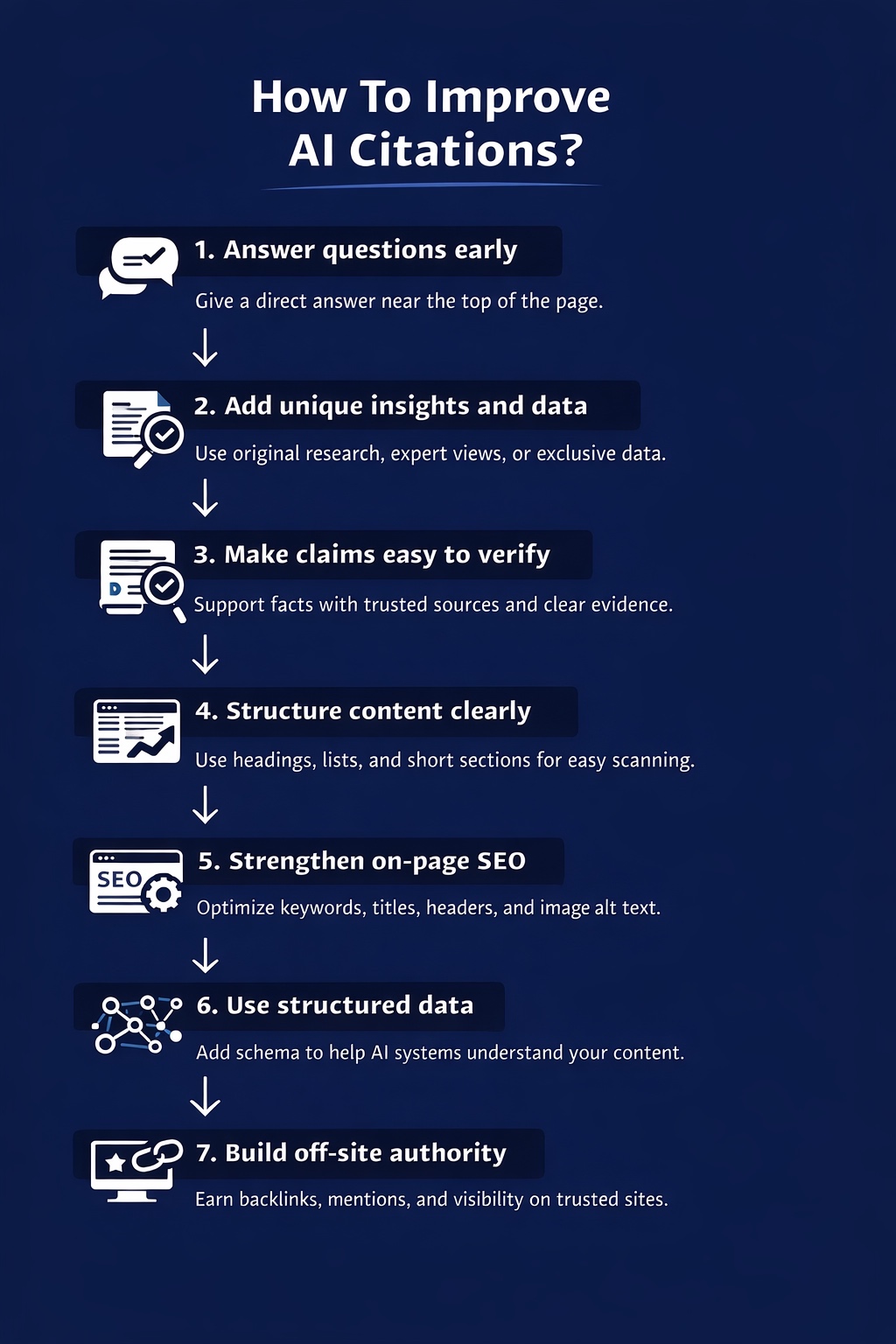
Improving your chances of getting AI citations requires a strategic approach to content creation. Let's explore some actionable steps you can take to boost your citation potential.
1. Answer Questions Early
One of the most effective ways to get cited in AI search is to answer the user's question immediately. Place the most important information right at the top of your page. AI answer engines often scan content for quick, clear answers to user queries. By providing a direct response upfront, you signal to systems like Google that your page has high relevance. This can increase your chances of being featured.
How do AI answer engines decide which sources to cite in their responses? They prioritize sources that are clear, direct, and authoritative. They look for content that efficiently addresses a specific question. Think about how you can structure your content to be easily pulled for a summary.
- Start with a concise summary.
- Use clear headings to frame the question.
- Get straight to the point.
This approach not only helps with AI but also improves the user experience, which can lead to better engagement and more organic clicks. You are essentially making your content "quotable" for both humans and machines.
2. Add Unique Insights And Data
In a world filled with generative AI content, uniqueness is your greatest asset. Generic information that can be found everywhere is less likely to be cited. To stand out, you need to provide unique data, fresh perspectives, or original research that AI can't simply regenerate from its existing knowledge base. This makes your content a primary source of factual information.
When a search engine synthesizes an answer, it looks for content that adds genuine value. If your article contains exclusive statistics or a novel analysis, it becomes a prime candidate for citation. Consider these approaches:
- Conducting your own surveys or case studies.
- Presenting proprietary data from your business.
By becoming a source of unique data, you position your brand as an authority. This not only boosts your citation chances but also encourages other websites to link back to you, further strengthening your credibility in the eyes of search algorithms.
3. Make Claims Easy To Verify
Trust is a major factor for AI engines. They are designed to prioritize information from credible sources. To build this trust, you must ensure that any claims you make are easy to verify. This means maintaining consistency across your site and linking to other authoritative sources to back up your statements. Source credibility is non-negotiable.
An AI is more likely to trust and cite a page that demonstrates its work. Think of it as showing your homework. Every factual claim should be supportable. Here are a few ways to do this:
- Link to original research or data sources.
- Ensure your own data is presented clearly.
- Maintain a consistent URL structure so pages are easy to find.
When your content is transparent and well-supported, it signals reliability. This reduces the "guesswork" for the AI, making it more confident in using your page for its citations. This practice also benefits your human readers by showing them you've done your research.
4. Structure Content Clearly
The structure of your content plays a huge role in how easily an AI search system can understand and use it. A well-organized page with logical headings, lists, and short paragraphs is much easier for an algorithm to parse. Think about creating an article that flows from a broad overview to specific details.
When an AI generates an answer, it often pulls information from different sections of a page to create a comprehensive summary. Clear structure helps the AI identify the most relevant parts of your content. Using H2s and H3s to break down topics allows the AI to grab snippets of information that directly answer different facets of a query.
Ultimately, a clean and logical layout makes your content more machine-readable. This improves your chances of being included in AI overviews and cited as a source. Good structure is not just about aesthetics; it's a technical requirement for visibility in the age of AI search.
5. Strengthen On-Page SEO
Fundamental on-page SEO practices are more important than ever for AI search visibility. AI engines like Google still rely on traditional ranking signals to determine the relevance and authority of a page. This includes optimizing your titles, meta descriptions, and headers with relevant keywords. Good SEO helps the AI understand what your page is about.
To strengthen your on-page SEO for AI, focus on clearly signaling your content's topic and intent. This helps AI systems match your page to user queries with greater accuracy. Consider these two key actions:
- Incorporate primary and secondary keywords naturally throughout your text.
- Use descriptive alt text for images to provide additional context.
By aligning your SEO efforts with the topics you want to be cited for, you create a strong signal of relevance. This foundation ensures that when an AI search is conducted, your well-optimized page is in the running to be selected as a credible source.
6. Use Structured Data
Structured data, or schema markup, is a powerful tool for communicating directly with search engines. It's a standardized format for providing explicit clues about the meaning of a page. By implementing structured data, you can tell an AI search system exactly what your content is about, whether it's an article, a product, or an event.
This detailed information helps the search engine categorize and understand your content with greater precision, increasing the likelihood that it will be used in a relevant AI-generated answer. For example, using "Article" schema can highlight the author, publication date, and headline, reinforcing your content's credibility.
While structured data may not directly result in a citation every time, it significantly improves how your content is processed and indexed. This can indirectly boost your visibility and, over time, contribute to more website traffic from AI search features. It removes ambiguity and makes your content a more reliable choice for AI.
7. Build Off-Site Authority
What happens off your website is just as important as what happens on it. Off-site authority is a measure of your brand's credibility across the internet, and AI search engines pay close attention to it. This authority is primarily built through backlinks from reputable websites and mentions on social media and other platforms.
When other high-quality sites link to your content, it acts as a vote of confidence. This signals to AI systems that your content is trustworthy and valuable. A strong backlink profile is one of the most powerful indicators of authority. Here are some ways to build it:
- Create unique, citable content that others want to reference.
- Engage in digital PR to get your brand mentioned in online publications.
- Share your content across relevant social media channels to increase its reach.
Building off-site authority is a long-term game, but it's essential for becoming a go-to source for AI search. The more your brand is talked about and linked to online, the more likely AI engines will be to trust and cite your content.
What Is A Practical Strategy To Improve AI Citations Over The Next 90 Days?
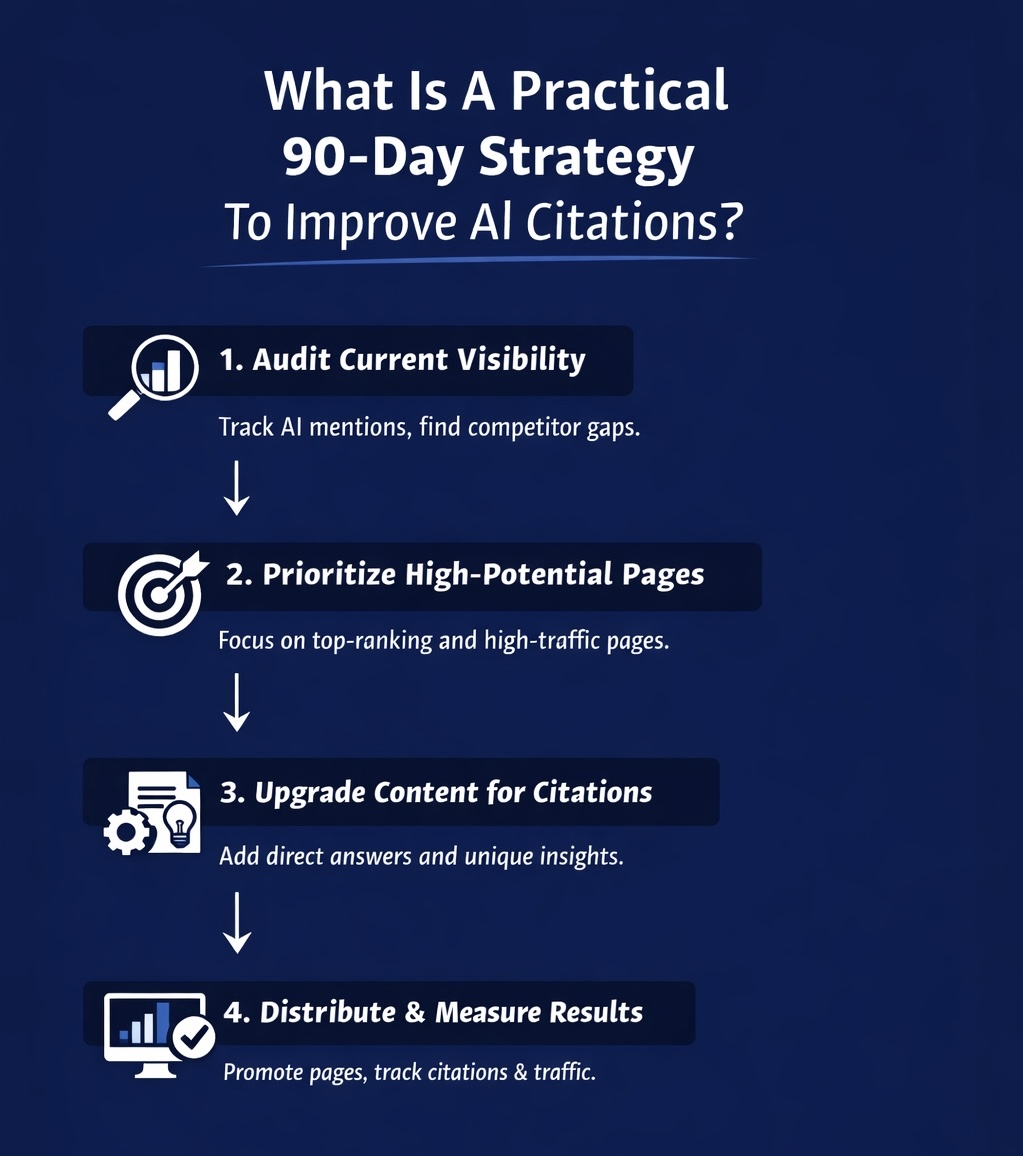
To increase your AI citations, you need a focused plan. Over the next 90 days, you can make significant progress by concentrating your digital marketing and SEO efforts on your highest-potential content. The following steps will guide you through this 90-day sprint.
1. Audit Your Current Citation Visibility
The first step in any improvement plan is to understand your starting point. You need to audit your current visibility in AI-generated answers. This means manually testing relevant queries on different AI platforms to see if your brand is being mentioned or cited. This initial assessment will help you establish a baseline.
Document which of your pages appear for certain queries and which competitors are showing up where you are not. This analysis will reveal gaps and opportunities. Pay attention to the types of questions that trigger AI answers in your niche, as this can inform your content strategy moving forward.
This audit isn't just about finding where you're cited; it's also about understanding where you're not and why. Are competitors answering questions more directly? Is their content better structured? This initial research is crucial for focusing your efforts and measuring your progress in increasing traffic and visibility from AI use.
2. Identify Your Highest-Potential Pages
After your audit, you'll have a better idea of where you stand. The next step is to identify the pages on your website that have the highest potential for earning AI citations. These are often pages that already perform well in traditional search or cover topics with high relevance to your audience's informational needs.
Look for content that aligns with the types of questions people are asking AI search engines. You can use your existing SEO data to find these gems. Focus on pages that have:
- Strong rankings for relevant keywords.
- High traffic but could be better optimized for direct answers.
By prioritizing these pages, you can leverage their existing authority to gain a foothold in AI search. Instead of starting from scratch, you'll be building on a solid foundation. This targeted approach ensures you're investing your time and resources where they will have the most impact.
3. Upgrade Content Using Citation-Ready Best Practices
Once you've identified your priority pages, it's time to upgrade them. This involves revising the content to align with the best practices for earning citations from AI platforms like Google. The goal is to make your content clearer, more authoritative, and easier for an AI to parse. Focus on improving accuracy, structure, and providing direct answers.
Review each page and ask yourself if it directly answers a question. If not, restructure it to do so. Add unique data, statistics, or insights to make it more valuable. Ensure all factual claims are supported and easy to verify. Breaking down complex topics into simple, digestible paragraphs can also make a big difference.
By systematically applying these upgrades, you significantly increase your content's chances of being selected for AI-generated answers and earning those valuable citations.
4. Expand Distribution And Review Performance
After upgrading your content, the final step in your 90-day plan is to promote it and monitor the results. Don't just hit "publish" and hope for the best. Actively distribute your updated pages across relevant channels, such as social media, email newsletters, and industry forums. This helps get fresh eyes on your content and can generate new backlinks and social signals.
As you promote your content, keep a close watch on your analytics. Track whether the changes are leading to an increase in brand mentions or citations in AI search. You can do this by periodically re-running the queries you identified in your initial audit. Look for any changes in your visibility.
Also, monitor your website traffic and engagement metrics for the pages you upgraded. Are you seeing an increase in organic traffic or higher user engagement? Tying your efforts back to these key performance indicators will help you understand what's working and refine your strategy for the future.
Should You Optimize Differently For ChatGPT, Perplexity, And Google AI?
Different AI engines like ChatGPT, Perplexity, and Google's Gemini have their own ways of generating answers and citing sources. Perplexity, for instance, is built as an "answer engine" that relies on live web retrieval and frequently shows citations. In contrast, ChatGPT's baseline models generate answers from their training data and may not provide sources unless browsing features are enabled.
How do different AI answer engines like ChatGPT and Perplexity choose and display citations? Their approaches vary, but there's also significant overlap. While some platform-specific tweaks can be beneficial, building a strong foundation of authoritative, well-structured content is a universal strategy that works across most LLMs. Let’s look at the nuances.
What Does Citation Overlap Reveals About Cross-Platform Visibility?
When you start analyzing where citations come from across different AI platforms, you'll likely notice a significant overlap. Many large language models tend to pull from the same pool of high-authority, well-regarded sources. This is because the fundamental principles of what makes content trustworthy and useful are universal.
This overlap suggests that a "rise all boats" strategy is highly effective. By focusing on creating content that is authoritative, well-structured, and rich with unique information, you increase your visibility across the board. You don't necessarily need a completely separate strategy for each AI search engine.
The core lesson from citation overlap is that quality wins. If your content is genuinely the best resource on a topic, it has a good chance of being cited by multiple platforms. This reinforces the idea that focusing on content excellence is a more sustainable approach than trying to game individual algorithms.
Where Does Platform-Specific Citation Opportunities Still Matter?
While a universal strategy is key, there are still platform-specific nuances that can create unique citation opportunities. Each AI search platform has its own interface and method for presenting information, which can influence what kind of content gets featured. For example, Google’s AI Overviews often pull from content that is well-suited for featured snippets.
Some platforms might prioritize different types of sources. For example, some AI engines heavily reference forums like Reddit for conversational queries, while others may lean more on academic papers or news articles for factual questions. Understanding these tendencies can help you tailor some of your content for a specific platform.
- Google AI: Optimizing for featured snippets can increase your chances of appearing in AI Overviews.
- ChatGPT with Browsing: Providing real-time, up-to-date information can be beneficial since it can access the live web.
Recognizing these differences allows you to make small, strategic adjustments. This doesn't mean creating entirely separate content, but rather fine-tuning your pages to align with the specific formats and source preferences of a target platform.
How To Balance Universal Authority With Platform-Specific Strategies?
The most effective approach to earning AI citations is to find a balance between building universal authority and making targeted, platform-specific optimizations. Your primary focus should always be on the universal strategy: creating high-quality, trustworthy, and well-structured content. This is the foundation that will make you eligible for citations across all AI search platforms.
Think of it as an 80/20 rule. Spend 80% of your effort on the foundational elements of authority, such as original research, clear writing, strong on-page SEO, and building backlinks. This work will benefit you everywhere. It establishes your credibility and ensures your content is a reliable source for any AI.
Then, dedicate the remaining 20% of your time to platform-specific tweaks. This could mean optimizing a page's structure to better fit Google's AI Overviews or adding a concise summary that works well for a chat-based AI. This balanced approach allows you to build a strong, sustainable presence without getting lost in the weeds of chasing every minor algorithm change.
What Are The Most Common Mistakes That Reduce AI Citations?
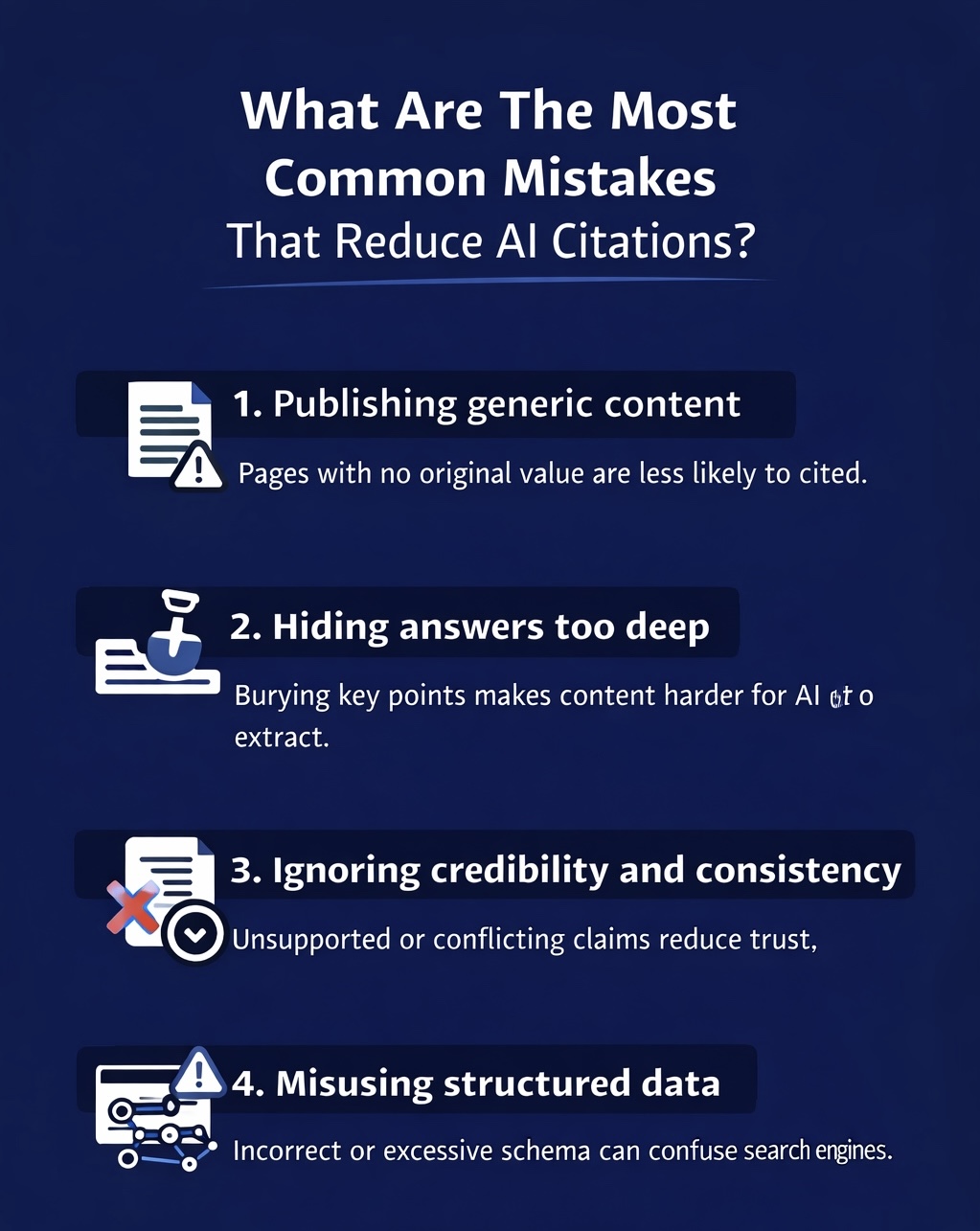
Many brands struggle to get AI citations because they make a few common mistakes. These pitfalls often relate to the quality and structure of their content, as well as their overall SEO strategy. Let's explore some of the most frequent missteps to avoid.
1. Publishing Generic Content With No Unique Valu
Publishing generic content often leads to a significant drop in relevance and visibility. Without unique value, AI search algorithms, like those utilized by Google and ChatGPT, may overlook your work, resulting in fewer organic clicks and diminished website traffic. To stand out in a crowded digital landscape, focus on creating tailored content that addresses specific queries and concerns. Leveraging large language models can help generate innovative ideas while ensuring factual information and consistency, ultimately enhancing your site’s performance across traditional search engines and social media platforms.
2. Hiding Key Answers Deep In The Page
Another common error is burying the most important information deep within a long article. AI search engines, much like busy human readers, are looking for quick and direct answers to their queries. If they have to scan through several paragraphs of fluff to find the answer, they will likely move on to a different source that presents the information more clearly.
Your page structure should be designed to surface key information immediately. This is especially important for platforms like Google, which often pull content for AI Overviews from the top of the page. Here's what to avoid and what to do instead:
- Don't start with a long, rambling introduction.
- Do place a concise summary or direct answer right after the main heading.
Think of your page as an inverted pyramid. The most critical information should be at the top, followed by supporting details. This structure makes it easy for an AI to identify the core message of your page and extract the relevant answer, increasing your chances of being cited.
3. Ignoring Source Credibility And Fact Consistency
Trust is a critical factor in the world of AI search. If your website contains inconsistent factual information or fails to cite its own sources, AI engines will view it as unreliable. Ignoring source credibility is a surefire way to be overlooked for citations. An AI is less likely to reference a source it cannot verify.
To build credibility, ensure that all factual information on your site is accurate and consistent. If you state a statistic on one page, make sure the same statistic is used on other relevant pages. Furthermore, back up your claims by linking to authoritative external sources. This demonstrates that you have done your research and are a trustworthy provider of information.
Every piece of content you publish contributes to your overall source credibility. A single page with inaccurate or unsupported claims can damage the trustworthiness of your entire domain. Maintaining a high standard of factual accuracy and consistency is non-negotiable for earning AI citations.
4. Using Structured Data Incorrectly Or Excessively
While structured data is a powerful SEO tool for AI search, using it incorrectly or excessively can do more harm than good. Implementing schema markup that doesn't accurately reflect the content on your page can confuse search engines and damage your credibility. The goal of structured data is to provide clarity, not to mislead.
Overuse of structured data can also be problematic. Stuffing your markup with irrelevant information in an attempt to manipulate rankings can be seen as spammy by search engines. It's important to use only the schema types that are relevant to your content. For example:
- Use "Article" schema for blog posts.
- Use "Product" schema for e-commerce pages.
- Use "FAQPage" schema only when you have a genuine FAQ section.
The key is to be helpful and accurate. Use structured data to give search engines a clear and honest summary of your page's content. When used properly, it's a valuable asset. When abused, it can quickly become a liability.
How Can You Measure Whether Your AI Citations Are Improving?
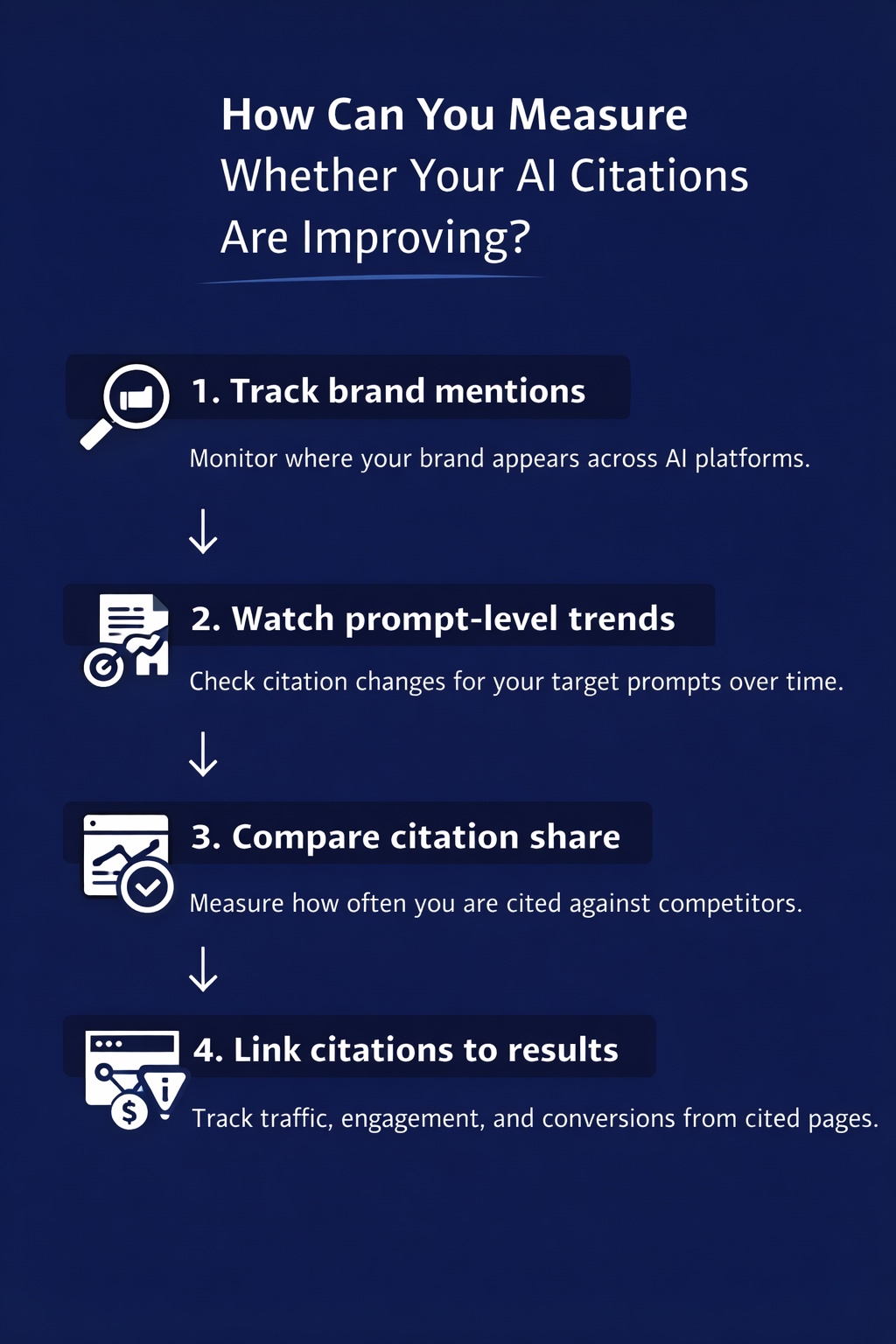
To know if your efforts are paying off, AI citation tracking is an unavoidable aspect. Monitoring your brand mentions, tracking citation trends for specific prompts, and comparing your performance against competitors will tell you if your strategy is working.
Let's break down how you can measure your improvement.
1. Track Brand Mentions Across AI Platforms
One of the most direct ways to measure your impact is to track how often your brand is mentioned in the answers generated by various AI platforms. This includes both direct citations with links and unlinked brand mentions. While citations drive traffic, mentions build brand awareness and signal authority.
You can set up alerts or use brand monitoring tools to catch mentions of your brand name across the web, which may include AI-generated content. Additionally, you'll need to perform manual searches on different AI search engines using relevant keywords and questions. Keep a log of when and where your brand appears.
This process provides a qualitative and quantitative measure of your visibility. Are you being mentioned more frequently? Are you appearing for a wider range of queries? Tracking these brand mentions over time will give you a clear indication of whether your authority is growing in the eyes of AI.
2. Monitor Prompt-Level Citation Trends Over Time
To get more granular with your measurement, you should monitor citation trends at the prompt level. This means identifying a set of key questions or prompts that are important for your business and regularly checking to see which sources are being cited for them. This allows you to track your performance on the queries that matter most.
Create a spreadsheet to log your findings. For each target prompt, record which domains are cited and how your own domain is performing. This will help you spot trends over time. Here’s what to look for:
- Are you gaining citations for prompts where you were previously absent?
- Are you losing citations to a new competitor?
This detailed tracking helps you understand the direct impact of your content upgrades. If you optimized a page to answer a specific question, prompt-level monitoring will tell you if that effort was successful. It turns the abstract goal of "improving citations" into a measurable, data-driven process.
3. Compare Citation Share Against Competitors
Understanding your performance in a vacuum isn't enough. You need to know how you stack up against your competitors. Analyzing your "citation share" gives you a competitive benchmark and helps you identify who is dominating the conversation in your niche within AI search. This is a critical part of any competitive SEO analysis.
To do this, select a basket of 10-20 high-value keywords or queries relevant to your industry. For each query, run a search on your target AI platforms and note which competitors are cited. Tally up the results to see who has the largest share of citations for that set of queries.
By regularly updating this analysis, you can track whether you are gaining ground on your competitors and identify which of their strategies might be working.
4. Tie AI Citation Gains Back To Traffic And Conversions
Ultimately, the goal of earning AI citations is to drive meaningful business results. That's why it's crucial to connect your citation gains back to your website's traffic and conversions. While AI-driven "zero-click searches" are on the rise, the clicks you do get from citations are often from highly-qualified, high-intent users.
Use your analytics tools to monitor referral traffic from AI platforms. You may need to use UTM parameters or analyze referral sources to identify traffic coming from AI-generated answers. Look for patterns. Do pages that are frequently cited in AI search see an increase in organic traffic or higher conversion rates?
By connecting the dots between your citation efforts and your bottom-line metrics, you can demonstrate the ROI of your AI citation optimization strategy. This proves that earning citations isn't just a vanity metric; it's a valuable driver of qualified traffic and potential customers.
How Can Scalenut help You Improve AI Citations?
Improving AI citations is not just about tracking where your brand appears. It is about understanding why certain pages get cited, where your visibility gaps are, and what actions can improve your chances of being referenced. That is where Scalenut helps. Instead of showing disconnected visibility data, it connects AI citation insights with practical SEO and content workflows so your team can strengthen pages that are more likely to earn citations across platforms like ChatGPT, Perplexity, and Google AI results.
Scalenut helps you turn citation insights into action by uncovering missed opportunities, guiding content improvements, and making execution faster. With the right visibility signals and content strategy in one place, teams can refine existing pages, create stronger supporting content, and build the topical authority that makes their site more citation-worthy over time.
- AI visibility insights tied to real prompts: See how your brand appears in AI-generated answers and identify the topics, prompts, and query areas where you need stronger visibility.
- Content planning built for citation growth: Turn citation gaps into a focused content strategy with pillar pages, supporting articles, and updates that improve your chances of being referenced.
- Faster execution from brief to draft: Go from research and planning to optimized content creation in one workflow, helping your team publish improvements faster.
- Stronger topical authority across your site: Build better content connections and coverage so search engines and AI systems can more clearly recognize your expertise.
If your goal is to improve AI citations and build stronger visibility across answer engines, Scalenut helps turn insights into a repeatable optimization process. Book a demo today!
Conclusion
Improving AI citations is essential for enhancing visibility across search and answer engines. By answering questions early, providing unique insights, and ensuring that your content is easy to verify, you can significantly boost your citation performance. Structuring your content clearly and strengthening your on-page SEO will also contribute to better results.
Additionally, understanding platform-specific strategies and avoiding common pitfalls can further elevate your authority online. As you implement these strategies, remember to monitor your progress and make adjustments as needed. If you're ready to take the next step in optimizing your AI citations, don’t hesitate to get a free trial or consultation to gain expert insights tailored to your needs.
Frequently Asked Questions
How does the AI answer engines source citation process work?
AI search engines use a process called Retrieval-Augmented Generation (RAG). When you enter a query, the system first searches the web for relevant documents. Then, the generative AI, powered by large language models, synthesizes an answer based on that retrieved information and includes citations to the original sources.
Is there an API for public answer engine with source citations?
Yes, some search engine platforms offer APIs that provide access to their answer-generation capabilities, often including source citations. For example, companies like Perplexity and others provide APIs that allow developers to integrate AI-powered answers with traceable links to factual information into their own applications.
What is the impact of AI citations on awareness in answer engine search?
AI citations significantly boost brand awareness and visibility in AI search. Being cited positions your brand as an authority on a topic, increasing trust among users who see your name linked as a source. This form of digital marketing is crucial for staying top-of-mind in a zero-click search environment.
In answer engine search, how do citations vs mentions affect awareness?
Both citations and mentions build awareness in an answer engine. Citations are direct, clickable links that can drive traffic, while mentions are unlinked references to your brand name. Mentions build brand recall within the AI search answer itself, while citations offer a path for users to explore your content further.
Is there a difference in citation logic between traditional search engines and AI answer engines?
Yes, the logic differs. Traditional search engines rank a list of links based on relevance. AI search engines synthesize an answer from multiple sources and then provide citations. The AI's logic for choosing a citation is based on which source best helps it construct a direct and accurate answer to specific queries.
How do different AI answer engines like ChatGPT and Perplexity choose and display citations?
Perplexity is designed to be a "retrieval-first" engine, so it actively searches the web and prominently displays inline citations. ChatGPT, by default, answers from its training data, but its browsing-enabled versions can also pull live data and display citations, though they may be less prominent than on Perplexity.


.svg)


.webp)