Which Trends in Generative Engine Optimization Matter Most?

Key Highlights
- Generative engine optimization (GEO) focuses on getting your content cited in AI answers, moving beyond traditional search rankings.
- GEO and SEO are not separate; strong search engine optimization fundamentals directly improve your AI search visibility.
- Key trends for 2026 include answer-first content, entity SEO, topical authority, and multi-platform optimization to appear in answer engines.
- Effective GEO strategies involve aligning content with AI search intent, creating citation-worthy pages, and using schema markup.
- Measuring GEO success requires new metrics like AI answer mentions, citation frequency, and share of voice.
- Structured content, fresh updates, and building authority beyond your own site are crucial for visibility.
Search is undergoing a fundamental shift. When a user asks a generative AI a question, they receive a direct, synthesized answer, not a list of links. This is the new reality of generative search, and it's reshaping how brands achieve online discovery. Unlike traditional search, where the goal is ranking on a results page, the new frontier is about being part of the AI's response itself.
This guide will explore emerging trends in generative engine optimization, explaining how this practice differs from traditional search engine optimization and what you can do to secure your brand’s place in this evolving landscape.
What Is Generative Engine Optimization?
Generative engine optimization, also known as answer engine optimization, is the practice of structuring your digital content so that artificial intelligence systems can easily find, understand, and cite it within their generated responses. While traditional SEO aims to rank your pages in a list of search results, GEO’s objective is to make your content a trusted source for the large language models that power these new answer engines.
The core difference lies in the output. SEO gets you a clickable link on a page, but GEO gets you featured directly within a synthesized, narrative answer. It's about becoming an authoritative voice that AI platforms trust and reference, ensuring your brand is present at the point of decision.
How GEO Works In AI-Powered Search Experiences
Generative search engines operate differently from their traditional counterparts. When a user poses a complex question, the AI doesn't just search for the entire phrase. Instead, it breaks the query into several smaller sub-queries, a process known as query fan-out. The AI then searches the web for content that addresses each of these individual sub-queries.
After gathering information from multiple sources, the AI synthesizes it into a single, cohesive response. It doesn't simply copy and paste; it rewrites and merges information to create new AI answers. The final step is citation, where the AI links back to the original sources it used. An effective GEO strategy ensures your content ranks for the sub-queries the AI generates.
A critical aspect to understand is that large language models are non-deterministic, meaning they can produce different search results for the same prompt. Therefore, a successful GEO strategy focuses on frequency—how often your brand appears across many different AI answers—rather than a fixed ranking. This requires a strong content structure and clear authority signals.
Why GEO Matters More In 2026
The rise of AI search is not a distant trend; it's a present reality with a rapidly growing market share. Platforms like ChatGPT have hundreds of millions of weekly users, and Google’s AI Overviews are appearing on billions of searches. As users increasingly turn to AI for answers, your brand's presence in these responses becomes essential for brand visibility. Ignoring this shift in digital marketing means missing a significant and expanding audience.
User behavior in AI search also differs significantly. People ask longer, more conversational questions and spend more time engaging with the detailed answers provided. They place higher trust in AI-generated responses, treating them as authoritative recommendations rather than just starting points for further research. This makes appearing in an AI answer more impactful than ever.
Early adopters of GEO are already gaining a competitive advantage. Research shows a growing divergence between top Google rankings and the sources cited by AI. Securing your AI search visibility now will position your brand as a trusted authority in this new search paradigm, ensuring you connect with users who are further along in their decision-making process.
Generative Engine Optimization vs SEO Key Features
While generative engine optimization and traditional SEO both aim to increase online visibility, their focus and methods differ significantly. Traditional search engine optimization is centered on ranking web pages for specific keywords in a list of links. Success is measured by rankings, click-through rates, and website traffic. It’s a game of getting onto the first page.
In contrast, GEO is about being featured within the synthesized, narrative answers provided by AI answer engines. The goal is to become a cited source. An effective GEO strategy emphasizes content structure and authority signals over keyword density and backlinks alone. The key question shifts from "Are we on page one?" to "Are we in the answer?" The following sections will break down how each approach works.
How Does Traditional SEO Work?
Traditional SEO revolves around optimizing your website to rank higher on traditional search engines like Google Search. The fundamentals of SEO involve demonstrating your content's relevance and authority for specific search queries. This process begins with keyword research, where you identify the terms and phrases your target audience uses to find information.
Using various SEO tools, you then optimize your website's on-page elements, such as titles, headings, and content, to align with these keywords. Simultaneously, you work on off-page factors, primarily building a strong backlink profile from other reputable websites. These links act as votes of confidence, signaling to search engines that your content is trustworthy and valuable.
The entire strategy is designed to appeal to search engine algorithms that crawl, index, and rank pages based on hundreds of factors.
How GEO Works
Generative engine optimization adapts your content strategy for the world of generative search. Instead of focusing solely on keywords, GEO prioritizes making your content easily digestible and citable for AI models. This means structuring your information in a way that directly answers potential questions, often using clear headings, bullet points, and concise paragraphs. The goal is to provide extractable snippets of information that an AI can use to build its AI answers.
Technical elements like schema markup also play a vital role. By adding structured data to your pages, you provide explicit context to AI crawlers, helping them understand what your content is about. This could involve marking up FAQs, author information, or specific data points, making it easier for the AI to retrieve and attribute your information accurately.
Ultimately, GEO is about demonstrating authority and trustworthiness in a way that resonates with AI. This involves publishing original research, including expert quotes, and citing sources clearly. Your AI search performance is measured not by a position on a results page, but by how frequently your brand is mentioned and cited as a credible source across a multitude of AI-generated responses.
Why Brands Need Both SEO And GEO
In the current digital marketing landscape, treating SEO and GEO as mutually exclusive is a mistake. They are two sides of the same coin, working together to maximize your brand’s visibility. AI models still rely on live web searches to find and verify information. This means that strong traditional SEO performance directly enhances your GEO potential. Pages that rank well in Google are more likely to be discovered and used by AI systems as they generate answers.
A combined SEO and GEO strategy creates a powerful flywheel effect. Your SEO efforts increase the chances of your content being found by AI crawlers. Once your content is cited in an AI answer, it generates valuable brand mentions and can drive highly qualified referral traffic. This increased authority and engagement can, in turn, positively influence your traditional search rankings. It’s a synergistic relationship where one strengthens the other.
Furthermore, a comprehensive strategy extends beyond your website to include other platforms like social media and forums where conversations are happening. AI models source information from the entire web, so having a presence and earning brand mentions across different channels reinforces your authority. Integrating both disciplines ensures you capture audiences across all search modalities.
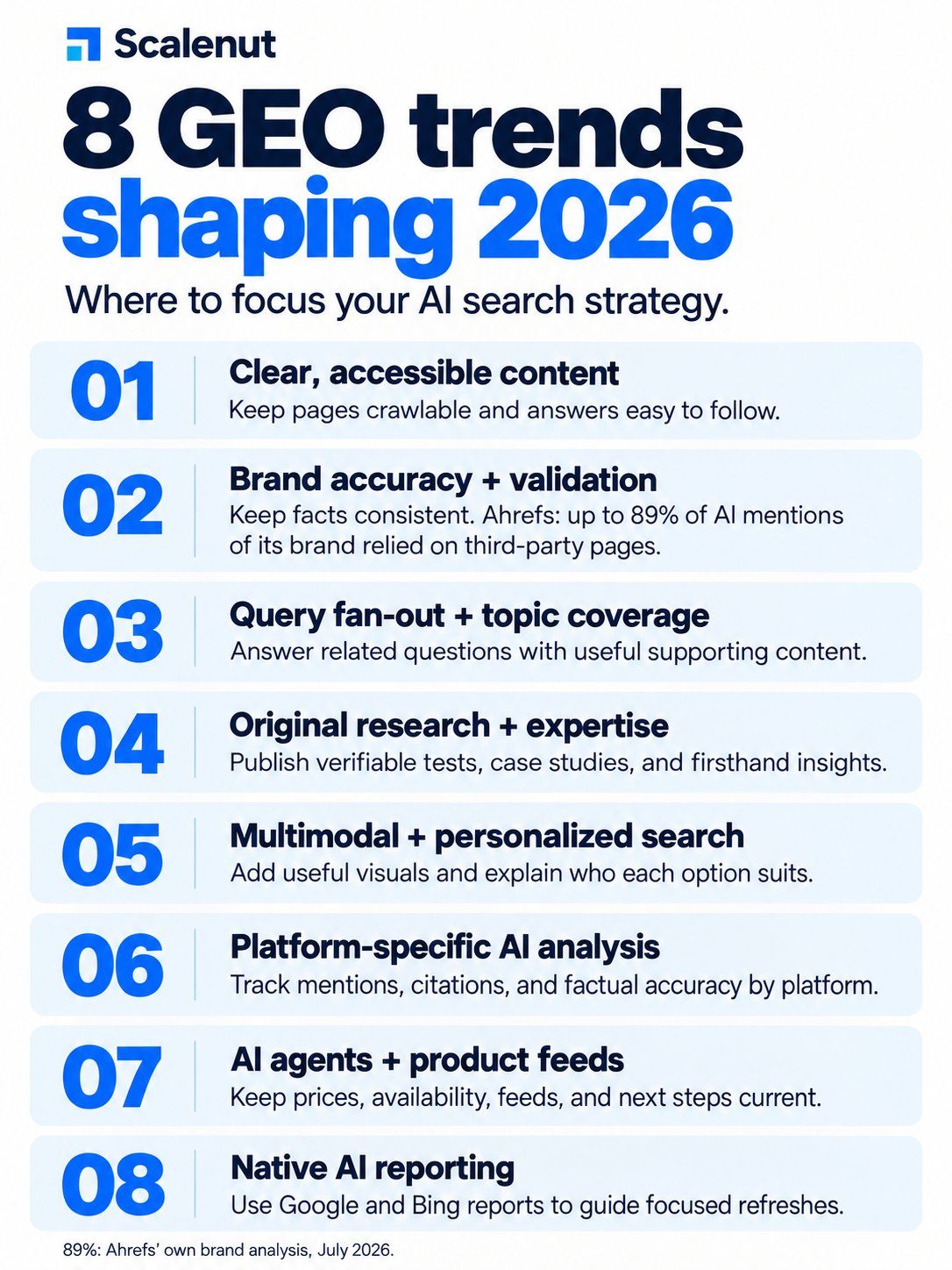
What Are The Biggest Trends In Generative Engine Optimization In 2026?

As generative engine optimization evolves, success by 2026 will depend on several key trends. The shift is moving from generic content to structured, authoritative, and citable information tailored for answer engines. Brands that adjust their strategies will increase AI search visibility and stay competitive.
The following trends highlight the most critical areas to focus on for future success.
Trend 1: Answer-First Content Is Outperforming Generic Long-Form Content
In the age of AI answers, the structure of your content matters more than ever. Generic, long-form articles that bury the key information deep within paragraphs are becoming less effective. Instead, content that adopts an "answer-first" approach is winning. This involves placing direct, concise answers to user queries right at the beginning of a section before providing additional context.
This structure makes it incredibly easy for AI models to extract the exact information they need to construct a response. Effective answer engine optimization requires a shift in content creation, prioritizing clarity and scannability. Think of your content not as a single narrative but as a collection of easily citable blocks of information.
This approach benefits both search engine optimization and user experience. To implement this trend, focus on:
- Placing a direct answer immediately following a heading.
- Using bullet points and numbered lists to summarize key points.
- Keeping paragraphs short and focused on a single idea.
- Structuring articles around specific questions your audience is asking.
Trend 2: Entity SEO Is Becoming Central To GEO
AI models don't just see strings of keywords; they understand concepts and the relationships between them. This is where entity SEO becomes a cornerstone of any modern GEO strategy. An entity is any well-defined thing or concept, such as a person, place, organization, or product. By clearly defining your brand and its offerings as entities, you help AI systems understand who you are and what you do with greater accuracy.
Your content strategy should focus on building strong associations between your brand entity and relevant topics. This involves consistently using the same terminology, earning brand mentions on authoritative sites, and creating a comprehensive web of content that reinforces your expertise. The goal is for AI to see your brand not just as a name, but as an authoritative entity connected to a specific knowledge domain.
Implementing schema markup is a practical way to support this. Structured data provides explicit information about the entities on your page, making it easier for AI to categorize and connect your content. As AI gets smarter, your ability to establish your brand as a clear, authoritative entity will be a major competitive differentiator.
Trend 3: Topical Authority Matters More Than Isolated Keyword Targeting
The days of winning at search by targeting isolated keywords are over. Both traditional search engines and AI models now prioritize topical authority—a deep and comprehensive expertise in a specific subject area. Instead of creating one-off articles, the winning strategy is to build out content clusters that cover a topic from every angle. This demonstrates a level of expertise that AI systems are programmed to trust and cite.
A content cluster consists of a central "pillar" page covering a broad topic, linked to several "cluster" pages that explore related subtopics in greater detail. This structure signals to search algorithms that you are a definitive source of information on that subject. Your keyword research should now focus on identifying these broader topics and all the related questions and subtopics your audience cares about.
By developing deep reservoirs of digital content around your core areas of business, you increase your AI search visibility across a wide range of related queries. This approach not only improves your chances of being cited in AI answers but also strengthens your overall SEO performance by establishing your site as an authoritative hub for valuable information.
Trend 4: Citation-Worthy Content Is Becoming A Competitive Advantage
AI models are designed to find and reference credible sources. To get cited in AI answers, your content must be inherently citable. This means moving beyond generic information and publishing original, high-value content that others will want to reference. Creating citation-worthy content is quickly becoming a significant competitive advantage in the digital space.
What makes content citable? Originality and authority are key. This includes publishing proprietary data from your own research, sharing unique case studies with real results, or featuring expert insights from named authorities in your field. When you provide information that can't be found anywhere else, you position your brand as a primary source, making it a prime candidate for AI citation.
This type of content naturally builds brand awareness and reinforces your expertise. When an AI cites your specific statistic or expert quote, it not only drives potential traffic but also lends your brand a powerful third-party endorsement. Focusing on creating these unique assets will be crucial for standing out in an increasingly crowded content landscape.
Trend 5: Structured Clarity Is Improving AI Retrieval
Large language models thrive on clarity and structure. To improve your chances of being retrieved and cited by answer engines, your content structure must be impeccably organized. AI systems need to parse your information quickly and efficiently, and a logical layout with clear hierarchies makes this possible. Long, unbroken walls of text are a major barrier to AI retrieval.
Using schema markup is a powerful technique for adding a layer of structured data that AI can easily understand. This code provides context about your content, such as identifying a passage as an answer to a specific question or labeling a piece of data as a statistic. This technical optimization directly improves how AI systems interpret and use your information.
An AI visibility toolkit can help you identify areas where your content structure could be improved. In general, best practices include:
- Using a logical heading hierarchy (H1, H2, H3) to organize topics.
- Employing bullet points and numbered lists for processes, features, and comparisons.
- Keeping paragraphs short and focused on a single, distinct idea.
Trend 6: Multi-Platform Optimization Is Replacing Google-Only Thinking
Focusing your optimization efforts solely on Google is no longer sufficient. Generative search engines and AI models gather information from across the entire web, including social platforms, forums, and video sites. A successful GEO strategy requires a multi-platform optimization approach, building a strong brand presence wherever your audience is active and where AI is listening.
Platforms like Reddit, YouTube, and industry-specific forums are frequently cited in AI responses. Genuine participation and valuable contributions on these sites can significantly boost your AI search performance. When AI systems see your brand being discussed and referenced across various channels, it reinforces your authority and credibility. This is about building a holistic digital footprint, not just a strong website.
This trend signals a broader shift in how we should think about online visibility. Your brand's authority is no longer determined by your website's backlink profile alone. It's now a composite of your activity and reputation across the digital ecosystem. Building a consistent and helpful brand presence on multiple platforms is essential for long-term success in the era of generative AI.
Trend 7: Brand Mentions And Digital Authority Signals Are Gaining Importance
In the world of GEO, not all signals of authority come with a hyperlink. AI models give significant weight to unlinked brand mentions across the web. Every time your brand is named in a relevant context—be it in an article, a forum discussion, or a social media post—it contributes to your digital authority. These mentions help AI systems build a comprehensive understanding of your brand's reputation and expertise.
This means your content marketing efforts should extend beyond your own blog. Actively seek opportunities to get your brand mentioned on third-party sites, especially those that AI models already trust and cite. This could involve guest posting, participating in expert roundups, or simply engaging in relevant online communities. The more frequently your brand is mentioned, the higher your share of voice becomes in the AI's "mind."
This shift elevates the importance of public relations and community management within your overall digital strategy. Building genuine relationships and contributing value to conversations across the web are now direct levers for improving your brand’s visibility in AI-generated answers. It's about earning your reputation, one mention at a time.
Trend 8: Refresh Cycles Are Becoming A GEO Growth Lever
AI models have a significant recency bias. Data shows that once content becomes more than three months old, AI citations to that page drop off sharply. This makes regular content updates, or refresh cycles, a critical component of any successful GEO strategy. The "publish and forget" approach to content creation is no longer viable if you want to maintain your AI search performance.
Integrating regular refreshes into your workflow ensures your content remains relevant and authoritative in the eyes of AI. This doesn't mean rewriting entire articles. Instead, focus on updating statistics, refreshing examples, adding new developments, and ensuring all information is current. A small update can signal to AI crawlers that your content is fresh and trustworthy.
Using an AI visibility toolkit can help you identify which pages are experiencing a drop-off in citations, allowing you to prioritize your refresh efforts. By treating your existing content as a living asset that requires periodic maintenance, you can sustain and even grow your visibility in AI-generated answers over time.
What’s The Best Generative Engine Optimization Strategy For AI Visibility?

The best generative engine optimization (GEO) strategy is comprehensive and integrated, focusing on clarity, authority, and accessibility for answer engines. Your goal is to make your content the most reliable and citable source for your audience’s questions. Achieve this by aligning with AI search intent, creating citation-friendly pages, and strengthening your brand’s digital authority. These steps boost brand visibility and position you as a leader in AI search.
Let’s look at the strategies for the best generative engine optimization for AI visibility:
1. Align Content With AI Search Intent
Understanding and aligning with AI search intent is the foundation of effective answer engine optimization. Users interact with AI differently, asking longer, more conversational user queries. Your content needs to be structured to answer these complex questions directly. This means anticipating not just the primary question, but also the follow-up questions a user might have.
A key part of this is optimizing for "fan-out" queries. When an AI receives a complex prompt, it breaks it down into smaller sub-queries to search the web. Your content should address these smaller, more specific queries in addition to the broader topic. This increases the likelihood that your page will be retrieved as a source for one of the components of the final AI answer.
To effectively align your content with AI search intent, consider the following best practices for this year:
- Analyze real user questions from forums and social media to understand conversational language.
- Structure your articles around a central question and use H2s and H3s to answer related sub-questions.
- Create dedicated content that targets the specific sub-queries an AI might generate.
2. Create Citation-Friendly Pages
To be featured in AI answers, your pages must be designed for AI citation. This goes beyond just providing good information; it requires presenting that information in a way that is credible, authoritative, and easy to reference. Citation-friendly content is the currency of generative engine optimization.
One of the most effective strategies is to publish original data, research, or unique expert insights. When you are the primary source of a statistic or an observation, AI models are more likely to cite you directly. Include quotes from named experts with their titles and affiliations. This not only adds credibility but also makes the content more citable, as the AI can attribute the insight to a specific authority.
Furthermore, always cite your own sources clearly. When you reference a statistic or a study, name the source. This practice demonstrates trustworthiness to both users and AI, increasing the likelihood that your content will be seen as a reliable hub of information. This focus on verifiable authority boosts brand awareness and generates valuable brand mentions.
3. Strengthen Entity Associations
Strengthening your brand's entity associations is a powerful way to improve your AI search visibility. An entity is a distinct concept that AI can understand, like your company or product. Your goal is to help AI models build a clear and accurate understanding of who you are and what topics you are an authority on. This is a core practice of modern entity SEO.
A key tactic is to use schema markup to explicitly define the entities on your website. For example, "Organization" schema can tell AI about your company, while "Person" schema can highlight the expertise of your authors. This structured data removes ambiguity and helps AI connect your brand to your areas of expertise, boosting your topical authority.
Beyond your own site, earning brand mentions on other authoritative websites strengthens these associations. When a reputable industry publication mentions your brand in the context of a specific topic, it reinforces that connection for AI models. Consistently creating high-quality content and engaging in relevant online discussions will naturally build these valuable entity associations over time.
4. Improve Content Coverage Across Topic Clusters
Demonstrating comprehensive topical authority is essential for a successful GEO strategy. Instead of publishing sporadic articles on various subjects, focus on building out content clusters. A topic cluster is a collection of interlinked digital content centered around a core subject. This structure signals to AI that you are a definitive source of information, not just a surface-level commentator.
Start by identifying the main topics central to your business. For each topic, create a "pillar" page that provides a broad overview. Then, develop multiple "cluster" pages that dive deep into specific subtopics, answering detailed questions and exploring niche angles. Each cluster page should link back to the main pillar page, creating a tightly woven web of expertise.
This approach to content creation helps you cover a subject from all sides, increasing your chances of being cited for a wide range of related queries. By systematically building out these content clusters, you establish your website as an authoritative resource, which is a powerful signal for both traditional search engines and AI models.
5. Measure AI Visibility Beyond Traditional Rankings
Success in GEO requires a new set of metrics that go beyond traditional search engine optimization KPIs like rankings and organic clicks. Since much of the interaction with AI answer engines is zero-click, you need to measure your brand's presence within the AI responses themselves. The most important metric here is share of voice. This measures how frequently your brand is mentioned in AI answers for a given set of queries compared to your competitors.
An AI visibility toolkit is designed specifically for this purpose. Unlike general AI optimization tools that might focus on content generation, GEO tools track your performance within AI platforms. They monitor brand mentions, track citation frequency, and analyze the sentiment of how your brand is being described. These tools provide the data you need to understand your current AI search visibility and identify opportunities for improvement.
By tracking metrics like citation frequency and share of voice over time, you can effectively measure the impact of your GEO efforts. This data-driven approach allows you to refine your strategy, benchmark against competitors, and demonstrate the ROI of optimizing for AI answer engines.
What Are The Best Generative Engine Optimization Techniques?

The best generative engine optimization techniques are practical, actionable, and designed to make your content more accessible and authoritative for AI. These methods build upon the foundations of good search engine optimization but add a specific focus on structuring content for answer engine optimization. Implementing these techniques will directly improve your AI search visibility.
From using question-based headings to implementing schema markup, these tactics are about creating clarity and signaling credibility. The following sections will detail five of the most effective techniques you can apply to your content strategy today to start winning in the new landscape of AI-powered search.
1. Use Question-Based Headings
A simple yet powerful technique in your content strategy is to frame your headings as questions. Users are increasingly posing full-sentence user queries to AI, and structuring your content to mirror this conversational style makes it easier for AI models to match your content to a user's intent. Headings like "What is GEO?" or "How Does AI Search Work?" directly align with how people seek information.
This approach organizes your content into a logical Q&A format, which is ideal for AI systems looking to extract direct answers. When an AI crawler encounters a question-based heading followed by a concise answer, it can easily identify that section as a relevant source for similar queries. This is a fundamental shift in content creation that prioritizes clarity.
To effectively implement this technique:
- Research common questions your audience asks using tools or by analyzing forums.
- Use H2 and H3 tags to pose these questions as headings within your articles.
- Immediately follow the heading with a direct and clear answer before elaborating further. This structure not only helps with AI answers but also improves the scannability and user experience of your page.
2. Add Direct Answer Blocks Under Key Sections
To maximize your chances of being cited in AI answers, you need to make the answers as easy as possible for AI to find. A highly effective technique for answer engine optimization is to place "direct answer blocks" immediately following your key headings. This involves writing a short, self-contained paragraph that concisely answers the question posed in the heading.
This practice is a core component of "answer-first" content structure. Instead of making the AI (or the user) read through several paragraphs to find the core information, you present it upfront. The AI can then easily extract this block of text to use in its response, often with a citation back to your page. This significantly improves your AI search visibility.
Think of these blocks as ready-made snippets for AI. They should be clear, factual, and directly address the topic of the section. After providing the direct answer, you can then use the rest of the section to provide more context, examples, and detail. This structure serves both AI crawlers and human readers, providing quick information for those who want it and deeper context for those who need it.
3. Publish Original Data, Research, Or Expert Insights
One of the most powerful ways to become a trusted source for AI is to create information that doesn't exist anywhere else. Publishing original data, proprietary research, or unique expert insights transforms your brand from a content curator into a primary source. This makes your content inherently citation-worthy and highly valuable to AI models looking for authoritative information.
Conducting your own surveys, analyzing your internal data to reveal industry trends, or commissioning a study are all excellent ways to generate original data. When you publish these findings, you become the definitive source for that information. AI systems are more likely to cite the origin of a statistic or study, giving you a direct path to being featured in their answers.
Similarly, featuring exclusive expert insights from named leaders in your field adds a layer of authority that is difficult to replicate. These unique perspectives provide fresh angles that AI can incorporate into its responses. This strategy not only earns brand mentions but also solidifies your reputation as a thought leader, making it a critical practice for 2026.
4. Implement Relevant Schema Markup
Schema markup is a form of structured data that you can add to your website's HTML to give search engines more context about your content. In a GEO strategy, this becomes even more crucial, as it provides a clear, machine-readable explanation of your information to AI models. It’s like adding labels to your content so AI can understand it without ambiguity.
For example, you can use FAQPage schema to explicitly identify questions and answers on your page, making it easy for an AI to pull them for its responses. Person schema can define the author of an article and their expertise, reinforcing E-E-A-T signals. Other relevant types include Organization, Article, and Review schema, all of which help AI categorize and trust your content.
While it's a technical aspect of search engine optimization, implementing schema markup has a direct impact on your AI search performance. It removes guesswork for AI crawlers, allowing them to process your information more accurately and efficiently. This simple step can significantly increase the likelihood that your content will be used to generate AI answers.
5. Strengthen Internal Linking Across Related Pages
A strong internal linking strategy is a fundamental practice that benefits both SEO and GEO. By linking related pieces of digital content together, you create a logical pathway for AI crawlers and users to follow. This helps establish semantic relationships between your pages, which is essential for building topical authority within content clusters.
When you create topic clusters, internal linking is the glue that holds them together. Each cluster page should link back to the main pillar page, and pages within the cluster should link to each other where relevant. This dense web of links signals to AI that you have a deep and interconnected body of knowledge on a particular subject.
This practice also helps distribute authority (or "link equity") throughout your site, which can improve the AI search visibility of individual pages. A well-structured internal linking plan guides AI systems to your most important content and demonstrates how your different articles and pages work together to form a comprehensive resource. It's a simple yet powerful way to showcase the depth of your expertise.
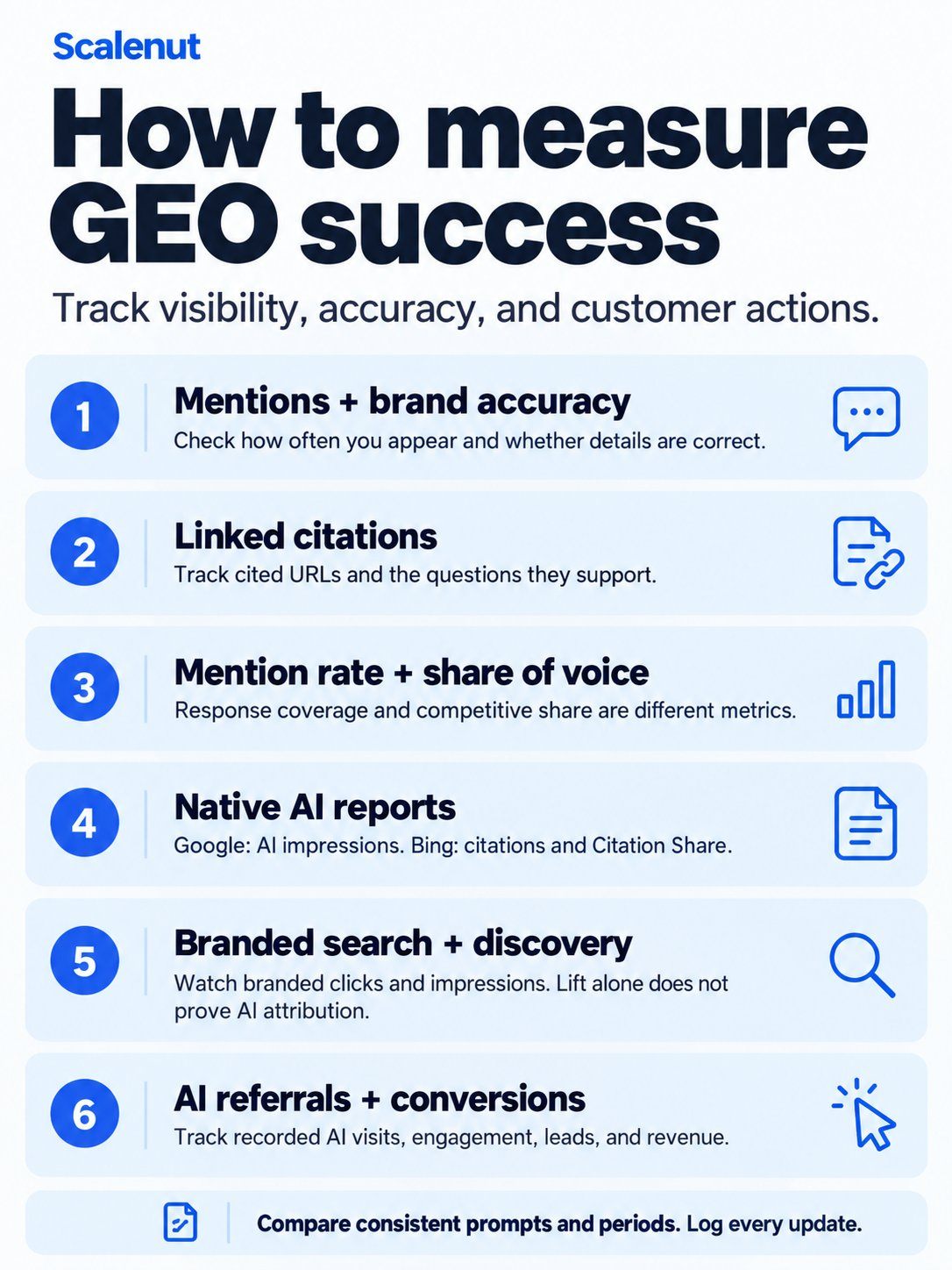
How Do You Measure Success In GEO AI Search Optimization?

Measuring success in a GEO strategy needs updated analytics. Traditional metrics like rankings and organic traffic miss key aspects of AI search optimization, where many interactions are zero-click. Instead, track your brand’s presence in AI-generated answers by focusing on citations and mentions.
This section will explore the specific metrics and methods you can use to effectively track the ROI of your GEO efforts.
1. AI Answer Mentions
One of the most direct ways to measure your GEO success is by tracking AI answer mentions. This metric counts the number of times your brand is named or your content is referenced within the AI answers generated by platforms like ChatGPT, Gemini, and Perplexity. Each mention is a win, as it places your brand directly in front of a user seeking information.
These brand mentions are more than just a vanity metric; they are a primary indicator of your share of voice in AI answer engines. Monitoring the frequency of these mentions tells you how well your content is resonating with AI models and how visible your brand is for your target topics. An increase in mentions over time is a clear sign that your GEO strategy is working.
GEO tools are specifically designed to track these mentions across various AI platforms. Unlike general AI tools, they can monitor a set of relevant queries and report back on how often your brand appears, providing a quantifiable measure of your performance that traditional analytics tools cannot capture.
2. Citation Frequency
Citation frequency is a crucial metric that measures how often your website pages are directly linked as sources in the responses from answer engines. While a brand mention builds awareness, a citation with a link can drive highly qualified referral traffic. Tracking this metric helps you understand which pieces of your citation-worthy content are performing best.
A high citation frequency for a particular page indicates that AI models view it as a highly authoritative and relevant source for specific queries. By analyzing which pages get cited most often, you can identify the characteristics of your most successful content and replicate that success across other pages. This data provides direct feedback on what's working in your GEO strategy.
This metric is a key part of your overall share of voice in AI. Specialized GEO tools can track these citations automatically, saving you from the manual effort of testing numerous prompts. Monitoring citation frequency over time allows you to see the direct impact of your content updates and optimization efforts on your brand awareness and referral traffic.
3. Share Of Voice In AI Platforms
Share of voice is arguably the most important macro-level metric for measuring GEO success. It calculates your brand visibility as a percentage of all brand mentions within a defined set of queries on AI platforms. For example, if your brand is mentioned in 20 out of 100 AI responses for your target queries, your share of voice is 20%. This provides a clear benchmark of your competitive standing.
This metric moves beyond simple counts of mentions or citations and puts your performance into context. Knowing you have a 20% share of voice is far more insightful than knowing you were mentioned 20 times. It helps you understand how you stack up against competitors and how much of the conversation around your topic you currently own.
An AI visibility toolkit is essential for accurately measuring share of voice. These tools monitor a vast number of queries across multiple AI platforms and compile the data into easy-to-understand reports. Tracking your share of voice over time is the best way to gauge the overall effectiveness of your efforts to improve your AI search performance.
4. Assisted Organic Traffic
While many AI interactions are zero-click, GEO can still drive traffic to your website, and this is often captured as assisted organic traffic. This occurs when a user sees your brand mentioned in AI answers, doesn't click the citation link, but later searches for your brand directly or navigates to your site. This journey won't show up as a direct referral from the AI platform in tools like Google Analytics.
However, a lift in direct or branded organic traffic that correlates with your GEO efforts can be a strong indicator of success. When users are exposed to your brand through AI-generated recommendations, it builds familiarity and trust. This increased brand salience often translates into more users seeking you out directly, even if they don't generate immediate organic clicks from the AI platform.
Tracking this requires a more nuanced analysis. You'll need to look for trends in your branded search volume and direct traffic, and correlate them with your efforts to improve AI search visibility. While harder to measure than a direct click, this assisted traffic is a valuable outcome of a strong GEO presence.
5. Branded Search Lift
A notable increase in branded search volume is a powerful secondary metric for measuring GEO success. Branded search occurs when users type your company or product name directly into a search engine. When your AI search visibility improves, more users are exposed to your brand as an authority, which naturally leads to an increase in people searching for you by name.
This lift in branded search queries is a strong indicator of growing brand awareness and a positive brand image. It shows that your presence in AI responses is not just being seen but is also making a memorable impression on users. They trust the AI's recommendation enough to actively seek you out for more information.
This metric bridges the gap between traditional search engine optimization and GEO. You can track your branded search volume using tools like Google Search Console. A sustained upward trend in these queries, especially when correlated with increased AI mentions, provides compelling evidence that your GEO strategy is successfully building your brand's authority and recall in the market.
6. Engagement From AI-Referred Visitors
When you do get direct traffic from AI citations, it's important to measure the quality of that traffic. Tracking the engagement rate of AI-referred visitors provides valuable insights into how well your digital content meets their expectations. These visitors are often highly qualified; they've already received a recommendation from the AI and are coming to your site with strong intent.
Metrics to watch include time on page, pages per session, and conversion rates. A high engagement rate from this segment suggests that your content is successfully delivering on the promise made by the AI. It confirms that your brand presence is not only visible but also valuable to the users who interact with it.
Comparing the engagement of AI-referred visitors to your site average can reveal the true value of your AI search performance. Early data suggests that traffic from AI citations often has higher conversion rates than typical organic traffic. This data can help you make a strong business case for continued investment in your GEO strategy.
Frequently Asked Questions
Which Generative Engine Optimization Is Best For AI?
The best GEO approach for AI is not a single tactic but a combination of people-first content, strong topical authority, clear site structure, and pages that are easy for search systems to understand, extract, and reference across evolving AI search experiences.
Can You Explain The Main Differences Between GEO And Traditional SEO?
Traditional SEO focuses on improving rankings, clicks, and discoverability in search results, while GEO focuses on increasing the chances that your content is selected, summarized, cited, or mentioned inside AI-generated answers. Both rely on quality, clarity, and crawlability.
What Strategies Are Recommended For Improving GEO Results?
Strong GEO strategies include aligning content with real user questions, publishing original and experience-backed insights, building topic clusters, strengthening brand and entity signals, and making pages technically accessible so AI systems can better interpret and surface them.
What Are The Best Practices For Generative Engine Optimization In 2026?
Generative engine optimization best practices in 2026 center on helpful original content, clean crawlable architecture, supported structured data, strong internal linking, evidence-backed claims, and regular content updates. The goal is to make pages useful for people while staying understandable to search systems.
How Does AI Impact Trends In Generative Engine Optimization?
AI is pushing GEO toward answer-ready formatting, deeper topic coverage, stronger originality, and better content extraction. As search experiences become more conversational and summary-driven, brands need content that is easier to trust, parse, and cite, not just rank.
How do GEO tools compare to general AI optimization tools?
GEO tools focus on improving and measuring brand visibility inside AI search results, including mentions, citations, and share of voice. General AI optimization tools are broader and often help with content creation, automation, or workflows rather than tracking how content appears in AI-generated answers.

.jpg)


.webp)
.jpg)
.jpg)
.jpg)