.jpg)
AEO vs SEO: What’s the Difference and Which Matters More?
Key Highlights
- Search Engine Optimization (SEO) focuses on ranking in traditional search engine results to drive organic traffic.
- Answer Engine Optimization (AEO) aims to have your content featured in direct answers by AI search and voice assistants.
- The primary difference lies in their goals: SEO seeks clicks from search results, while AEO seeks inclusion in AI-generated answers.
- AEO and SEO are complementary; strong SEO builds the authority needed for AEO success in today's digital marketing landscape.
- A modern content strategy must integrate both, using structured data and clear formatting to satisfy search engines and AI systems.
- Success in 2026 requires optimizing for both user intent in traditional search and direct queries in AI search.
The world of digital marketing is constantly changing, and how users find information is at the heart of this transformation. For years, SEO strategies have dominated how we approach search engine results. Now, a new player has emerged: Answer Engine Optimization (AEO). While SEO aims to get your website to the top of the search results page, AEO focuses on providing direct, concise answers to user queries within AI-powered platforms. This guide will explore the key differences between these two approaches and explain why both are vital for your success in 2026.
What Is AEO?
AEO, or Answer Engine Optimization, focuses on enhancing content to be featured in response to user queries. It prioritizes providing precise answers and structured information, making it essential for search engines to deliver relevant results efficiently. AEO is becoming increasingly important in today's digital landscape.
What Is SEO?
Search Engine Optimization (SEO) is the established practice of improving a website to rank higher in results on traditional search engines like Google and Bing. The core objective of SEO is to increase organic traffic by making your content more relevant and authoritative for specific keywords. It involves a mix of on-page optimization, content quality improvements, technical SEO, and off-page strategies like link building. All these elements work together to boost your search rankings.
AEO vs Traditional SEO Comparison: What Is the Real Difference?
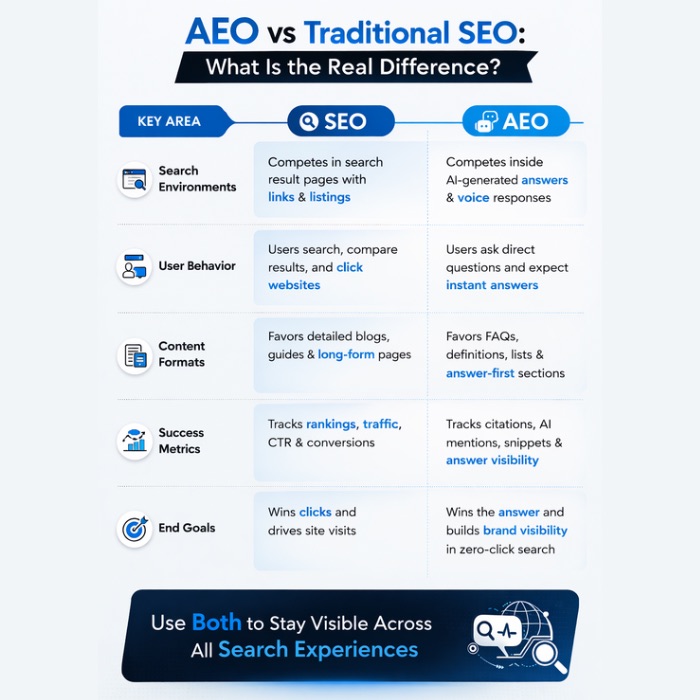
AEO and SEO have different goals. SEO aims to improve keyword rankings and increase website clicks, measuring success by higher SERP positions and more organic traffic. AEO targets having your content chosen as a direct answer by AI engines or voice assistants—delivering instant, zero-click responses. SEO depends on backlinks, domain authority, and in-depth content; AEO prioritizes structured data, clear definitions, and question-based formats for easy AI interpretation. Mastering both ensures comprehensive search visibility.
1. Different Search Environments
SEO operates primarily within the traditional search results page (SERP). The environment is a list of blue links, local packs, and featured snippets where users browse and select the best option. Your goal is to stand out among competitors on this page.
AEO, however, targets a different space: the answer itself. This environment includes Google's AI Overviews, chatbot responses from platforms like ChatGPT, and answers given by voice assistants. Here, there isn't a list of options; there's a single, generated response.
This shift means that for answer engine optimization, your content must be structured for extraction by AI search systems, not just for ranking on a Google search results page. Traditional search engines are evolving into answer engines, making visibility within these AI-generated responses a new frontier for marketers.
2. Different User Behavior
User behavior in a traditional SEO context involves typing a search query, scanning the results page, and clicking on a link that seems most relevant. Users expect to browse different websites to find the information they need, making the click-through a key part of the journey.
Conversely, AEO caters to a more direct form of user behavior. Users engaging with AI assistants ask conversational queries and expect an immediate, complete answer without navigating away. This is a zero-click experience where the interaction ends on the results page.
This change in user behavior highlights a difference in intent. An SEO-focused search query might be broader, indicating a willingness to explore. A query aimed at an answer engine is often a specific question demanding a concise response. Optimizing for AEO means creating a user experience that delivers information instantly.
3. Different Content Formats
For traditional SEO, long-form content like deep-dive articles, comprehensive guides, and detailed blog posts often performs well. These formats allow for in-depth keyword integration and demonstrate topical authority, which helps web pages rank higher. The focus is on creating the most thorough resource available.
AEO, however, favors content formats that are concise and easily digestible for natural language processing models. This includes FAQs, definitions, bulleted lists, and "answer-first" paragraphs where the direct answer is provided upfront. The content structure must be clear and logical.
To succeed in both, you need to blend these formats. Create relevant content that is both comprehensive (for SEO) and well-structured with scannable, answer-focused sections (for AEO). This dual approach ensures your content quality meets the needs of both human readers and AI systems.
4. Different Success Metrics
Measuring SEO performance typically involves tracking metrics like keyword rankings, organic traffic, click-through rates (CTR), and backlink growth. Tools like Google Search Console are essential for monitoring how your pages are performing in organic search results and whether your search rankings are improving over time.
AEO performance, on the other hand, is measured by visibility in answer-driven features. Key metrics include the number of times your content appears in featured snippets, inclusion in AI Overviews, and brand mentions or citations in AI chatbot responses. It's less about traffic and more about answer ownership.
While there is some overlap, the focus is different. SEO success is tied to driving users to your site, so traffic and conversions are paramount. AEO success is about brand exposure and authority within the answer itself, which might not always result in a direct click but builds trust.
5. Different End Goals
The ultimate goal of SEO is to increase organic traffic and drive conversions by achieving high rankings for relevant keywords. It's about building domain authority and topical authority to become a go-to resource that users actively visit. The end result is a sustainable flow of qualified visitors to your website.
In contrast, the end goal of AEO is to achieve brand visibility and establish authority by being the source of direct answers. The aim is to have your brand mentioned or your content cited in AI-generated responses, influencing users before they even click a link. This focuses on building trust at the point of information discovery.
While both contribute to overall online visibility, they serve different strategic purposes. SEO captures users who are actively looking to navigate to a site based on their search intent, while AEO positions your brand as an expert in zero-click environments, shaping perceptions and building brand recall.
Why AEO Is Growing So Fast in 2026?
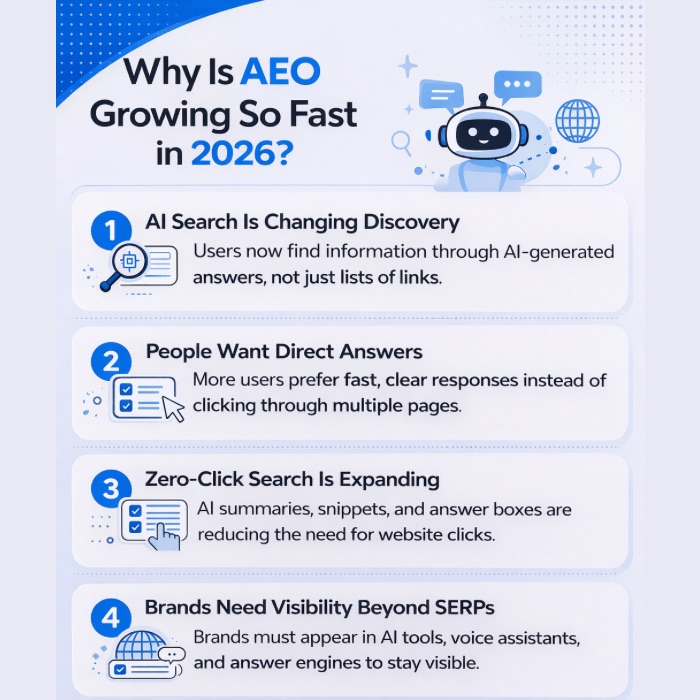
Answer engine optimization is booming in 2026 as search evolves. Users now expect quick, concise answers, something generative AI delivers well. With AI search tools and voice assistants on the rise, people are used to asking questions and getting direct responses. Brands must adapt to remain visible. As AI becomes the main gateway to information, optimizing for these answers is essential for survival and growth.
1. AI Search Interfaces Are Changing Discovery
The way people discover information is undergoing a fundamental transformation thanks to AI search interfaces. Instead of a list of links, users are now presented with synthesized answers generated by AI. This change moves the point of discovery from a website to the search interface itself.
These AI systems are designed to understand complex, conversational user queries and provide comprehensive responses directly. This means your content's visibility no longer depends solely on its ranking but on its suitability for extraction and summarization by generative AI.
For brands, this shift requires a focus on answer engine optimization. If your content isn't structured in a way that AI can easily parse and trust, you risk becoming invisible in this new era of search. Your strategy must evolve to ensure you appear within these AI-driven answers.
2. More Users Want Direct Answers, Not Just Links
Today's digital consumers are short on time and seek efficiency. They prefer direct answers to their user queries rather than sifting through multiple websites to find information. The modern search experience is about getting the right information as quickly as possible.
This demand is met by features like Google's AI Overviews and other AI-powered summaries that appear at the top of the results page. These tools use natural language to provide immediate, context-rich responses, often eliminating the need for users to click any further.
Focusing on AEO is critical because it aligns your content with this user expectation. By optimizing for direct answers, you meet users where they are, build trust by providing immediate value, and ensure your brand remains visible even when users don't click through to a webpage.
3. Zero-Click Search Behavior Is Expanding
Zero-click searches, where a user's query is answered on the search results page itself, are becoming increasingly common. This trend is fueled by the prevalence of featured snippets, knowledge panels, and now, comprehensive AI search summaries.
This behavior signifies a shift in search intent. Users with highly specific or fact-based needs often find their answers without ever visiting a website. They might ask conversational queries like "What is the capital of Australia?" or "How to tie a tie?" and get a complete answer instantly.
As zero-click search expands, your brand's visibility depends on appearing within these answer formats. If your strategy only focuses on driving clicks, you'll miss a massive audience that gets its information directly from the SERP. AEO is the key to capturing this valuable, high-intent audience.
4. Brands Need Visibility Beyond Traditional SERPs
In today's crowded digital marketing landscape, relying solely on traditional search results is no longer enough. Brand visibility needs to extend into the new environments where consumers are seeking information, including AI chatbots, voice assistants, and social media search functions.
AEO visibility ensures your brand is present in these emerging channels. When an AI cites your content or a voice assistant speaks your brand's name, it builds authority and trust in a way that a simple link in traditional search results cannot.
This expanded online visibility is crucial for long-term growth. By optimizing for answers, you are future-proofing your brand and ensuring it remains a relevant and authoritative voice, no matter how search technology evolves. This broadens your reach beyond what traditional SEO alone can achieve.
Is AEO Replacing SEO?
No, Answer Engine Optimization is not replacing traditional SEO. Instead, it's building on it. Think of their relationship as symbiotic rather than competitive. Strong SEO is the foundation for AEO success. Without the authority, trust signals, and discoverability that come from solid SEO practices, your content is unlikely to be considered a reliable source by AI engines in the first place. AI favors content from trusted domains with strong organic rankings.
The future of digital marketing lies in integrating both strategies. SEO gets your content discovered and establishes its credibility with search engines. AEO then refines that content so it can be effectively extracted and presented as a direct answer. You need SEO to get in the game and AEO to win in the new answer-driven search engine results landscape. AEO is more effective for direct inclusion in AI-powered answers, but it relies on the authority built by SEO.
When Should You Prioritize SEO Over AEO?
Understanding the nuances between different optimization strategies is crucial. As you begin to carve out your online presence, prioritizing SEO is essential. If your main goal is to drive organic traffic, build brand awareness, or establish authority in your niche, focus on SEO first; it forms the foundation for all search-related efforts. Address any technical SEO issues as a top priority; without a solid technical base, both traditional and AI-driven search results will suffer. SEO ensures your site is ready before you enhance it with advanced strategies.
Let’s look in detail when you should focus on SEO over AEO:
1. Organic Traffic Is the Main Goal
If your business model relies heavily on driving a high volume of website traffic to generate leads, sales, or ad revenue, then SEO should be your primary focus. SEO is specifically designed to increase your visibility in Google search results and attract users to your site.
Improving your search rankings directly correlates with an increase in organic traffic. A strong SEO performance ensures a steady stream of visitors who are actively searching for the products, services, or information you offer. This is especially important for e-commerce sites, publishers, and lead-generation businesses.
Prioritize SEO when your key objectives include:
- Increasing overall website traffic.
- Boosting conversions and sales from organic channels.
- Maximizing impressions and clicks in search results.
- Building a large audience for your content.
2. You Are Building Foundational Topical Authority
Establishing topical authority is the process of becoming a recognized expert on a specific subject in the eyes of search engines. This is a fundamental SEO strategy that involves creating a deep and interconnected web of content around a core topic.
This process starts with comprehensive keyword research to identify all the relevant subtopics and questions your audience is asking. You then create a content structure, often using pillar pages and topic clusters, to cover the subject exhaustively. This signals to search engines that your domain is an authoritative source.
Building this foundation is a prerequisite for more advanced optimizations. Before you can be seen as an answer engine's trusted source, you must first prove your expertise to traditional search engines. Strong topical authority boosts your domain authority and makes all your content more likely to rank.
3. Your Site Still Has Technical SEO Gaps
Technical SEO is the backbone of your website's performance in search engine results. If your site has issues with crawlability, indexing, site speed, or mobile-friendliness, it will struggle to rank, regardless of your content quality. These foundational problems must be addressed first.
Using SEO tools to conduct a site audit can reveal critical gaps. Issues like broken links, poor URL structure, or improper use of robots.txt can prevent search engines from properly accessing and understanding your content. This will hamstring both your SEO and AEO efforts.
Therefore, if your optimization strategy has not yet addressed these technical fundamentals, that's where you need to focus. A clean, fast, and easily crawlable website is essential for any form of search visibility. Fixing these gaps is a non-negotiable first step.
4. You Need Sustainable Long-Term Search Growth
SEO strategies are designed for sustainable, long-term growth. The efforts you put into creating quality content, building backlinks, and improving your site's authority compound over time. This creates a durable asset that consistently drives organic traffic.
While AEO can provide quick visibility wins in answer boxes, a strong SEO foundation ensures your entire domain grows in value. This leads to higher search rankings across a broad range of keywords, not just specific questions. It's about building lasting domain authority that can weather algorithm changes.
If your goal is to build a brand that has staying power in search, focusing on core SEO principles is the way to go. It helps you understand and target search intent at every stage of the customer journey, creating a resilient and powerful engine for organic growth.
When Should You Prioritize AEO Over Traditional SEO?
Once your SEO foundation is strong, focus on Answer Engine Optimization (AEO). If your brand needs more visibility in AI search results or your audience relies on voice assistants and AI tools, AEO is a smart move. It delivers immediate value and improves user experience. Prioritize AEO if answer-driven formats dominate your niche, as visibility there matters more than traditional blue links.
Here’s when you should focus on prioritizing AEO over traditional SEO:
1. Your Audience Uses AI Tools for Research
Understanding your audience's behavior is key. If your target demographic is tech-savvy and has adopted AI search tools like ChatGPT, Perplexity, or voice assistants for their research, then you need to meet them there. Their user queries are likely to be more conversational and question-based.
These users are looking for quick, synthesized information, not a list of articles to read. By prioritizing answer engine optimization, you can tailor your content to fit this new research method. This involves structuring your content to directly answer the types of questions your audience is asking these generative AI platforms.
If you fail to optimize for this behavior, you risk losing an entire segment of your audience that has moved beyond traditional search engines. Focusing on AEO ensures you remain relevant and accessible to this growing user base.
2. Your Brand Needs More Visibility in AI Answers
If your brand is struggling to appear in the AI-generated answers that are showing up on the search results page, it's time to prioritize answer engine optimization. Gaining AEO visibility is crucial for building trust and authority in an AI-driven search landscape.
When your brand is cited or mentioned in an AI search response, it acts as a powerful endorsement. This type of brand visibility can be more impactful than a traditional ranking, as it positions your company as a definitive source of information.
Consider prioritizing AEO if you want to:
- Associate your brand with expertise and authority.
- Gain exposure in zero-click search environments.
- Influence users at the very beginning of their research journey.
- Ensure your brand is part of the conversation on AI platforms.
3. You Want to Capture High-Intent Question Queries
User queries that are phrased as questions often signal a very specific and high search intent. The user knows exactly what they want to find out and is looking for a quick, reliable answer. Capturing this traffic is a significant opportunity.
AEO is perfectly suited for this task. By structuring your content to provide concise answers to these conversational queries, you increase your chances of being featured in snippets and AI summaries. This allows you to connect with users at the precise moment they need your expertise.
Unlike broader keyword searches, these question-based queries often indicate a user who is further along in their decision-making process. Providing them with a direct answer builds immediate trust and can be a powerful driver of high-quality leads and conversions.
4. SERPs in Your Niche Are Becoming More Answer-Driven
Take a close look at the Google search results for your most important keywords. Are they filled with AI Overviews, "People Also Ask" boxes, and featured snippets? If so, the landscape of your niche has already shifted towards answers.
In such an environment, competing for one of the ten blue links becomes less effective. The prime real estate on the search engine results page is now occupied by these answer formats. To remain visible, you must adapt your strategy to compete for these spots.
Prioritizing answer engine optimization is a direct response to this market change. It allows you to reclaim visibility that may have been lost to AI-generated content. If you don't fight for a place in the answer, your competitors will, and you'll be pushed further down the page.
How AEO and SEO Work Together in a Modern Content Strategy?
AEO and SEO are two sides of the same coin in a modern content strategy. They work together to maximize your brand's total search visibility. SEO builds the foundational authority and ensures your content is trustworthy and discoverable by search engines. It gets you in the running. AEO then refines that content, structuring it so it's perfectly formatted for extraction by AI systems. This synergy ensures your content not only ranks but also becomes the definitive answer.
For content teams, this means the optimization strategy must be dual-focused. Every piece of content should be created with both ranking and answer selection in mind. Strong SEO practices, like building topical authority and earning backlinks, fuel your AEO visibility. In turn, success in AEO, like winning featured snippets, can bolster your SEO performance by signaling to search engines that your content is a high-quality, authoritative resource. Together, they create a powerful loop that drives comprehensive search dominance.
How To Optimize for AEO and SEO at the Same Time?
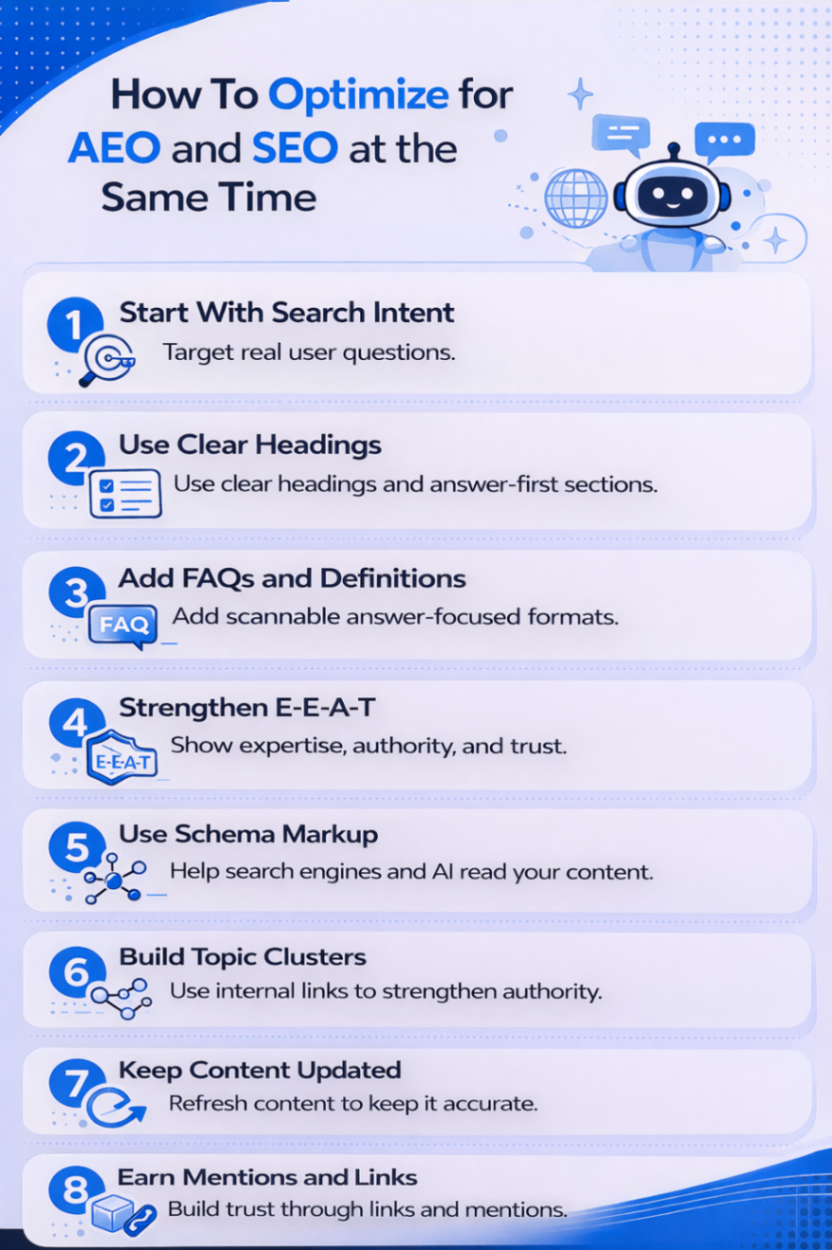
Optimizing for both AEO and SEO means creating content that serves both users and AI. A unified approach helps your content rank well and get chosen as the answer. Let’s look some of the key ways in which you can optimize your pages for both AEO and SEO:
1. Start With Search Intent and Real User Questions
The foundation of any successful combined strategy is a deep understanding of search intent. Go beyond traditional keywords and identify the real user queries your audience is asking. This includes the conversational queries they might use with voice assistants or AI chatbots.
Your goal is to create relevant content that directly addresses these questions. Start by mapping out the core problems your audience faces and the language they use to describe them. This research will guide your entire content creation process, ensuring you provide precise answers.
To get started, focus on:
- Analyzing "People Also Ask" sections on Google.
- Using tools to find question-based keywords.
- Monitoring forums and social media for common questions in your niche.
- Creating content that answers the "who, what, where, when, why, and how" related to your topics.
2. Use Clear Headings and Answer-First Sections
A logical content structure is critical for both users and AI systems. Use clear, hierarchical headings (H1, H2, H3) to organize your information. Phrase your headings as questions whenever possible, as this directly mirrors how users search and how answer engines look for information.
Adopt an "answer-first" or "inverted pyramid" style of writing. Under each heading, provide a concise, direct answer to the question in the first sentence or paragraph. This makes your content highly scannable for human readers and easy for AI to extract for featured snippets.
Following the direct answer, you can then expand with more detail, examples, and context. Use formatting elements like bold text and bullet points to break up information and highlight key points. This approach to answer engine optimization makes your content more effective for all audiences.
3. Add FAQs, Definitions, and Comparisons
Integrating specific content formats that are favored by answer engines is a powerful tactic. Adding a dedicated FAQ section to your pages is an excellent way to target multiple long-tail question queries in one place. These provide concise answers that are ideal for extraction.
Similarly, including clear definitions for key terms in your industry helps both users and natural language processing models understand your content. Comparison tables are another effective format, as they structure information in a way that is easy for AI to parse and present when users are weighing options.
To enhance your content for AEO, be sure to:
- Include a well-researched FAQ section on relevant pages.
- Use FAQPage schema markup to help search engines identify it.
- Clearly define industry jargon.
- Create comparison tables for products, services, or concepts.
4. Strengthen E-E-A-T Signals
E-E-A-T (Experience, Expertise, Authoritativeness, and Trustworthiness) is crucial for both SEO and AEO. Search engines and AI systems prioritize content from sources they deem credible. You must actively demonstrate why your content is trustworthy.
Strengthen these authority signals by including author bios that highlight their expertise and first-hand experience. Back up your claims with data, cite reputable sources, and showcase any credentials or awards. These trust signals are vital for building both domain authority and user confidence.
High-quality content that is well-researched and written by experts sends a strong message to algorithms. This not only improves your online visibility in traditional search but also significantly increases the likelihood that AI will select your content as an authoritative answer.
5. Use Schema Markup Where Relevant
Schema markup, or structured data, is code that you add to your website to help search engines understand your content more effectively. It's a key component of both technical SEO strategies and answer engine optimization because it provides explicit context about your information.
By using schema for elements like FAQs, how-to guides, products, reviews, or articles, you label your content in a machine-readable format. This makes it easier for search engines to display your content as a rich result in the search results, such as a star rating or a dropdown FAQ.
This enhanced visibility can improve click-through rates and make your content more attractive for extraction by AI. You can use tools like Google's Rich Results Test and monitor performance in Google Search Console to ensure your schema is implemented correctly.
6. Build Internal Links Around Topic Clusters
A well-organized internal linking structure is fundamental to a strong content strategy. Building topic clusters, a main pillar page linked to several related cluster pages, helps search engines understand the relationships between your content and your depth of expertise on a subject.
This practice boosts your SEO performance by spreading link equity throughout your site and helping to improve keyword rankings for a wide range of terms. For AEO, it reinforces your topical authority, making your entire cluster of content more likely to be seen as a credible source by AI.
When an AI system is looking for an answer, it doesn't just evaluate a single page; it looks at the entire domain's authority on that topic. A strong topic cluster model with strategic internal links demonstrates that authority clearly and effectively, benefiting both your SEO and AEO efforts.
7. Keep Content Updated
Freshness is a key signal of content quality and relevance for both SEO and AEO. Outdated information can harm your credibility and cause your rankings to drop. Regularly auditing and updating your content is a non-negotiable part of modern digital marketing.
This means refreshing statistics, updating examples, replacing outdated screenshots, and adding new information to reflect recent developments. This not only improves your SEO performance but also ensures that AI systems see your content as current and trustworthy, increasing your chances of AEO success.
Relevant content is accurate content. Set a schedule for reviewing your most important pages to ensure they remain the best possible resource on the topic. This commitment to quality will pay dividends in both traditional search rankings and AI answer inclusion.
8. Earn Mentions, Links, and Third-Party Validation
Authority and trust signals are not just built on your own site. Third-party validation in the form of backlinks and brand mentions is one of the most powerful ways to show search engines and AI that you are a credible source.
Backlinks from reputable websites remain a core SEO ranking factor. For AEO, both linked and unlinked brand mentions across the web help AI models recognize your brand as an authority in its field. When multiple trusted sources reference your brand, it builds significant trust.
To earn these valuable signals, you should:
- Create original, data-backed research that others want to cite.
- Contribute expert quotes and insights to industry publications.
- Engage in digital PR to get your brand mentioned in the media.
- Collaborate with other trusted brands in your niche.
What Metrics Should You Track for AEO vs SEO?
Tracking the right metrics is key to measuring AEO and SEO success. While both boost visibility, their performance indicators differ: SEO tracks traffic and rankings, while AEO focuses on answer ownership and presence in AI-generated responses. Tools like Google Search Console help monitor both. For a complete picture, use a combined dashboard, SEO shows if people find and visit your site; AEO reveals if you influence the conversation before clicks occur.
SEO Metrics
When evaluating your SEO performance, the primary metrics revolve around your visibility in organic search results and the traffic it generates. Some of this includes:
- Keyword Rankings: A fundamental indicator that shows whether your optimization efforts are working by tracking your position for target keywords.
- Organic Traffic: Measured in sessions and users; critical for monitoring if your site is attracting more visitors over time, which can be tracked in Google Analytics.
- Click-Through Rate (CTR): Available in Google Search Console; indicates how effective your titles and meta descriptions are at compelling users to click.
- Backlinks and Domain Authority: Key long-term indicators of SEO health; an increase in referring domains signals growing trust and authority, impacting your ability to achieve and maintain high search rankings.
AEO Metrics
Measuring AEO performance requires looking beyond traditional traffic metrics. The main goal of answer engine optimization is to appear in direct answers, so your metrics should reflect this. Key metrics include:
- Featured Snippet Ownership: Control over highlighted information in search results.
- Inclusion Rate in AI Search Summaries: Frequency of appearing in AI-generated content summaries (like Google's AI Overviews).
- Brand Mentions and Query Coverage in AI Features: Visibility and recognition of brands in AI-driven search features.
- Voice Search Presence: Representation and accessibility in voice-activated search queries.
While harder to track directly, monitoring these elements can indicate your AEO success. Ultimately, AEO metrics are about visibility and influence, not just clicks. Tracking how often your brand is presented as the authoritative source for direct answers gives you a clear picture of your AEO performance.
AEO vs SEO: Which One Should Your Business Focus on in 2026?
In 2026, the question isn't whether to focus on AEO or SEO; it's how to integrate them effectively. Your business should not choose one over the other. Instead, view them as two essential components of a single, unified digital marketing strategy. SEO is the foundation that builds your authority and makes you discoverable. AEO is the next layer that adapts your content for the new age of AI-driven search.
Start with a strong SEO foundation. Ensure your site is technically sound, you're targeting the right keywords, and you're building topical authority. Once that's in place, layer in AEO practices. Structure your content to answer questions directly, use schema markup, and optimize for conversational search intent. The businesses that will win in 2026 are those that master both, achieving maximum online visibility across all forms of search.
How you Can Bring AEO and SEO Together With Scalenut
Understanding the difference between AEO and SEO matters only if you can act on it. Scalenut combines AI visibility tracking with hands-on SEO execution in one platform. You can monitor how your brand appears across AI search experiences, uncover prompt and citation gaps, track competitors, and turn those insights into content improvements that strengthen answer visibility and organic performance.
Why Scalenut Fits This Workflow
- AI Visibility Tracking: Monitor Visibility Score, Average Position, Share Of Voice, and brand presence across AI search platforms.
- Prompt-Level Insights: See which prompts surface your brand, where visibility drops, and which sources AI systems rely on.
- Competitor Analysis: Compare your presence against competitors and identify missed visibility opportunities.
- AI Traffic Monitoring: Understand which AI agents engage with your site and which pages attract AI-driven discovery.
- SEO Execution Tools: Act on insights with tools for content optimization, planning, audits, and internal linking.
Scalenut helps connect AI search metrics like citations, prompt coverage, and share of voice with the SEO actions needed to improve rankings, authority, and discoverability. Book a demo to see how Scalenut can help you grow visibility across both AI search and traditional search.
Conclusion
The relationship between AEO and SEO showcases a dynamic landscape in digital marketing that continuously evolves. Understanding user intent and optimizing for both traditional and AI search engines is crucial for maintaining authority and visibility. Prioritizing content quality and leveraging innovative strategies, such as schema markup and generative AI, can enhance organic search performance. As user behavior shifts, adapting your content strategy will not only improve search rankings but also foster a richer user experience, ensuring sustained growth in online presence.
Frequently Asked Questions
What is SEO vs AEO?
SEO, or search engine optimization, focuses on ranking higher in traditional search engines through keyword research and authority building to drive traffic. AEO, or answer engine optimization, focuses on structuring content to be selected as a direct answer by AI search and voice assistants, prioritizing inclusion over clicks.
What is the main difference between answer engine optimization vs traditional SEO agencies?
The main difference lies in their focus. A traditional SEO agency prioritizes ranking in organic search results to drive traffic. An agency focused on answer engine optimization also optimizes for inclusion in AI search answers, featured snippets, and voice responses to address direct user queries in zero-click environments.
AEO strategies vs traditional SEO effectiveness: What strategies can help my website rank well in both AEO and SEO?
To rank well in both, combine SEO strategies with answer engine optimization. Create high-quality, authoritative content with a clear content structure, use question-based headings, implement schema markup, and build strong authority signals. This ensures your content is valuable for both traditional rankings and AI extraction.
How are search engines evolving towards answer engines and what does that mean for SEO?
Search engines are increasingly focusing on providing direct answers to user queries, prioritizing relevant content over traditional SEO tactics. This evolution emphasizes the importance of optimizing for user intent, making AEO (Answer Engine Optimization) essential for visibility in search results.
Answer engine optimization vs search engine optimization: Is AEO more effective for AI-powered searches than traditional SEO?
AEO leverages structured data and machine learning to deliver precise answers, making it more effective for AI-powered searches compared to traditional SEO. While SEO focuses on visibility and ranking, AEO prioritizes user intent and direct responses, aligning better with the future of search technology.
Can you explain how large and small businesses should approach traditional SEO vs AI answer engine optimization?
Large businesses can leverage extensive resources for a robust SEO strategy, while small businesses should focus on niche keywords and local SEO. In contrast, AI Answer Engine Optimization requires both to adapt quickly, using data-driven insights to enhance visibility and user engagement effectively.
How should marketing teams focus on AEO vs traditional SEO?
Marketing teams should prioritize AEO by optimizing for voice search and featured snippets, while still maintaining effective traditional SEO practices. Balancing both strategies ensures comprehensive visibility in search results, catering to evolving user behaviors and preferences as we move toward 2026.
How does user intent differ in AEO versus SEO?
User intent in AEO focuses on immediate answers and concise information, catering to quick queries often displayed in rich snippets. In contrast, SEO targets broader search behaviors, aiming for comprehensive content that engages users with deeper insights. Understanding these differences can enhance both strategies.
What role do keywords play in AEO compared to standard SEO methods?
Keywords in AEO focus on user intent and context, emphasizing semantic relevance over exact matches. In contrast, standard SEO relies heavily on keyword density and placement. Understanding this difference aids in optimizing content to meet evolving search engine algorithms' expectations effectively.
Why is it important to focus on AEO as well as SEO in current digital marketing?
Focusing on both AEO and SEO is crucial in today's digital marketing landscape. AEO enhances visibility in voice search and AI-driven results, while SEO ensures website optimization. Together, they create a comprehensive approach that caters to diverse search behaviors and improves overall online presence.


.svg)


.webp)