.jpg)
You ask ChatGPT to recommend products in your category. A competitor appears, but your brand does not. A few more manual checks give you different answers, leaving you unsure which prompts, sources, or content gaps to investigate.
The right GEO tool helps you spot those patterns and prioritize your next move. The choice depends on whether your team needs broad benchmarking, custom prompt tracking, citation analysis, or support for content and technical improvements.
We compare 7 of the best GEO tools for competitor analysis in 2026, covering their capabilities, practical limits, and workflow differences to help you shortlist the right platform for your team.
At a glance: the best GEO tools for competitor analysis in 2026
Here is a quick snapshot of what each tool is best known for before we break them down in detail.
- Scalenut: Best for teams that want competitor analysis tied directly to SEO and content execution.
- Semrush AI Visibility Toolkit: Best for brands that want GEO competitor analysis inside a broader SEO suite.
- Ahrefs Brand Radar: Best for large-scale AI share of voice and citation benchmarking.
- Profound: Best for enterprise teams that need deeper AI visibility and prompt-level analysis.
- AthenaHQ: Best for tracking category visibility and recommendation share across competitors.
- Peec AI: Best for prompt-level competitor tracking, source gap analysis, and prioritized content and off-page recommendations.
- Scrunch: Best for segmented competitor tracking, AI bot visibility, and delivering pages designed for generative AI agents.
How we evaluated the GEO tools
We evaluated these 7 generative engine optimization tools using official product pages, pricing pages, and help documentation. We focused on:
- Competitor intelligence: Benchmarking and visibility gaps at the prompt level.
- Citations and segmentation: Source analysis and filtering by AI platform, topic, persona, and market.
- Platform coverage: Included AI engines and data refresh frequency.
- Pricing and limits: Subscription costs, prompt allowances, and plan restrictions.
- Ability to act: Recommendations, content workflows, and technical improvements that help teams respond to findings.
Our recommendations reflect publicly documented capabilities and how well they fit different teams’ competitor analysis needs.
Which Are The Best GEO Tools For Competitor Analysis In 2026?
Not every GEO SEO tool helps with competitor analysis in the same way. Some are better for prompt and citation tracking, some are stronger for enterprise visibility analysis, and some stand out because they connect competitive insights to real SEO and content execution.
Here are the 7 GEO tools that stand out most in 2026 based on how well they help teams track competitor visibility, identify gaps, and act on what they find.
1. Scalenut
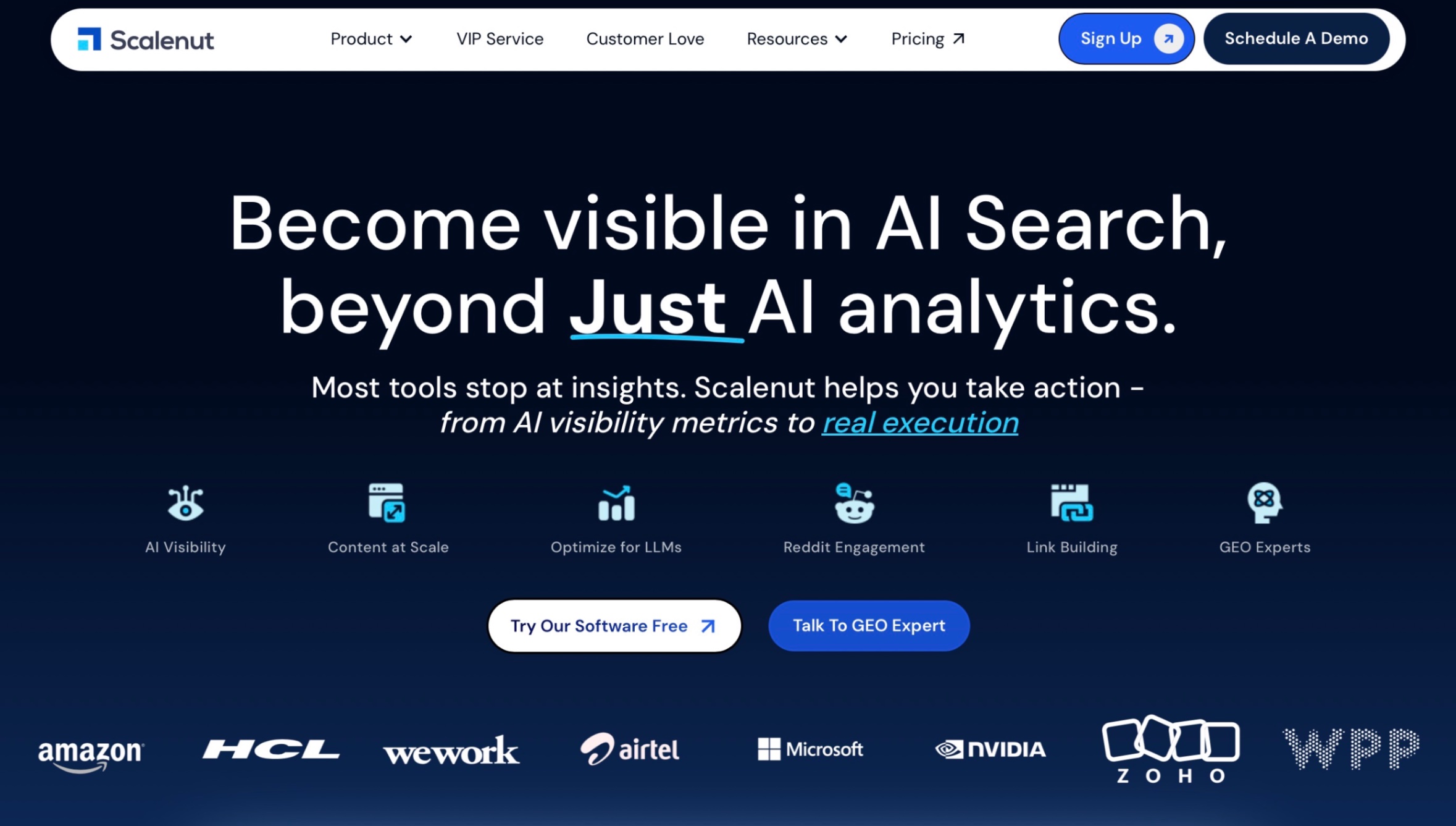
Scalenut is a GEO and SEO platform that combines AI visibility tracking with content planning, optimization, and execution. Its positioning is different from monitoring-first tools because it is built not only to show where competitors are winning in AI answers, but also to help teams act on those gaps inside the same workflow.
Best For:
Teams that want competitor analysis plus execution, not just reporting. It is especially well suited to brands that want to track AI visibility across prompts and competitors, then move directly into content planning, optimization, and on-page action without stitching together multiple tools.
What Are The Key Competitor Analysis Capabilities Of Scalenut?
- Benchmarks your brand’s visibility against competitors across prompts, topics, and AI engines
- Tracks core competitive signals such as Visibility Score, Share Of Voice, Average Position, and Brand Visibility Rank
- Surfaces prompt-level insights so teams can see where competitors are being mentioned and where their own brand is missing
- Includes citation tracking to show which sources AI systems appear to rely on when generating answers
- Highlights competitor visibility patterns across AI platforms, making it easier to spot where rival brands are pulling ahead
- Uses query fanouts to show how one user question can expand into related AI queries, which helps teams identify adjacent competitor opportunities and missed coverage areas
- Adds sentiment analysis so competitor and brand mentions can be understood in context, not just counted at surface level
What Other Features Do You Get With Scalenut?
- AI visibility monitoring across platforms such as ChatGPT and Perplexity, with regular data refreshes by default
- Content Optimizer with GEO-oriented guidance, including GEO Score, prompt coverage support, and step-by-step improvement recommendations
- Cruise Mode for SERP-informed drafting and content creation, which helps teams move from competitive insights into production faster
- Keyword Planner for intent-based clustering and topic planning, which is useful when turning prompt and visibility gaps into a stronger content roadmap
- Content Audit for identifying performance gaps and connecting them to optimization opportunities, including AI-prompt-driven traffic signals
- Link Manager for improving internal and external linking structure with AI-led discoverability in mind
- AI traffic and interaction reporting, including AI bot tracking, top AI sources, and most referenced pages
What Could Be The Potential Limitations Of Scalenut?
- Its biggest strength is that it blends GEO monitoring with SEO execution, so teams looking only for a narrow monitoring tool may find it broader than they need
Book a free strategy call today!
2. Semrush AI Visibility Toolkit
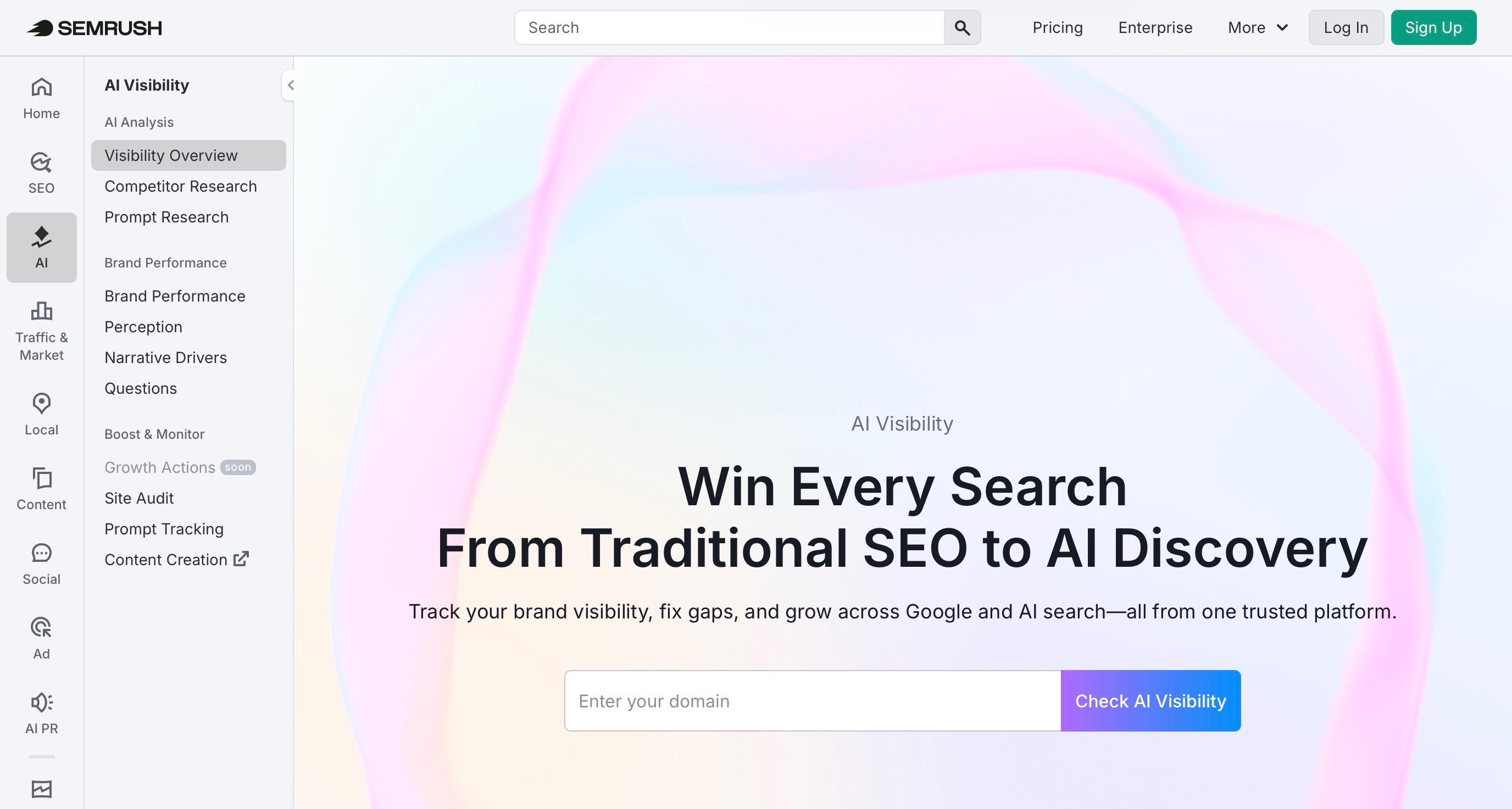
Semrush AI Visibility Toolkit is a competitor analysis and AI search visibility product designed to help brands measure how often they appear in AI-generated answers, compare that visibility against competitors, and uncover the prompts and topics where rivals are gaining ground.
Best For:
Teams that want GEO competitor analysis inside a broader SEO workflow. It is especially useful for brands that want prompt gap discovery, competitor benchmarking, and AI visibility reporting in the same ecosystem.
What Are The Key Competitor Analysis Capabilities Of Semrush AI Visibility Toolkit?
- Uses Semrush’s prompt database to benchmark competitor visibility and discover gaps, while custom Prompt Tracking monitors the buyer questions you choose daily.
- Benchmarks relative visibility across competing brands
- Identifies prompts and topics where competitors are cited but your brand is not
- Helps teams see where competitors are outperforming and which gaps to prioritize
What Other Features Do You Get With Semrush AI Visibility Toolkit?
- Visibility benchmarking across AI search results
- Mention analysis to understand how AI platforms talk about your brand
- AI search optimization recommendations tied to performance
- Integration with the broader Semrush platform for SEO, content, and reporting workflows
What Could Be The Potential Limitations Of Semrush AI Visibility Toolkit?
- Best suited for teams already working inside a Semrush-led workflow
- Stronger as part of a broader platform than as a narrow standalone GEO tool
- May feel less specialized for teams that want only one focused competitor analysis function
Explore the reporting strengths, pricing, and prompt limits in our Semrush AI Toolkit review to see how it fits your GEO workflow.
3. Ahrefs Brand Radar
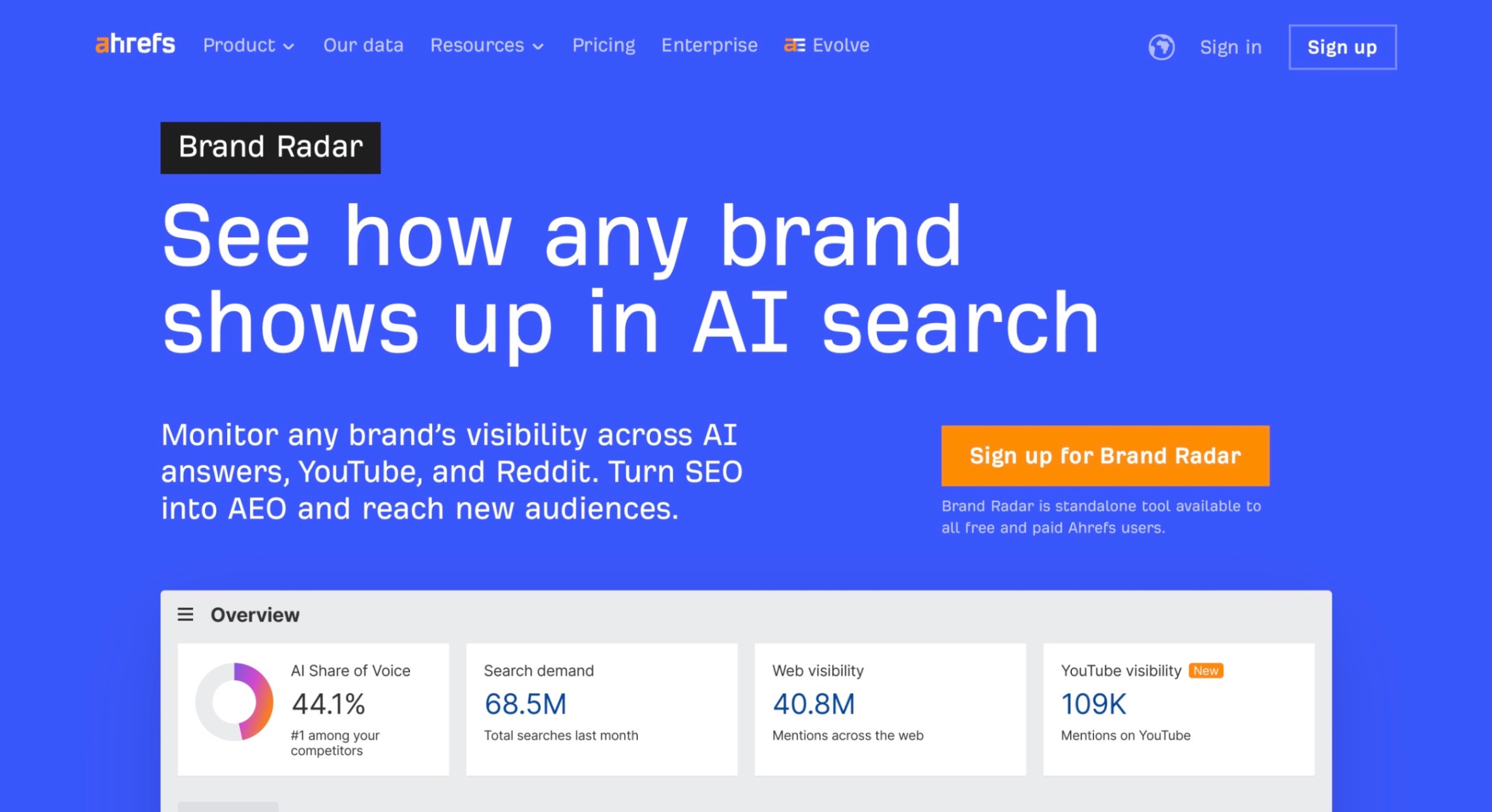
Ahrefs Brand Radar combines a large search-backed AI visibility index with custom prompt tracking. The index helps teams benchmark share of voice, mentions, and citations against competitors at scale, while custom tracking monitors the specific buyer questions your AI SEO team chooses.
Best For:
Teams that want large-scale share of voice and citation benchmarking with fast setup. It is a strong fit for brands that care most about where they are mentioned, cited, and outperformed across major AI platforms.
What Are The Key Competitor Analysis Capabilities Of Ahrefs Brand Radar?
- Benchmarks AI share of voice against competitors
- Identifies top cited pages and domains
- Tracks visibility across brands, products, regions, and authors
- Helps teams spot which competitors and sources are winning the most visibility in AI-generated answers
What Other Features Do You Get With Ahrefs Brand Radar?
- Views into search demand, web visibility, and video visibility
- Access to real AI-generated answers for analysis
- Dedicated reporting on cited domains and cited pages
- Custom prompt tracking with topic tags, fanout-query analysis, and daily, weekly, or monthly tracking frequency
What Could Be The Potential Limitations Of Ahrefs Brand Radar?
- Stronger for measurement and benchmarking than execution
- Less suited for teams that want direct content workflow or optimization actions inside the tool
- May need to be paired with other systems for teams focused on execution after insight
Still weighing Brand Radar? Compare tracking depth, pricing, and execution options in our Ahrefs Brand Radar alternatives guide.
4. Profound
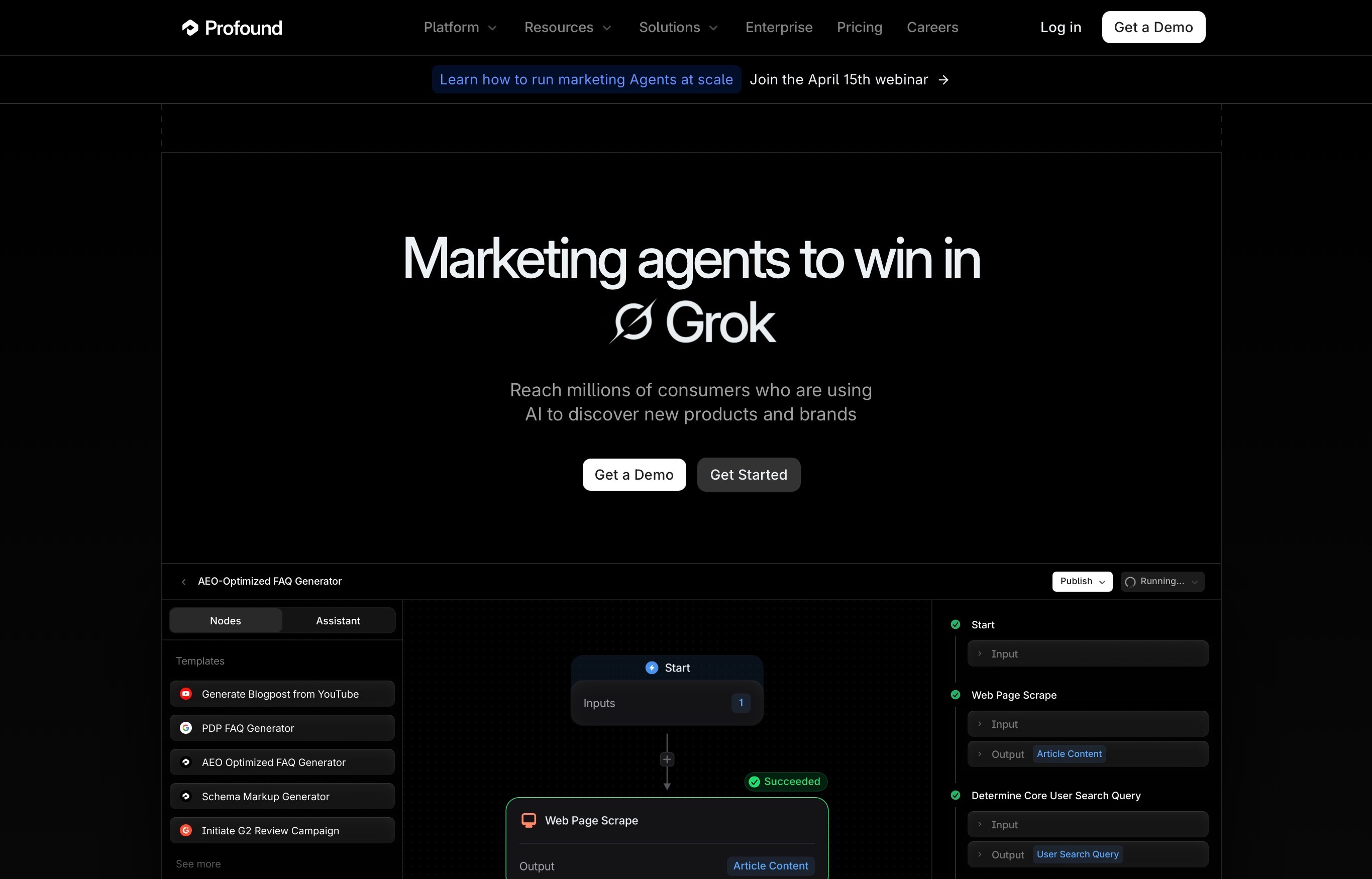
Profound is an AI search visibility platform built to help brands understand how they appear across answer engines, identify where competitors are winning, and analyze the prompts and citations shaping those outcomes.
Best For:
Enterprise teams that need deeper AI visibility analysis across multiple answer engines. It is especially useful for brands that want prompt-level insight, citation visibility, and AI crawler analytics.
What Are The Key Competitor Analysis Capabilities Of Profound?
- Shows prompts where competitors appear and your brand does not
- Helps teams analyze citations connected to brand and competitor visibility
- Supports prompt volume analysis to prioritize which AI queries matter most
- Tracks AI search visibility across major answer engines
What Other Features Do You Get With Profound?
- Prompt volume data to estimate AI search demand
- Agent analytics to understand how AI crawlers and answer engines interact with your site
- Multi-engine coverage across major answer platforms
- Agents for building repeatable research and content workflows, with Sheets for running those workflows across multiple inputs
- Documents for reviewing and collaborating on Agent outputs, and Skills for standardizing workflows with reusable instructions
What Could Be The Potential Limitations Of Profound?
- Best suited to enterprise teams rather than smaller teams with simpler needs
- Stronger for deep visibility analysis than for lightweight tracking workflows
- Ongoing brand monitoring requires a custom-priced Enterprise plan. The free trial is limited to seven days, with 50 prompts checked daily across ChatGPT, Gemini, and Google AI Overviews.
Take a closer look at prompt intelligence, Agents, and workflow trade-offs in our Profound AI review to assess its fit for your team.
5. AthenaHQ
AthenaHQ is an AI search visibility platform focused on helping brands track competitive positioning, share of voice, and recommendation frequency across high-intent AI queries.
Best For:
Teams that care most about category visibility, recommendation share, and competitive benchmarking. It is a strong fit for brands managing multiple markets, locations, or business units.
What Are The Key Competitor Analysis Capabilities Of AthenaHQ?
- Tracks share of voice, recommendation frequency, and positioning in real time
- Helps brands compare visibility against competitors across AI platforms
- Supports competitive benchmarking across locations, markets, and regions
- Focuses on high-intent comparison and recommendation-style AI queries
What Other Features Do You Get With AthenaHQ?
- Cross-location benchmarking for multi-market visibility tracking
- Category-level visibility tracking for recommendation and comparison prompts
- Industry-focused use cases across areas such as travel, agencies, multi-location businesses, and CPG benchmarking
- On-page and off-page GEO actions, citation intelligence, and a content optimization agent to help turn visibility gaps into actionable improvements
What Could Be The Potential Limitations Of AthenaHQ?
- Best fit is clearer for teams focused on category and competitive visibility than for teams wanting a broad all-in-one SEO suite
- Starter supports a single region and language; multi-region and multi-language benchmarking requires Enterprise
- Starter includes 3,600 monthly credits, with one credit used per AI response. API access and additional credits are paid add-ons
Understand AthenaHQ’s GEO actions, credit system, and plan restrictions in our AthenaHQ review before building your tracking setup.
6. Peec AI
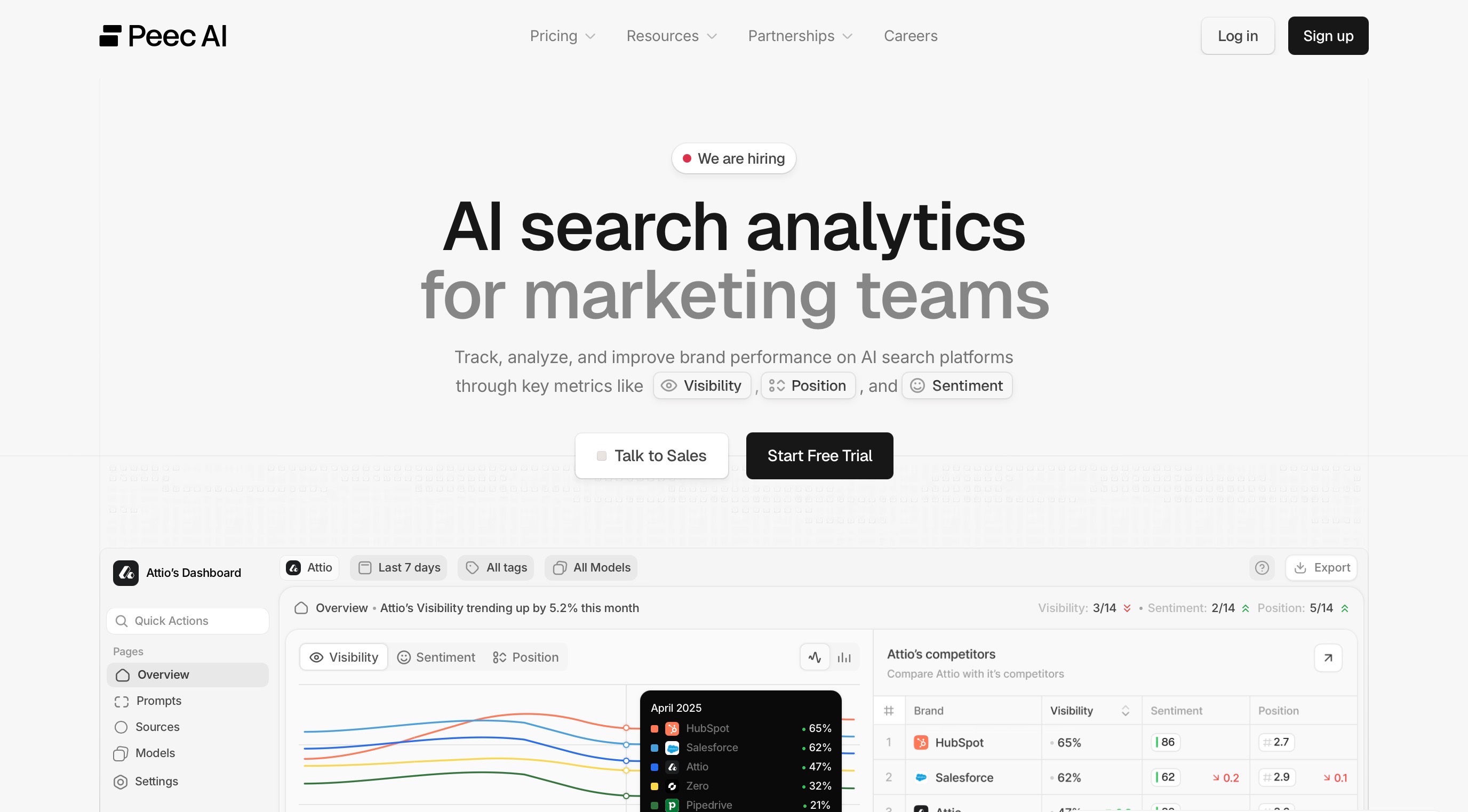
Peec AI is an AI search analytics platform built for marketing teams that want to identify important prompts, monitor rankings, and track competitive visibility across major AI models.
Best For:
Teams that want a simpler prompt-first setup for competitor tracking. It is especially useful for brands that want model-level and country-level filtering without moving into a heavier enterprise platform.
What Are The Key Competitor Analysis Capabilities Of Peec AI?
- Tracks rankings and visibility for the prompts that matter most
- Supports filtering by model, including ChatGPT, Claude, and Perplexity
- Supports country-based filtering to analyze visibility by market
- Uses topics and tags to organize and analyze prompt groups more precisely
- Identifies frequently used source domains and URLs that mention competitors but not your brand
What Other Features Do You Get With Peec AI?
- Prompt setup and organization features to define what you want to monitor
- Actions prioritizes on-page content improvements and off-page opportunities based on source citation frequency and competitor gaps
- Agent Analytics checks AI crawler access and analyzes bot visits, crawl failures, and requested pages using connected server logs
- Expanded country coverage and one-click filtering for models and tags
- YouTube transcript analysis for brand mentions in video content
What Could Be The Potential Limitations Of Peec AI?
- Stronger as a focused AI visibility tool than a broad all-in-one SEO suite
- Better suited to teams that want a cleaner workflow than deep enterprise complexity
- Actions provides prioritized recommendations, but your team still needs to create and publish content and pursue off-page opportunities
See how competitor tracking, Actions, and Agent Analytics work together in our Peec AI review.
7. Scrunch
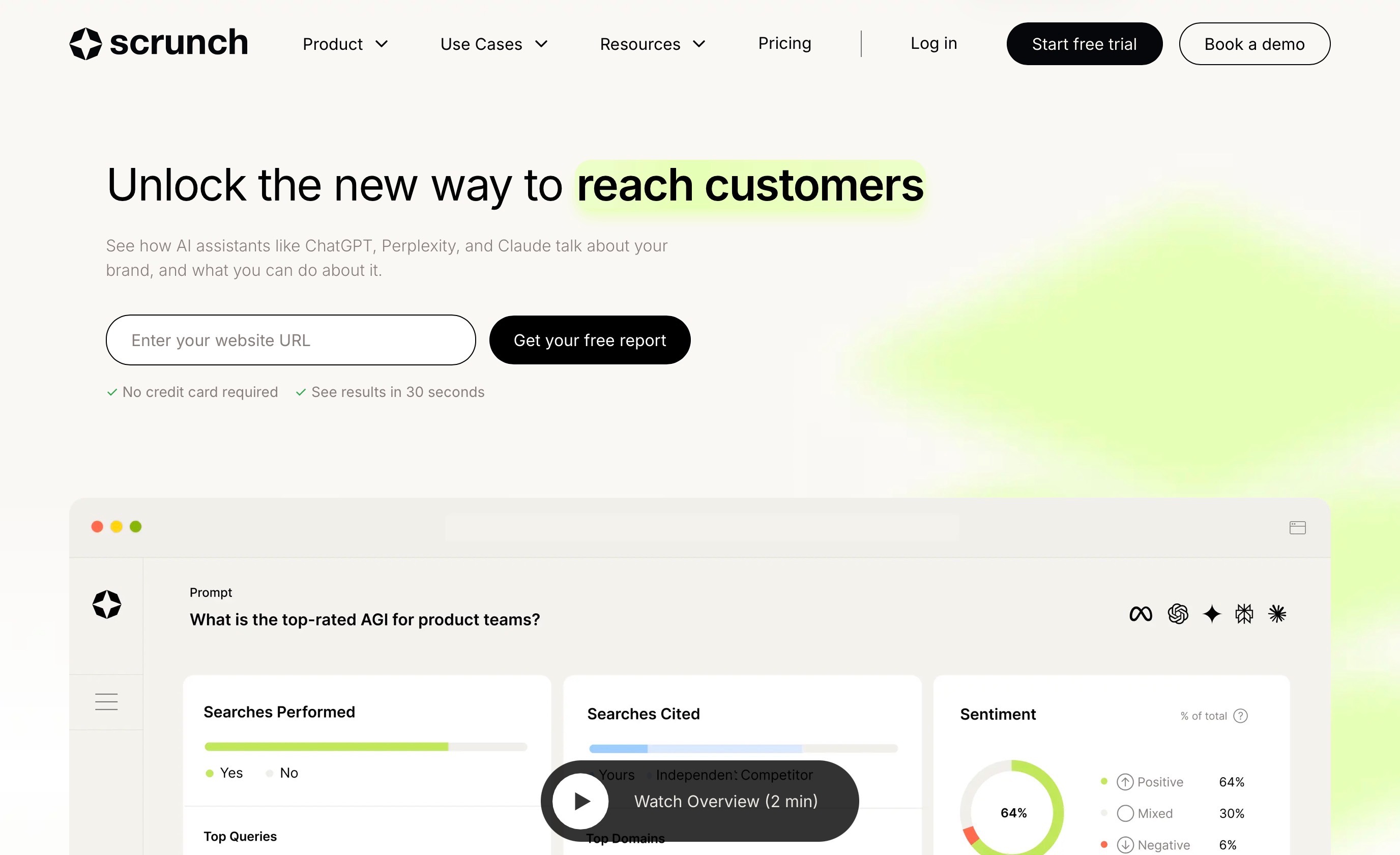
Scrunch AI is an AI customer experience and AI search visibility platform that helps brands track prompts, citations, competitors, and rankings while also monitoring how AI bots crawl their sites.
Best For:
Teams that need deeper segmentation and AI bot visibility. It is a strong fit for brands and agencies that want competitor tracking by persona, topic, and geography, not just top-line visibility metrics.
What Are The Key Competitor Analysis Capabilities Of Scrunch?
- Tracks prompt analytics with trends, citations, competitors, and rankings
- Supports benchmarking by competitor, persona, topic, and GEO
- Uses citation analysis to show which sources and pages AI systems rely on
- Helps identify where competitors are gaining visibility through monitoring and gap detection
What Other Features Do You Get With Scrunch?
- Real-time AI bot crawl and traffic monitoring
- Automatic error detection for crawl and content consumption issues
- Content recommendations and page-level optimization guidance tied to AI visibility
- Suggested competitor discovery based on AI search patterns
- Agent Experience Platform (AXP) creates lightweight, machine-readable versions of website pages for AI agents while preserving the experience for human visitors
What Could Be The Potential Limitations Of Scrunch?
- May be more platform depth than smaller teams need
- Can feel heavier than a lightweight prompt tracking tool
- Better differentiated by segmentation, monitoring, and bot visibility than by traditional SEO suite integration
- Starter includes 350 custom prompts, three user seats, three personas, and five page audits; teams needing higher allowances should factor in upgrades or additional capacity
Explore crawler diagnostics, competitor segmentation, and pages designed for AI agents in our Scrunch AI review.
Which GEO Tool Is Best For Your Team?
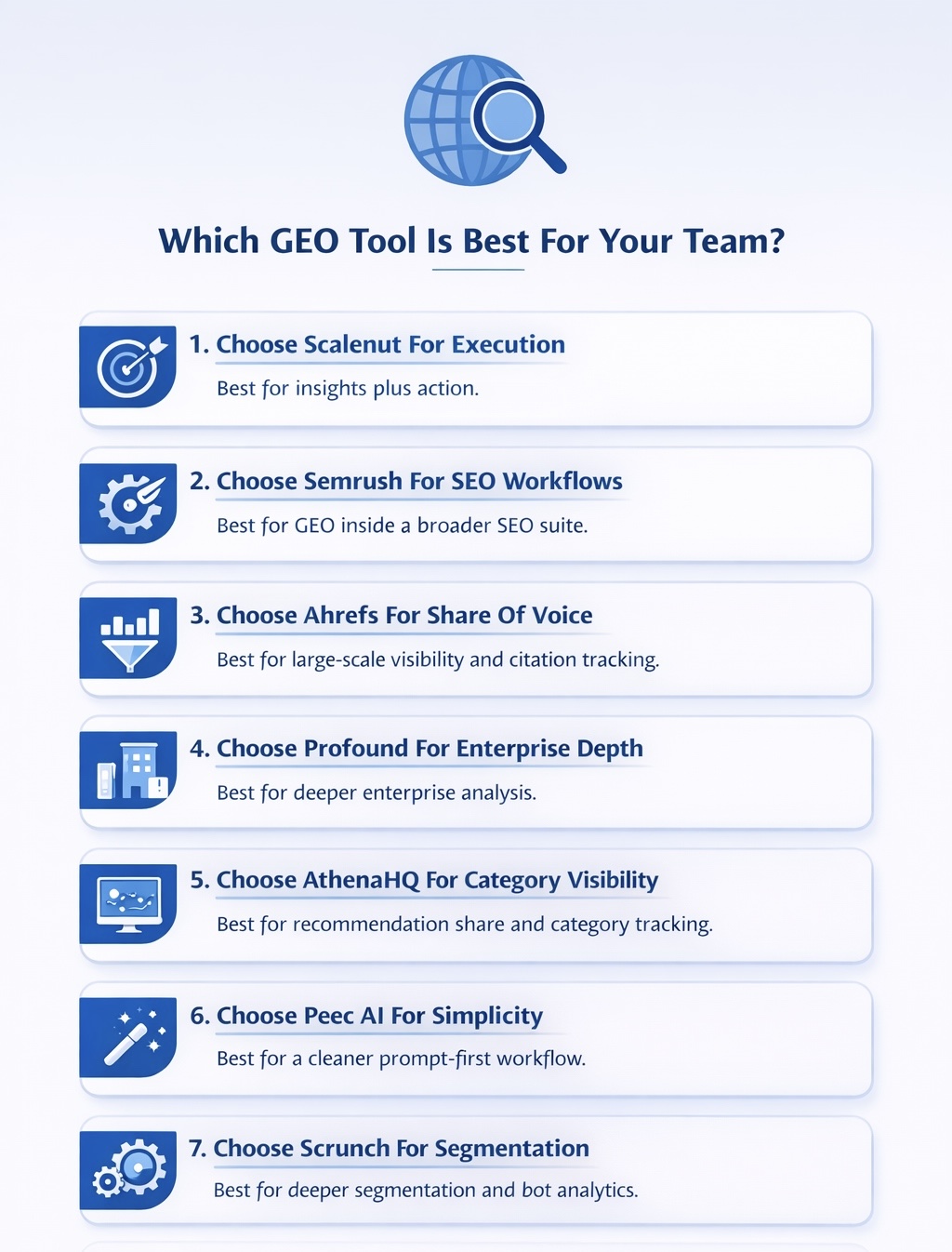
The best GEO tool depends on what your team needs most from competitor analysis. Here are the best fits based on team priority.
1. Choose Scalenut If You Want Competitor Analysis Plus Execution
Choose Scalenut if your team wants more than visibility tracking. It is a better fit for teams that also want to turn insights into content and optimization action.
2. Choose Semrush If You Want GEO Inside A Broader SEO Suite
Choose Semrush if your team already works inside a larger SEO platform. It fits best when GEO needs to sit alongside existing SEO research and reporting.
3. Choose Ahrefs If You Want Share Of Voice And Citation Benchmarking At Scale
Choose Ahrefs if your main priority is large-scale benchmarking. It is a strong fit for teams focused on AI share of voice, mentions, and cited sources.
4. Choose Profound If You Need Enterprise Depth
Choose Profound if your team needs deeper enterprise-grade analysis. It is better suited to brands that want broader AI visibility intelligence across platforms.
5. Choose AthenaHQ If Category Leadership And Recommendation Frequency Matter Most
Choose AthenaHQ if you care most about how often your brand is recommended versus competitors. It is a strong fit for category-level tracking and portfolio visibility.
6. Choose Peec AI if you want prompt tracking and prioritized recommendations
Choose Peec AI if your team wants focused prompt-level competitor tracking and source gap analysis. Its Actions feature helps prioritize content improvements and off-page opportunities based on cited sources and competitor gaps.
7. Choose Scrunch if you need segmentation, bot visibility, and pages designed for AI agents
Choose Scrunch if your team needs competitor tracking by topic, persona, and geography alongside monitoring of AI bot activity on your site. Its Agent Experience Platform also delivers machine-readable versions of your pages designed for AI agents.
The right choice depends on whether your team values execution, scale, enterprise depth, or simpler competitive visibility tracking most.
Looking for expert help beyond software? See what to look for in the best agency to optimize for ChatGPT and Google AI Overviews.
How Do You Choose The Right GEO Tool For Competitor Analysis?
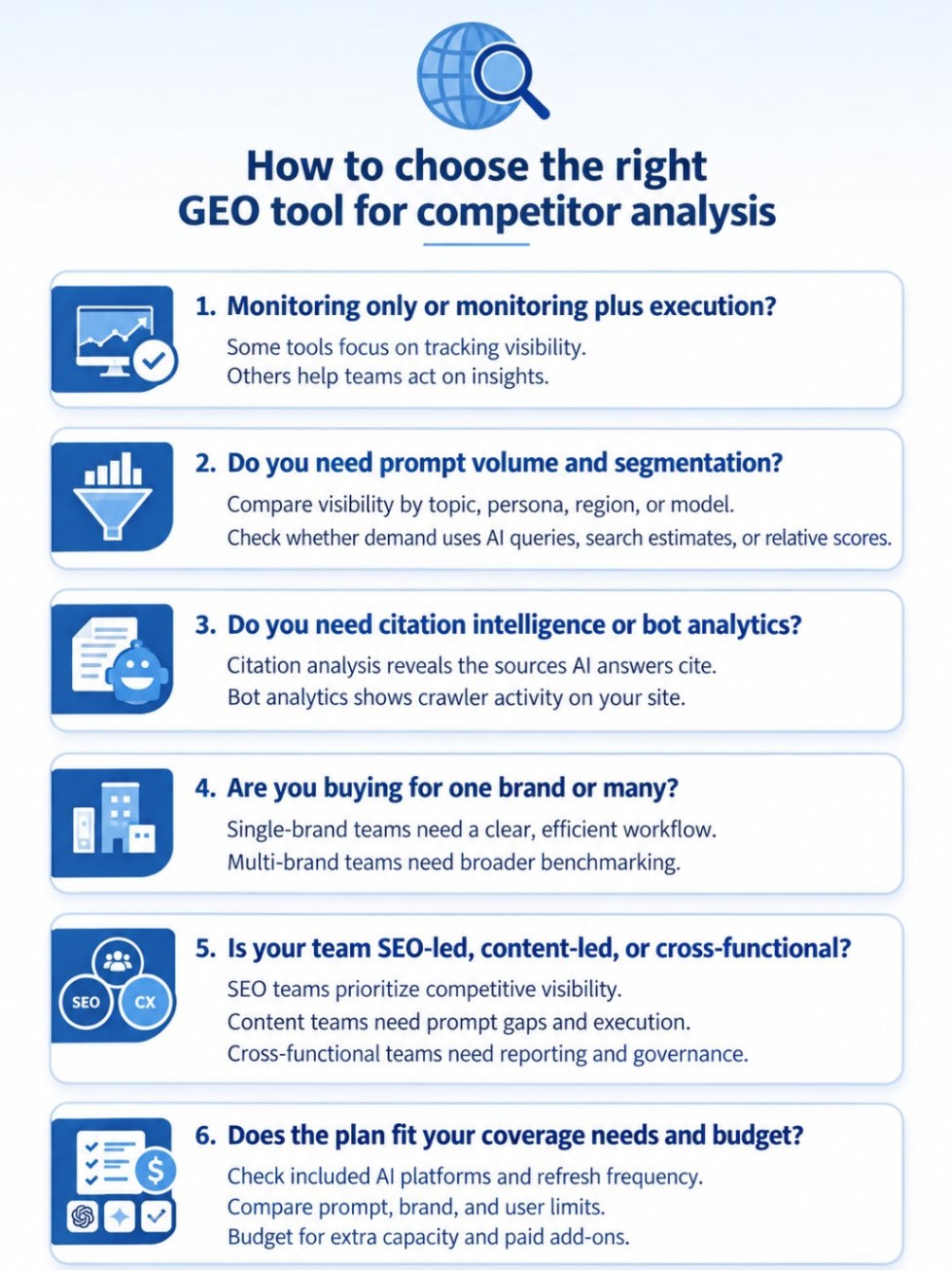
The right GEO tool is not the one with the longest feature list. It is the one that matches how your team actually evaluates competitors, turns insights into action, and reports performance across AI search.
Here are the key questions to use before you shortlist a platform.
1. Do You Need Monitoring Only, Or Monitoring Plus Execution?
Some GEO tools are built mainly to track visibility, mentions, prompts, and competitor movement. That is useful if your team already has a strong SEO or content engine and only needs better intelligence.
Others are more valuable when they help you move from insight to action. If your team wants to identify competitor gaps and then quickly turn those gaps into content, optimization, or workflow decisions, execution matters just as much as reporting. This is usually the more important filter for lean teams that cannot afford disconnected tools.
2. Do You Need Prompt Volume And Segmentation?
Not every competitor insight is equally useful. Look for tools that help you prioritize relevant prompts and segment visibility by topic, persona, funnel stage, region, or AI platform. If prompt volume is available, check how it is measured, since observed AI queries, search-based estimates, and relative demand scores represent different types of data.
If a platform only tells you that a competitor appears more often, that is still surface-level data. The better question is where they are winning, under what conditions, and whether those wins matter to your market.
3. Do You Need Citation Intelligence Or Bot Analytics?
Some teams need to know which websites, pages, or sources AI systems cite when competitors get mentioned. That is what makes citation intelligence valuable. It helps you understand the evidence layer behind AI visibility, not just the output.
Bot analytics matters when you also want to see whether AI crawlers and agents are actually reaching your site. This becomes more important when your team suspects discoverability or crawl access may be affecting performance, not just content quality.
4. Are You Buying For One Brand Or Many?
A single-brand team usually needs speed, clarity, and a clean workflow. The platform should make it easy to monitor direct competitors, spot gaps, and report progress without adding unnecessary complexity.
Multi-brand teams, category leaders, and agencies often need portfolio-level tracking, broader benchmarking, and better ways to compare performance across markets or business units. In those cases, platform depth matters more than simplicity.
5. Is Your Team SEO-Led, Content-Led, Or Enterprise Cross-Functional?
The best GEO tool for an SEO-led team is not always the best one for a content team or an enterprise buying committee. SEO-led teams often care most about competitive visibility, query coverage, crawl access, and share of voice. Content-led teams usually need clearer prompt gaps, topic opportunities, and faster paths from insight to creation.
Enterprise cross-functional teams usually need stronger reporting, segmentation, governance, and broader platform coverage. That means the right choice depends as much on internal workflow as it does on feature depth.
6. Does the plan cover your AI platforms, tracking needs, and budget?
Check which AI platforms, regions, and languages are included in your chosen plan and how often competitor data refreshes. Distinguish between broad database-based benchmarking and custom tracking of your selected buyer prompts, since their coverage and update schedules can differ.
Compare the total cost for the prompts, brands, users, and platforms your team needs. Check how usage limits work and whether additional tracking capacity, API access, or extra markets cost more.
The best GEO tool is the one that fits your team’s decision-making model, not just the one with the most impressive dashboard.
Need agency support for a larger rollout? Explore the best GEO agencies for enterprise SaaS companies and see which teams are built for complex AI visibility growth.
Conclusion
The best GEO tool for competitor analysis should help you understand where rivals appear, which sources AI platforms cite, and what to improve next. Look for actionable recommendations that strengthen your brand presence, guide your content strategy, and improve content structure across existing pages and new content. Review these insights alongside SEO metrics from Google search to assess both AI visibility and your traditional search performance, including organic traffic.
Shortlist tools based on your priority prompts, markets, budget, and workflow, then test how easily your team can act on the findings. Measure business impact through qualified visits, leads, or conversions as you refine your answer engine optimization efforts.
Frequently Asked Questions
What AI features should I look for in a GEO tool for competitor benchmarking in 2026?
Prioritize competitor share of voice, prompt-level gaps, citation analysis, and filters for relevant AI platforms and markets. Check refresh frequency, custom prompt limits, and access to underlying answers. Choose recommendations, content workflows, or bot analytics according to your team’s execution needs.
What are the key best practices for using GEO tools for competitor analysis in 2026?
Track a consistent set of buyer prompts, direct competitors, AI platforms, and markets. Review trends over multiple checks, investigate commonly cited sources, and prioritize gaps linked to purchase decisions. Record content changes so you can compare visibility before and after updates.
How can I use GEO tools to compare my brand’s visibility to rivals in 2026?
Track your brand and direct competitors using the same prompts, platforms, locations, and reporting period. Compare mention frequency, share of voice, citations, and placement where available. Segment results by topic and buying stage to identify the questions where rivals consistently outperform you.
How do top GEO platforms help analyze competitor visibility in 2026?
Top GEO platforms organize competitor mentions, citations, and recommendations into reports by prompt, topic, platform, and market. Some also identify source gaps or suggest content and off-page actions, helping teams prioritize opportunities instead of manually reviewing every AI answer.
What tools track GEO performance and AI search engine rankings accurately?
Scalenut, Semrush, Ahrefs Brand Radar, Profound, AthenaHQ, Peec AI, and Scrunch support AI visibility measurement. Evaluate accuracy through stored answers, transparent metric definitions, consistent prompt settings, and repeat checks. Compare trends across several runs rather than relying on one snapshot.
What are the best GEO tools for US businesses doing competitor analysis in AI search?
US businesses should prioritize US tracking coverage and relevant buyer prompts. Scalenut suits content execution, Semrush broader SEO workflows, Ahrefs large-scale benchmarking, Profound enterprise analysis, AthenaHQ recommendation tracking, Peec AI source gap prioritization, and Scrunch segmentation and crawler diagnostics.
Do GEO tools provide real-time competitor visibility tracking?
Refresh frequency depends on the platform and feature. Semrush and Peec AI document daily custom prompt tracking, while Scrunch offers a real-time AI bot feed. Check competitor-answer refresh schedules separately from bot monitoring before choosing a tool for time-sensitive reporting.


.svg)


.webp)