Profound vs Scrunch at a glance
- Best fit: Profound suits enterprises needing deep intelligence and customizable automation. Scrunch suits teams wanting flexible monitoring and AI-agent content delivery.
- Visibility monitoring: Both track mentions, citations, sentiment, competitors, full responses, and trends. Profound provides deeper segmentation, while Scrunch offers a simpler prompt-level workflow.
- Prompt intelligence: Profound uses data from over 1.5 billion real AI conversations, although full Prompt Volumes search requires Enterprise. Scrunch provides custom prompt tracking and topic-level AI Search Trends.
- Content execution: Profound Agents and Aim support content creation, optimization, approvals, and publishing. Scrunch focuses on identifying gaps and improving existing pages.
- Technical optimization: Profound analyzes crawler behavior and AI traffic. Scrunch additionally uses AXP to serve streamlined content directly to AI agents.
- Pricing: Profound starts at $99 per month billed annually. Scrunch starts at $250 per month billed annually or $300 month-to-month. Both provide trial access.
- User ratings: Profound has a 4.5/5 G2 rating from 1,123 reviews, while Scrunch has a 4.6/5 G2 rating from 72 reviews.
- Where both fall short: Neither combines specialized AEO intelligence with a complete traditional SEO workflow, so some teams may still need additional tools for research, optimization, audits, and internal linking.
Profound and Scrunch can both track brand visibility, competitors, sentiment and citations across AI platforms. That overlap makes them look interchangeable, but the buying decision comes down to what your team needs to do after finding a visibility gap.
Profound combines demand intelligence with Agents that create and optimize content. Scrunch focuses on auditing existing pages and improving how AI agents access them through AXP. Profound starts at $99 per month, while Scrunch starts at $250, but price alone does not reveal the better value. This comparison breaks down the workflows, limits and trade-offs that matter before you buy.
Profound vs Scrunch for AEO: What does each platform do?
Profound and Scrunch both monitor brand visibility, competitors, citations and sentiment across AI platforms. Their main difference is how they help digital marketing teams act on that data. Profound connects visibility intelligence with demand research and content automation, while Scrunch focuses on auditing, optimizing and delivering existing website content to AI agents.
Profound
What is Profound?
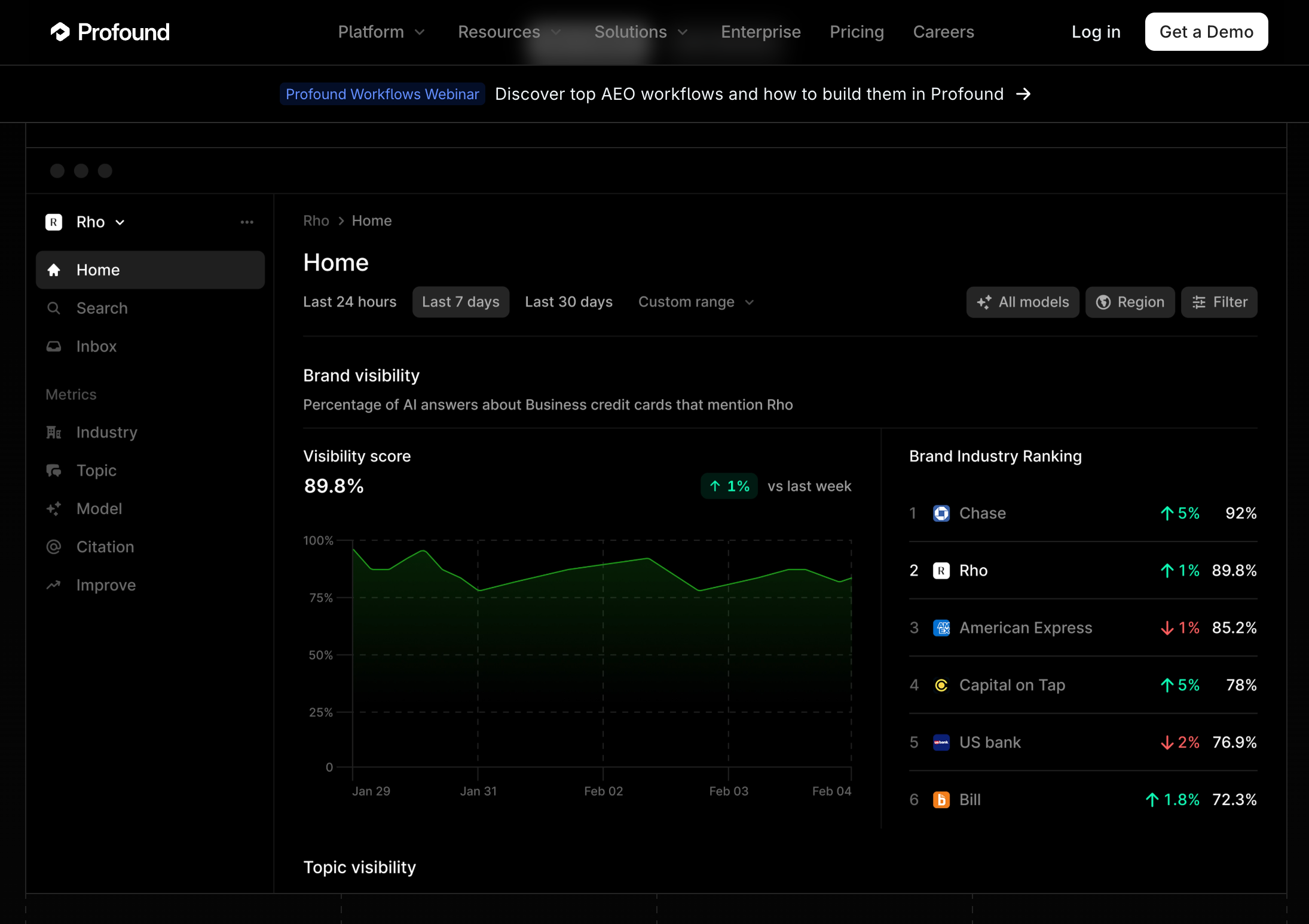
Profound is an AEO platform that combines AI visibility monitoring, prompt-demand research, crawler analytics and automated marketing workflows. It helps teams understand how their brand appears in AI answers, identify high-value opportunities and create or optimize content based on those findings.
What makes Profound different?
- Prompt Volumes: Validates topics and prompts against a proprietary dataset of more than 1.5 billion anonymized AI conversations. Teams can analyze volume, trends, intent and audience signals.
- Aim and Profound Agents: Aim prioritizes high-impact marketing projects, while Agents turn those opportunities into briefs, drafts, content updates and automated workflows.
- FactCheck: Compares claims made by AI platforms with a brand’s connected source of truth. It identifies inaccurate statements and the citation sources contributing to them.
- Agent Analytics: Uses server-log data to track verified AI crawlers, identify crawlability issues and connect AI bot activity with citations and referral traffic.
Want a closer look at Profound’s capabilities and limitations? Read our complete Profound AI review.
Scrunch

What is Scrunch?
Scrunch, now a Sitecore company, is an AI search optimization platform that combines visibility monitoring with site auditing, page optimization and AI-agent content delivery. It helps teams identify where their brand is missing, diagnose why existing pages are not being accessed or cited and improve how those pages are presented to AI agents.
What makes Scrunch different?
- Site Maps and Deep AI Audits: Show page-level agent traffic, citations, AI referrals and audit scores. Deep audits examine access controls, content delivery, content quality and alignment with target prompts.
- Optimizer: Creates an AI-optimized version of an existing page or provides step-by-step recommendations for updating the human-facing page.
- Agent Experience Platform: Detects AI retrieval agents at the CDN layer and serves them streamlined, server-rendered content without changing the experience for human visitors.
- AI Search Trends: Surfaces estimated prompt activity, topic momentum and real prompts behind emerging areas of AI search volume demand.
Want to explore Scrunch’s monitoring, auditing and AXP workflows in detail? Read our complete Scrunch AI review.
What are the main differences between Profound and Scrunch for AEO?
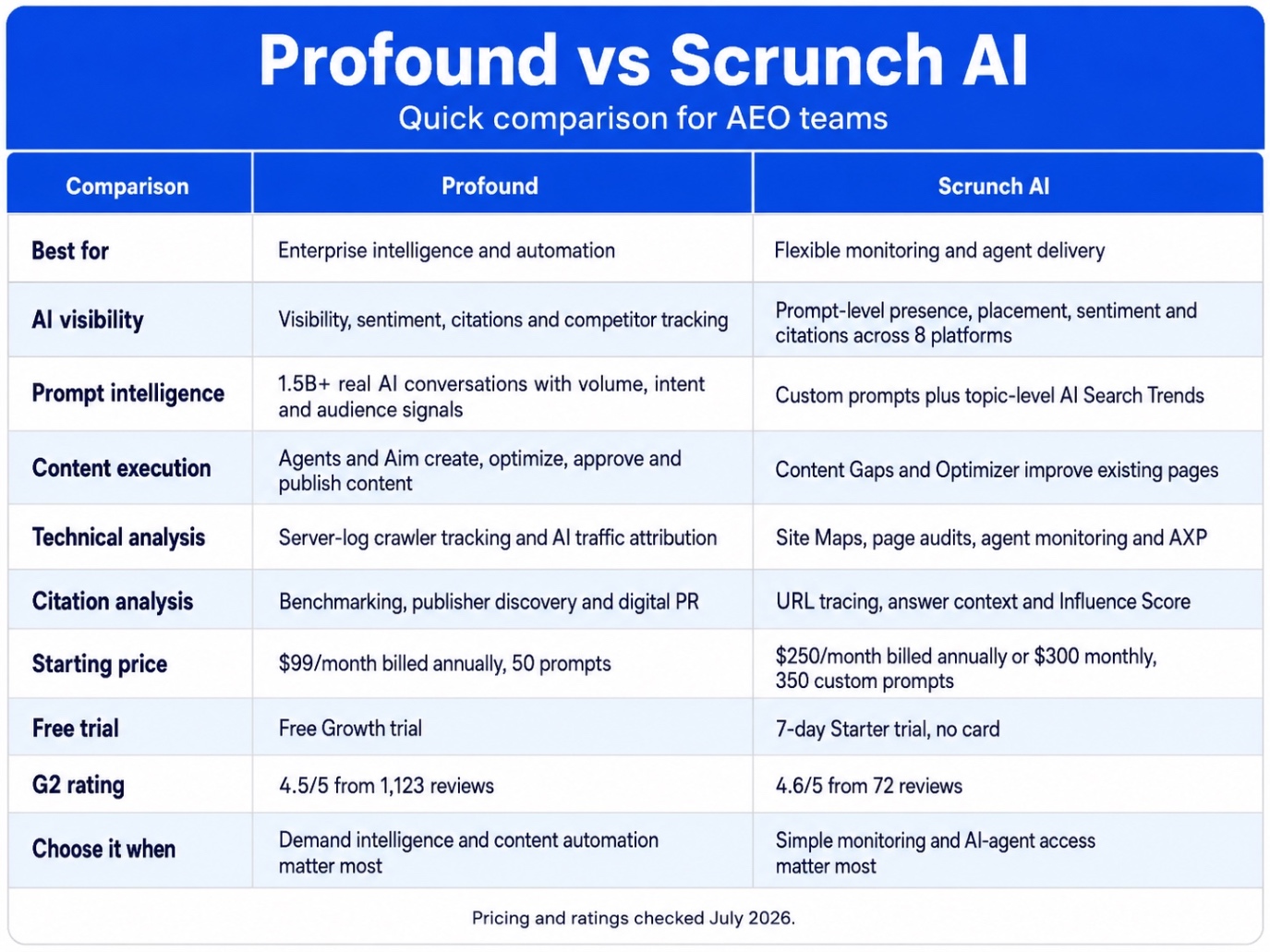
Profound and Scrunch overlap in AI visibility tracking, competitor monitoring, prompt analysis and citation tracking. They differ most in how they turn those insights into action: Profound emphasizes demand intelligence and content automation, while Scrunch focuses on site diagnostics, page optimization and AI-agent delivery.
Let’s compare them across monitoring, prompt intelligence, content execution, technical optimization and citation analysis.
Which tool is better for monitoring AI visibility?
What Profound offers
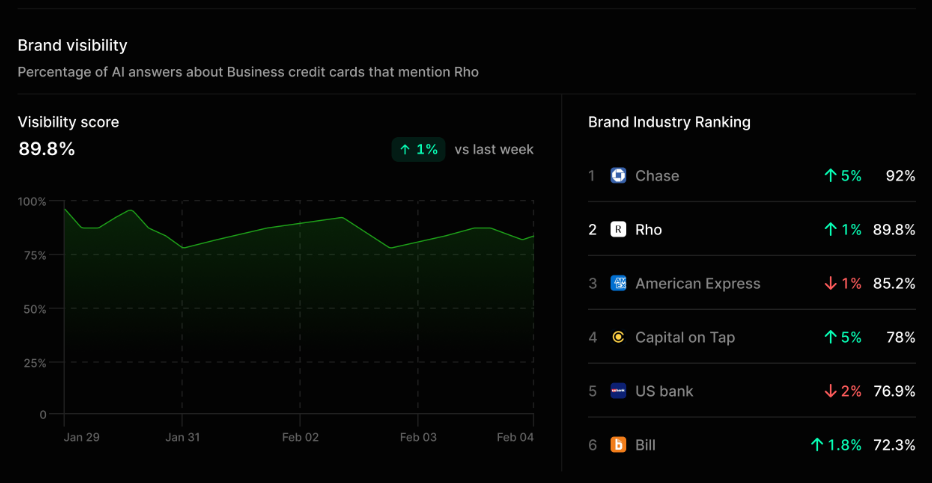
Profound’s Answer Engine Insights tracks visibility score, share of voice, brand sentiment, citations and competitor rankings through daily prompt runs. You can review full AI responses and filter AI search performance by platform, prompt, topic, tag, persona and location.
Its language support for more than 150 regions and 30 languages makes it particularly useful for enterprises comparing visibility across markets, product lines and competitive sets. Daily trend lines show how visibility, citations and sentiment change over time.
What Scrunch offers
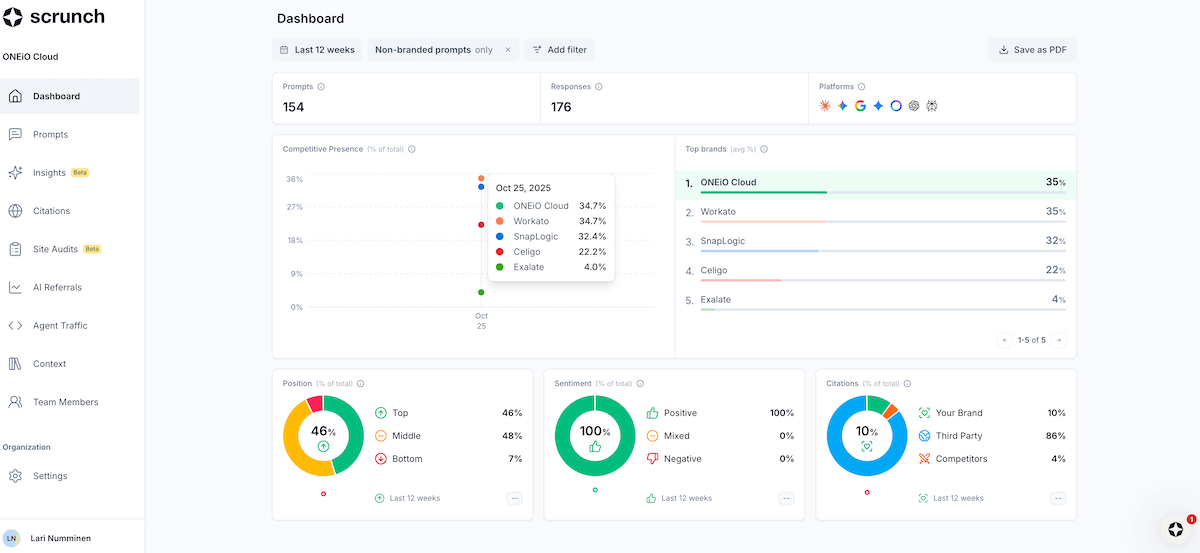
Scrunch tracks brand presence, answer share, competitor visibility, citations, placement and sentiment across eight major AI platforms. You can open individual prompts to review full responses and compare how your brand and competitors appear across models.
Its filters cover platforms, prompts, personas, funnel stages and geographies. Daily snapshots and customizable date ranges help teams separate sustained visibility changes from one-off fluctuations.
Profound vs Scrunch: Which is best for monitoring AI visibility?
Choose Profound if you need enterprise-level benchmarking across multiple regions, topics, product lines or competitive sets. Its deeper segmentation is particularly useful for complex reporting requirements.
Choose Scrunch if you prefer a more self-serve workflow with prompt-level answers, citations and flexible audience filters. Both are capable AI visibility trackers, so monitoring alone should not determine your final choice. Their differences become clearer when you compare prompt intelligence, content execution and technical optimization.
Not sure which numbers actually signal progress? Explore the best AI visibility tracking success metrics to measure.
Which tool is easier to set up and use?
What Profound offers
Profound uses a more guided workflow and can surface a broad competitive landscape without requiring teams to define every competitor upfront. This reduces some of the setup needed to reach useful competitive insights, particularly when you want to discover brands appearing in AI answers that were not already on your radar.
What Scrunch offers
Scrunch starts onboarding from your website URL and can generate initial brand details, competitors, personas and prompts. It also gives teams more control over how monitoring is organized, with configurable competitors, topics, personas, funnel stages, tags and prompt groups. That flexibility can require more setup, but it becomes useful for teams with an established reporting framework.
Profound vs Scrunch: Which is easier to use?
Choose Profound if you want to reach a broad competitive view with less upfront classification. Choose Scrunch if you prefer more control over how prompts, audiences and reporting are structured. Ease of use therefore depends on whether your priority is faster competitive discovery or deeper configuration.
Which tool is better for finding prompts worth tracking?
What Profound offers
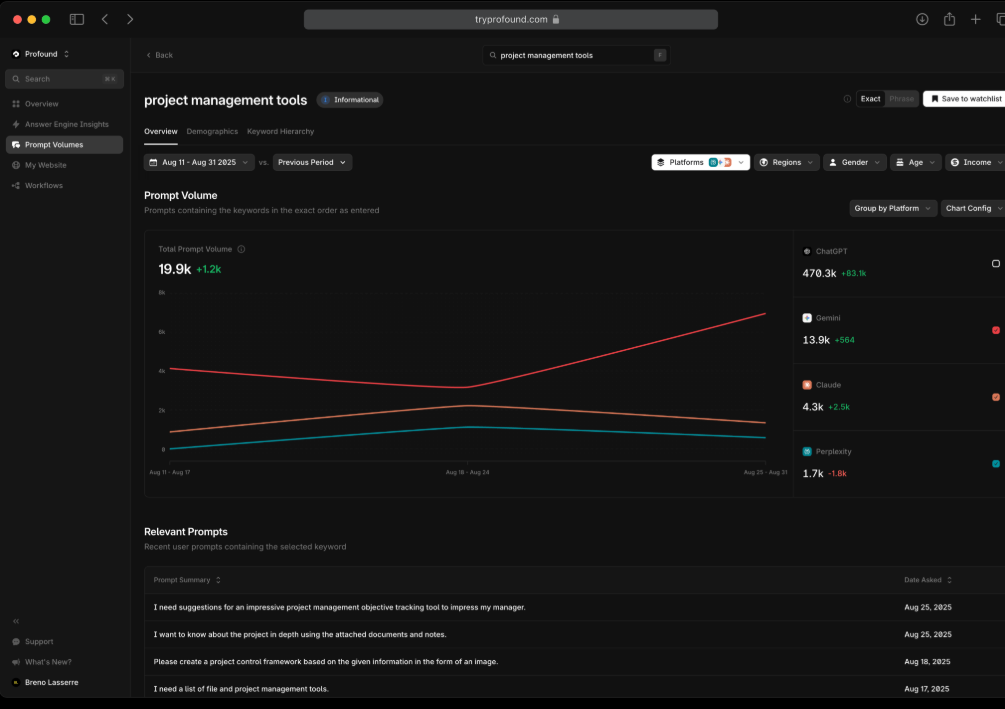
Profound’s Prompt Volumes validates prompt ideas against a proprietary dataset of more than 1.5 billion anonymized AI conversations. It provides keyword volume, topic trends, intent signals and audience data to show what people are asking across AI platforms.
Teams can discover high-demand prompts, add them to their tracking set and organize them by topic, funnel stage, persona or region. This helps prioritize prompts based on estimated demand rather than relying only on manually created lists.
What Scrunch offers

Scrunch combines custom prompt tracking with AI Search Trends. The feature shows estimated prompt volume and momentum at the topic level, helping teams identify rising or declining areas of interest.
Users can select relevant topics, review the real prompts behind each trend and add useful prompts to their tracked set. Scrunch also supports consistent prompt groups organized by topic, persona and funnel stage. It should not be described as relying only on synthetic prompts.
Profound vs Scrunch: Which is best for finding prompts worth tracking?
Choose Profound when demand data will directly shape your prompt strategy and content priorities. Its more granular volume, search intent and audience signals make it better for discovering and validating opportunities.
Choose Scrunch when you already understand your customer journey and need a flexible, repeatable prompt set for monitoring visibility over time. Its trend data can expand that set, but its main strength is structured monitoring rather than granular demand research.
Which tool is better for turning insights into content?
What Profound offers
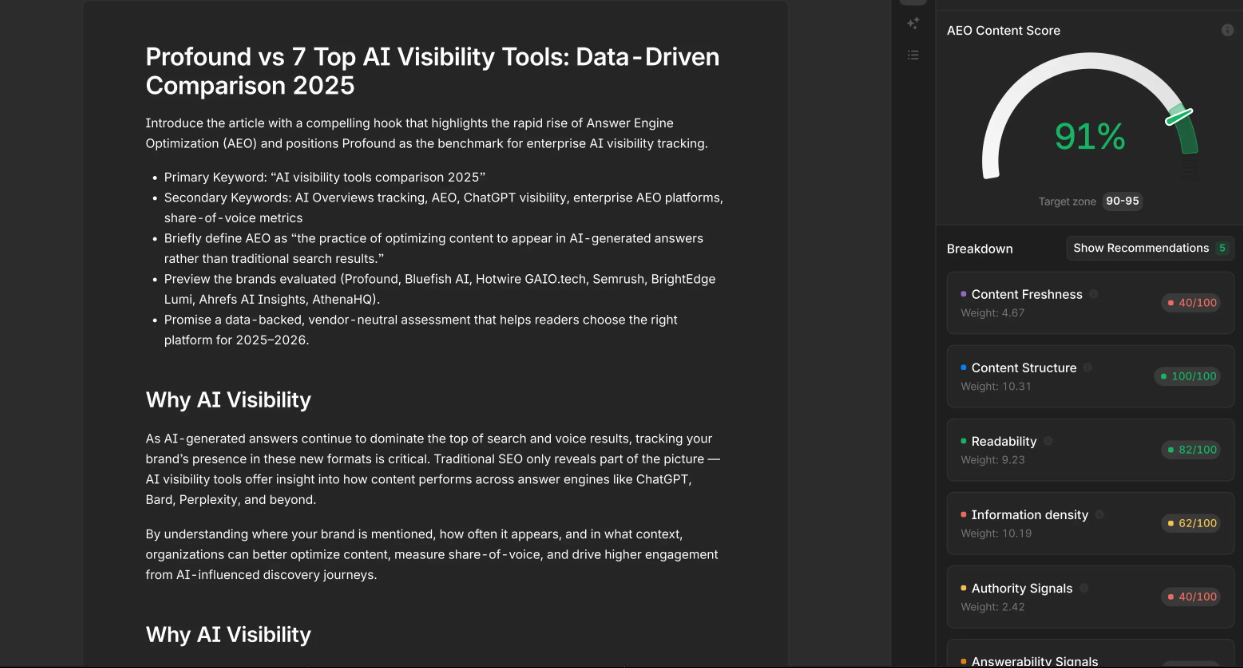
Profound connects its visibility, prompt and citation data directly to Profound Agents. These workflows can identify content gaps, generate briefs and full drafts, refresh existing pages and create content targeting prompts where competitors currently outperform your brand.
Agents also support brand guidelines, human approval steps and CMS integrations. Teams can review or edit each output before publishing, which makes the feature suitable for scaling content production without fully automating editorial decisions.
What Scrunch offers

Scrunch focuses on improving existing website content rather than producing net-new articles. Site Maps and Deep AI Audits identify pages with weak citations, limited agent traffic, technical access issues or content that does not align with tracked prompts.
Its Optimizer can create an AI-optimized version of an existing page or provide step-by-step recommendations for manual updates. AXP then serves the optimized version directly to AI agents without changing the page shown to human visitors.
Profound vs Scrunch: Which is best for turning insights into content?
Choose Profound if content-production capacity is your main bottleneck. It provides the stronger workflow for moving from opportunity discovery to briefs, drafts, optimization and publishing.
Choose Scrunch if you already have a substantial content library but need to improve how AI agents access, interpret and cite it. Profound is stronger for creating and scaling content, while Scrunch is stronger for auditing, optimizing and delivering existing content to AI agents.
Need a tool built specifically for content production? Explore the best AI content creation tools for 2026.
Which tool is better for technical optimization and AI crawler access?
What Profound offers
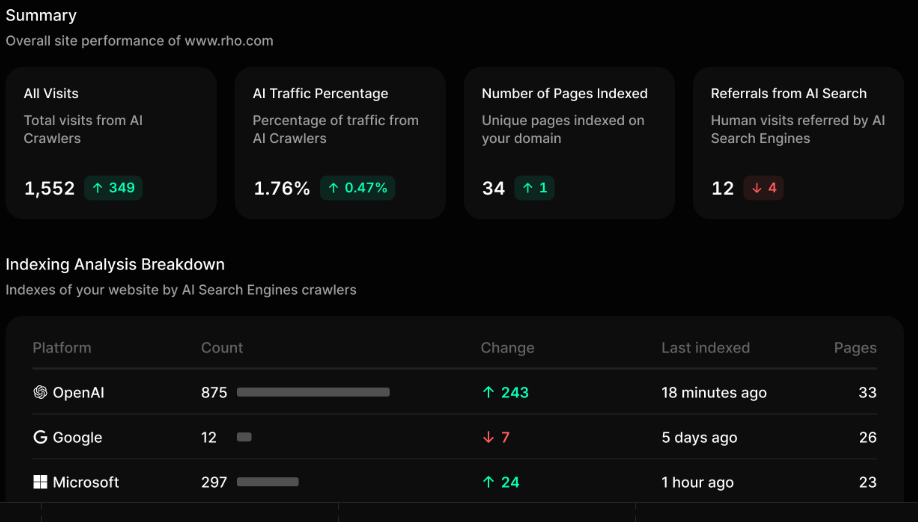
Profound Agent Analytics uses server-log data to show which verified AI crawlers access your site, which pages they request and how frequently they return. It also tracks server response times, rendering issues, AI citations and human referral traffic from AI platforms.
Its crawlability diagnostics help identify blocked pages, slow responses and content that AI bots cannot fully retrieve or render. Profound now also offers Dynamic Bot Rendering, which detects Answer Engine agents and serves them a fully rendered version of a page without changing the human-facing website. Rendering policies can be configured for specific pages, page patterns, domains or individual bots.
Want similar crawler intelligence with a different workflow or price point? Compare the best Profound AI competitor tools for GEO in 2026.
What Scrunch offers
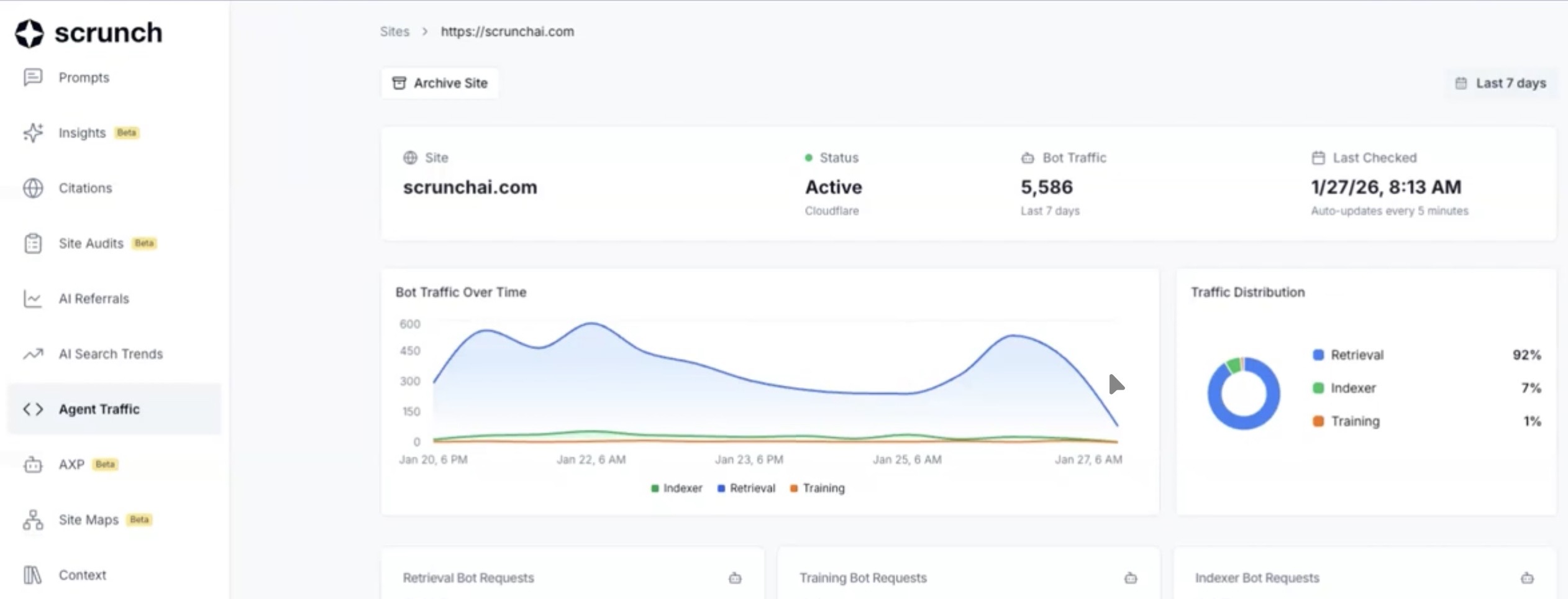
Scrunch combines Agent Traffic, Site Maps, page audits and AXP. These features identify access restrictions, JavaScript rendering problems, content-delivery issues and pages that receive agent traffic but fail to earn citations.
AXP detects AI retrieval bots at the CDN layer and serves them a streamlined, server-rendered version of the page. It can remove JavaScript dependencies, simplify dynamic components and structure existing content so it is easier for AI agents to retrieve and interpret, while human visitors continue to receive the original website experience.
Profound vs Scrunch: Which is best for technical optimization and AI crawler access?
Choose Profound when you need to measure crawler behavior, diagnose technical barriers and connect AI bot activity with citations and referral traffic, while also ensuring Answer Engine agents can access fully rendered page content.
Choose Scrunch when AI-specific content delivery and optimization are central requirements. Both platforms can now address rendering barriers, but their workflows differ: Profound combines crawler analytics with configurable bot rendering, while Scrunch’s AXP goes further into transforming and delivering streamlined, AI-optimized versions of existing pages.
Which tool is better for citation and source analysis?
What Profound offers
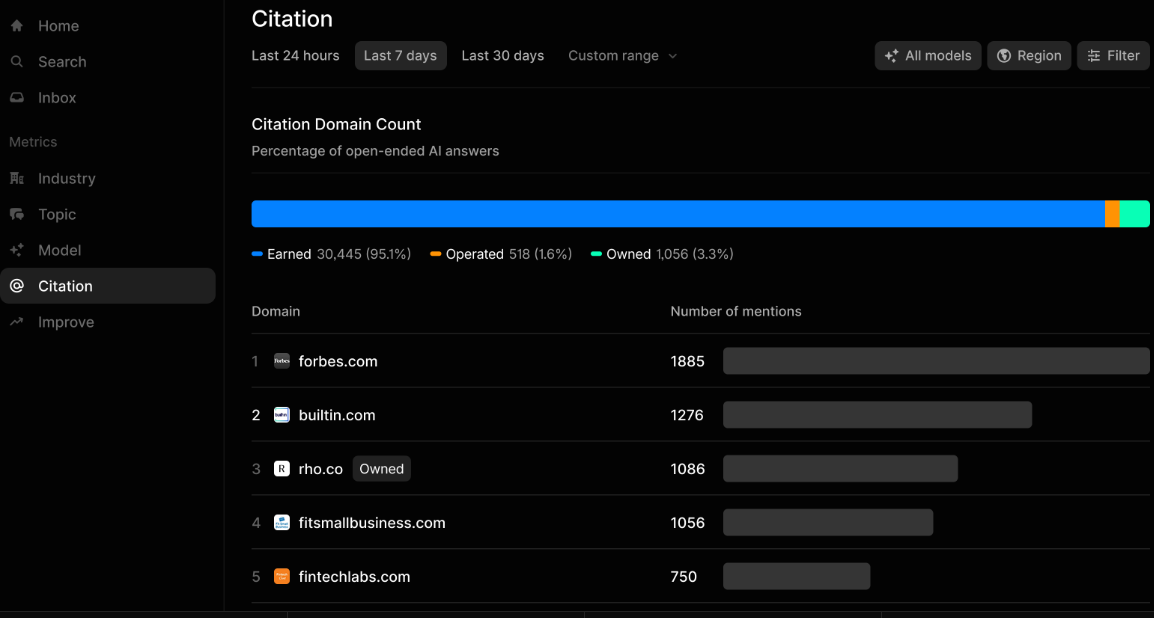
Profound tracks every source cited across monitored prompts and compares your citation share with competitors by platform, topic and prompt. Sources can be categorized as owned, competitor, earned media, social, institution or other.
Its earned-media filters surface frequently cited publishers and authors that may be worth targeting for outreach. Watched Pages also tracks citation changes for individual URLs, helping teams measure whether new or updated content is gaining visibility.
What Scrunch offers

Scrunch records every cited domain and URL, along with the number of prompts and responses citing each source. It also measures citation consistency and assigns an Influence Score based on how broadly and consistently a source appears across tracked answers.
Teams can filter citation data by platform, prompt type, topic, persona, country, funnel stage and citation owner. Scrunch also shows competitor and third-party sources alongside full response context. However, Influence Score measures a source’s reach across tracked answers, not its editorial quality.
Profound vs Scrunch: Which is best for citation and source analysis?
Choose Profound if you want to connect citation data with content planning, competitor benchmarking and digital PR outreach. Its source categorization and publisher discovery are particularly useful for broader authority-building strategies.
Choose Scrunch if you need granular URL-level analysis and a clear way to prioritize sources by their influence across prompts. Neither is categorically better. Profound is stronger for strategic content and outreach workflows, while Scrunch is stronger for detailed source tracing and prioritization.
Not sure Scrunch’s citation intelligence justifies the cost? Compare 7 Scrunch AI alternatives before paying $250.
Which platform offers the best value for money?
What Profound offers
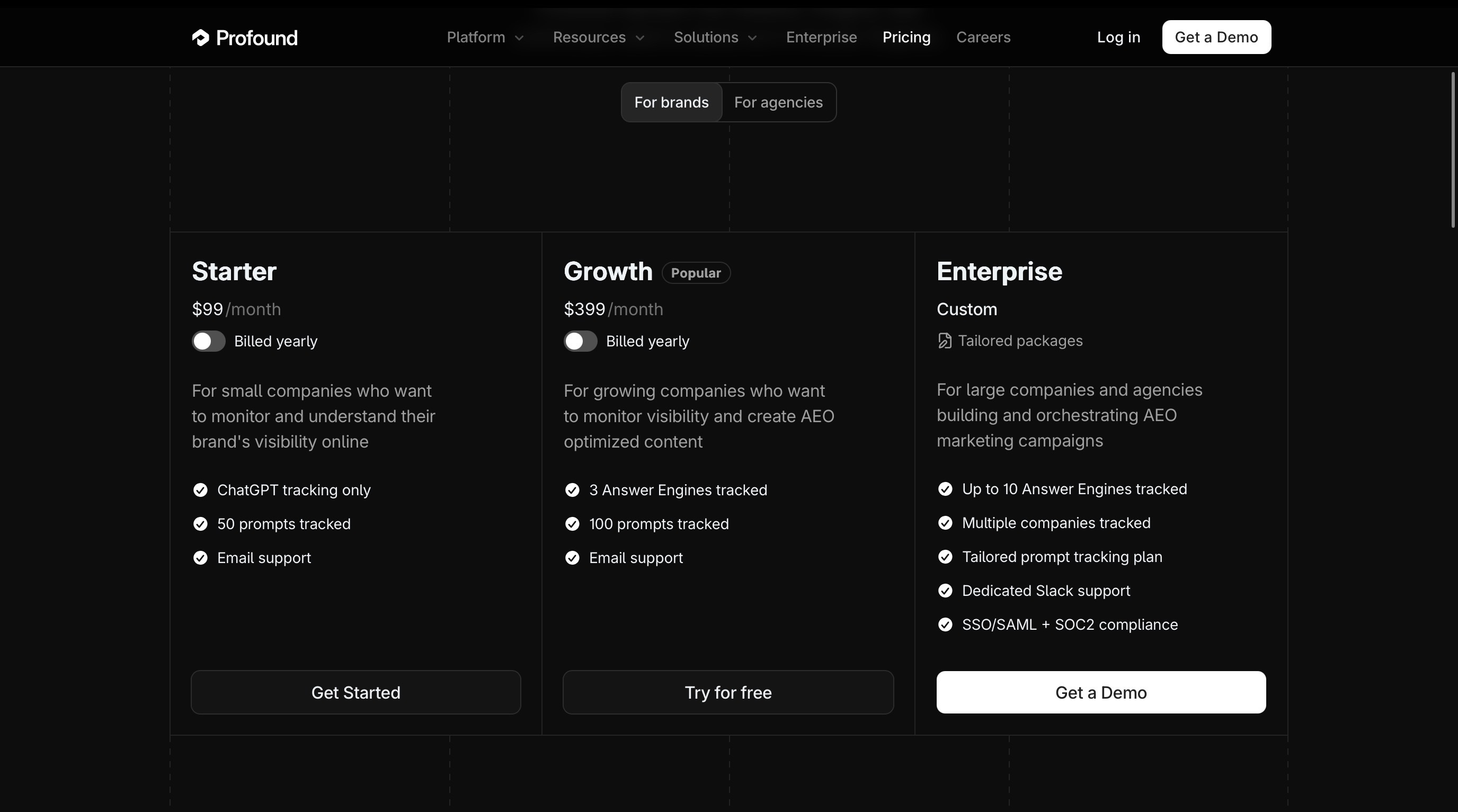
- Starter: $99/month. Includes ChatGPT tracking, 50 prompts, one seat and 100 monthly Agent credits.
- Growth: $399/month. Includes three answer engines, 100 prompts, three seats and 400 monthly Agent credits. A seven-day free trial is available.
- Enterprise: Custom pricing. Adds broader platform coverage, custom limits, API access, SSO and dedicated support.
- Agency Growth: $99/month plus add-ons. Includes 10 monthly pitch workspaces, agency workspace management and consolidated billing. Full client workspaces cost an additional $399 per month each.
- Agency Enterprise: Custom pricing. Includes tailored client and trial workspaces, a dedicated agency partner, go-to-market support and premium Slack support.
What Scrunch offers
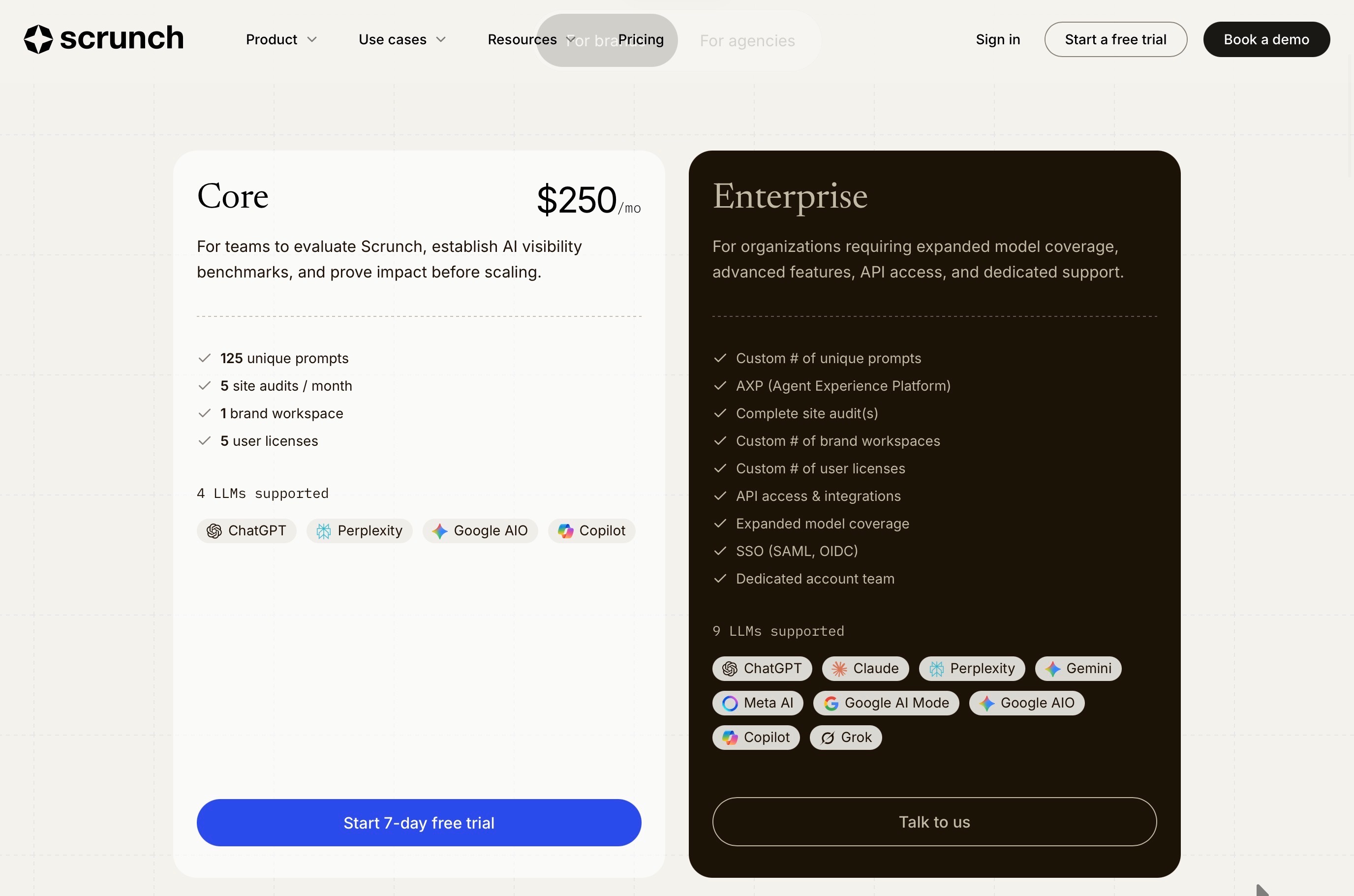
- Core: $250/month. Includes 125 prompts, four AI platforms, five monthly site audits, one brand workspace and five user licenses. A seven-day free trial is available.
- Agency Core: $500/month. Includes 250 prompts, four AI platforms, five monthly audits per brand, three brand workspaces, three pitch workspaces and unlimited users. A seven-day free trial is available.
- Enterprise: Custom pricing. Adds nine-platform coverage, AXP, complete site audits, custom prompts and workspaces, enterprise security and dedicated support.
Profound vs Scrunch: Which offers better value for money?
Choose Profound Starter if you need an affordable entry price point and only want to monitor ChatGPT. Scrunch Core offers better value for multi-platform monitoring, site audits and team access. Profound Growth is the stronger investment if you will actively use its content creation and automation features.
For enterprise buyers, the better value depends on whether you prioritize Profound’s demand intelligence and content workflows or Scrunch’s AXP and technical optimization capabilities.
Looking for a more affordable entry point? Compare the 11 best GEO tools under $100 per month for 2026.
What are users saying about Profound and Scrunch?
Profound has a 4.5/5 G2 rating from 1,123 reviews, while Scrunch has a 4.6/5 rating from 72 reviews. Reviews for both tools are largely positive, but they reveal different strengths and limitations.
What users say about Profound
Profound users consistently value its data depth, prompt tracking, competitor comparisons, and full AI responses. These capabilities make visibility less dependent on guesswork and help teams prioritize content using measurable evidence.
“It gives me a clear view of how our brand shows up across AI platforms,” says Amy L., SEO Specialist on G2.
The main concerns are its learning curve, reporting flexibility, and content workflows. “Content optimization and workflows are still fairly generic and could benefit from more customization and depth,” says Isa N., SEO/AEO/GEO Manager on G2.
Overall, Profound’s depth is its biggest advantage, but teams need the expertise and time to use that depth effectively.
What users say about Scrunch
Scrunch users frequently praise its intuitive interface, flexible prompt organization, citation analysis, competitor tracking, and responsive support. Agencies particularly value the control it provides over client monitoring.
“The control it gives us over how we're tracking our clients' AI visibility is second-to-none,” says Sarah S., Founder and Search-First Strategist on G2.
Critical feedback focuses on data analysis, reporting flexibility, and the breadth of AI Search Trends. “Right now it is very limited in terms of topics you can search,” says Scott S., Marketing Manager on G2.
Scrunch appears easier to adopt, but teams needing granular demand intelligence or deeper analysis should validate those workflows during the trial.
Verdict
Profound offers greater analytical depth but a steeper learning curve. Scrunch is easier to adopt, although users flag limitations in topic coverage and reporting.
Choose Profound for deeper intelligence and Scrunch for simpler monitoring. Test both with your prompts and reporting workflow before committing.
Where do Profound and Scrunch fall short, and when should you consider Scalenut?
Profound and Scrunch now extend well beyond visibility monitoring. The more useful question is not whether they support action, but which workflows they are built to execute.
Profound’s main trade-offs
Profound connects visibility data with research and execution through Prompt Volumes, Agents, and Aim. However, Prompt Volumes searches, API access, SSO, and custom engine, language, and regional coverage require an Enterprise plan. Agents are available on self-serve plans, but usage is credit-based.
Scrunch’s main trade-offs
Scrunch uses Content Gaps and Optimizer to identify opportunities and improve existing pages, while AXP delivers lightweight content directly to AI agents. However, its workflow focuses more on optimizing and delivering existing website content than producing net-new articles at scale. AXP and broader model coverage also require an Enterprise plan.
Where Scalenut fits
Scalenut is better suited to content and SEO teams that want visibility insights connected to everyday execution. Its AI Visibility suite covers brand monitoring, prompt-level analysis, citations, recommendations, and AI traffic. The GEO Action Center then connects those insights with Article Writer, Content Optimizer, Keyword Planner, content audits, and internal linking.
Choose Profound for advanced prompt intelligence and customizable automation, Scrunch for AI-agent content delivery, and Scalenut for an integrated SEO and GEO content workflow.
Ready to turn AI visibility insights into an actionable growth plan? Book a strategy call with Scalenut today.
Final verdict: Which tool should you choose?
Profound is the stronger choice for large enterprises needing demand intelligence, regional benchmarking, and customizable automation. Scrunch is better when AI-agent access, content delivery, and a streamlined user experience are higher priorities.
Before selecting either of these AEO tools, test the same priority prompts, competitors, and pages. Compare response evidence, citations, core plan limits, and how quickly actionable insights become content optimization tasks. Choose the platform that improves visibility across AI engines while supporting performance in traditional search engines.
Frequently asked questions
Which tool is more effective for AI search optimization, Profound or Scrunch?
Neither tool is universally more effective. Profound is better suited to enterprises that need deeper prompt-demand research, regional benchmarking and automated content workflows. Scrunch is better for teams focused on page auditing, technical accessibility and delivering optimized content directly to AI agents through AXP.
How often do Profound and Scrunch refresh AI visibility data?
Both platforms provide daily visibility data. Profound runs tracked prompts across supported answer engines each day and records changes in citations, sentiment and competitive presence. Scrunch provides daily snapshots showing how brand presence, answer share, sentiment and citations change across prompts and platforms.
Are there major feature differences between Profound and Scrunch for GEO?
Yes. Profound combines visibility monitoring with Prompt Volumes, Agent Analytics and Agents for creating or optimizing content. Scrunch combines monitoring with site audits, AI Search Trends, optimization recommendations and AXP, which serves streamlined versions of existing pages to AI agents.
How much do Profound and Scrunch cost for AEO?
Profound starts at $99 per month, billed annually, for ChatGPT tracking. Its Growth plan costs $399, while Enterprise pricing is custom. Scrunch Core costs $250 per month, Agency Core costs $500 and Enterprise pricing is custom. Both offer seven-day trials on selected plans.
Can Profound and Scrunch improve AI visibility or only track it?
Both platforms go beyond tracking. Profound can turn visibility and prompt insights into briefs, drafts, content updates and publishing workflows through Agents. Scrunch identifies content and technical gaps, audits existing pages and uses AXP to improve how AI agents retrieve and interpret them.
Which tool is better for creating new content versus optimizing existing pages?
Profound is the stronger choice for net-new content production because Agents can generate briefs, complete drafts and CMS-ready updates. Scrunch is better for teams with established content libraries that need page-level auditing, optimization recommendations and AI-agent delivery through AXP.
What integrations do Profound and Scrunch support?
Profound connects Agent Analytics with platforms such as Cloudflare, Vercel, Google Analytics and WordPress, while Agents support CMS workflows through tools including Webflow and Contentful. Scrunch provides CDN integrations, GA4-based traffic tracking, a Data API and MCP connections for AI assistants and workflows.
Do Profound and Scrunch offer free trials?
Yes. Profound offers a seven-day free trial of its Growth plan, while Scrunch offers seven-day trials for Core and Agency Core. These trials let teams evaluate each AI search visibility monitoring tool before committing to an answer engine optimization platform.
Which AI platforms do Profound and Scrunch track?
Profound supports up to 9 AI answer engines: ChatGPT, Perplexity, Google AI Mode, Gemini, Copilot, Meta AI, Grok, DeepSeek, Claude and Google AIO. Scrunch supports the same platforms except DeepSeek. Coverage varies by plan.
Which tool is better for agencies?
Profound suits agencies needing prompt research, content automation and client workspaces for generative engine optimization, although full client workspaces cost extra. Scrunch suits agencies wanting bundled multi-client monitoring, pitch workspaces and unlimited users. Custom plans may suit enterprise teams better.
Was Scrunch acquired by Sitecore?
Yes. Sitecore acquired Scrunch on June 3, 2026. Sitecore plans to combine Scrunch’s monitoring, recommendations and AXP with its digital experience platform. Scrunch has stated that it will continue operating as a standalone platform while supporting existing customers.
Are there any case studies that show Profound or Scrunch’s performance in AEO?
Yes. Profound has published case studies including Plaid, which reported 300%+ growth in LLM referral traffic and 210% higher conversions. Scrunch case studies include Strapi, which reported a 226% increase in non-branded AI citations within three months, and Stratabeat clients with 100–260%+ AI visibility gains.


.svg)


.webp)