Quick summary
- Scalenut is the best overall GEO tool for small businesses that want affordable AI visibility tracking, SEO, content creation, audits, and optimization in one workflow.
- Atyla and OtterlyAI are strong affordable options if your priority is tracking AI mentions, prompts, citations, competitors, and visibility without a full content platform.
- BrandInAI is best for brand perception monitoring, while LLMrefs is better for businesses that want broad AI engine coverage and straightforward visibility tracking.
- Frase and Writesonic are better suited to content-focused teams that want GEO capabilities alongside AI-assisted content creation and optimization.
- Semrush makes the most sense for businesses already invested in traditional SEO and looking to add AI visibility monitoring to their existing workflow.
- Scrunch AI is better suited to teams that need deeper AI visibility intelligence and can justify a higher starting price.
- For most small businesses, the right choice comes down to budget, AI engine coverage, prompt limits, ease of use, and whether you need monitoring only or tools to act on the insights.
The cheapest GEO tool is not always the most affordable choice for a small business.
A low-cost dashboard might tell you that competitors are getting mentioned more often in AI answers. But if it cannot show you what needs fixing or help you improve the content, you may still need more tools and more manual work.
The better question is what you actually get for your budget. We compared the top GEO tools for small businesses across pricing, AI engine coverage, visibility tracking, and content execution to help you choose between a lightweight monitor and a platform that helps turn visibility gaps into action.
How Did We Evaluated These GEO Tools?
To identify the best GEO tools for small businesses, we compared each platform using the same core criteria:
- Affordability: whether pricing is practical for small businesses and lean teams.
- AI engine coverage: which major AI search and answer engines are tracked.
- Visibility insights: including mentions, citations, competitors, and share of voice.
- Content execution: whether the tool helps turn insights into content improvements.
- Ease of use: how practical the platform is for teams with limited time and resources.
Pricing and feature availability were checked against current vendor information where available. Scalenut is our tool, and is included in the comparison. We have aimed to assess every tool using the same criteria.
What Are The Top GEO Tools For Small Businesses In 2026?
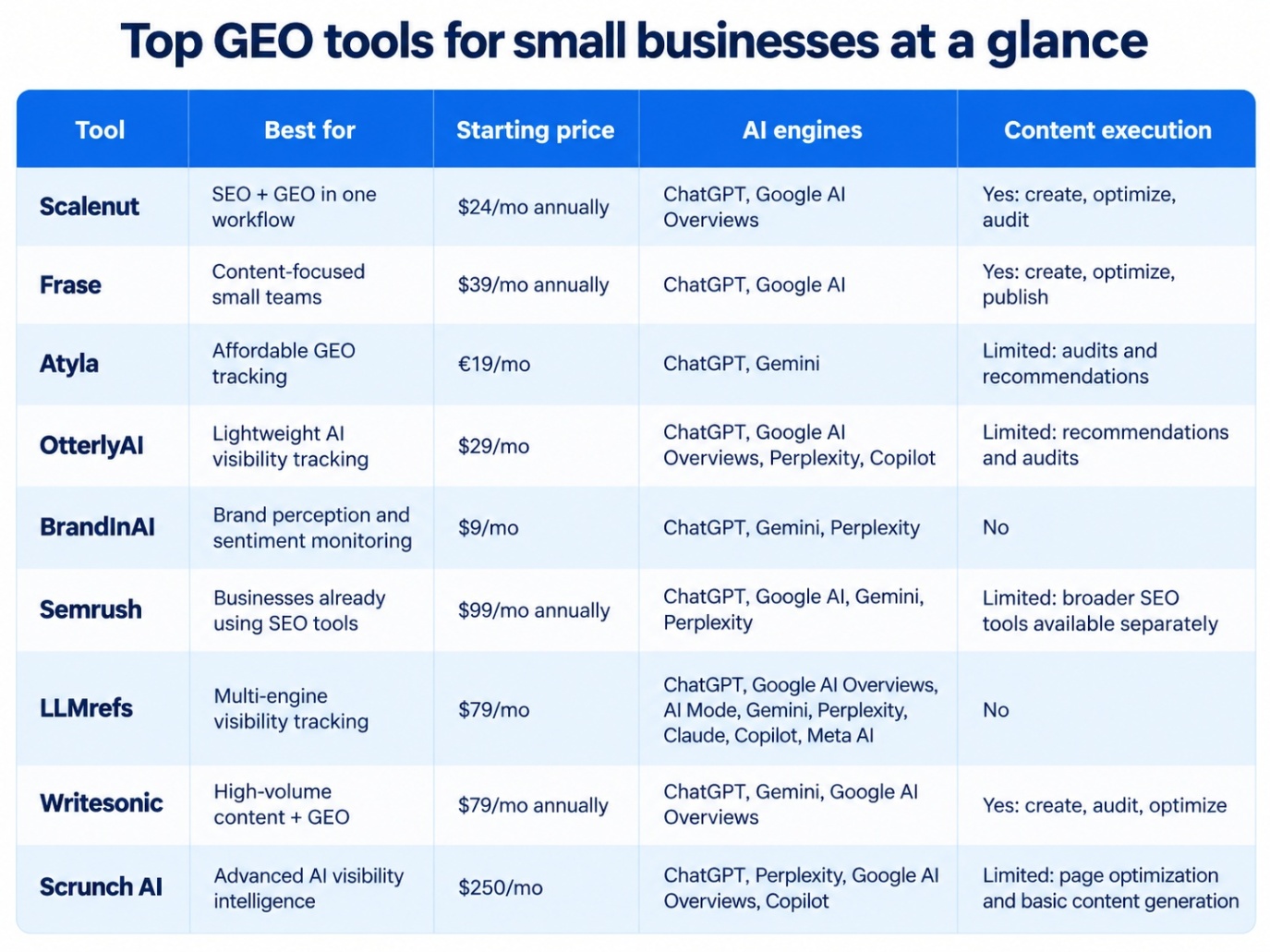
The best GEO platforms for small businesses in 2026 are the ones that do more than track AI visibility. They should help you understand where your brand appears, which competitors are being recommended, what sources AI engines trust, and what content gaps you need to fix next.
Below, we’ll break down the top GEO tools for small businesses, along with their key features, pros, cons, and more.
1. Scalenut (G2 Rating: 4.7/5)
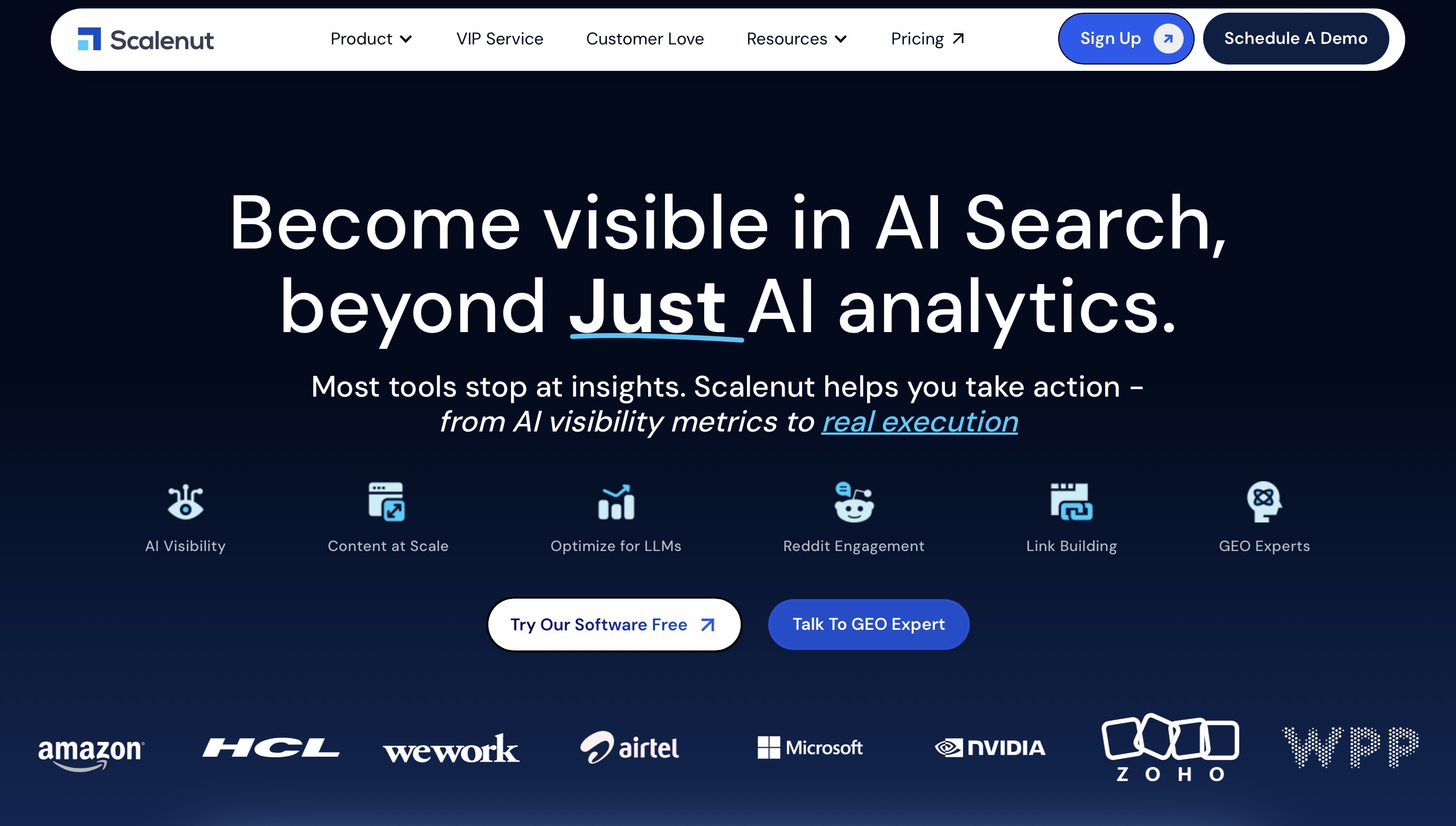
Scalenut is the best overall GEO tool for small businesses that want AI visibility tracking, SEO execution, and content optimization in one place. It is especially useful because it does not just show visibility gaps, but also helps you act on them through content creation, audits, and optimization workflows.
What Are The Notable GEO Features Of Scalenut?
- AI Visibility Tracking: Tracks brand mentions, prompt coverage, historical trends, and competitor visibility across AI search.
- ChatGPT And Google AIO Tracking: Helps monitor how your brand appears across ChatGPT and Google AI Overviews, with Perplexity tracking available on higher plans.
- GEO Content Creation: Helps create content designed for both search rankings and AI answer visibility.
- Existing Content Optimization: Improves old pages so they become clearer, stronger, and more citation-friendly.
- GEO Content Audit: Identifies pages that need better structure, depth, or optimization for AI search.
- Keyword Clusters: Helps plan topical authority around related keywords and buyer questions.
- Internal Linking: Supports better content connections so search engines and AI engines can understand your site better.
- Technical And Content Fixes: Higher plans include deeper fixes and recommendations depending on the plan.
- VIP Service: Useful for businesses that want expert-led SEO, GEO, content, backlinks, technical fixes, AI visibility support, and reporting.
What Are The Pros And Cons Of Scalenut?
Pros:
- All-In-One Workflow: Combines AI visibility tracking, SEO planning, content creation, audits, and optimization.
- Execution-Focused: Helps you move from “where are we missing?” to “what should we improve next?”
- Strong For Existing Content: Useful for refreshing old pages and improving their GEO potential.
- Small-Business Friendly: Reduces the need to use separate tools for GEO tracking, SEO planning, and content optimization.
- Expert Support Available: VIP Service is helpful for teams that want done-with-you or expert-led execution.
Cons:
- Prompt Limits By Plan: Lower plans may feel limited if you want to track many prompts, competitors, or services.
- Advanced Tracking On Higher Plans: Perplexity tracking and deeper capabilities may require a higher-tier plan.
- More Than A Basic Tracker: If you only want simple AI mention monitoring, Scalenut may offer more functionality than you need.
What Is Scalenut Best For?
Scalenut is best for small businesses that want to improve SEO and GEO visibility without managing multiple tools. It works especially well for SaaS companies, service businesses, ecommerce brands, local businesses, and lean marketing teams.
Final Verdict
Choose Scalenut if you want one tool to track AI visibility, create GEO-ready content, optimize existing pages, and build a practical SEO plus GEO workflow. It is the best overall pick because it connects visibility insights with actual execution.
2. Frase (G2 Rating: 4.8/5)
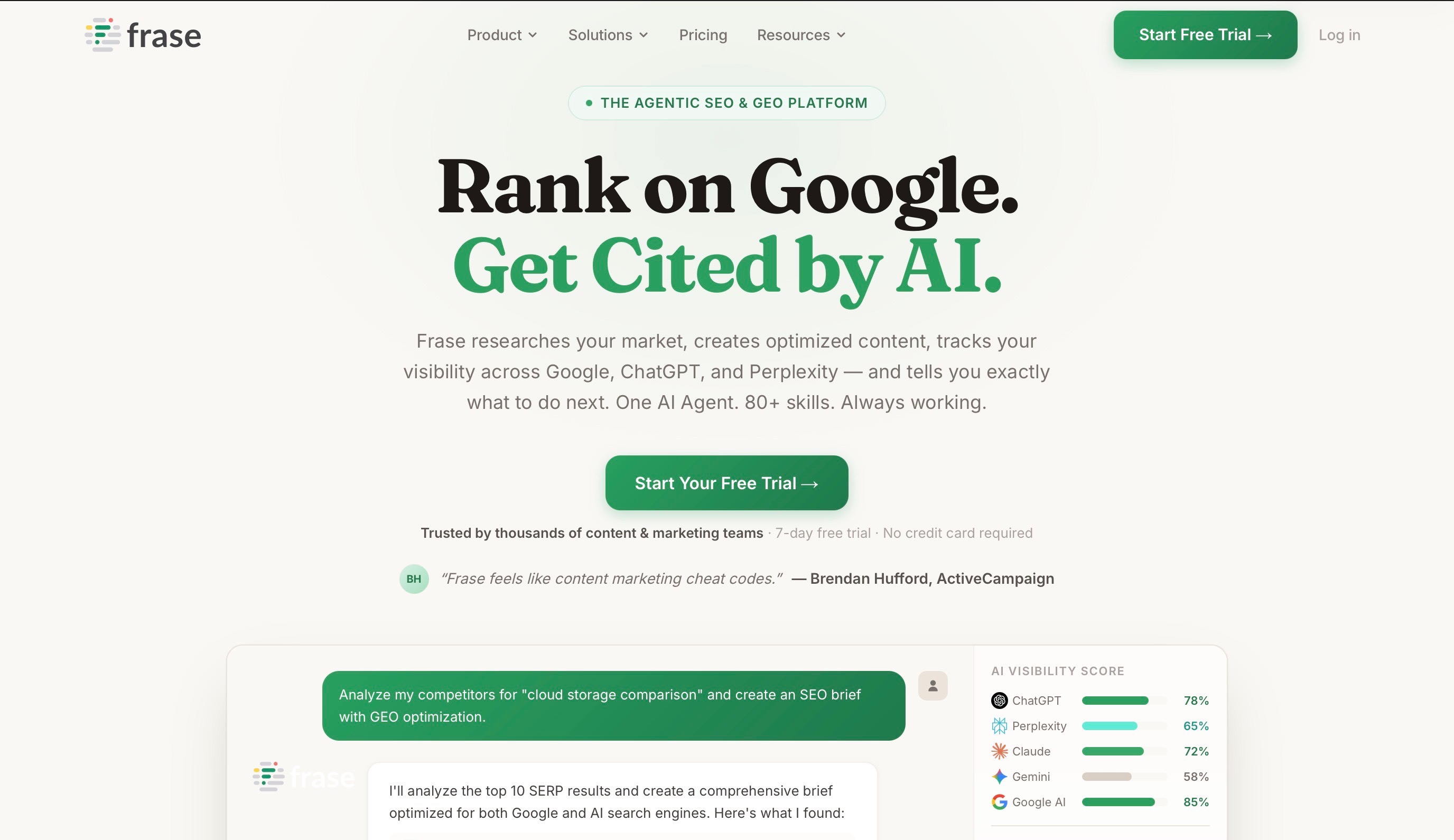
Frase is a strong GEO and SEO content platform for small businesses that want to research, write, optimize, and track content from one place. It feels most useful when your main GEO problem is creating clearer, better-structured content that AI engines can understand and cite.
What Are The Notable GEO Features Of Frase?
- AI Visibility Tracking: Tracks where your brand appears across AI search platforms.
- Multi-Platform AI Tracking: Tracks major AI platforms, including ChatGPT, Claude, Gemini, Perplexity, Google AI Overviews, Microsoft Copilot, Grok, and DeepSeek.
- Prompt Tracking: Helps monitor prompts that mention your brand, competitors, and key buying topics.
- Competitor Benchmarking: Lets you compare your AI visibility against competitors.
- Content Optimization: Helps improve content for traditional search and AI search visibility.
- GEO Scoring: Supports optimization for AI search engines along with SEO.
- Content Opportunities: Helps identify pages and topics that need improvement.
- AI Agent Workflow: Supports research, writing, optimization, AI visibility, site audits, and publishing workflows.
What Are The Pros And Cons Of Frase?
Pros:
- Strong Content Workflow: Helpful for research, briefs, writing, and optimization.
- SEO Plus GEO Positioning: Built for both Google rankings and AI search visibility.
- Good AI Platform Coverage: Tracks multiple AI platforms, including ChatGPT, Google AI Overviews, Gemini, Claude, and Perplexity.
- Helpful For Lean Content Teams: Reduces manual SERP research and content planning work.
- Affordable Starting Point: Plans start at $39/month, making it accessible for many small businesses.
Cons:
- Less Execution-Led Than Scalenut: Strong for content optimization, but not as complete if you want SEO, GEO, internal linking, audits, and expert execution in one workflow.
- Can Take Time To Learn: The platform has multiple content and optimization features, so beginners may need some time to use it well.
- AI Tracking Depth Depends On Plan: AI visibility features and limits may vary based on the plan or add-on setup.
What Is Frase Best For?
Frase is best for small businesses and content teams that want to create better briefs, optimize existing content, and improve answer-ready pages for SEO and GEO.
Final Verdict
Choose Frase if content optimization is your main priority. It is a strong option for small teams, but if you want deeper SEO plus GEO execution in one place, Scalenut is still the better overall fit.
3. Atyla

Atyla is a focused GEO monitoring platform for small businesses that want to understand how their brand appears across AI search engines. It is useful if you want affordable prompt tracking, competitor visibility, GEO audits, and clear action plans without starting with a heavy enterprise tool.
What Are The Notable GEO Features Of Atyla?
- AI Visibility Monitoring: Tracks how often your brand appears in AI-generated answers.
- Prompt Tracking: Lets you monitor selected prompts across AI engines.
- Competitor Analysis: Shows which competitors are recommended instead of your brand.
- AI Search Engine Coverage: Tracks visibility across platforms like ChatGPT, Perplexity, Gemini, Claude, Grok, and Mistral.
- GEO Audit: Helps identify visibility gaps and improvement opportunities.
- Optimization Recommendations: Provides action plans instead of only showing visibility data.
- Affordable Entry Plan: Pricing starts at €19/month for the Essential plan, with Starter at €69/month and Growth at €149/month.
What Are The Pros And Cons Of Atyla?
Pros:
- Affordable GEO Entry Point: Lower starting price than many AI visibility tools.
- Built Specifically For GEO: Focuses on AI visibility instead of traditional SEO first.
- Good For Prompt Monitoring: Useful for tracking buyer-style prompts and brand presence.
- Competitor Visibility: Helps small teams see which competitors are showing up more often.
- Action-Oriented Audits: More helpful than basic monitoring-only dashboards.
Cons:
- Not A Full SEO Platform: Better for GEO tracking and audits than complete SEO execution.
- Limited Content Workflow: Does not replace a full content creation and optimization platform.
- Prompt Limits By Plan: Lower plans may feel limited if you want to track many products, services, or competitors.
- Less Established Review Footprint: It does not yet have the same G2 review depth as more established tools.
What Is Atyla Best For?
Atyla is best for small businesses, startups, and lean marketing teams that want affordable GEO monitoring, prompt tracking, competitor visibility, and a practical GEO audit.
Final Verdict
Choose Atyla if you want a lightweight and affordable way to start tracking AI visibility. It is a good monitoring-first option, but if you also need content creation, optimization, and SEO execution, Scalenut is the stronger choice.
4. Otterly.AI (G2 Rating: 4.8)

OtterlyAI is a lightweight AI search monitoring tool for small businesses that want to track brand mentions, website citations, prompt visibility, and competitor presence across AI search platforms. It is most useful when you want clear monitoring without needing a full SEO content suite.
What Are The Notable GEO Features Of OtterlyAI?
- AI Search Monitoring: Tracks brand visibility across AI search platforms.
- Prompt Monitoring: Lets you define prompts that mirror real buyer questions.
- Brand Mention Tracking: Shows when and where your brand appears in AI-generated answers.
- Citation Tracking: Monitors website citations and source links across AI answers.
- Competitor Tracking: Compares your visibility against competing brands.
- Share Of AI Voice: Helps show how much visibility your brand owns compared to competitors.
- Platform Coverage: Tracks platforms like ChatGPT, Google AI Overviews, Google AI Mode, Gemini, Perplexity, and Microsoft Copilot.
- Free GEO Tools: Offers supporting tools like AI keyword research, AI referral traffic checks, GEO content checks, and AI crawler simulation.
What Are The Pros And Cons Of OtterlyAI?
Pros:
- Simple Monitoring Workflow: Easy to use if your main goal is tracking AI visibility.
- Strong Citation Focus: Helpful for seeing which websites and pages AI platforms reference.
- Good Platform Coverage: Covers major AI search platforms used by buyers.
- Competitor Visibility: Useful for understanding where competitors are winning prompts.
- Affordable Entry Point: Pricing starts at $29/month, which works well for small businesses testing GEO.
Cons:
- Not A Full Content Platform: Better for monitoring than creating or optimizing content.
- Limited Execution Support: It can show visibility gaps, but your team still needs to act on them.
- Prompt Limits By Plan: Lower plans may feel restrictive if you want broader tracking.
- Less Useful Without A Content Workflow: You may still need another tool for SEO briefs, content updates, and optimization.
What Is OtterlyAI Best For?
OtterlyAI is best for small businesses that want a simple way to monitor AI visibility, brand mentions, citations, and competitor presence across major AI platforms.
Final Verdict
Choose OtterlyAI if you mainly want AI visibility monitoring without a heavy SEO workflow. It is a solid tracker, but if you also need to create and optimize GEO-ready content, Scalenut is the stronger pick.
5. BrandInAI
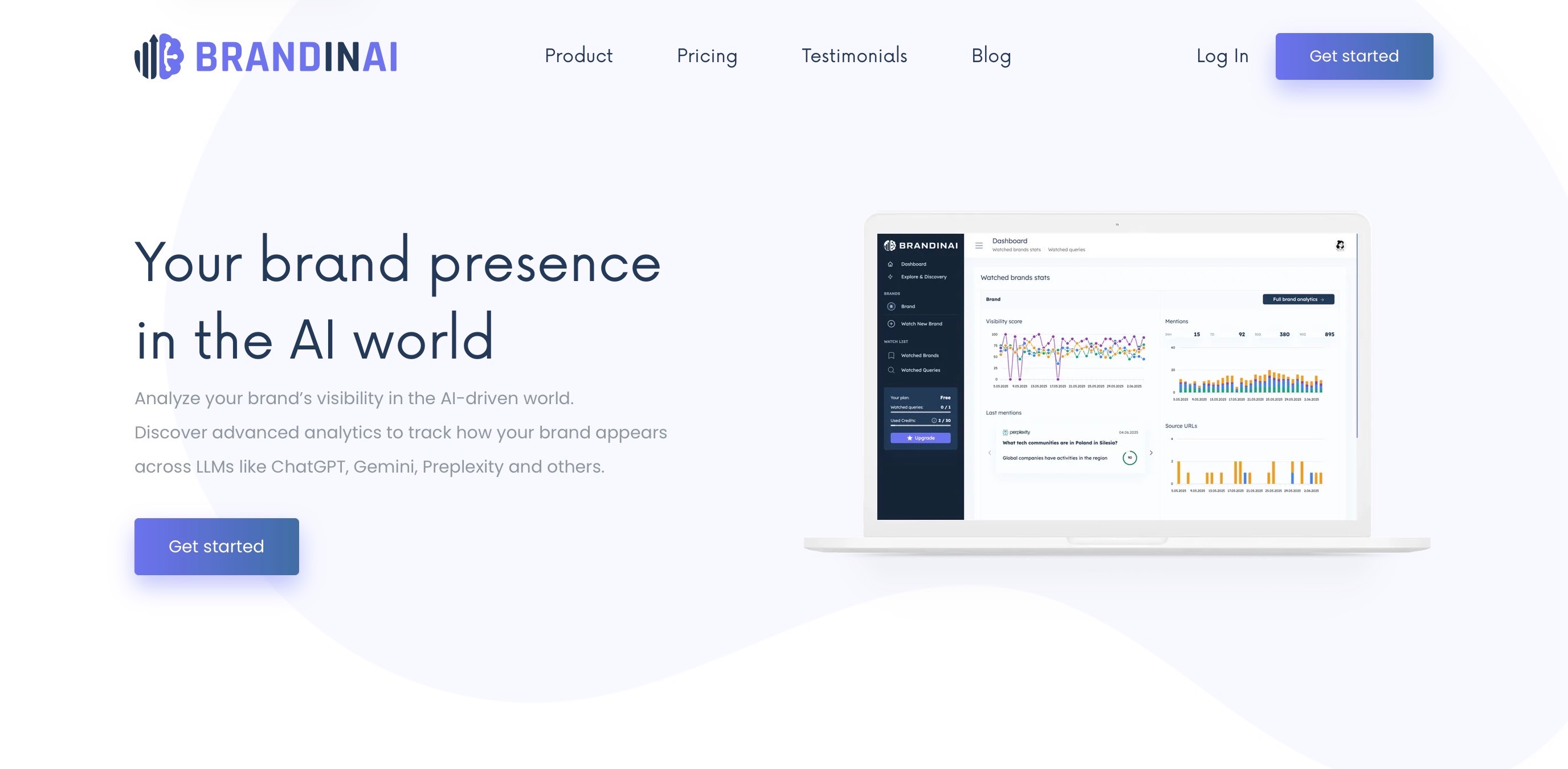
BrandInAI is a brand visibility and perception monitoring tool for businesses that want to understand how AI systems describe, mention, and compare their brand. It is especially useful for small teams that care about brand narrative, sentiment, and AI recommendation strength.
What Are The Notable GEO Features Of BrandInAI?
- Mentions Tracking: Monitors how often your brand appears across major AI models.
- AI Presence Monitoring: Tracks brand visibility and representation in AI-generated content.
- Query Tracking: Lets you monitor specific queries related to your brand, products, and competitors.
- Competitor Benchmarking: Compares your AI visibility and positioning against competitors.
- URL Monitoring: Shows which URLs appear in AI-generated responses.
- Recommendation Strength Measurement: Measures how strongly your brand is recommended in AI answers.
- AI Perception Insights: Helps understand how AI systems describe and frame your brand.
- Multi-Model Coverage: Tracks platforms like ChatGPT, Gemini, Perplexity, DeepSeek, and other LLMs.
What Are The Pros And Cons Of BrandInAI?
Pros:
- Strong Brand Perception Focus: Goes beyond visibility to show how AI describes your brand.
- Useful For Sentiment And Narrative: Helpful for PR, branding, and reputation-led GEO work.
- Competitor Comparisons: Shows how your brand is positioned against other businesses.
- URL Monitoring: Helps identify which pages AI tools are referencing.
- Budget-Friendly Entry Point: Works well for teams that want a simple AI brand monitoring layer.
Cons:
- Not A Content Creation Tool: Does not replace SEO or GEO content workflows.
- Limited Execution Support: Better for monitoring and perception analysis than fixing content gaps.
- Less SEO-Heavy: Not ideal if you need keyword clusters, content audits, internal linking, or page optimization.
- Better As A Complement: Works best alongside a stronger SEO and GEO execution platform.
What Is BrandInAI Best For?
BrandInAI is best for small businesses, PR teams, founders, and marketers that want to monitor how AI tools mention, describe, and recommend their brand.
Final Verdict
Choose BrandInAI if AI brand perception and sentiment tracking matter most to you. It is useful as a lightweight monitoring layer, but for small businesses that need visibility tracking plus content execution, Scalenut is the more complete option.
6. Semrush (G2 Rating: 4.5/5)

Semrush is a strong option for small businesses that already take SEO seriously and want AI visibility added to the same workflow. It is not the lightest tool on this list, but it works well if you want AI search insights alongside keyword research, competitor analysis, site audits, and broader SEO data.
What Are The Notable GEO Features Of Semrush?
- AI Visibility Toolkit: Tracks how your brand appears across AI-generated answers.
- Prompt Tracking: Helps monitor selected prompts and compare how your brand performs.
- Competitor Analysis: Shows how competitors appear across AI search responses.
- Brand Performance Reports: Helps track visibility trends for your domain.
- AI Visibility Score: Gives a directional view of how often and how prominently your brand appears.
- Citation And Mention Insights: Helps identify where AI tools are picking up brand and competitor signals.
- SEO Tool Integration: Connects AI visibility insights with keyword research, site audits, and competitor SEO data.
- Add-On Prompt And Domain Tracking: Lets teams expand limits when they need more tracking depth.
What Are The Pros And Cons Of Semrush?
Pros:
- Strong SEO Foundation: Useful if you already rely on keyword research, site audits, backlinks, and competitor analysis.
- Good For SEO Teams: Easier to adopt if your team already understands traditional SEO workflows.
- AI Plus SEO View: Helps connect AI visibility with broader organic visibility data.
- Competitor Research Depth: Strong for businesses that want to compare AI visibility with SEO competitors.
- Scalable For Growing Teams: Works well as your tracking, reporting, and SEO needs become more advanced.
Cons:
- Can Feel Heavy For Beginners: The platform has a lot of features, which may overwhelm small teams.
- Higher Cost For Small Businesses: Pricing and add-ons can add up if you need more prompts, domains, or advanced features.
- Less Content-Execution Focused Than Scalenut: Strong for data and visibility, but not as smooth if your main need is creating and optimizing GEO-ready content.
- AI Visibility Limits Depend On Setup: Prompt and domain limits may need add-ons as your use case grows.
What Is Semrush Best For?
Semrush is best for small businesses that already use SEO data and want to add AI visibility tracking to a broader search marketing workflow.
Final Verdict
Choose Semrush if you want AI visibility insights inside a powerful SEO platform. It is a strong option for SEO-mature teams, but for small businesses that want GEO tracking plus content execution in one simpler workflow, Scalenut is easier to act on.
7. LLMrefs

LLMrefs is a focused AI search visibility tracker built for teams that want to monitor brand mentions, citations, share of voice, and rankings across major AI search engines. It feels practical for small businesses that want broad AI visibility platform coverage without moving into enterprise platform level pricing.
What Are The Notable GEO Features Of LLMrefs?
- AI Search Visibility Tracking: Measures brand visibility across AI search engines.
- Prompt Tracking: Tracks prompts for brand mentions, sources, and fan-out queries.
- Share Of Voice: Shows how your brand compares against competitors in AI answers.
- Citation Tracking: Helps identify which sources and URLs AI engines use.
- AI Search Rankings: Tracks how brands appear across AI-generated responses.
- Broad Platform Coverage: Covers ChatGPT, Google AI Overviews, Google AI Mode, Gemini, Perplexity, Claude, Grok, Copilot, and Meta.
- Geo-Targeting Support: Supports tracking across multiple countries and languages.
- Weekly Reports: Provides recurring AI visibility reports for ongoing monitoring.
What Are The Pros And Cons Of LLMrefs?
Pros:
- Strong Platform Coverage: Useful if you want to monitor visibility across many AI engines.
- Simple Pricing: The main plan is listed at $79/month, which is easier to understand than complex credit-based tools.
- High Prompt Allowance: Tracks 500 prompts on the listed plan, which is helpful for broader testing.
- Good For Share Of Voice: Useful for comparing brand visibility against competitors.
- Focused GEO Workflow: Built specifically around AI search analytics rather than traditional SEO.
Cons:
- Not A Full SEO Platform: Better for AI visibility tracking than full SEO planning or technical optimization.
- Limited Content Execution: You may still need another tool to create, audit, and optimize content.
- You Need Prompt Strategy First: The tool is more useful when you already know which prompts matter.
- Less Established Review Footprint: Public review data is still limited compared with older SEO platforms.
What Is LLMrefs Best For?
LLMrefs is best for small businesses and marketing teams that want broad AI search tracking, share-of-voice data, prompt monitoring, and citation visibility at a predictable monthly price.
Final Verdict
Choose LLMrefs if your priority is AI visibility tracking across many AI platforms. It is a useful monitoring tool, but if you want to move from tracking to content improvement, Scalenut is the more complete GEO and SEO workflow.
8. Writesonic (G2 Rating: 4.7/5)
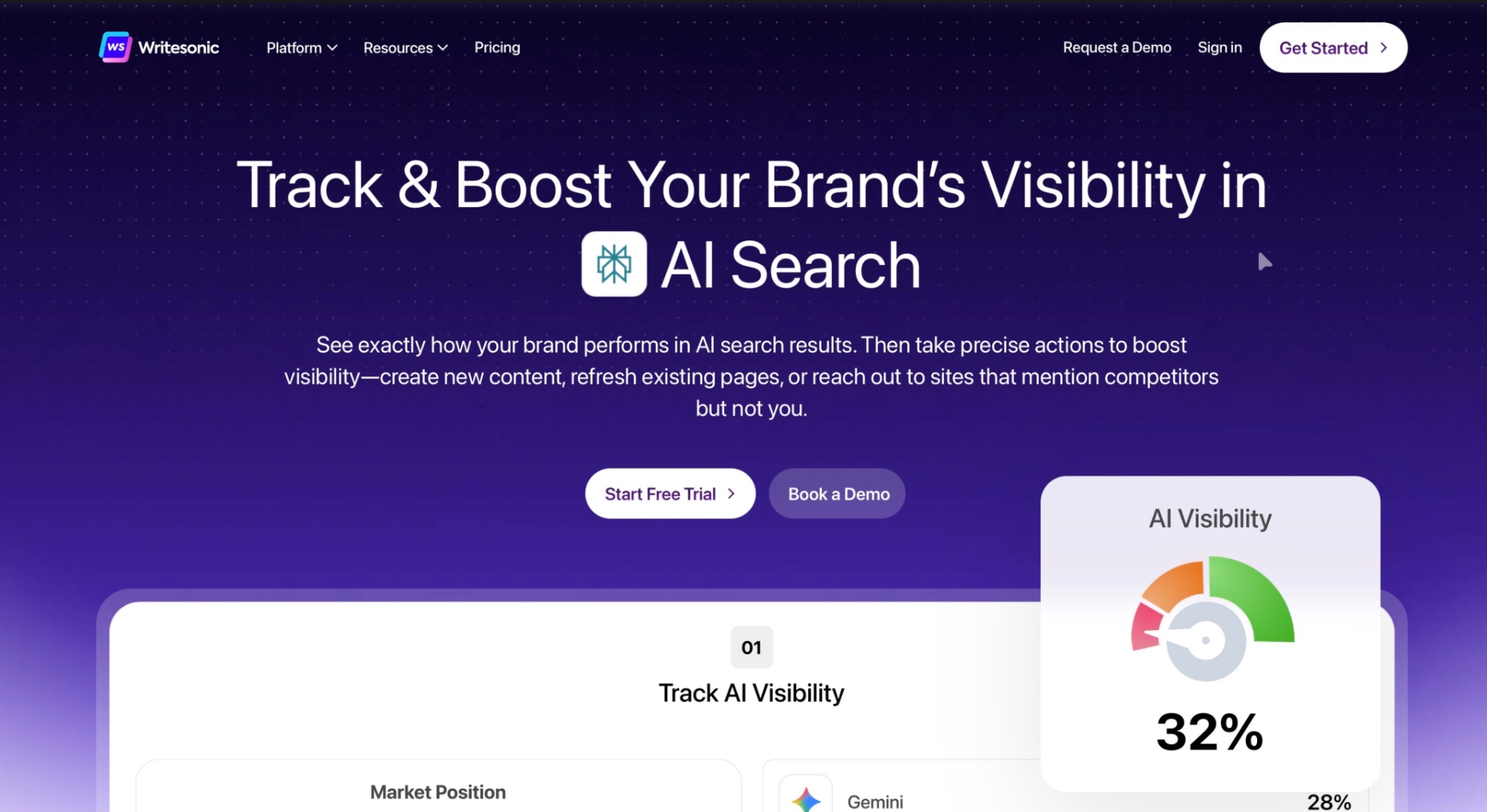
Writesonic is a good fit for small businesses that want AI content creation, SEO workflows, and AI search visibility tracking in one platform. It is especially useful for teams that publish a lot of content and want to monitor how that content performs across AI search experiences.
What Are The Notable GEO Features Of Writesonic?
- AI Search Tracking: Tracks how your brand appears across AI platforms.
- ChatGPT Visibility Tracking: Monitors visibility in ChatGPT.
- Google AI Overviews Tracking: Helps track how your brand appears in Google AI-generated results.
- Gemini Tracking: Includes Gemini visibility on supported plans.
- AI Bot Traffic Monitoring: Helps identify AI crawler and bot traffic signals.
- Prompt Tracking: Tracks AI queries and prompts based on plan limits.
- Action Center: Gives recommendations to improve AI search visibility.
- Prompt Explorer: Helps discover and diversify prompts using SEO keywords, Reddit, People Also Ask, and related sources.
- Content Engine: Supports content creation and refreshing for Google rankings and AI citations.
What Are The Pros And Cons Of Writesonic?
Pros:
- Strong Content Production: Useful for creating blogs, landing pages, ads, and other marketing content quickly.
- SEO Plus GEO Workflow: Combines AI search tracking with content creation and optimization.
- Good For High-Volume Teams: Helpful if your team publishes often and needs faster drafts.
- Action-Oriented Insights: The Action Center makes visibility data easier to turn into next steps.
- Built-In AI Search Tracking: Supports AI visibility tracking instead of only AI writing.
Cons:
- Can Feel Busy: The platform has many AI writing, SEO, and GEO features, which may take time to navigate.
- Editing Still Matters: AI-generated drafts still need human review, fact-checking, and brand voice refinement.
- Prompt Limits Depend On Plan: GEO usefulness depends on how many prompts and platforms your plan includes.
- Not Purely GEO-Focused: It is broader than a dedicated AI visibility tracker, which may be more than some small teams need.
What Is Writesonic Best For?
Writesonic is best for small businesses and content-heavy teams that want AI writing, SEO content creation, and AI visibility tracking in one platform.
Final Verdict
Choose Writesonic if your team creates a high volume of content and wants GEO tracking built into a broader AI content workflow. It is a practical option for teams that need both content speed and AI search visibility insights.
9. Scrunch AI (G2 Rating: 4.6/5)

Scrunch AI is a more advanced AI visibility and brand presence platform for teams that want deeper insight into how AI systems represent their brand. It is better suited for growing small businesses, agencies, and mid-market teams that need prompt monitoring, citation tracking, competitor visibility, and more structured reporting.
What Are The Notable GEO Features Of Scrunch AI?
- AI Search Monitoring: Tracks how your brand appears across AI search and answer engines.
- Prompt Monitoring: Monitors branded and non-branded prompts.
- Competitor Visibility Tracking: Shows which competitors appear in AI responses.
- Citation Analysis: Helps identify which sources AI platforms are using.
- AI Brand Presence Tracking: Measures how AI tools understand and represent your brand.
- Page Audits: Helps analyze pages for AI search readiness.
- Agent Traffic Monitoring: Tracks how AI agents and bots interact with your site.
- Agency And Team Workflows: Supports reporting and multi-client use cases for agencies and growing teams.
What Are The Pros And Cons Of Scrunch AI?
Pros:
- Strong AI Visibility Focus: Built specifically around AI search, brand presence, and prompt monitoring.
- Good For Competitor Insights: Helpful for understanding which competitors AI tools recommend and cite.
- Useful Reporting: Works well for teams that need visibility dashboards and client-ready insights.
- Citation Tracking: Helps identify the sources influencing AI-generated answers.
- Scales Beyond Basic Monitoring: Better suited for teams that are ready to invest seriously in AI search visibility.
Cons:
- Higher Starting Price: Starting at $250/month, it may be expensive for very small businesses.
- Less Ideal For Beginners: Best for teams that already understand SEO, content, and visibility tracking.
- Not A Full Content Platform: It focuses more on monitoring, reporting, and brand presence than end-to-end content creation.
- May Be More Than Small Teams Need: Lean businesses with simple tracking needs may not use the full feature set.
What Is Scrunch AI Best For?
Scrunch AI is best for growing small businesses, agencies, and marketing teams that need deeper AI visibility tracking, competitor monitoring, citation analysis, and structured reporting.
Final Verdict
Choose Scrunch AI if you need advanced AI visibility intelligence and have the budget to support a more robust tracking workflow. It is a strong fit for teams that want deeper reporting and competitive insight across AI search.
Working with a lean budget? Check out the best GEO tools under $100/month that small teams can actually use.
What Features Should Small Businesses Look For In A GEO Tool?
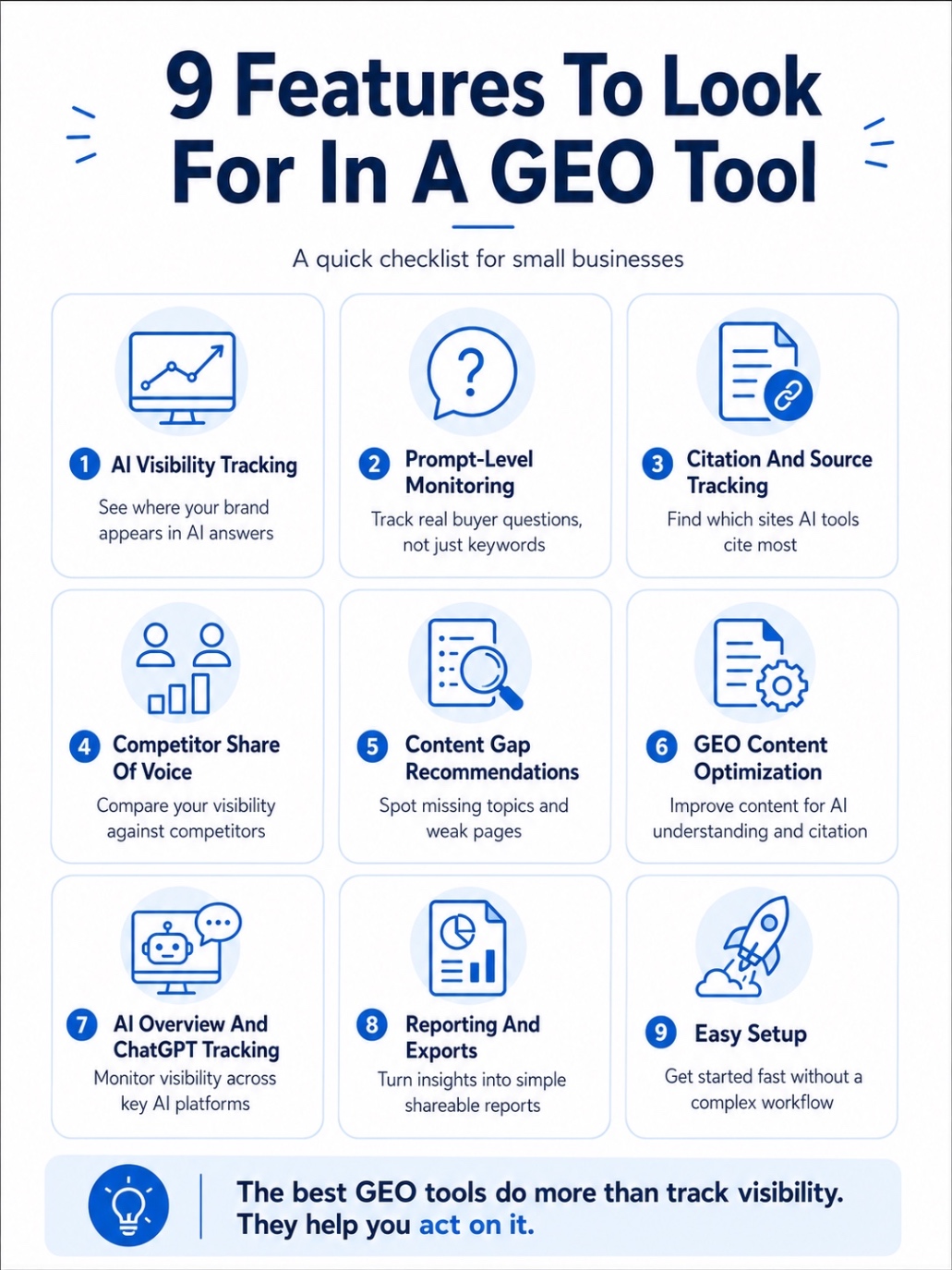
A good GEO tool should help you do three things clearly: track where your brand appears in AI answers, understand why competitors are winning, and find the content gaps you need to fix. For small businesses, the best tool is not the most complex one. It is the one that gives clear visibility and practical next steps.
Here are the key features to check before choosing a GEO tool for your small business.
1. AI Visibility Tracking
Your GEO tool should show whether your brand appears in AI-generated answers across platforms like ChatGPT, Perplexity, Gemini, Claude, and Google AI Overviews. This helps you understand if buyers can actually discover your business through AI search.
2. Prompt-Level Monitoring
A strong tool should track real buyer-style prompts, not just keywords. For example, instead of only tracking “CRM software,” it should help you monitor prompts like “best CRM for small businesses” or “affordable CRM for startups.”
3. Citation And Source Tracking
The tool should show which sources AI engines are using to form answers. This helps you see whether AI tools are citing your website, competitors, review sites, directories, Reddit threads, or third-party blogs.
4. Competitor Share Of Voice
GEO is easier to improve when you know who is already winning. Look for a tool that shows how often competitors appear, which prompts they show up for, and where your brand is missing.
5. Content Gap Recommendations
Tracking alone is not enough. The tool should help you spot missing topics, weak pages, FAQ gaps, comparison content opportunities, and pages that need better structure or authority.
6. GEO Content Optimization
A good GEO tool should help you improve content so AI engines can understand, summarize, and cite it more easily. This includes clearer answers, better topic coverage, stronger FAQs, sufficient internal links, and optimized existing pages.
7. AI Overview And ChatGPT Tracking
Not all AI platforms show the same answers. At minimum, small businesses should look for tools that track visibility in Google AI Overviews and ChatGPT, since both can influence how buyers discover and compare brands.
8. Reporting And Exports
The tool should make reporting simple. Look for clear insights on brand visibility, prompt performance, competitor movement, citation sources, and content opportunities that can be shared with your team or clients.
9. Easy Setup
Small businesses do not need another complicated dashboard. The right GEO tool should make it easy to add your brand, choose competitors, track prompts, review results, and move quickly from insight to action.
The right GEO tool should not only show where your brand is missing, but also help you understand what to improve next so every content update becomes more intentional.
Want to know how AI tools describe your brand? Explore the best GEO tools for sentiment analysis in 2026.
Which GEO Tool Is Best For Each Type Of Small Business?
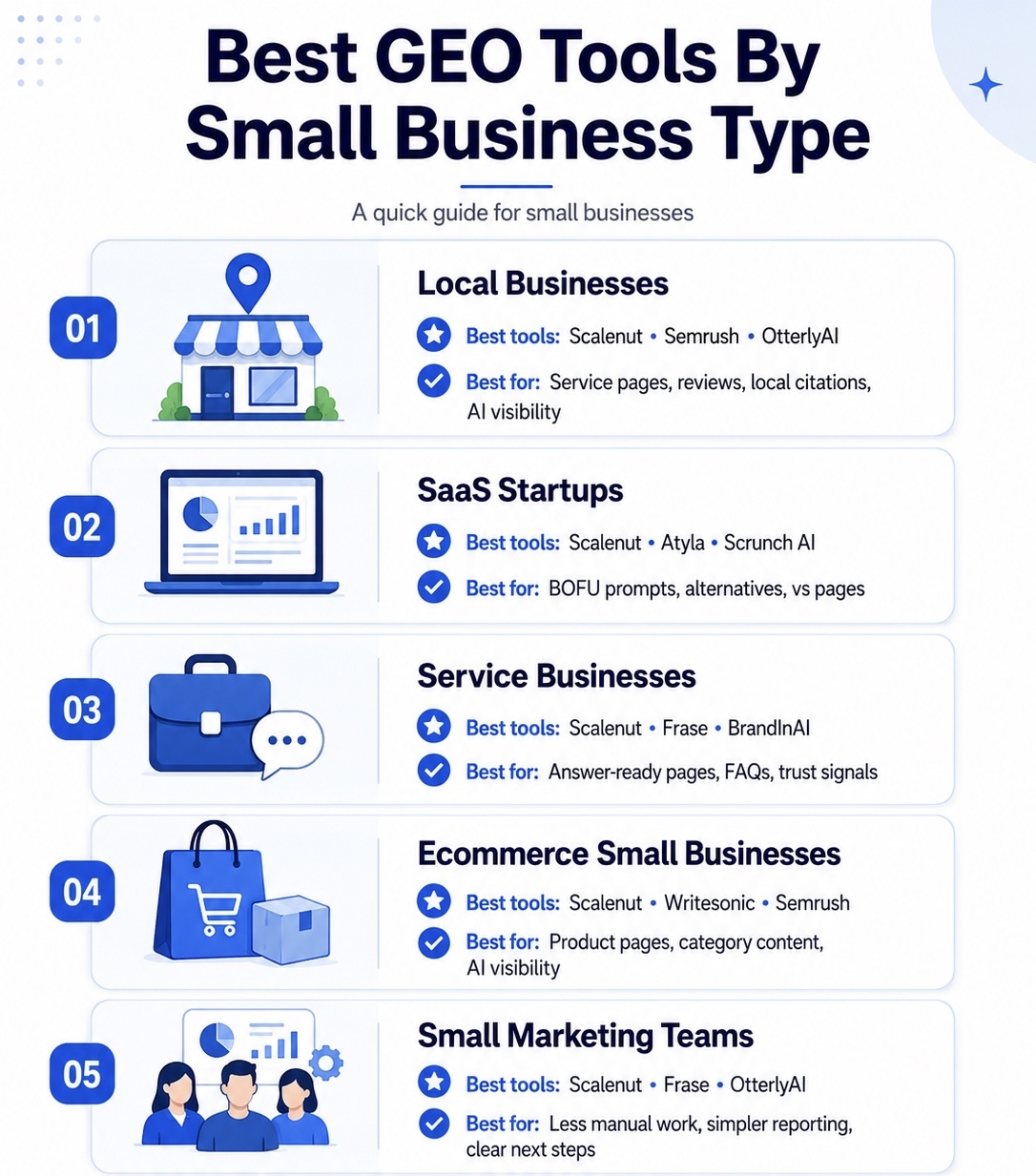
The best GEO tool depends on how your buyers search, compare, and decide. A local business needs different signals than a SaaS startup, and an ecommerce brand needs different support than a service provider.
Here are the best GEO tools to consider based on your small business type.
1. What Are The Best GEO Tools For Local Businesses?
For local businesses, the best GEO tools are Scalenut, Semrush, and OtterlyAI. Local businesses need clear service pages, strong reviews, accurate business information, local citations, and AI visibility tracking.
Scalenut is best if you want to improve local service pages and SEO content. Semrush works well for local SEO and competitor research. OtterlyAI is useful for tracking brand mentions and citations across AI platforms.
2. What Are The Best GEO Tools For SaaS Startups?
For SaaS startups, the best GEO tools are Scalenut, Atyla, and Scrunch AI. SaaS teams need prompt tracking for BOFU queries like “best X software,” “X alternatives,” and “X vs Y.”
Scalenut is best for creating and optimizing comparison-led content. Atyla is a good affordable option for GEO audits and prompt tracking. Scrunch AI is better for teams that need deeper AI visibility intelligence.
3. What Are The Best GEO Tools For Service Businesses?
For service businesses, the best GEO tools are Scalenut, Frase, and BrandInAI. These businesses need answer-ready pages, FAQs, comparison content, reviews, and trust signals.
Scalenut helps turn service expertise into optimized SEO and GEO content. Frase is useful for briefs and answer-style content. BrandInAI works well for basic AI brand presence monitoring.
4. What Are The Best GEO Tools For Ecommerce Small Businesses?
The best GEO tools for ecommerce small businesses are Scalenut, Writesonic, and Semrush. Ecommerce teams need product-led content, category pages, buying guides, structured product information, and AI visibility tracking.
Scalenut is best for optimizing product and category content. Writesonic works well for high-volume product-led content. Semrush is useful if you already rely on SEO data for ecommerce growth.
5. What Are The Best GEO Tools For Small Marketing Teams?
For small marketing teams, the best GEO tools are Scalenut, Frase, and OtterlyAI. These teams need tools that reduce manual research, simplify reporting, and give clear next steps.
Scalenut is the strongest overall fit because it connects AI visibility, SEO planning, content creation, and optimization. Frase is useful for content-focused teams. OtterlyAI is a good lightweight option for AI visibility monitoring.
If you only need to monitor visibility, a lightweight tracker can work. But if you want to turn AI visibility gaps into better content, Scalenut is the better starting point for most small businesses.
How Do You Choose The Right GEO Tool For Your Small Business?

The right GEO tool should match your goals, budget, and ability to act on the insights. Some tools only show where your brand appears in AI answers, while others help you improve the content that AI engines can find, understand, and cite.
Here are the steps to choose the right GEO tool for your small business.
1. Decide Whether You Need Monitoring Or Execution
Start by deciding if you only need AI visibility tracking or if you also need help improving your content. Monitoring tools show where you stand. Execution-focused tools like Scalenut help you turn those gaps into SEO and GEO actions.
2. List The AI Prompts Your Buyers May Ask
Write down the prompts your customers may use before they buy. For example:
- Best [service] near me
- Top [software] for small businesses
- Best [product] for [use case]
- [Brand] alternatives
- [Brand] vs [competitor]
3. Check Which AI Platforms Matter Most
Look for tools that track the platforms your buyers actually use, such as ChatGPT, Google AI Overviews, Gemini, Perplexity, and Claude. You do not need every platform at first, but you do need the ones that shape discovery in your niche.
4. Compare Pricing Against Prompt Limits
Do not judge the tool by price alone. Check how many prompts, projects, competitors, AI platforms, and refreshes each plan includes. A cheaper plan may not be useful if it limits the data you need.
5. Look For Actionable Recommendations
A GEO tool should not leave you with a dashboard full of numbers and no next step. Look for content gaps, citation opportunities, competitor insights, and page-level recommendations that your team can actually use.
6. Test The Tool For 30 Days
Use the first month to track a focused set of high-intent prompts. Add your top competitors, review citation sources, and see whether the tool gives you insights worth turning into content updates.
7. Track Brand Mentions, Citations, And Content Wins
Once the tool is set up, watch whether your brand gets mentioned more often, whether your website earns citations, and whether optimized pages start showing up for more buyer-style prompts.
The best GEO tool is the one that helps you move from “Are we visible?” to “What should we improve next?” without adding unnecessary complexity to your workflow.
Want to see which brands AI engines recommend before yours? Compare the best GEO tools for competitor analysis.
Are GEO Tools Worth It For Small Businesses?
Yes, GEO tools are worth it if your customers use AI tools to research products, services, vendors, or local recommendations. They are especially useful for small businesses in SaaS, local services, ecommerce, healthcare, finance, B2B services, agencies, and consulting because buyers in these spaces often compare options before taking action.
But GEO tools work best when your foundation is already strong. If your website has thin content, unclear service pages, weak reviews, or inconsistent business information, fix those basics first. AI engines need credible, well-structured information to understand, trust, and cite your brand.
Conclusion
GEO for small businesses is no longer something separate from content strategy, search optimization, and online presence. As large language models, AI answer engines, and traditional search engines continue to shape how buyers discover brands, the right GEO strategy can help you understand where you show up, where competitors are winning, and what content needs to improve.
Start by choosing GEO platforms with the GEO capabilities you actually need, whether that is generative engine optimization, answer engine optimization, competitive intelligence, agent analytics, or content generation with generative AI. Then track a small set of high-intent prompts, optimize your most important pages, and review your visibility every month so your business keeps showing up where buyers are already searching.
Frequently Asked Questions
Which GEO platforms drive the best ROI for small business marketing?
The best ROI usually comes from GEO platforms that connect visibility tracking with clear content actions. Scalenut is a strong fit because it combines AI visibility tracking, GEO content creation, prompt discovery, content scoring, and optimization workflows in one place.
How can small businesses use GEO tools to improve local search results?
Small businesses can use GEO tools to find buyer prompts, improve local service pages, strengthen FAQs, and track AI mentions. For local visibility, they should also keep business details, reviews, service pages, and location-based content accurate and consistent.
Which GEO platforms offer the most user-friendly features for small business owners?
Scalenut, OtterlyAI, and Atyla are good user-friendly options for small business owners. Scalenut works well when you need guided content execution, while OtterlyAI and Atyla are simpler options for tracking AI mentions, citations, prompts, and competitors.
Are there affordable GEO tools suited specifically for small businesses?
Yes, several GEO tools are affordable for small businesses. Scalenut is useful for AI visibility and content workflows, while OtterlyAI, Atyla, and BrandInAI work well for lighter monitoring. Compare pricing against prompt limits, platform coverage, and actionability.
What should I look for when choosing a GEO tool for my small business?
Look for AI visibility tracking, prompt monitoring, citation tracking, competitor insights, content gap recommendations, and simple reporting. If you need execution support, Scalenut is worth considering because it connects visibility insights with GEO content creation and optimization.
How do GEO tools help small businesses attract nearby customers?
GEO tools help identify local prompts buyers may ask, such as “best dentist near me” or “top salon in [city].” They also show whether AI tools mention your business, cite your pages, or recommend competitors for local searches.
What are the main benefits of using GEO tools for small business marketing?
GEO tools help small businesses track AI visibility, understand competitor mentions, find citation gaps, improve content, and prioritize high-intent prompts. The biggest benefit is clarity. You can see where your brand is missing and what needs improvement next.
Do small businesses need technical skills to use GEO tools effectively?
Most small businesses do not need deep technical skills to use GEO tools effectively. The bigger requirement is knowing your audience, offers, competitors, and buyer questions. Tools like Scalenut can help turn those insights into content and optimization actions.
Are there any GEO tools that integrate with popular small business platforms?
Yes, some GEO and SEO tools support integrations or workflows with platforms small businesses already use. Look for CMS support, exports, reporting, collaboration features, and SEO workflow integrations so your team can turn GEO insights into practical content updates.


.svg)


.webp)