How to Choose an AI Brand Visibility Tool in 2026?
Quick summary
- AI brand visibility tools track mentions, citations, sentiment, position, share of voice, competitors, and visibility trends across AI-generated answers.
- Choose a tool based on platform coverage, prompt tracking, answer-level evidence, source intelligence, reporting depth, recommendations, execution features, and total cost.
- Test each provider with the same prompts, competitors, markets, and languages. Verify the underlying answers instead of relying only on dashboard scores.
- Scalenut is best for SEO and content teams that want AI visibility tracking, recommendations, content creation, optimization, audits, internal linking, and publishing in one workflow.
- Profound suits enterprise teams needing deep reporting, prompt demand data, crawler analytics, shopping insights, security, and multi-market support.
- AthenaHQ works well for agencies needing broad platform coverage and GEO recommendations, while Peec AI is better for focused daily monitoring, source analysis, and unlimited users.
- Semrush AI Visibility Toolkit fits existing Semrush users, Scrunch AI focuses on crawler access and agent experience, and AirOps is strongest for large-scale content creation and refresh workflows.
- SE Visible offers straightforward monitoring for smaller teams and SE Ranking users, but teams needing daily updates or built-in execution may require a more specialized platform.
What is an AI brand visibility tool?
An AI brand visibility tool monitors how your brand appears in answers generated by platforms such as ChatGPT, Gemini, Perplexity, and Google AI search experiences. It can track brand mentions, website citations, share of voice, average position, competitor visibility, sentiment, prompt-level performance, frequently cited sources, and visibility trends over time.
Unlike a traditional SEO rank tracker, it does not focus only on where a page ranks in standard search results. It analyzes the generated answers themselves to show whether AI platforms mention your brand, which sources they use, how competitors are positioned, and how these patterns change over time.
Why is manual AI brand visibility tracking not enough?
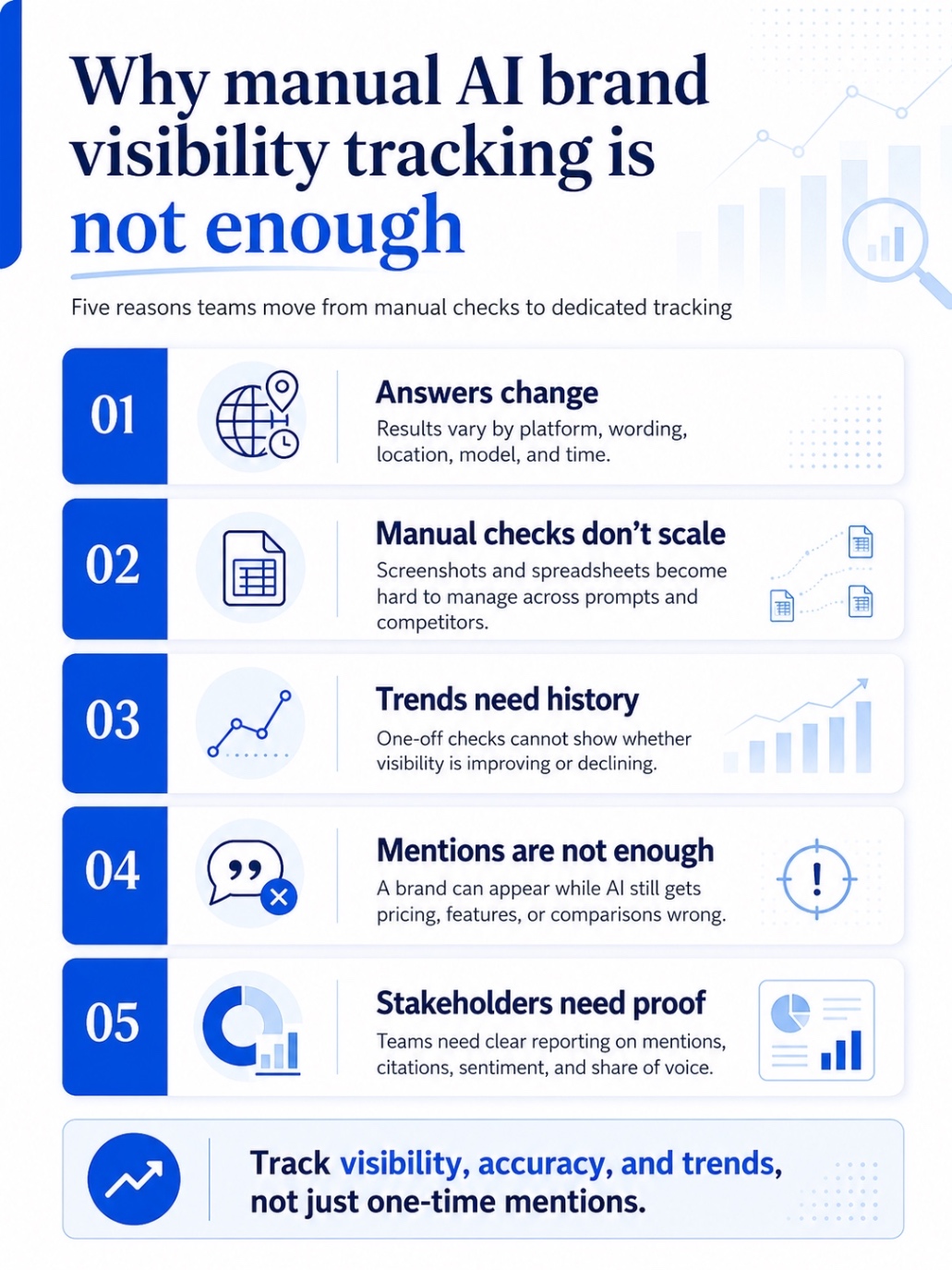
Checking a few prompts manually can show how your brand appears at that moment. It cannot tell you whether that visibility is consistent, improving, or accurately representing your brand.
Here are five reasons dedicated AI visibility tracking becomes necessary as your GEO program grows.
1. AI answers vary between checks
The same or similar prompts can produce different answers across platforms, models, locations, wording, and time. A handful of manual searches cannot provide a dependable visibility benchmark.
2. Manual tracking becomes difficult to scale
Monitoring hundreds of prompts across multiple products, competitors, markets, and AI platforms quickly becomes unmanageable. Teams often spend more time collecting screenshots than analyzing what changed.
3. Historical data shows whether your strategy is working
A single result cannot reveal whether a content update improved visibility or whether the change was temporary. Since AI search is volatile, historical tracking helps you compare performance before and after content, technical, or authority-building work.
4. A brand mention is not always a positive result
Your brand may appear while AI presents outdated pricing, incorrect features, irrelevant use cases, or unfavorable competitor comparisons. You need to track both how often your brand appears and how accurately it is described. Want to understand what those mentions actually mean? Learn how to track and improve brand mentions in LLMs.
5. Stakeholders need measurable evidence
Structured reporting makes it easier to show changes in mentions, citations, share of voice, sentiment, and competitor visibility. It also helps connect the actions your team takes with the results that follow.
An AI brand visibility tool becomes valuable when you need repeatable measurement, accurate brand insights, and clear reporting, not just proof that your brand appeared once.
Which capabilities matter most in an AI brand visibility tool?
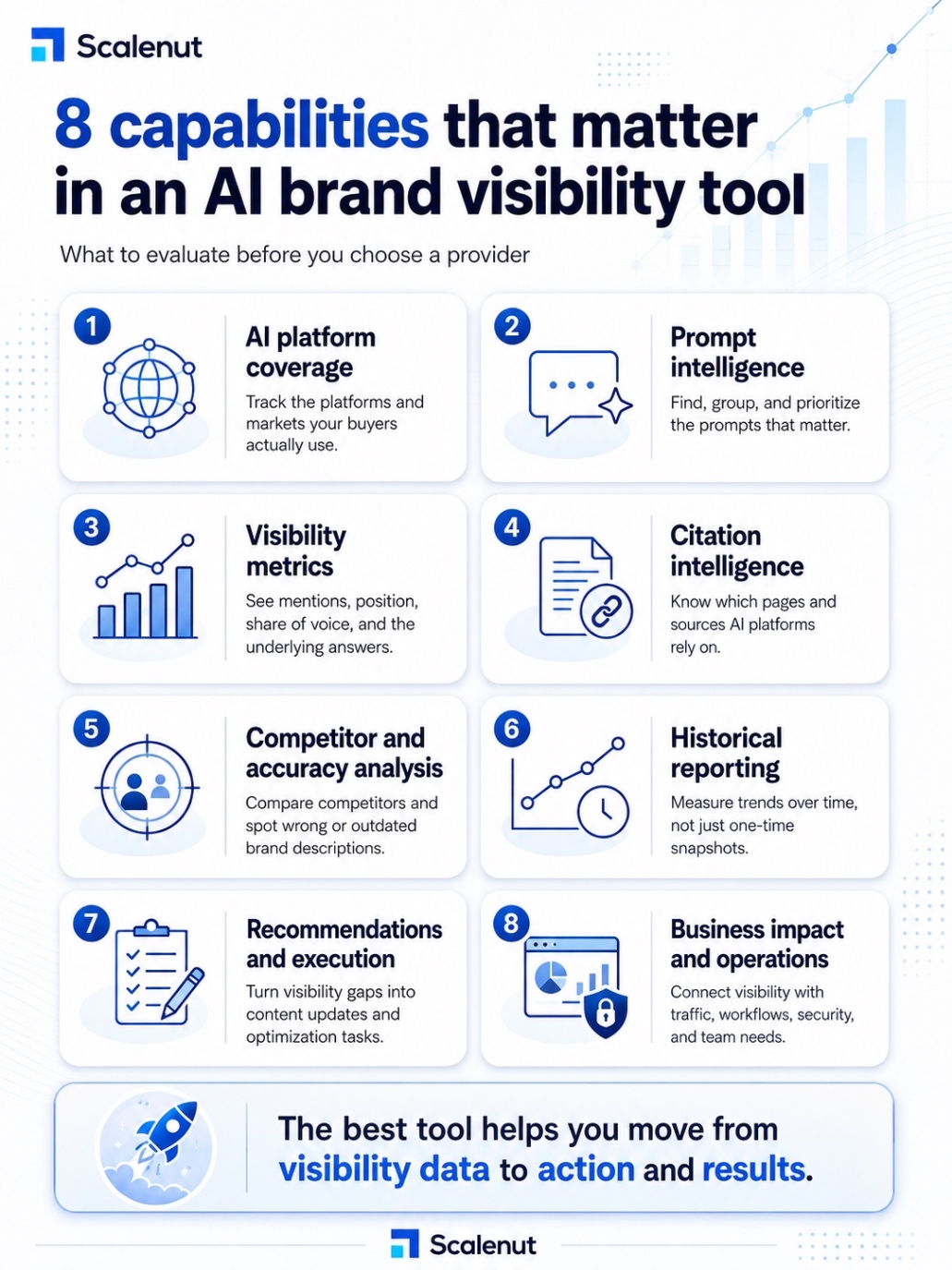
The right AI brand visibility tool should combine reliable platform coverage, prompt intelligence, visibility and citation data, competitor analysis, historical reporting, actionable recommendations, and workflow support.
Let’s look at each of these capabilities in detail.
1. Relevant AI platform and market coverage
Check whether the tool monitors the AI platforms your audience actually uses. Also confirm its coverage across countries, languages, locations, and models rather than choosing the provider with the longest platform list.
2. Reliable prompt intelligence
Evaluate how the platform discovers, prioritizes, and tracks prompts. Look for prompt suggestions, intent grouping, demand indicators, configurable locations and languages, transparent scoring, and a clear data-refresh schedule.
3. Complete visibility metrics with answer-level evidence
The platform should track mentions, average position, visibility scores, and share of voice. More importantly, it should let you open the original AI answers behind those metrics and verify the context yourself. Not sure which numbers deserve attention? Use these AI brand visibility metrics that matter to separate meaningful progress from vanity reporting.
4. Citation and source intelligence
Look for insights into which pages and domains AI platforms cite, which competitor sources are winning, and which of your pages are being overlooked. Useful citation reporting should help explain why visibility is being gained or lost so that you can work on improving AI citations.
5. Competitor, sentiment, and accuracy analysis
The tool should compare your visibility and positioning against relevant competitors while showing how AI describes each brand. It should also help identify incorrect features, outdated pricing, missing use cases, and misleading comparisons.
6. Historical reporting and useful segmentation
Check whether you can analyze performance over time by platform, prompt, topic, competitor, product, country, and date range. Historical data should help separate sustained improvement from normal fluctuations in AI answers.
7. Actionable recommendations and execution
A useful platform should move beyond identifying gaps. Look for specific recommendations and the ability to create, update, optimize, internally link, audit, or publish content based on what the visibility data reveals.
8. Business impact and operational fit
Assess whether the platform tracks AI referral traffic or bot activity and integrates with your existing analytics, CMS, and reporting workflows. Also review collaboration, permissions, security, support, and total cost at your required scale.
The best tool is not the one that reports the most metrics. It is the one that helps your team move clearly from visibility data to diagnosis, action, and measurable results.
What are the 8 best AI brand visibility tools to consider in 2026?
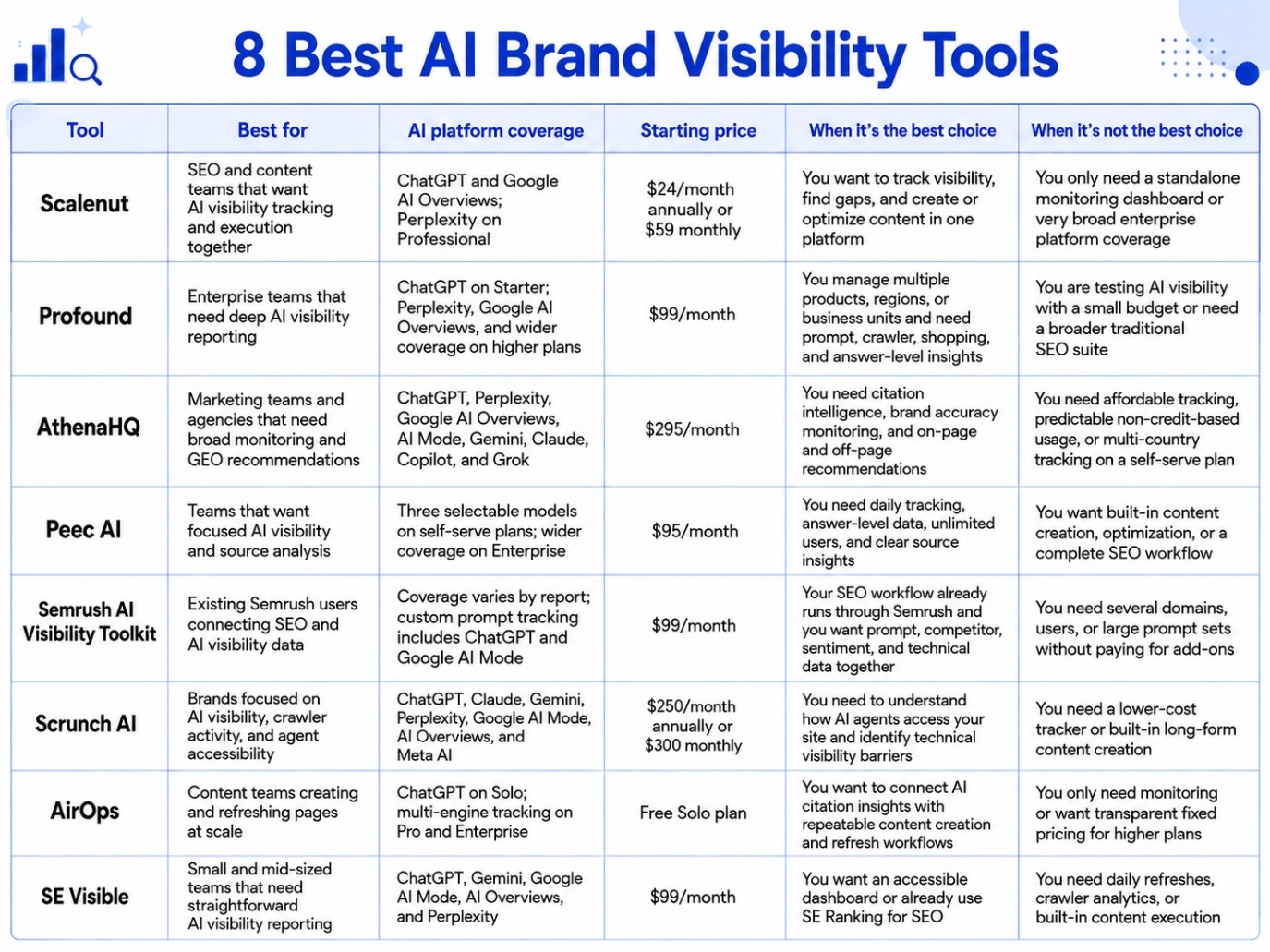
The best AI brand visibility tool depends on whether you need basic monitoring, deep enterprise reporting, technical crawler insights, content execution, or a combined SEO and GEO workflow.
Here are 8 tools worth comparing based on their strengths, pricing, and ideal use cases.
1. Scalenut
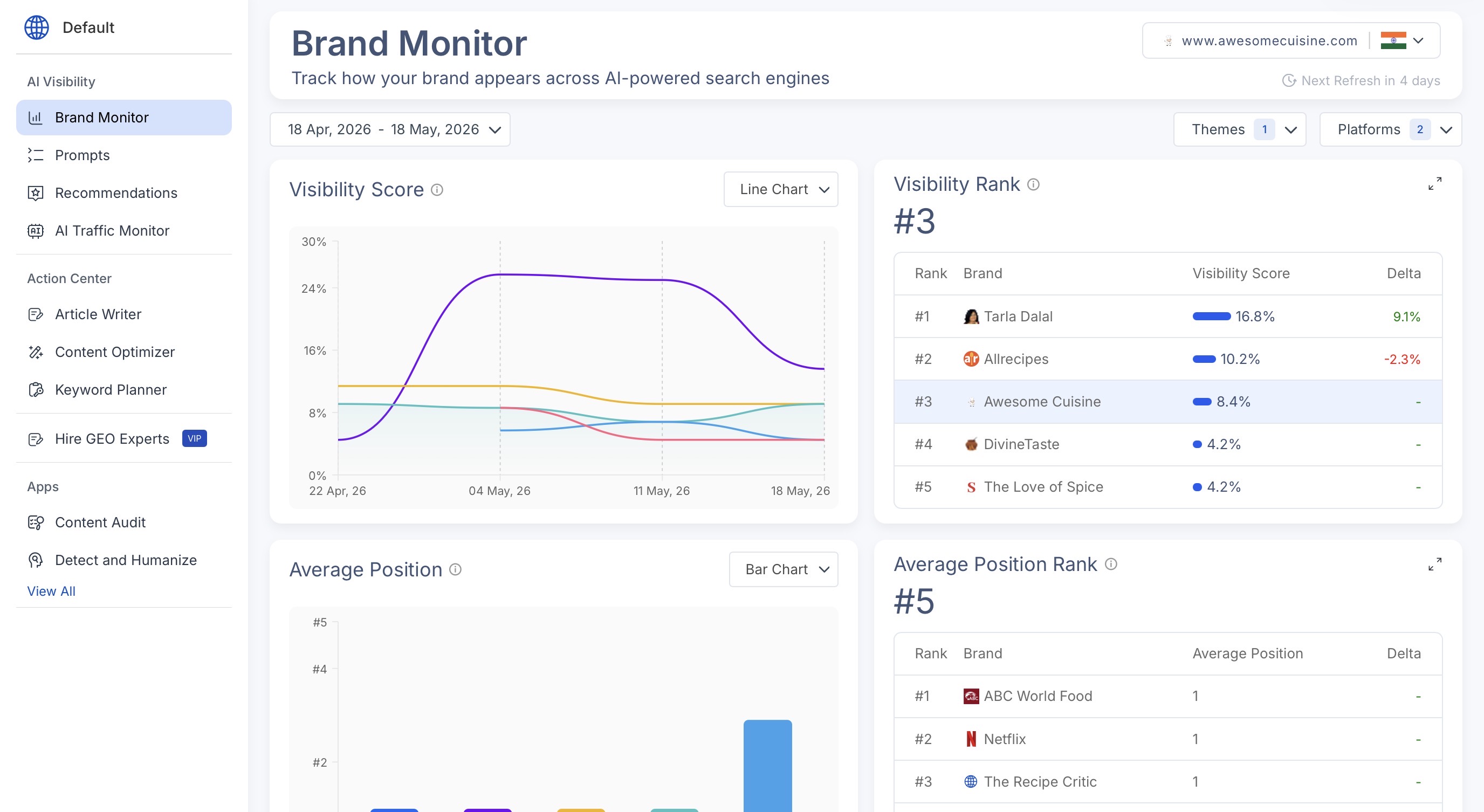
Best for: SEO and content teams that want to track AI visibility and turn the findings into content and optimization work within the same platform.
Scalenut combines AI brand visibility monitoring with GEO content creation, optimization, audits, internal linking, and SEO planning. Its main advantage is that teams can move from identifying a visibility gap to acting on it without switching tools.
Where Scalenut stands out as an AI brand visibility tool
- Brand and competitor tracking: Measures visibility score, average position, share of voice, and performance across AI platforms.
- Prompt and citation intelligence: Shows which prompts mention your brand, which sources are cited, and where competitors are gaining visibility.
- Answer context: Includes sentiment analysis, query fanout, and access to the AI responses behind the metrics.
- Actionable recommendations: Identifies content gaps, backlink opportunities, and relevant community discussions.
- Built-in execution: Supports GEO article creation, existing-content optimization, content audits, internal linking, and publishing workflows.
- AI traffic insights: Tracks AI bot activity, source engines, crawl trends, and frequently accessed pages.
How much does Scalenut cost?
Annual plans start at $24 per month for Starter, $36 per month for Plus, and $80 per month for Professional. Monthly plans cost $59, $89, and $199, respectively. AI platform coverage, prompt limits, workspaces, and content limits increase by plan.
When should you shortlist Scalenut?
- You want AI visibility tracking and content execution in one workflow.
- Your team manages both SEO and GEO.
- You need prompt, citation, sentiment, competitor, and traffic insights.
- You want to create or update content directly from identified visibility gaps.
- You need a more accessible entry point than enterprise-focused platforms.
When should you consider another tool?
- You only need a standalone AI mention tracker.
- Your priority is tracking a very large number of prompts on the entry plan.
- You need extensive enterprise reporting across many AI platforms and international markets.
- You do not need content creation, optimization, or SEO capabilities.
Scalenut is best suited to teams that want to do more than monitor AI visibility. It connects measurement with the content and SEO work required to improve it.
2. Profound
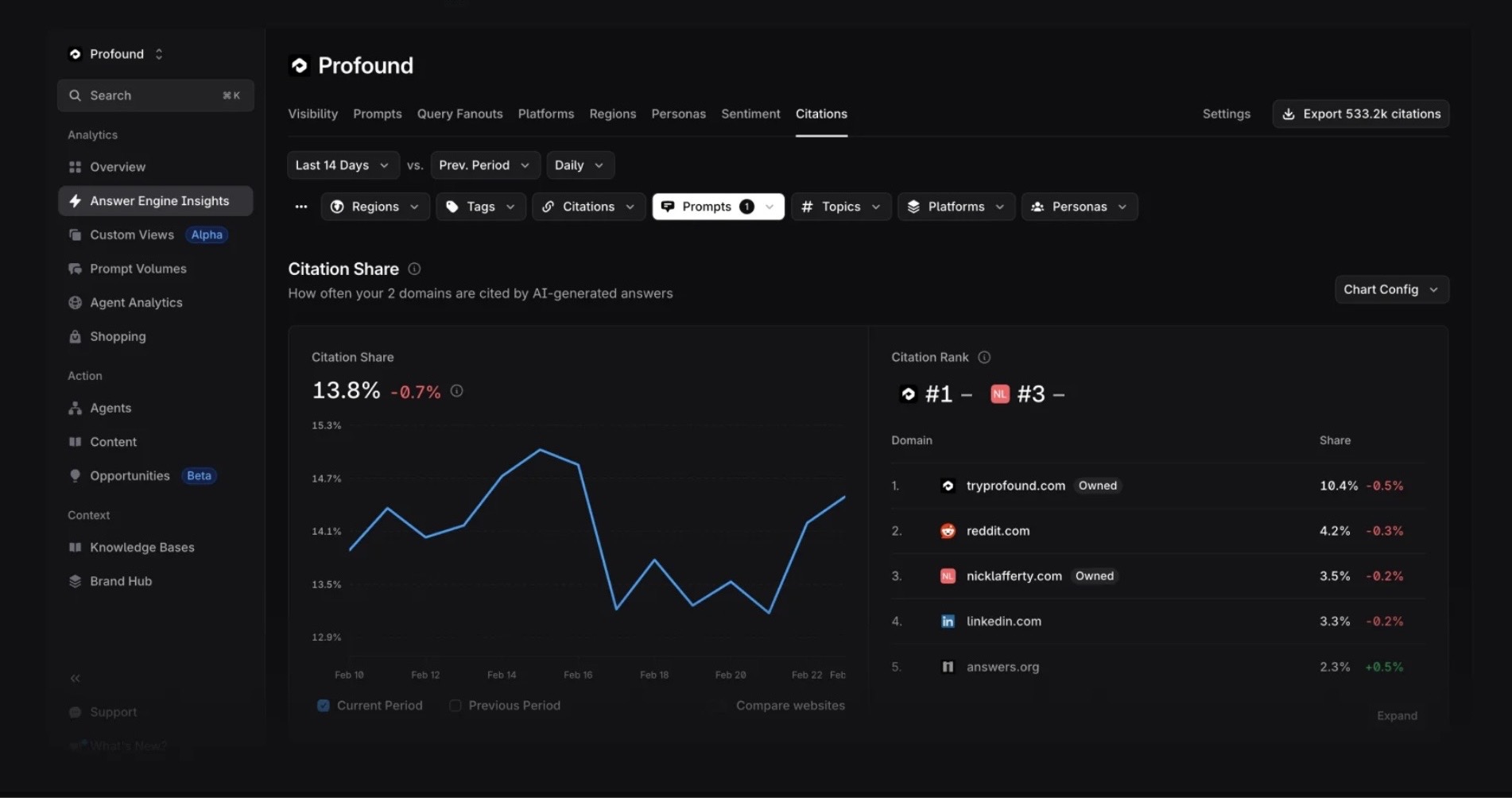
Best for: Enterprise teams that need deep AI visibility reporting across multiple products, regions, and markets.
Profound combines AI visibility tracking, prompt demand data, crawler analytics, shopping insights, and content workflows. It is built for teams that need detailed reporting rather than a basic brand mention dashboard.
Where Profound stands out as an AI brand visibility tool
- Answer Engine Insights: Tracks visibility, citations, sentiment, share of voice, and competitor rankings.
- Prompt Volumes: Helps prioritize prompts using estimated demand, intent, and trend data.
- Agent Analytics: Shows how AI crawlers interact with your site.
- Shopping Insights: Monitors product and merchant visibility in ChatGPT Shopping.
- Profound Agents: Supports content research, creation, optimization, and publishing.
How much does Profound cost?
Profound starts at $99 per month for ChatGPT tracking. The $399 per month Growth plan adds Perplexity, Google AI Overviews, more prompts, and content capabilities. Enterprise pricing is custom, and a seven-day Growth trial is available.
When should you shortlist Profound?
- You manage multiple products, regions, or competitive sets.
- You need answer-level data and detailed enterprise reporting.
- You want prompt intelligence, crawler analytics, and content workflows together.
- You require enterprise security, access controls, and integrations.
When should you consider another tool?
- You only need basic, affordable AI visibility tracking.
- You want broader SEO capabilities alongside AI visibility.
- You need a simpler and lower-cost content workflow.
Profound is a strong choice for mature teams that can make full use of its reporting depth, technical data, and enterprise features.
Still weighing enterprise reporting against hands-on execution? Read the full Scalenut vs Profound AI comparison before deciding.
3. AthenaHQ
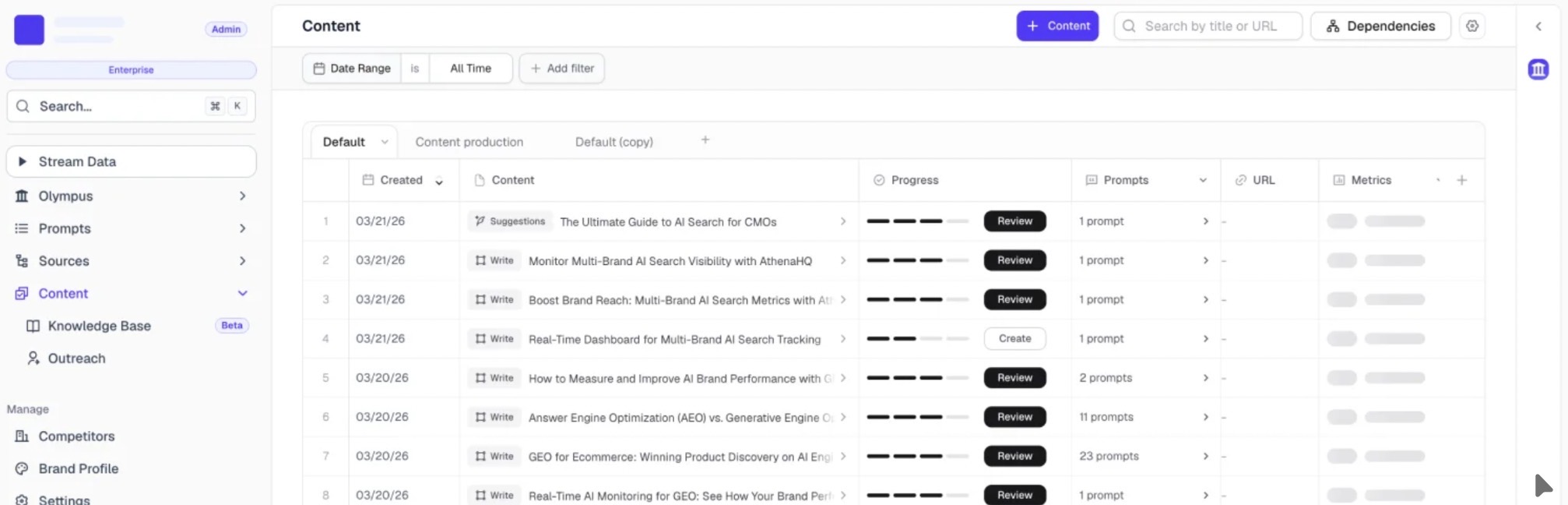
Best for: Marketing teams and agencies that want broad AI platform coverage with citation analysis and GEO recommendations.
AthenaHQ tracks brand visibility across major AI platforms and combines competitor monitoring, citation intelligence, content recommendations, and website crawler analysis.
Where AthenaHQ stands out as an AI brand visibility tool
- Broad platform coverage: Tracks ChatGPT, Perplexity, Google AI Overviews, AI Mode, Gemini, Claude, Copilot, and Grok.
- Citation intelligence: Shows which sources influence AI answers and where your brand may need stronger third-party authority.
- Brand accuracy monitoring: Helps identify incorrect or incomplete information about your brand.
- Content recommendations: Suggests on-page and off-page actions based on visibility and citation gaps.
- Agency support: Includes client reporting, unlimited seats, and role-based access.
How much does AthenaHQ cost?
The Self-Serve plan costs $295 per month and includes 3,600 monthly credits. A discounted first month is available for $95. Enterprise pricing is customized and adds capabilities such as multi-country tracking, advanced content agents, API access, AI traffic analysis, SSO, and audit logs.
When should you shortlist AthenaHQ?
- You want to monitor your brand across several AI platforms.
- You need citation analysis and specific GEO recommendations.
- You manage reporting for multiple clients or stakeholders.
- You want to identify both on-page content gaps and off-page authority opportunities.
When should you consider another tool?
- You need an affordable option for a small prompt set.
- Credit-based usage makes your monthly cost difficult to predict.
- You need multi-country tracking on a self-serve plan.
- You want a complete SEO and content platform alongside AI visibility.
AthenaHQ is a practical choice for teams that want broad monitoring and guided GEO recommendations, but buyers should review credit limits and Enterprise-only features before choosing a plan.
Need a closer look at recommendations, pricing, and workflow depth? Explore the Scalenut vs AthenaHQ comparison.
4. Peec AI
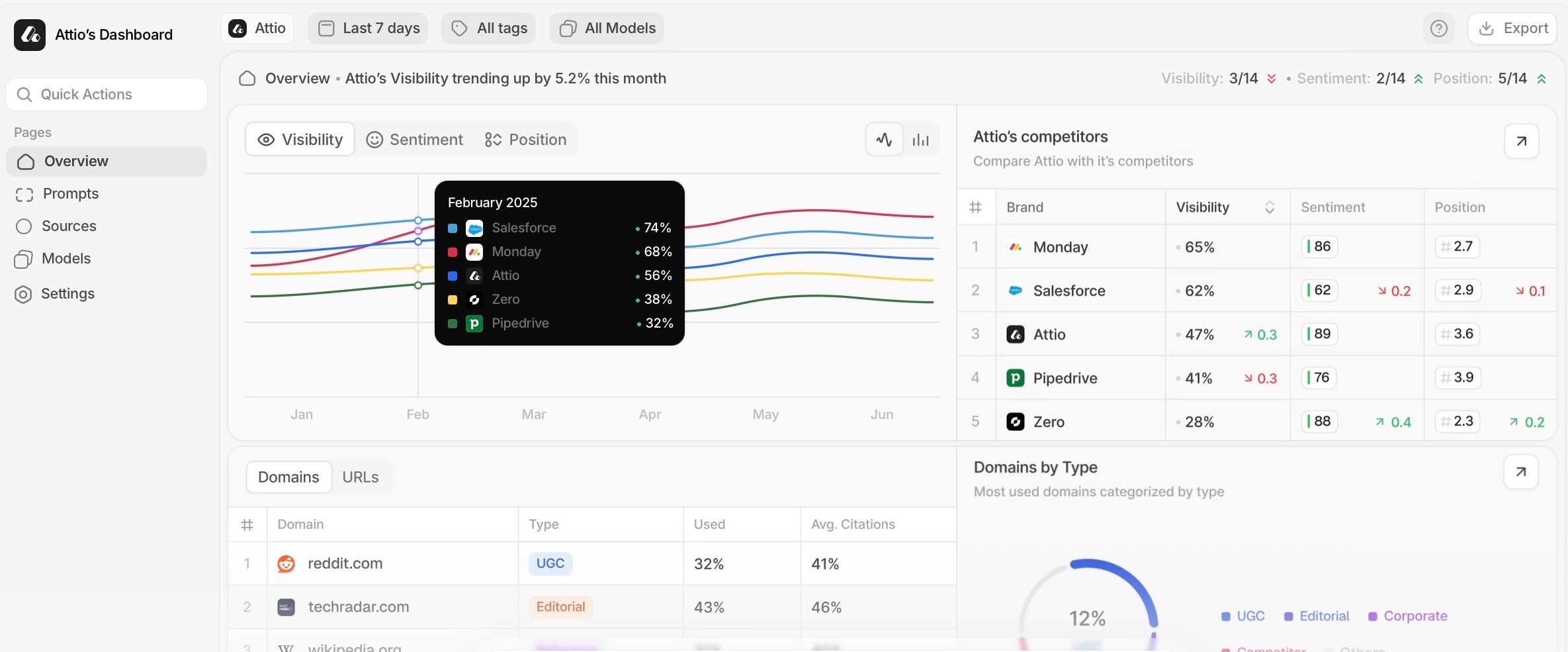
Best for: SEO and content teams that want clear AI visibility tracking, competitor analysis, and source insights without a complex enterprise setup.
Peec AI tracks how brands perform across selected AI platforms through daily prompt monitoring. Its dashboards focus on visibility, position, sentiment, share of voice, competitors, and the sources shaping AI answers.
Where Peec AI stands out as an AI brand visibility tool
- Clear answer-level data: Lets you review the original AI responses behind visibility and sentiment scores.
- Source intelligence: Separates URLs used during answer generation from links explicitly cited in the response.
- Flexible tracking: Self-serve plans include three AI models, daily tracking, and unlimited users.
- Prioritized recommendations: Actions highlights source gaps, competitor wins, and practical opportunities to pursue.
- Technical and reporting options: Agent Analytics tracks AI crawler activity, while MCP, exports, and Looker Studio support custom reporting workflows.
How much does Peec AI cost?
The Starter plan costs $95 per month for 50 prompts, three models, and one project. Pro costs $245 per month for 150 prompts and two projects, while Advanced costs $495 per month for 350 prompts, five projects, multi-country tracking, and Looker Studio. Enterprise pricing is custom.
When should you shortlist Peec AI?
- You want daily visibility tracking with a simple, easy-to-read interface.
- Citation and source gaps are central to your GEO strategy.
- You need unlimited users without paying for additional seats.
- Your team already has a separate workflow for creating and optimizing content.
When should you consider another tool?
- You want the platform to create and optimize content for you.
- You need more than three AI models without paying for add-ons or Enterprise.
- You want traditional SEO research, rank tracking, and content tools in the same platform.
- You need multi-country tracking below the Advanced plan.
Peec AI is a strong monitoring and analysis platform, but its Actions feature recommends what to address rather than executing the content work for you.
Before shortlisting it, read our hands-on Peec AI review for a closer look at its dashboards, source insights, pricing, and execution limits.
5. Semrush AI Visibility Toolkit
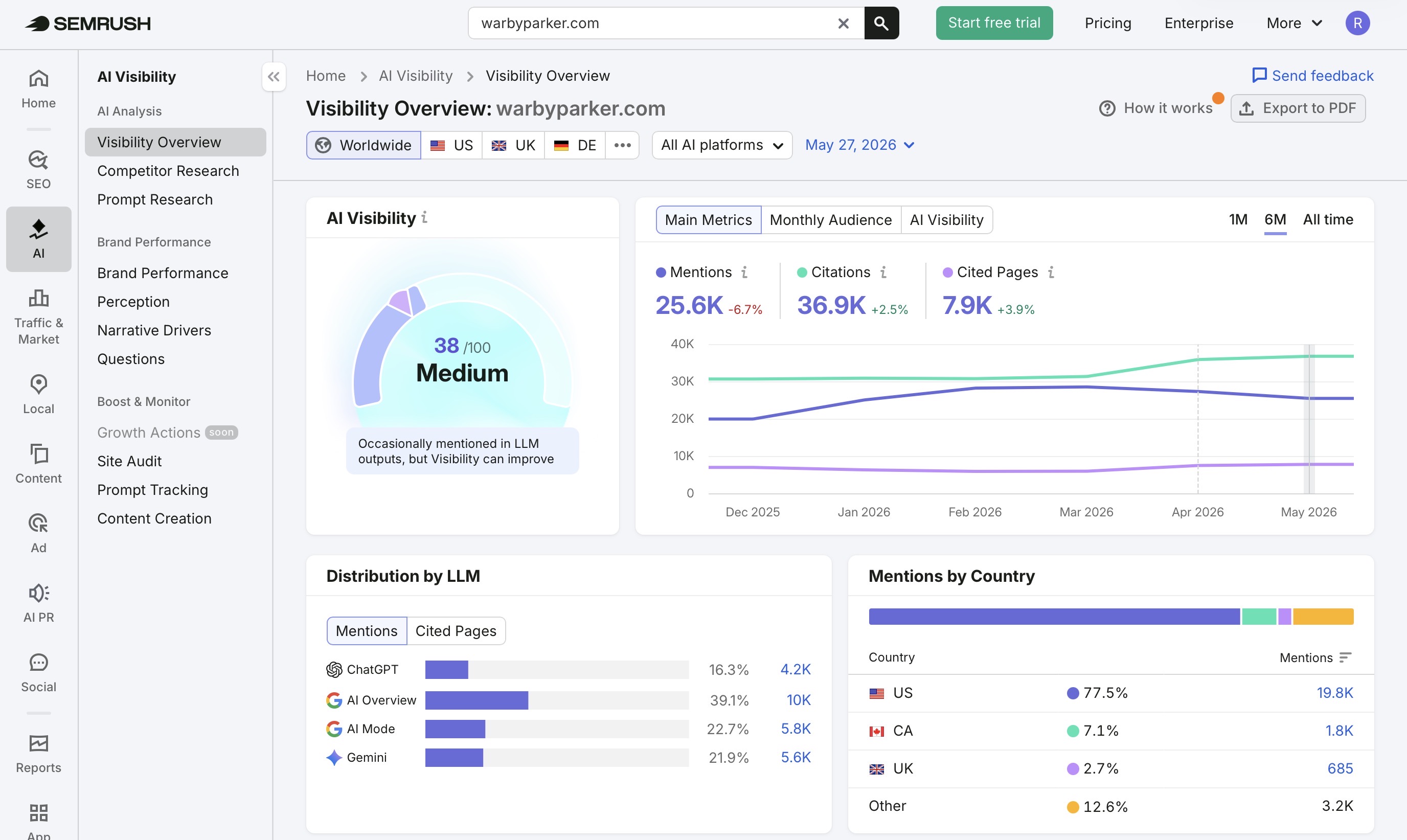
Best for: Existing Semrush users who want to connect AI visibility data with traditional SEO reporting.
The AI Visibility Toolkit tracks how brands appear across AI-generated answers and combines prompt research, competitor benchmarking, sentiment analysis, citations, and technical AI-readiness checks.
Where Semrush stands out as an AI brand visibility tool
- SEO and AI visibility together: Semrush One combines AI visibility with keyword rankings, backlinks, competitor research, and site audits.
- Large prompt database: Helps identify relevant topics, prompts, cited sources, and competitors without relying only on manually added prompts.
- Brand Performance: Tracks share of voice, sentiment, narratives, and competitor visibility across major AI platforms.
- Daily prompt tracking: Monitors custom prompts across ChatGPT Search, Google AI Mode, and Gemini, with access to the underlying results.
- AI Search Site Audit: Checks whether technical issues could prevent AI crawlers from accessing your pages.
How much does Semrush cost?
The standalone AI Visibility Toolkit costs $99 per month and does not include a free trial. It covers one domain, 25 tracked prompts, and AI Search Site Audit checks for up to 100 pages.
Additional domains cost $99 per month, while 50 extra prompts cost $60 per month. Each additional team member also needs a separate toolkit license.
When should you shortlist Semrush?
- Your SEO workflow already runs through Semrush.
- You want to compare traditional rankings and AI visibility in one ecosystem.
- You need prompt research alongside custom daily prompt tracking.
- You want visibility, sentiment, citation, competitor, and technical site data together.
When should you consider another tool?
- You need to track several domains, users, or large prompt sets affordably.
- You want more than 25 tracked prompts on the entry plan.
- You need content creation and optimization built directly into the visibility workflow.
- You prefer a platform focused entirely on GEO rather than a broader SEO ecosystem.
Semrush is most valuable when you already use its SEO data. However, teams should calculate the cost of extra domains, prompts, and user licenses before choosing it for larger programs.
6. Scrunch AI
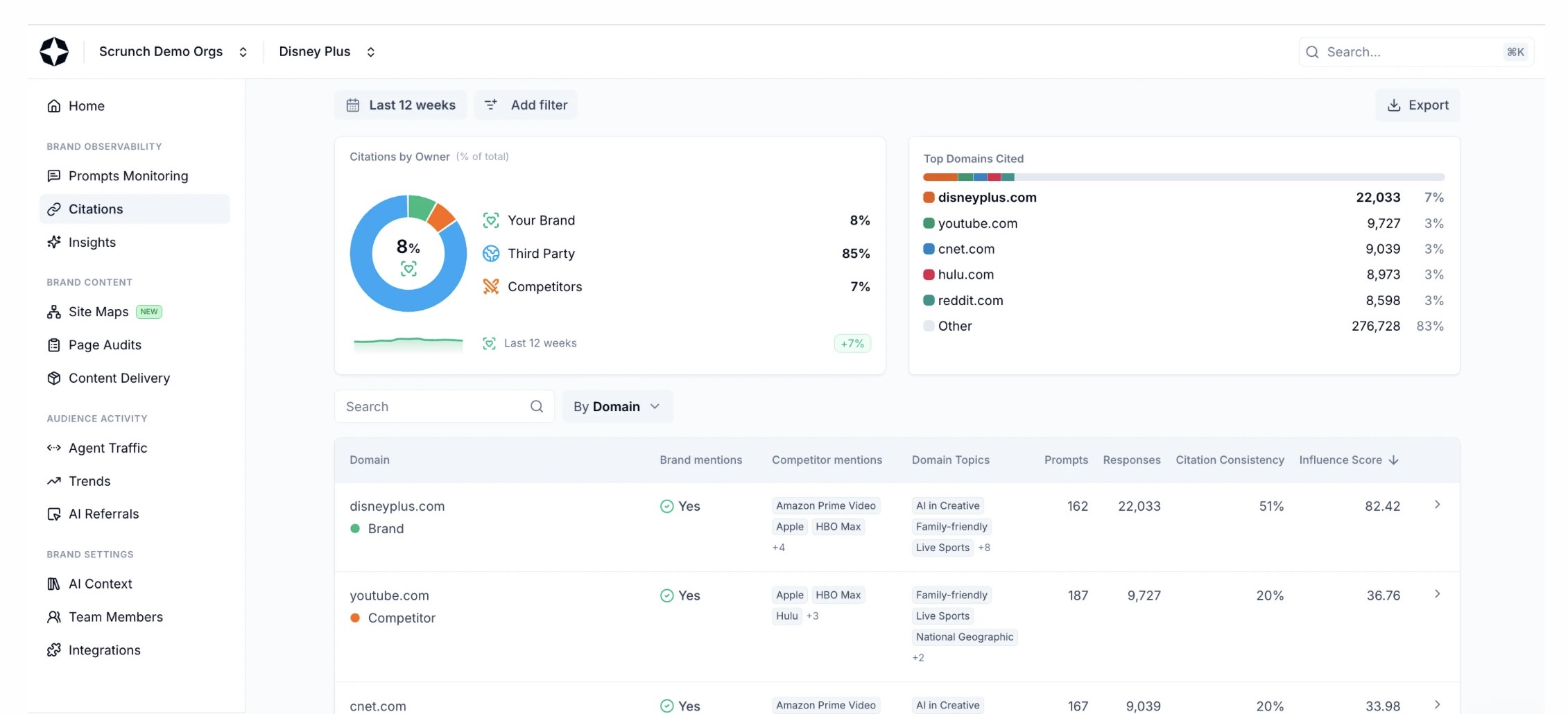
Best for: Brands that want AI visibility monitoring alongside technical insights into how AI agents access their websites.
Scrunch AI combines prompt monitoring, citation analysis, AI traffic tracking, and page audits. Its main differentiator is its focus on both brand visibility and the website experience delivered to AI agents.
Where Scrunch AI stands out as an AI brand visibility tool
- Cross-platform monitoring: Tracks brand presence, placement, sentiment, and citations across major AI platforms.
- Detailed segmentation: Filters performance by prompt, topic, persona, model, competitor, and region.
- Agent traffic monitoring: Shows which AI bots visit your site and which pages they access.
- Page audits: Identifies technical and content issues that may limit AI visibility.
- Agent Experience Platform: Offers a separate product that serves AI agents a structured, optimized version of your site content.
How much does Scrunch AI cost?
Starter costs $250 per month annually or $300 monthly, while Growth costs $417 annually or $500 monthly. Enterprise pricing is custom, and a seven-day trial is available.
When should you shortlist Scrunch AI?
- You want to connect AI visibility with crawler and referral traffic.
- Technical access or content readability may be limiting your citations.
- You need reporting across personas, topics, regions, or product lines.
- You want a technical solution for improving how AI agents consume your site.
When should you consider another tool?
- You need a lower-cost option for basic monitoring.
- You want traditional SEO and content creation tools in the same platform.
- The included page audit limits are too low for your website.
- Your priority is creating new content rather than improving agent access.
Scrunch AI is best suited to teams that want to understand both what AI platforms say about their brand and how AI agents interact with their website.
Considering its crawler analytics and Agent Experience Platform? Read the detailed Scrunch AI review to see where its technical layer adds value.
7. AirOps
Best for: Content and SEO teams that want to connect AI visibility insights with large-scale content creation and refresh workflows.
AirOps combines AI visibility tracking with content execution. It is particularly useful for teams managing large content libraries that need to turn citation gaps and performance data into repeatable updates.
Where AirOps stands out as an AI brand visibility tool
- Unified page insights: Combines AI citations, Google Search Console data, and GA4 traffic at the page level.
- Prompt and citation tracking: Shows where your brand appears, which sources earn citations, and where competitors lead.
- Actionable opportunities: Identifies onsite, offsite, and community opportunities based on tracked prompts.
- Scalable content workflows: Uses agents, Playbooks, Workflows, and Grids to create or refresh content across many pages.
- Brand governance: Applies Brand Kit context across content workflows to maintain consistency.
How much does AirOps cost?
The free Solo plan includes 100 tracked prompts and pages, ChatGPT-only insights, and 20,000 monthly tasks. Pro adds 250 tracked prompts and pages, multi-engine insights, 75,000 tasks, and unlimited users, but its price is not publicly listed. Enterprise pricing is customized.
When should you shortlist AirOps?
- You need to create or refresh content at scale.
- You want visibility data connected directly to content workflows.
- You need page-level insights combining AI citations, SEO data, and traffic.
- You want to act on both owned-content and third-party citation gaps.
When should you consider another tool?
- You only need a simple AI visibility dashboard.
- You want fixed, publicly listed pricing before contacting sales.
- ChatGPT-only tracking on the free plan is too limited.
- You need traditional rank tracking, backlink analysis, and technical SEO tools in the same platform.
AirOps is strongest when content execution is as important as visibility tracking. Teams that only need monitoring may find its workflow and task-based system more than they require.
If workflow automation is central to your decision, read our in-depth AirOps review to understand its setup, pricing, and ideal use cases.
8. SE Visible
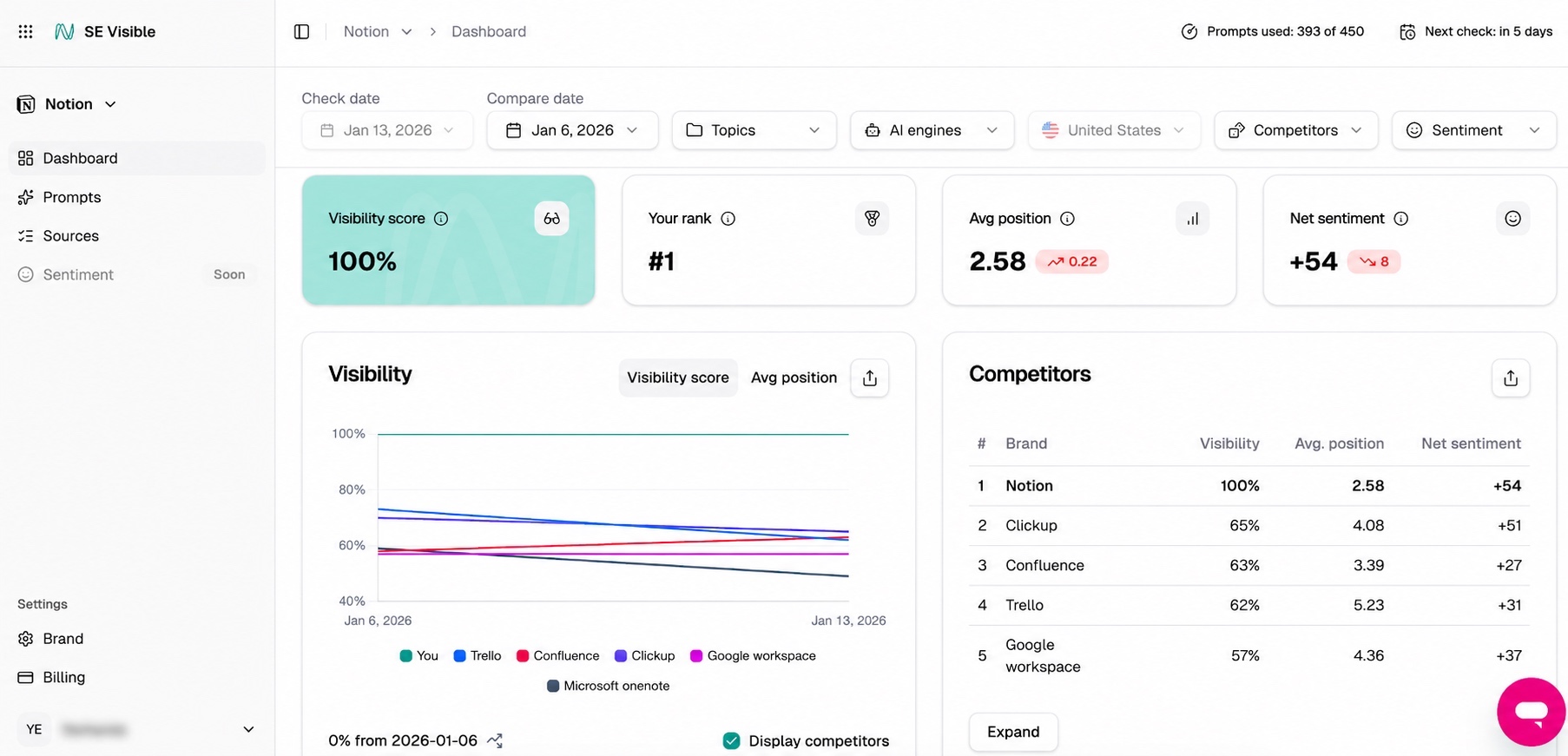
Best for: Small and mid-sized teams that want straightforward AI visibility monitoring with the option to connect it to a broader SEO platform.
SE Visible tracks how brands appear across ChatGPT, Gemini, Perplexity, Google AI Mode, and AI Overviews. It focuses on mentions, sentiment, competitors, prompts, cited sources, and visibility trends.
Where SE Visible stands out as an AI brand visibility tool
- Clear visibility reporting: Tracks visibility score, average position, sentiment, competitor rank, and historical changes.
- Prompt and answer analysis: Shows which prompts mention your brand and lets you review the context of AI-generated answers.
- Source intelligence: Identifies the domains and URLs that influence AI responses.
- Flexible filtering: Segments data by AI engine, topic, date, region, and competitor.
- SE Ranking connection: Can be paired with SE Ranking for keyword tracking, site audits, backlink analysis, and content optimization.
How much does SE Visible cost?
Basic costs $99 per month for 200 prompts and three projects. Core costs $189 per month for 450 prompts and five projects, while Plus costs $355 per month for 1,000 prompts and ten projects. A 10-day free trial is available.
When should you shortlist SE Visible?
- You want a simple dashboard without an enterprise-level learning curve.
- You need competitor, sentiment, prompt, and source reporting.
- You already use SE Ranking or want SEO and AI visibility within the same ecosystem.
- Weekly data updates are sufficient for your reporting needs.
When should you consider another tool?
- You need daily prompt tracking.
- You want broader AI platform coverage.
- You need built-in content creation and optimization without adding SE Ranking.
- You require deeper agent traffic or crawler analytics.
SE Visible is a practical monitoring option, especially for SE Ranking users, but teams needing daily data or built-in execution may require a more specialized platform.
How should you test an AI brand visibility tool before buying it?
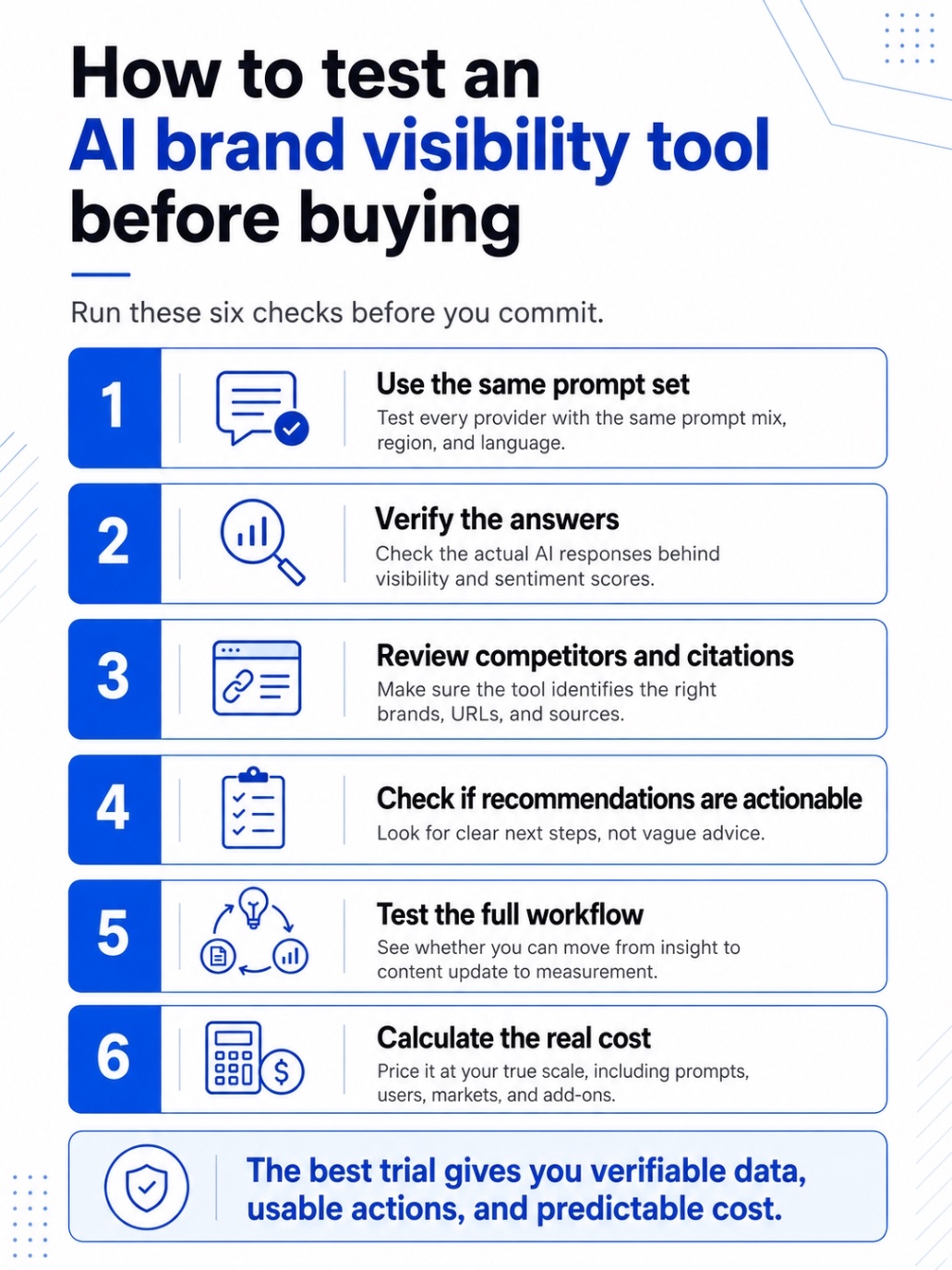
A product demo can show what a platform can do, but a structured trial reveals whether its data and workflow are reliable enough for your team.
Here are six practical tests to run before making a decision.
1. Use the same prompt set in every tool
Create one test set covering category, comparison, alternative, use-case, pricing, and branded prompts. Keep the region, language, competitors, and evaluation period consistent so you can compare results fairly.
2. Verify the answers behind the metrics
Open the responses used to calculate visibility, position, sentiment, and share of voice. Confirm that the dashboard reflects what the AI answer actually says rather than relying only on summary scores.
3. Check competitors and cited sources manually
Review whether the tool identifies the right competitors, URLs, and third-party domains. Irrelevant competitors or misclassified sources can distort the conclusions you draw from the data.
4. Test whether recommendations are actionable
A useful recommendation should identify the affected prompt, page, source, or content gap and suggest a clear next step. Broad advice such as “improve authority” is difficult to prioritize or measure.
5. Follow one insight through the complete workflow
Choose a real visibility gap and test whether you can diagnose it, update or create content, publish the change, and monitor the result. This shows how much manual work or additional software the platform still requires.
6. Calculate the cost at your actual scale
Price the tool using the prompts, platforms, countries, projects, users, refresh frequency, and content volume you need. Include add-ons and higher-tier features so the entry price does not hide the true operating cost.
The best trial is not the one with the most impressive dashboard. It is the one that gives your team evidence it can verify, actions it can execute, and costs it can predict.
What warning signs should you watch for when evaluating an AI brand visibility tool?
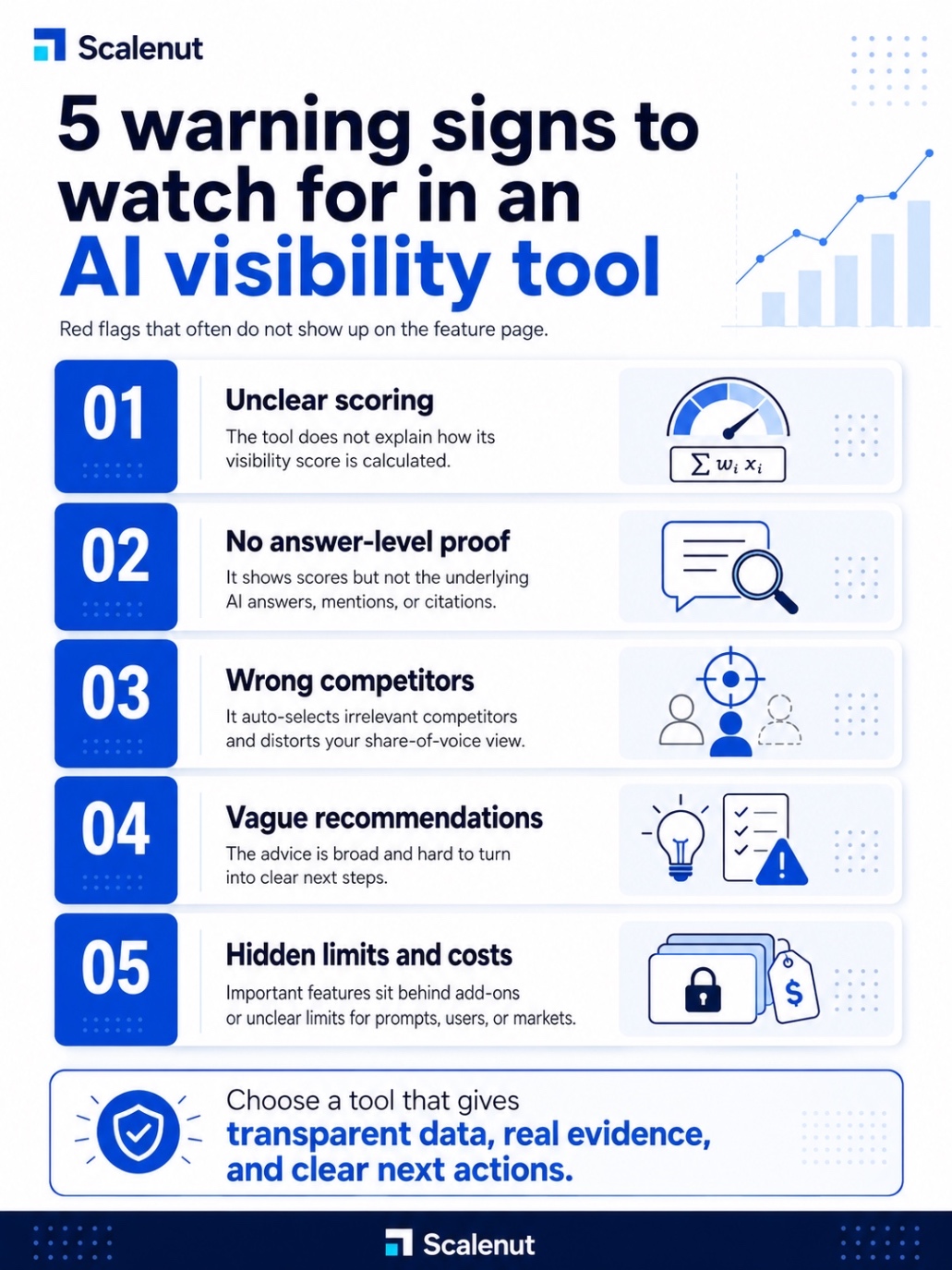
Feature pages can make most AI visibility platforms look similar. The real differences often appear in how the data is collected, explained, and turned into action.
Here are five red flags to check during a demo or free trial.
1. The scoring methodology is unclear
Be cautious if the provider shows a visibility score without explaining the formula, prompts, platforms, or responses behind it. You should know exactly what the score measures before using it as a benchmark.
2. The data cannot be verified
A dashboard should let you open the underlying AI answer and review the mention, citation, sentiment, and brand position yourself. Scores without answer-level evidence are difficult to audit or trust.
3. The competitor set is inaccurate
Automatically suggested competitors can include marketplaces, publishers, or unrelated brands. Check whether you can add, remove, and organize competitors so your share-of-voice data reflects the market you actually compete in.
4. The insights do not lead to action
Broad recommendations such as “improve authority” or “create better content” offer little practical value. A useful platform should identify the affected prompts, pages, citations, or content gaps and clarify what needs attention.
5. The true cost is difficult to calculate
Review limits for prompts, AI platforms, countries, projects, users, and data refreshes. A low entry price can become expensive when essential coverage, reporting, or workflow features require separate add-ons.
A strong provider should make its methodology, evidence, competitive data, next steps, and total cost easy to evaluate before you commit.
Final thoughts: Which AI brand visibility tool should you choose?
Start by shortlisting tools based on the AI platforms you need to track, the number of prompts and markets you manage, and whether you only want visibility reporting or also need help acting on the findings. Then test each option with the same prompt set, verify the answers behind the metrics, and calculate the full cost at your expected scale.
Scalenut is worth considering if your team wants to connect AI visibility tracking with SEO and content execution. It helps you monitor mentions, citations, competitors, sentiment, prompts, and AI traffic, then use those insights to create, update, optimize, audit, and internally link content within the same workflow.
The next step is to identify your highest-priority prompts and visibility gaps, then see how Scalenut can support both measurement and execution. Book a strategy call with Scalenut to evaluate your current AI visibility and build a practical plan for improving it.
Frequently asked questions
What key features should I look for when choosing an AI brand visibility tool?
Look for platform coverage, prompt tracking, citations, source analysis, competitor benchmarking, sentiment, historical trends, answer-level evidence, and clear search visibility features. The strongest tools also provide actionable insights and help your team turn visibility gaps into content, authority, or technical improvements.
How do AI brand visibility tools collect and compare data?
Most tools run selected prompts across supported AI search engines, store the responses, and classify mentions, citations, sentiment, position, and competitors. They then compare these results across prompts, platforms, locations, and time periods to estimate your brand’s visibility and relative performance.
How accurate are AI brand visibility tools?
AI visibility tools are useful for trend tracking and competitive comparison, but their scores are estimates rather than absolute truth. Accuracy improves when the provider shows underlying responses, explains its methodology, controls location and model variables, and repeats prompts consistently over time.
Which AI platforms should a brand visibility tool track?
A tool should track the AI platforms your audience actually uses, such as ChatGPT, Google AI Overviews, Google AI Mode, Gemini, Perplexity, Claude, or Copilot. Prioritize relevant AI answer engines rather than choosing a provider simply because it lists the most platforms.
How can I compare different AI visibility tools to find the best fit for my brand?
Compare tools using the same prompt set, competitors, markets, languages, and evaluation period. Review the underlying answers, source classifications, recommendations, update frequency, integrations, and total cost. The best fit is the platform that supports your actual reporting and execution workflow.
What benefits do AI-powered brand visibility tools offer over manual tracking methods?
Manual checks provide isolated snapshots and become difficult to repeat across hundreds of prompts. AI-powered platforms automate monitoring, preserve historical data, compare competitors, and surface changes in citations or sentiment, making performance easier to analyze, report, and improve systematically.
Are there recommended AI visibility tools specifically for marketing agencies?
Marketing agencies should prioritize multi-client workspaces, flexible reporting, exports, competitor management, and clear usage limits. Scalenut is worth considering because it combines AI visibility monitoring with generative engine optimization, content creation, optimization, audits, internal linking, and publishing workflows.
Which AI brand visibility tools are most popular and reliable in 2026?
There is no universal reliability ranking for 2026. Frequently considered options include Scalenut, Profound, AthenaHQ, Peec AI, Semrush, Scrunch AI, AirOps, and SE Visible. The best AI visibility platform depends on your budget, engines, prompt volume, and workflow.
What factors affect the accuracy of AI brand visibility monitoring tools?
Accuracy depends on prompt selection, response frequency, platform interface, model version, location, language, personalization, scoring methodology, and competitor classification. Results may also vary between runs, so reliable tools preserve complete answers and use consistent tracking conditions to reveal meaningful trends.
How is an AI visibility tool different from a traditional SEO tool?
Traditional SEO tools measure rankings, traffic, backlinks, and technical performance in traditional search. AI visibility tools examine generated answers, including mentions, citations, sentiment, and competitor positioning. Some platforms combine both to support SEO and answer engine optimization within one workflow.
How much does an AI brand visibility tool cost?
Pricing ranges from free entry plans to several hundred dollars per month, with enterprise contracts priced separately. Costs usually depend on prompts, platforms, countries, projects, users, refresh frequency, and add-ons, so calculate the total price using your expected scale.
Should I choose a tracking-only tool or an SEO and GEO platform?
Choose a tracking-only tool when you mainly need monitoring, reporting, and competitor benchmarks. Choose an SEO and GEO platform when your team also needs research, content creation, optimization, internal linking, audits, publishing, and measurement within a connected workflow.


.svg)


.webp)