Profound vs Gauge: Quick verdict
- Choose Profound if you need deeper AI search research, real-user prompt demand data, AI crawler and referral analytics, and customizable Agents for content and reporting workflows.
- Choose Gauge if you want to monitor a larger prompt set daily and connect visibility data with GA4, Google Search Console, Semrush, and a guided content execution workflow.
Profound offers more depth and flexibility, while Gauge provides a more structured path from identifying visibility gaps to creating and measuring content.
You need more than a visibility score. You need to know which prompts matter, why competitors are being cited, and what your team should do next. Another dashboard that reports the problem without helping you act will not be enough.
That is the real tension in Profound vs Gauge. Profound gives teams deeper prompt research, audience segmentation, crawler intelligence, and configurable workflows. Gauge runs 600 prompts daily and connects that monitoring to recommendations and content production.
The better choice depends on whether you need greater control over the data or a faster route from insight to execution. I compared both platforms across coverage, prompt tracking, analytics, workflows, integrations, and pricing to show where each one genuinely fits.
What is Profound?
Profound is an AI search marketing platform that helps brands understand and improve how they appear across answer engines. Its core products cover AI visibility and citation tracking, real-user prompt demand, AI crawler activity, shopping visibility, and agent-led content workflows.
What is Profound best for?
Profound is best for enterprise, AEO, brand, and content teams that need detailed visibility analysis across platforms, regions, topics, and competitors. Prompt Volumes supports demand research, Answer Engine Insights tracks brand representation, and Agent Analytics connects AI crawler activity with site performance.
Where may Profound not be enough?
Profound is centered on AI search rather than being a broad traditional SEO suite. Teams that also need keyword clustering, sitewide SEO audits, internal-link management, or backlink research may still require separate tools. Its more advanced content and automation workflows also depend on configuring Agents rather than following a fixed, guided process.
Trying to avoid disconnected SEO and AI search workflows? See how to integrate AEO with traditional SEO within one coordinated strategy.
What is Gauge?
Gauge is an AI visibility and marketing platform that tracks brand mentions, citations, sentiment, and competitor performance across AI answer engines. Ask Gauge combines this data with GA4, Google Search Console, and Semrush, while its Content Engine turns identified visibility gaps into briefs, drafts, approvals, and published content.
What is Gauge best for?
Gauge is best for content and growth teams that want a guided workflow from monitoring to execution. Its Growth plan supports 600 prompts run daily across six AI platforms, making it useful for teams monitoring a large prompt set while connecting AI visibility with search and referral performance.
Where may Gauge not be enough?
Gauge is not a replacement for a full traditional SEO platform, since it connects to tools such as Semrush and Google Search Console rather than replacing their broader research and technical SEO capabilities. Its Starter plan also tracks ChatGPT only, while Claude, Grok, and unlimited location tracking require Enterprise.
Before comparing plans, understand which capabilities matter most when choosing a generative AI optimization tool for your team.
Profound vs Gauge: Which offers better AI visibility tracking?
Both tools track brand mentions, citations, sentiment, competitor performance, and historical visibility. The main difference is how deeply they let teams analyze that data.
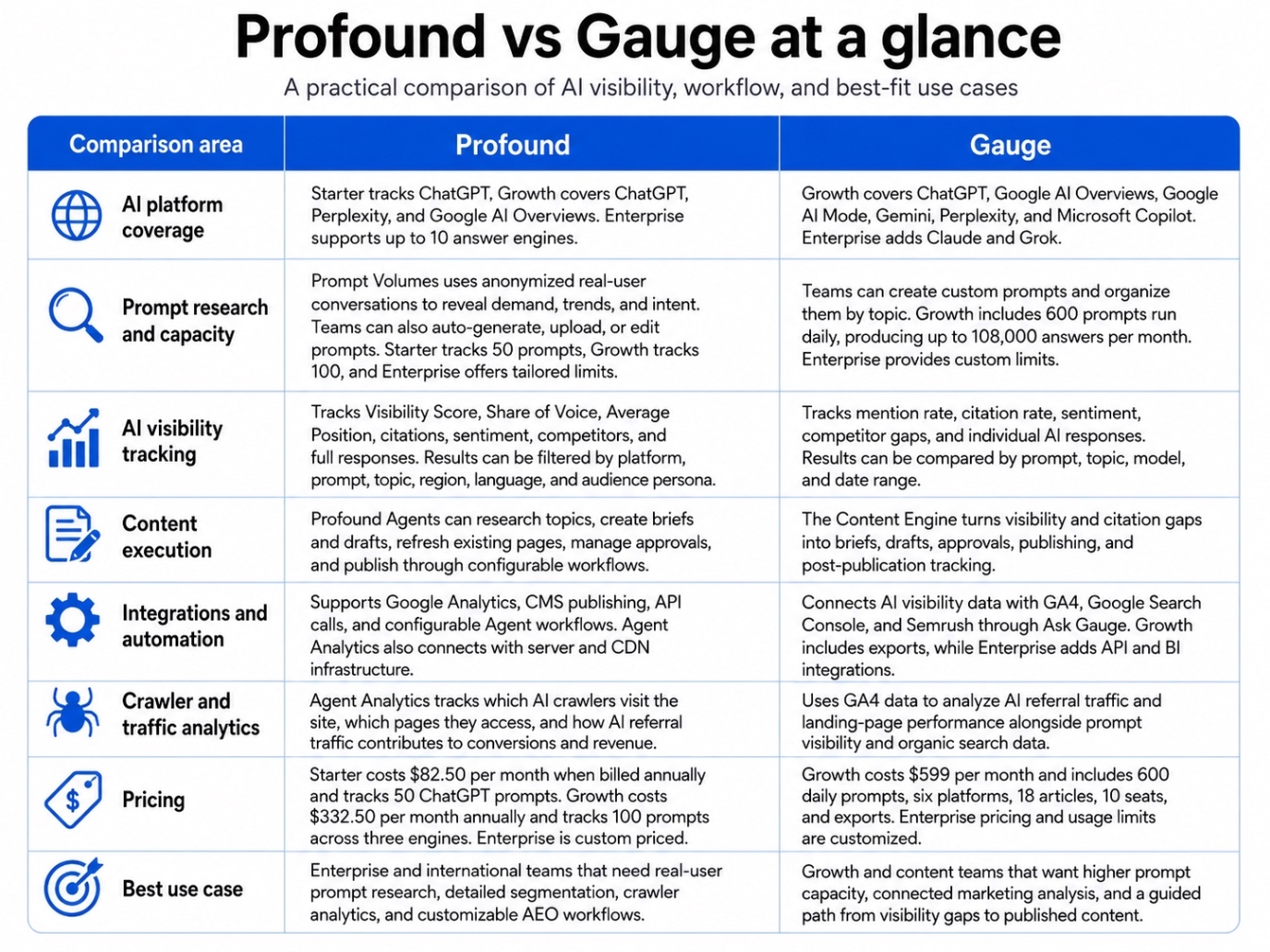
Profound provides more detailed reporting across Visibility Score, Share of Voice, Citation Share, and Average Position. Teams can filter results by platform, prompt, topic, region, tag, and audience persona, while also reviewing full AI responses and citation sources. This makes it better suited to enterprises managing multiple markets or brands.
Gauge focuses on simpler daily monitoring across major AI platforms. It tracks mention rate, citation rate, visibility, sentiment, and competitor gaps, then connects those insights with GA4, Google Search Console, and Semrush through Ask Gauge to suggest next actions.
Verdict: Profound is stronger for deeper segmentation, platform breadth, and enterprise reporting. Gauge is better for accessible daily tracking tied closely to content and marketing action.
Profound vs Gauge: Which tool has better AI platform and geographic coverage?
Profound offers broader coverage overall. Its Starter plan tracks ChatGPT, Growth expands to three answer engines, and Enterprise supports up to 10, including platforms such as Claude, Grok, Gemini, Google AI Overviews, and Google AI Mode. It also supports more than 150 regions and 30 languages.
Gauge’s Growth plan covers ChatGPT, Gemini, Perplexity, Microsoft Copilot, Google AI Overviews, and Google AI Mode. Claude and Grok require Enterprise. Growth includes one custom location, while Enterprise adds unlimited location tracking.
Verdict: Profound is better for teams that need wider platform, regional, and language coverage. Gauge covers the main AI platforms well, but its broader engine and location options sit behind Enterprise.
Want a more practical monitoring workflow? See how to monitor brand presence in ChatGPT and Perplexity beyond occasional manual searches.
Profound vs Gauge: How do Profound and Gauge handle prompt research and tracking?
Profound’s Prompt Volumes and custom prompt workflows
Profound offers the stronger research layer. Prompt Volumes uses anonymized real-user conversations from ChatGPT, Gemini, Claude, and Perplexity to show demand, trends, intent, and actual prompt phrasing.
Teams can pull high-volume queries into tracking, auto-generate prompts from brand and topic settings, or upload and edit prompts manually. Profound supports 50 prompts on Starter, 100 on Growth, and custom limits for Enterprise.
Gauge’s topic-led prompt monitoring
Gauge takes a more direct tracking approach. Teams define custom prompts, group them into topic clusters, and monitor responses daily across supported AI platforms.
Its Growth plan includes 600 prompts run daily, while Enterprise offers a custom prompt allowance. This provides more fixed tracking capacity than Profound’s standard plans.
Which approach is more useful?
Verdict: Profound is better for discovering prompts, validating demand, and prioritizing what to track. Gauge is better when teams already know their target topics and want to monitor a larger number of custom prompts daily.
Prompt results can shift even when your content has not changed, so understand how AI search volatility affects reliable visibility tracking.
Profound vs Gauge: Which platform provides stronger citation and competitor intelligence?
Profound separates brand mentions from citations and tracks Citation Share against competitors by platform, topic, and prompt. It shows every cited URL and classifies sources as owned, competitor, earned media, social, institutional, or custom. Teams can also identify frequently cited publishers and authors for outreach.
Gauge compares mention rates and citation frequency against competitors. It reveals the prompts where competitors appear and your brand does not, along with the pages, domains, and content types earning those citations. These gaps can feed directly into its Content Engine and Ask Gauge recommendations.
Verdict: Profound is stronger for detailed source classification, citation benchmarking, and outreach research. Gauge is better for turning competitor citation gaps into specific content actions.
To understand which sources are shaping AI answers, explore how citation tracking in LLMs works and which signals deserve your attention.
Profound vs Gauge for content creation and optimization
How Profound turns visibility insights into content
Profound Agents use Prompt Volumes and Answer Engine Insights to identify content gaps, create briefs or full drafts, and refresh existing pages. Its no-code builder lets teams customize research, writing, optimization, and publishing steps, with direct WordPress and Webflow integrations.
How Gauge’s Content Engine works
Gauge follows a more guided workflow. It identifies topics where competitors are cited, researches top-cited pages, creates a brief and draft, grades the content, and sends it for approval before publishing to Webflow or Framer. It then tracks whether the article earns citations.
Which offers more control?
Verdict: Profound offers more flexibility for custom workflows and existing-content updates. Gauge provides a simpler path from a visibility gap to a reviewed, published article. Both support human review, while Profound can also automate publishing once the workflow is configured.
See how answer engine optimization combines direct answers, credible sourcing, authority, and crawlability to improve visibility in AI-generated results.
Profound vs Gauge: Which tool is better for AI traffic, crawler analytics, and attribution?
Profound’s Agent Analytics tracks which AI crawlers visit a website, how often they access it, and which pages they crawl. Its Google Analytics integration also connects AI referral traffic with conversions and revenue.
Gauge uses its GA4 integration to track AI referral traffic across owned properties. Ask Gauge combines this data with Google Search Console, Semrush, and prompt responses to analyze how AI visibility relates to traffic and broader search performance.
Verdict: Profound is stronger for AI crawler monitoring and revenue attribution. Gauge is better for analyzing AI referrals alongside SEO and visibility data.
Curious which bots are actually visiting your site? Learn how AI user agents crawl content and when allowing or restricting access makes sense.
Profound vs Gauge for reporting, teams, and agencies
Profound supports custom dashboards that can be shared privately, organization-wide, or through public links. Its Agency Mode keeps each client’s prompts, competitors, regions, and data in separate workspaces, while admins manage permissions, usage, and pitch environments from one dashboard.
Gauge’s Growth plan includes 10 seats and data exports, while Enterprise adds unlimited seats, API access, and BI integrations. Its Agency Mode provides a separate instance for each active client, plus 100-prompt pitch workspaces for prospect audits.
Verdict: Profound offers stronger dashboard sharing and centralized control for complex agency operations. Gauge provides a more clearly packaged agency workflow for pitching prospects and managing active clients.
If client reporting and multi-account workflows are priorities, compare the leading AI visibility tools for marketing agencies.
Profound vs Gauge pricing
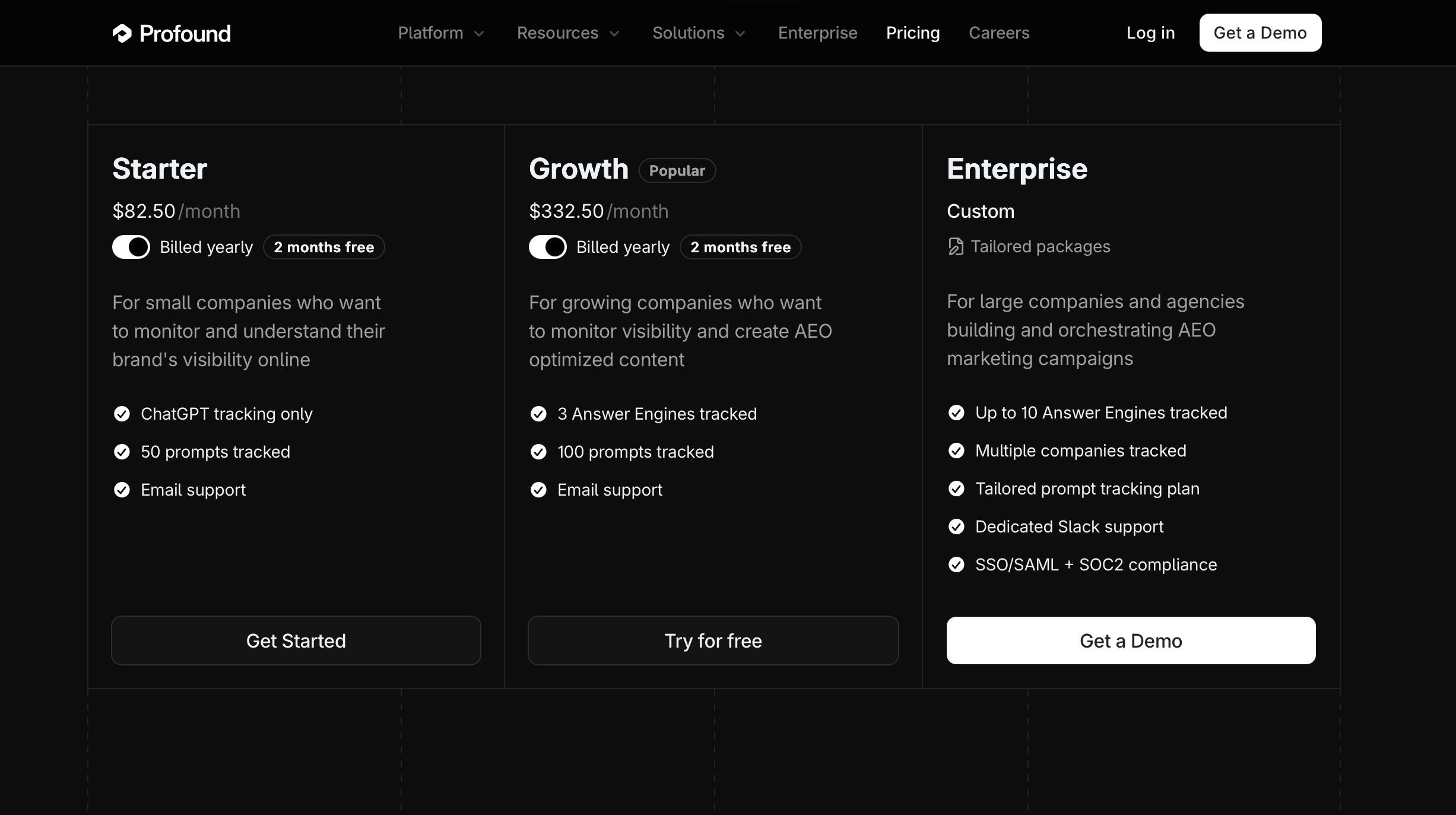
Profound’s Starter plan costs $82.50 per month when billed annually and tracks 50 prompts on ChatGPT. Growth costs $332.50 per month annually and tracks 100 prompts across three answer engines. Enterprise pricing is custom and supports up to 10 engines, multiple companies, and tailored prompt limits.
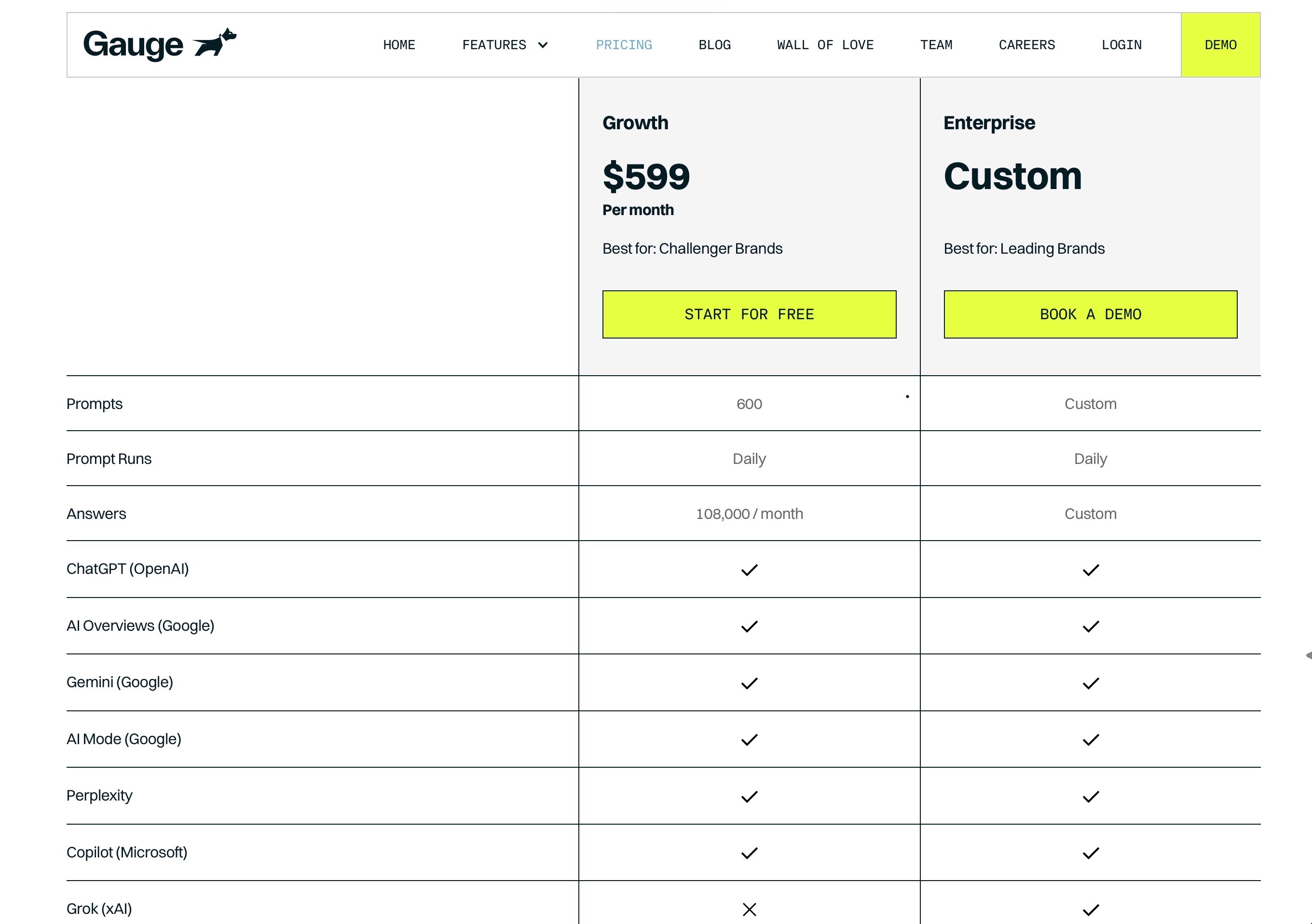
Gauge’s Growth plan costs $599 per month and includes 600 prompts run daily across six platforms, generating up to 108,000 answers per month. Enterprise pricing is custom and adds flexible limits and access to Claude and Grok.
Verdict: Profound pricing offers a lower entry price for smaller tracking needs. Gauge costs more but provides substantially higher prompt capacity on its standard plan. Both require a custom quote for Enterprise.
Which is easier to use, Profound or Gauge?
Profound offers self-serve Starter and Growth plans, with custom or auto-generated prompts for faster setup. Its core visibility dashboards are straightforward, but building automated workflows through Profound Agents requires users to configure nodes, actions, approvals, and publishing steps.
Gauge follows a more guided workflow. Teams organize prompts into topics, review competitor and citation gaps, use Ask Gauge for recommendations, and move selected opportunities into the Content Engine.
Verdict: Gauge is easier for teams that want a structured path from tracking to content action. Profound provides more workflow flexibility, but its configurable Agents require more setup.
When to Choose Profound
Profound is the better fit if your team needs:
- Real-user prompt research and demand prioritization through Prompt Volumes
- Visibility tracking across multiple engines, regions, languages, and audience segments
- Server-level AI crawler monitoring and AI referral attribution
- Configurable Agents for research, content optimization, approvals, and publishing
- Dedicated tracking for product visibility in ChatGPT Shopping
It is especially well suited to enterprise and international teams that need deeper segmentation and customizable workflows.
When to Choose Gauge
Gauge is the better fit if your team needs:
- High-volume daily tracking, with 600 prompts across six platforms on Growth
- Competitor and citation gaps broken down by prompt, topic, model, and date
- AI visibility analyzed alongside GA4, Google Search Console, and Semrush data
- Prioritized recommendations through Ask Gauge
- A guided Content Engine that turns visibility gaps into drafts, approvals, publishing, and impact tracking
It is best suited to growth and content teams that want a structured path from monitoring to execution.
To prove whether visibility gains are producing meaningful results, review the AI search content performance metrics worth tracking.
When is Scalenut a better alternative to both Profound and Gauge?
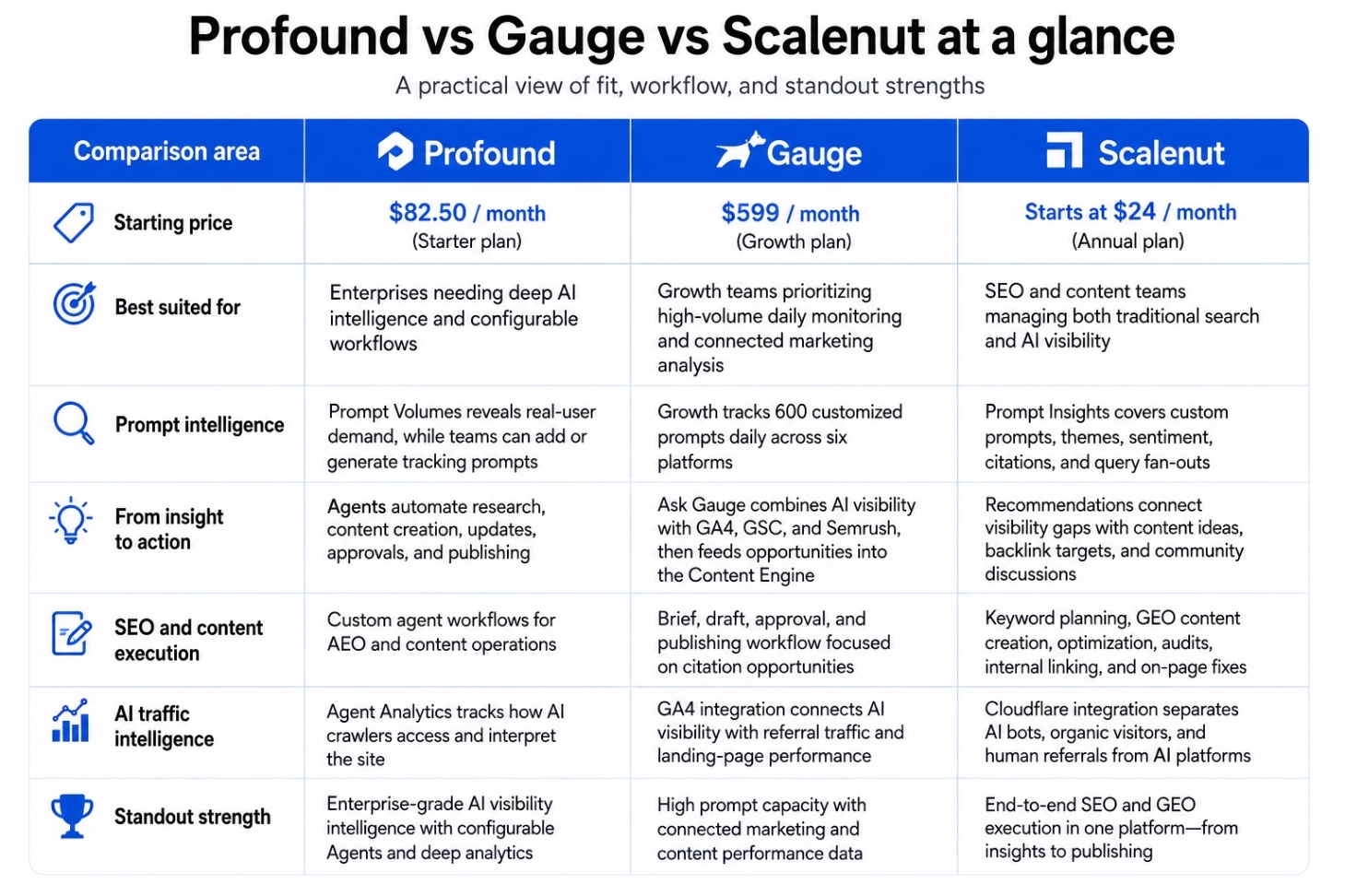
Scalenut becomes the better alternative when AI visibility monitoring is only one part of your team’s workflow. It is designed for SEO and content teams that also need to research topics, create and optimize pages, improve internal links and on-page elements, build authority, and publish content from the same platform.
For a closer look at analytics depth versus connected SEO and GEO execution, explore this Scalenut vs Profound AI comparison.
Scalenut’s standout features include:
- AI visibility intelligence: Tracks prompts, citations, sentiment, competitors, Visibility Score, Share of Voice, Average Position, and query fan-outs.
- Execution-focused recommendations: Converts visibility gaps into content ideas, backlink opportunities, and relevant community discussions.
- SEO and GEO content workflow: Supports keyword clustering, GEO article creation, content audits, existing-page optimization, and internal linking.
- AI traffic monitoring: Uses Cloudflare data to distinguish AI bot activity from human traffic and identify frequently accessed pages.
- Authority and publishing tools: Includes Social UpReach, a Backlinks Marketplace, and direct publishing to WordPress and Shopify.
This makes Scalenut particularly useful when the same team is responsible for improving visibility across both traditional search results and AI-generated answers.
Want a deeper look at the platform? This full Scalenut review examines its AI visibility, research, content, optimization, linking, and publishing workflows.
Ready to turn AI visibility insights into action? Try Scalenut for free and manage your SEO and GEO workflow in one place.
Profound vs Gauge: Final verdict
Profound is the stronger choice for teams that need deeper AI search intelligence. Prompt Volumes, infrastructure-level crawler analytics, broad answer-engine coverage, and configurable Agents make it better suited to enterprise teams with complex research and reporting needs.
Gauge is the more practical choice when the priority is monitoring a larger prompt set and turning findings into action quickly. Its connections with GA4, Google Search Console, and Semrush, combined with Ask Gauge and the Content Engine, create a more guided path from visibility gaps to published content.
Frequently Asked Questions
How are AI search visibility monitoring tools compared: Gauge vs Profound?
Profound is stronger for prompt research, crawler analytics, regional coverage, and configurable enterprise workflows. Gauge is better for high-volume daily prompt tracking, connected GA4, GSC, and Semrush analysis, and a more guided path from visibility gaps to content execution.
Gauge vs Profound: Which AEO platform is right for you?
Choose Profound when your priority is deeper prompt research, crawler analytics, international segmentation, and configurable enterprise workflows. Choose Gauge when marketing teams need higher daily prompt capacity, connected GA4, GSC, and Semrush analysis, plus a guided route from visibility gaps to published content.
How can Gauge AI improve my brand's visibility in AI-driven search results?
Gauge improves brand presence by tracking mentions, citations, sentiment, and competitor gaps across AI platforms. Ask Gauge combines this data with GA4, Google Search Console, and Semrush, helping teams identify which content, sources, and prompts deserve attention within their AI visibility efforts.
What is the main difference between Profound and Gauge?
Profound emphasizes research depth, segmentation, crawler intelligence, and configurable Agents. Gauge emphasizes high-volume daily tracking, connected marketing data, and a guided Content Engine. Both support generative engine optimization, but their workflows suit different levels of customization and operational control.
Is Profound cheaper than Gauge?
Based on the pricing reviewed for this comparison, Profound offers lower-priced entry plans, while Gauge’s public Growth plan costs $599 per month. Gauge includes substantially more daily prompts, so value depends on whether your priority is affordability or monitoring scale.
Profound vs Gauge: Which tool offers better prompt tracking?
Profound is stronger for discovering and prioritizing real-user queries through Prompt Volumes, then moving selected queries into tracking. Gauge offers more fixed daily monitoring capacity, with 600 prompts on Growth, making it better for teams already managing a large, defined prompt set.
Does Profound create AI-optimized content?
Yes. Profound Agents can research topics, build briefs, create drafts, refresh existing pages, manage approvals, and publish through configurable workflows. This is useful when content production must respond directly to prompt demand, citation gaps, and specific metrics from Answer Engine Insights.
Does Gauge integrate with GA4 and Google Search Console?
Yes. Ask Gauge combines its prompt and citation data with GA4, Google Search Console, and Semrush. This helps teams connect AI visibility with referral traffic, landing-page performance, organic search data, and content opportunities rather than reviewing each source in a separate dashboard.
Is Profound or Gauge better for agencies?
Both support agencies, but the better fit depends on workflow. Profound suits agencies needing separated client workspaces, shareable dashboards, and deeper segmentation. Gauge is useful for prospect audits, active-client instances, higher prompt capacity, and guided recommendations that support reporting and business growth.
Is Scalenut a good alternative to Profound and Gauge?
Yes. Scalenut is a strong alternative when the same team manages AI visibility, SEO research, content creation, optimization, audits, internal linking, and publishing. It is particularly useful for teams that want monitoring and execution connected without relying on several separate tools.
Is Gauge AI SEO suitable for both organic and paid search strategies?
Yes. Gauge combines AI visibility, GA4, Google Search Console, and Semrush data for organic analysis, while its Google Ads and ChatGPT Ads integrations bring paid performance into the same workspace. This helps teams compare channel gaps, overlap, and opportunities more clearly.


.svg)


.webp)