You need more than a dashboard that tells you where your brand appears in AI search. You need enough prompts to trust the data, access to the platforms your buyers use, and a clear way to turn visibility gaps into better content. Gauge can handle that full workflow, but its six-platform Growth plan costs $599 per month, which may be difficult to justify if your priority is simpler monitoring, deeper SEO execution, stronger crawler intelligence, or enterprise reporting.
That does not make Gauge a poor tool. It means the best alternative depends on which part of the workflow matters most to your team. The seven alternatives below show where you can get a better fit for your budget, tracking needs, content workflow, or technical requirements.
Quick summary: Which Gauge alternative should you choose?
- Best for integrated SEO and GEO execution: Scalenut. Choose it to connect AI visibility tracking with keyword planning, content creation, optimization, auditing, internal linking, and publishing.
- Best for enterprise AI visibility intelligence: Profound. Choose it for advanced analytics, AI crawler monitoring, customizable reporting, governance controls, and multi-brand or multi-team management.
- Best for focused daily monitoring: Peec AI. Choose it for straightforward prompt, citation, sentiment, and competitor tracking without paying for a broader content-production suite.
- Best for technical AI readiness: Scrunch AI. Choose it to monitor AI crawler activity, audit how agents access your website, and improve machine-readable content delivery.
- Best for broad platform coverage: AthenaHQ. Choose it to monitor visibility across several major AI platforms and turn citation and competitor gaps into recommended GEO actions.
- Best for AI visibility and content production: Writesonic. Choose it to combine daily visibility tracking with SEO audits, content optimization, article creation, and prioritized on-page and off-page actions.
- Best for combined SEO and AI visibility research: Semrush AI Visibility Toolkit. Choose it to analyze AI mentions and citations alongside Semrush’s keyword, backlink, competitor, and technical SEO data.
Why might you need a WithGauge.com alternative?
Gauge covers daily AI visibility monitoring, competitor analysis, marketing-data analysis, and content creation. However, another platform may fit your workflow better for the following reasons:
- A more flexible pricing structure: Gauge has a significant jump between its Starter and Growth plans. Smaller teams may prefer a platform with more gradual pricing tiers or usage-based upgrades.
- Broader platform coverage at a lower price: Gauge’s Starter plan has limited model coverage, while access to ChatGPT, Gemini, Perplexity, Copilot, AI Mode, and other platforms requires Growth or Enterprise.
- Deeper traditional SEO capabilities: Gauge connects with GSC, GA4, and Semrush, but teams that need built-in keyword clustering, SERP research, technical SEO audits, internal linking, or content inventory management may need a broader SEO platform.
- Server-level AI crawler analytics: Gauge tracks prompt responses, citations, and AI referral traffic, but technical teams may prefer a tool that analyzes server or CDN logs to show how individual AI crawlers access their website.
- A simpler monitoring-only workflow: Gauge includes an AI marketing agent, recommendations, audits, and content production. Teams that only need prompt, citation, and competitor tracking may prefer a lighter and less expensive specialist tool.
- Broader content and CMS workflows: Gauge can create, grade, approve, publish, and monitor articles, but teams may need more CMS integrations, customizable approval stages, content refresh automation, or traditional optimization tools.
- Different reporting and data-access options: Gauge includes exports on paid plans, while API and BI integrations require Enterprise. Teams may prefer alternatives that provide API access, Looker Studio, white-labeled reports, or scheduled exports on lower plans.
The best reason to switch is not finding a platform with more features. It is finding one that handles your most important workflow at the right depth and price.
How we evaluated these Gauge alternatives
- Criteria: We compared pricing, tracking capacity, included AI platforms, reporting, integrations, and content execution.
- Research: We used official pricing pages and public product documentation.
- Freshness: We reviewed available pricing and feature information in September, 2026.
- Disclosure: Scalenut is our tool and is included in the comparison. We outline each tool’s strengths, limitations, and suitability for different teams.
What are the 7 best Gauge alternatives in 2026?
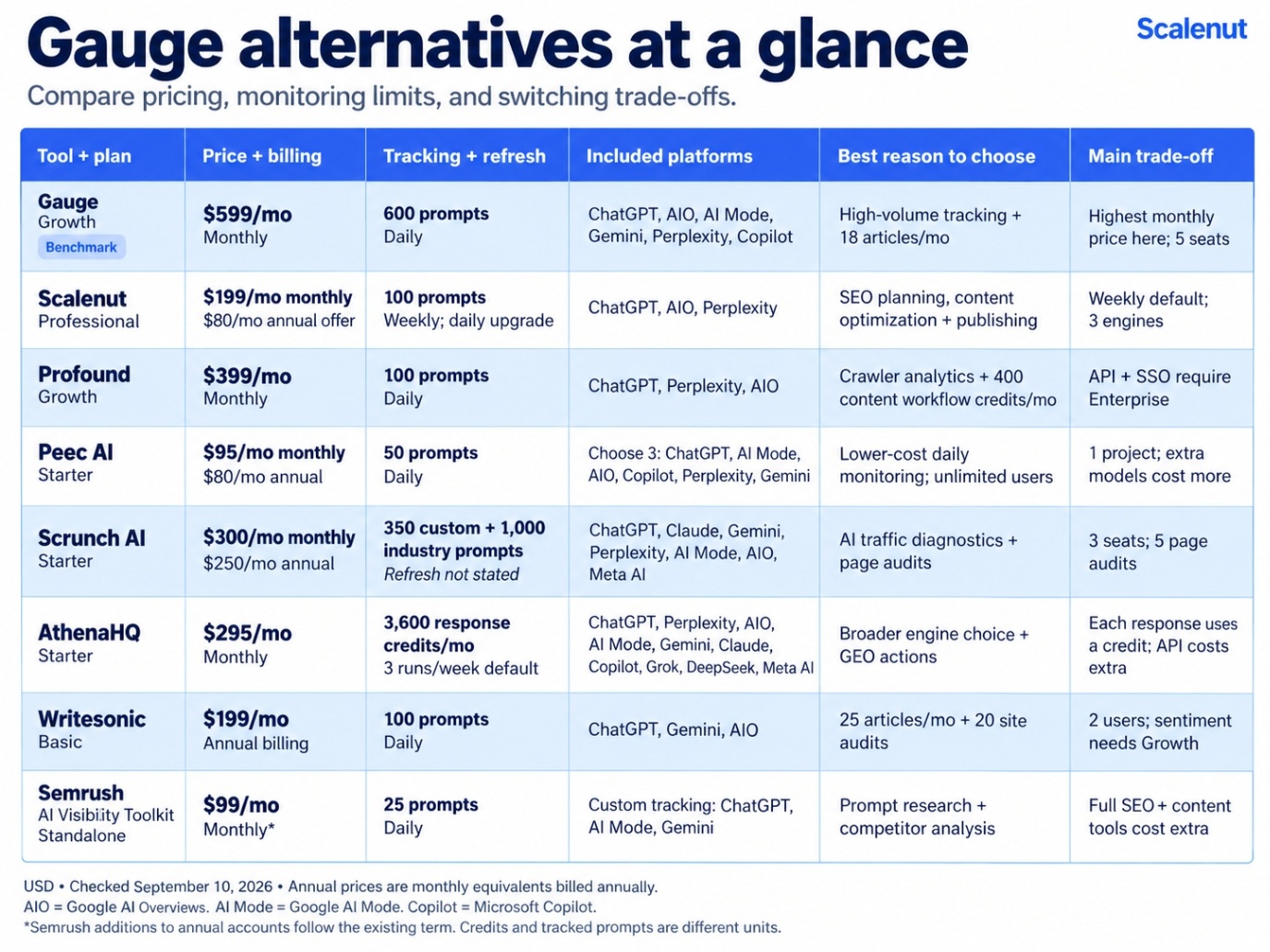
The best Gauge alternatives are Scalenut, Profound, Peec AI, Scrunch AI, AthenaHQ, Writesonic, and the Semrush AI Visibility Toolkit. Scalenut and Writesonic offer broader content execution, Profound and Scrunch suit enterprise or technical teams, while Peec AI, AthenaHQ, and Semrush focus on different levels of monitoring, platform coverage, and SEO research.
Let’s look at each tool in detail.
1. Scalenut
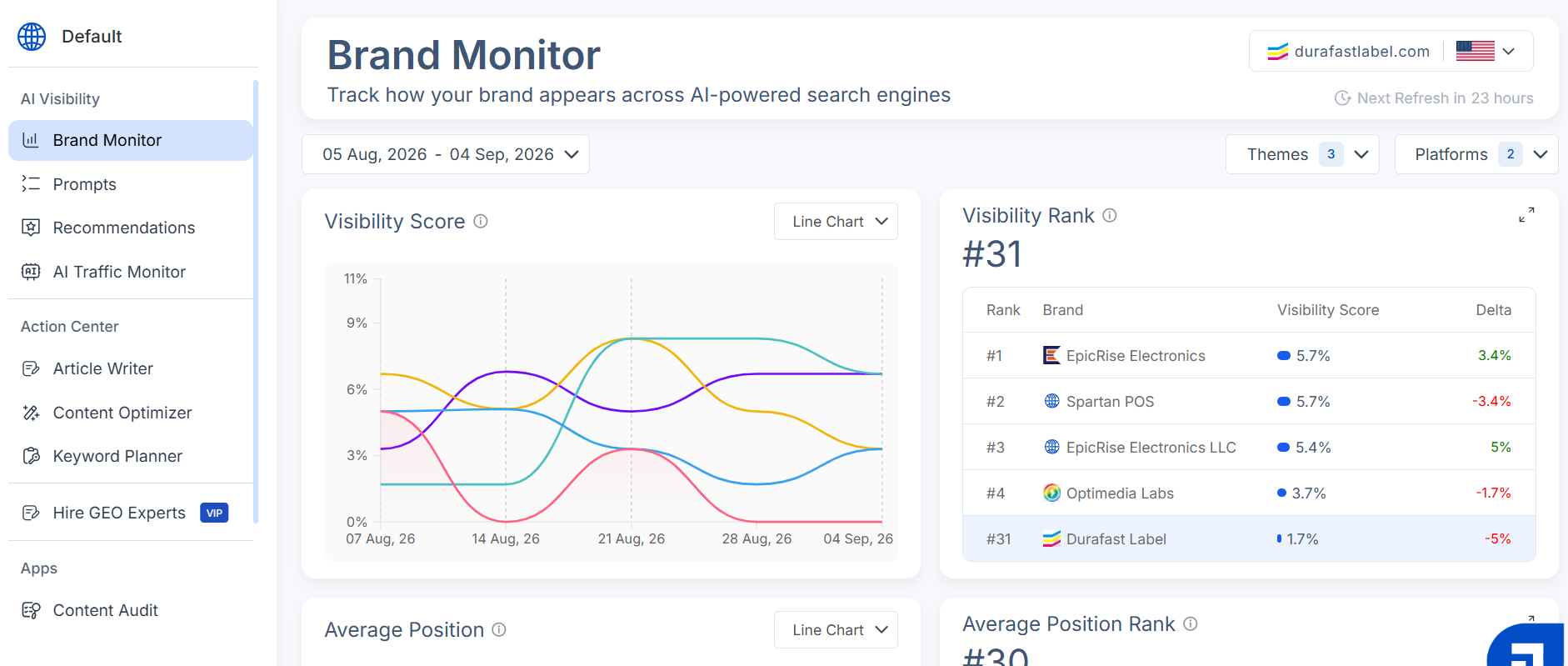
Best for: SEO and content creator teams that want AI visibility tracking connected to planning, optimization, and publishing.
Scalenut combines AI visibility monitoring with SEO and GEO execution. It tracks brand performance, identifies prompt and citation gaps, and turns them into content and authority actions.
Key features
- Brand Monitor: Measures Visibility Score, Share of Voice, Average Position, competitor performance, and visibility by platform and theme.
- Prompt Insights: Tracks mentions, citations, sentiment, query fan-outs, and prompts where competitors appear instead.
- Recommendations: Surfaces content gaps, backlink sources, and relevant community discussions.
- AI Traffic Monitor: Uses Cloudflare data to separate human, AI-referred, and crawler traffic and identify frequently accessed pages.
- Content execution: Creates GEO articles, optimizes existing pages, and supports keyword clustering and content audits.
- Publishing and authority tools: Includes internal linking, WordPress and Shopify publishing, Social UpReach, and a Backlinks Marketplace.
Pricing
- Starter: $59 monthly or $24 per month annually for 10 weekly tracked prompts across ChatGPT and Google AI Overviews.
- Plus: $89 monthly or $36 per month annually for 25 prompts, two workspaces, content audits, internal linking, and publishing.
- Professional: $199 monthly or $80 per month annually for 100 prompts across ChatGPT, Google AIO, and Perplexity, plus unlimited workspaces and users.
- VIP Service: Custom pricing. A seven-day free trial is available.
Main pros
- Connects visibility data with SEO and GEO execution
- Lower entry price than most specialist monitoring platforms
- Includes research, creation, optimization, auditing, and publishing
- Tracks AI crawler and referral activity
Main cons
- Public plans refresh AI visibility weekly rather than daily.
- Perplexity requires Professional.
- AI Visibility does not support CSV or PDF exports.
- Full search traffic monitoring requires Cloudflare.
- The broader toolset may be unnecessary for monitoring-only teams.
Gauge vs. Scalenut: How do they compare?
Scalenut provides broader SEO and GEO execution at a lower price. Gauge offers greater tracking capacity, with 600 daily prompts across six platforms versus Scalenut Professional’s 100 weekly prompts across three.
Verdict: Choose Scalenut for integrated SEO, GEO, and content execution. Choose Gauge for higher-volume daily monitoring across more AI platforms.
Want the full breakdown? Read our Scalenut review to see how its GEO tracking, AI visibility metrics, and SEO execution workflow work in real workflows.
2. Profound
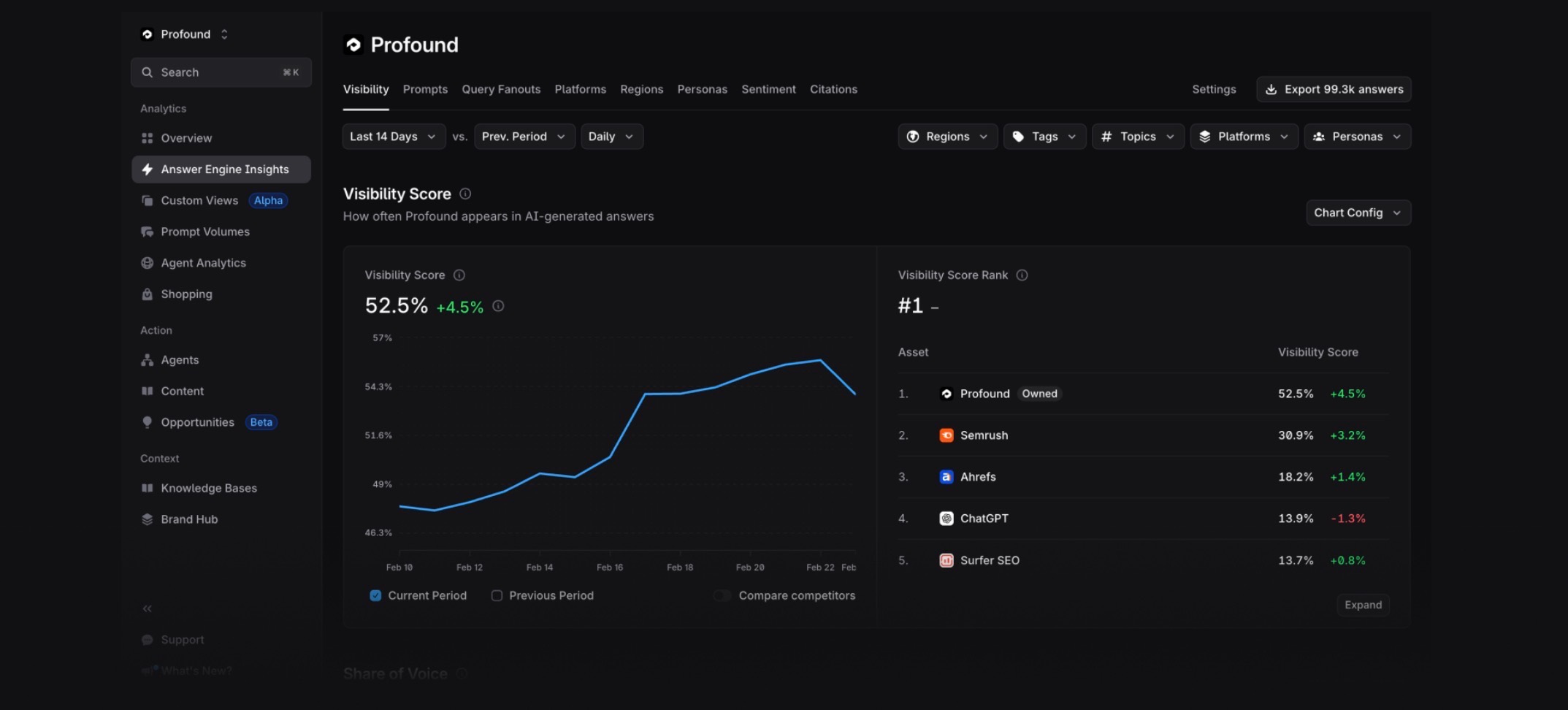
Best for: Enterprise teams that need advanced AI visibility analytics, crawler intelligence, governance, and reporting across multiple answer engines.
Profound is an AEO platform for monitoring and improving how brands appear in AI-generated answers. It combines prompt tracking, citation and competitor analysis, AI crawler monitoring, customizable reporting, and content workflows.
Key features
- Answer Engine Insights: Tracks visibility, share of voice, sentiment, citations, competitor rankings, and performance across topics, regions, and platforms.
- Daily prompt tracking: Runs custom and suggested prompts daily and provides the responses shown through consumer-facing AI platforms.
- Citation and competitor analysis: Identifies the sources influencing AI answers and compares brand performance against competitors.
- Agent Analytics: Uses server and CDN logs to track verified AI crawlers, AI-referred traffic, frequently accessed pages, and crawl issues.
- Profound Agents: Supports workflows for creating, refreshing, and optimizing content based on identified visibility gaps.
- Enterprise reporting: Provides filters, CSV exports, integrations, APIs, and customizable reports.
- Governance controls: Supports SOC 2 Type II compliance, SSO, role-based access, encrypted data handling, and multiple-company tracking on Enterprise plans.
Pricing
- Starter: $99 per month for 50 prompts tracked across ChatGPT, plus 100 Agents credits per month.
- Growth: $399 per month for 100 prompts across ChatGPT, Perplexity, and Google AI Overviews, plus 400 Agents credits per month for content generation, optimization, and other agent workflows.
- Enterprise: Custom pricing with tailored prompt limits, multiple-company tracking, custom Agents credits, and access to up to 9 answer engines.
Main pros
- Detailed visibility, citation, sentiment, and competitor reporting
- Daily prompt tracking across supported platforms
- Server-level AI crawler and referral analysis
- Custom reports, exports, APIs, and integrations
- Strong security and access controls for enterprise teams
Main cons
- Starter only tracks ChatGPT.
- Broader platform coverage and higher prompt limits require more expensive plans.
- Advanced governance and multiple-company tracking require Enterprise.
- Agent Analytics requires a compatible server, CDN, or hosting integration.
- Its reporting and configuration may be excessive for smaller teams.
- Traditional SEO research, auditing, and internal linking are less comprehensive than in broader SEO and GEO platforms.
Gauge vs. Profound: How do they compare?
Profound is stronger for enterprise analytics, crawler monitoring, reporting, and governance. Gauge offers higher self-serve prompt capacity and connects AI visibility data with marketing analytics and content creation.
Verdict: Choose Profound for enterprise control and Gauge for high-volume tracking with content execution.
Still deciding between deeper analytics and guided execution? Compare Profound vs. Gauge to see which platform better fits your AI visibility workflow.
3. Peec AI
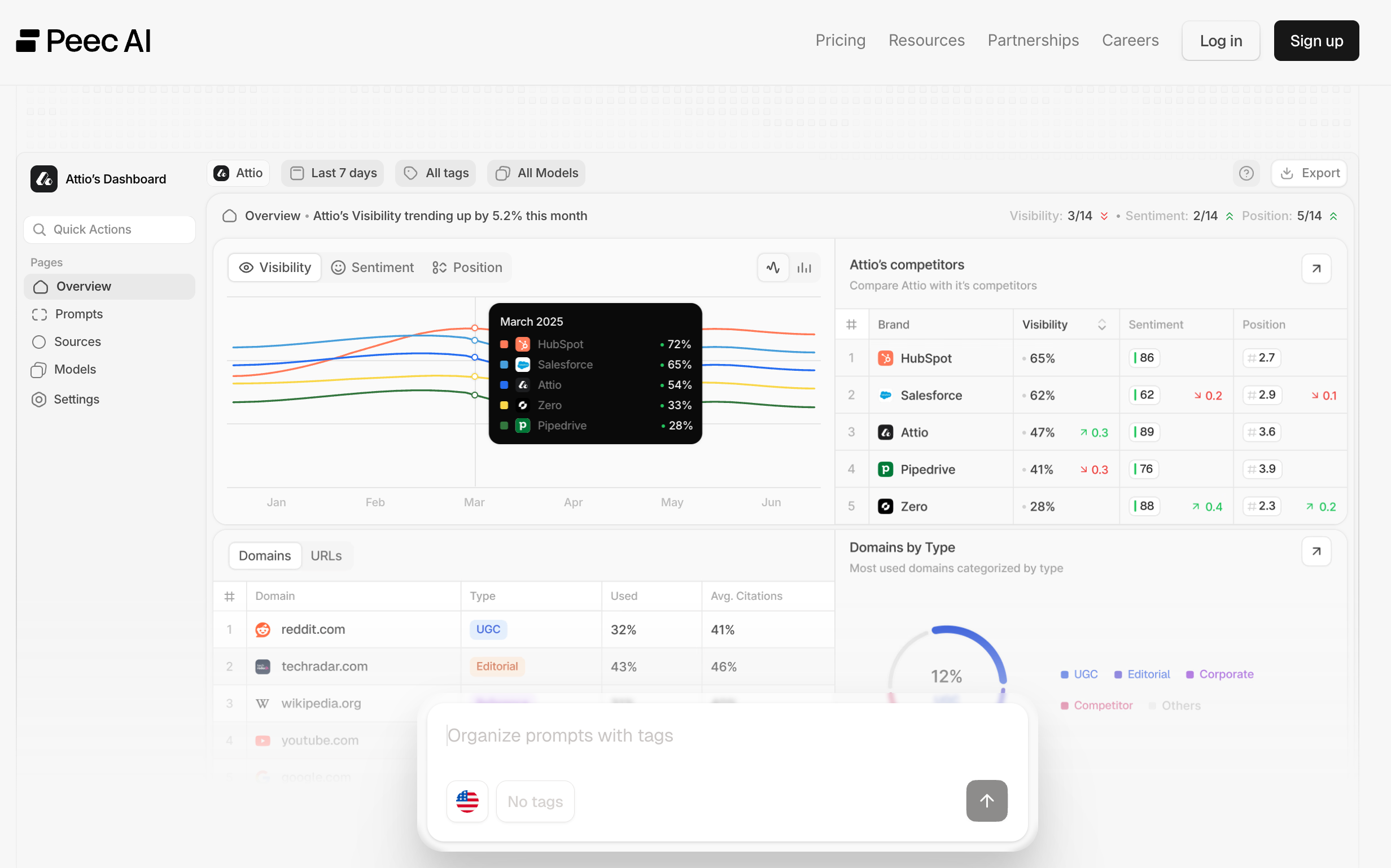
Best for: Marketing and SEO teams that want focused daily AI visibility tracking without a broader content and SEO suite.
Peec AI monitors how brands appear across AI search platforms. It focuses on prompt tracking, competitor benchmarking, sentiment, citations, and source analysis through a relatively streamlined reporting interface.
Key features
- Daily prompt tracking: Runs tracked prompts daily through consumer-facing AI interfaces rather than relying only on APIs.
- Brand metrics: Measures visibility, average position, sentiment, and share of voice across models, topics, and competitors.
- Source and citation analysis: Shows which domains and URLs AI platforms retrieve or explicitly cite, along with the prompts that trigger them.
- Competitor tracking: Compares brand visibility, position, sentiment, and share of voice against selected competitors.
- Actions: Turns visibility and citation gaps into prioritized recommendations for improving brand performance.
- Regional tracking: Supports tracking across countries and languages, with the number of countries varying by plan.
- Reporting and integrations: Includes exports, with Looker Studio available on Advanced and API access, MCP, SSO, and custom integrations available on Enterprise.
Pricing
- Starter: $95 per month for 50 prompts, three models, unlimited users, one project, and one country.
- Pro: $245 per month for 150 prompts, three models, unlimited users, two projects, and up to three countries per project.
- Advanced: $495 per month for 350 prompts, three models, five projects, multi-country tracking, and Looker Studio.
- Enterprise: Custom pricing with all available models, customizable prompt tracking, unlimited projects, API access, SSO, and dedicated support.
Annual billing receives a 15% discount.
Main pros
- Daily tracking on every self-serve plan
- Three selectable AI platforms included from Starter
- Clear visibility, position, sentiment, and competitor metrics
- Detailed domain- and URL-level source analysis
- Unlimited users across public plans
- Simple interface for teams focused primarily on monitoring
Main cons
- Self-serve plans include only three models; broader coverage requires paid model add-ons.
- API access, SSO, unlimited projects, and all-model access require Enterprise.
- Starter is restricted to one project and one country.
- Looker Studio is limited to Advanced and Enterprise.
- Peec provides recommended actions but does not offer Gauge’s native brief-to-article and publishing workflow.
- Teams still need separate tools for keyword research, technical SEO, content auditing, and article optimization.
Gauge vs. Peec AI: How do they compare?
Peec AI provides a simpler and less expensive monitoring workflow, with daily tracking, selectable models, unlimited users, and detailed source analysis. Gauge offers greater prompt capacity and connects visibility data with GA4, GSC, Semrush, Ask Gauge, and a built-in content engine.
Verdict: Choose Peec AI for focused, accessible AI visibility monitoring and Gauge for high-volume tracking connected to marketing analytics and content execution.
Considering Peec AI for agency reporting? Read our full Peec AI review for a closer look at its daily tracking, dashboards, client reporting capabilities, and pricing.
4. Scrunch AI
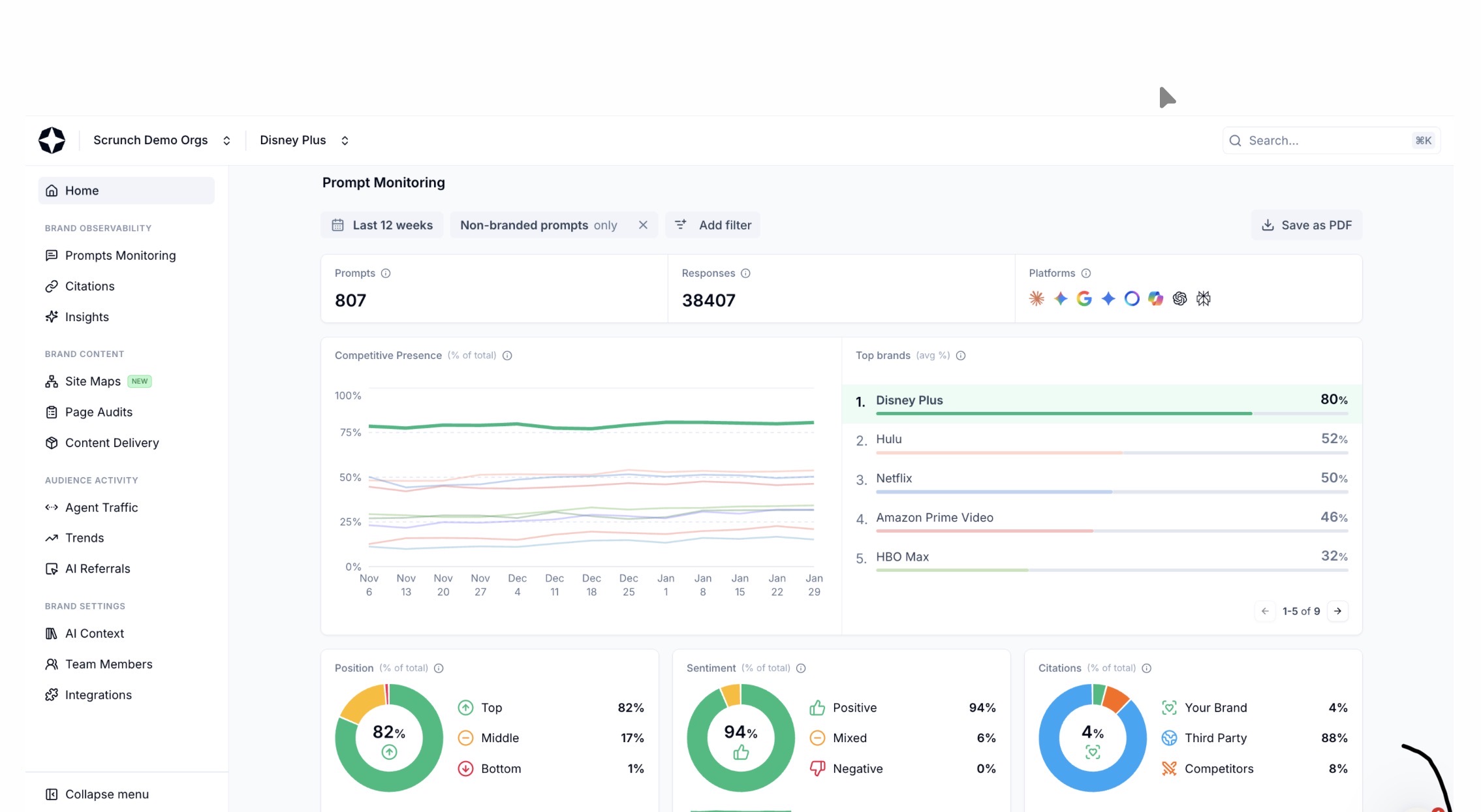
Best for: Technical and enterprise teams that need AI visibility tracking, site audits, and crawler analysis.
Scrunch AI monitors brand presence in AI answers and evaluates how easily AI agents can access a website. It combines prompt monitoring, citation intelligence, site auditing, bot traffic analysis, and page recommendations.
Key features
- AI visibility monitoring: Tracks brand presence, answer share, sentiment, citations, competitors, and full responses.
- Prompt analysis: Provides daily snapshots with filters for model, topic, persona, geography, language, and funnel stage.
- Citation intelligence: Identifies cited domains and URLs, citation trends, ownership, content types, and source influence.
- AI site audits: Checks access, content delivery, and page-quality issues that may affect AI visibility.
- Agent Traffic: Separates AI bot activity by model, page, and request type, including training, indexing, and retrieval.
- Agent Experience Platform: Enterprise customers can serve simplified, AI-optimized pages to detected agents through supported edge platforms.
Pricing
- Core: $250 per month for 125 prompts, four platforms, five monthly site audits, one workspace, five users, and one page optimization per month.
- Enterprise: Custom pricing with nine platforms, custom prompts and workspaces, full site audits, APIs, SSO, dedicated support, and optional AXP access.
Scrunch offers a seven-day Core trial.
Main pros
- Combines visibility monitoring with technical AI-readiness audits
- Detailed citation, competitor, and sentiment analysis
- Page-level AI bot traffic data
- Four platforms on the self-serve plan
- Five user licenses included
Main cons
- Core is limited to one brand, one country, and 125 prompts.
- APIs, Looker Studio, SAML or OIDC SSO, and AXP require Enterprise.
- Core audits cover 25 pages and allow one page optimization monthly.
- Agent Traffic and AXP require compatible technical integrations.
- It lacks Gauge’s full brief-to-article and CMS publishing workflow.
Gauge vs. Scrunch AI: How do they compare?
Scrunch goes deeper into AI crawler activity, site readiness, and agent-focused content delivery. Gauge offers higher self-serve prompt capacity and connects visibility findings with marketing data, article creation, and publishing.
Verdict: Choose Scrunch for technical AI readiness and crawler intelligence. Choose Gauge for high-volume tracking connected to content execution.
Considering Scrunch AI for stronger control over how AI systems interpret your brand? Read our full Scrunch AI review for a closer look at its Agent Experience Platform, hallucination monitoring, and visibility features.
5. AthenaHQ
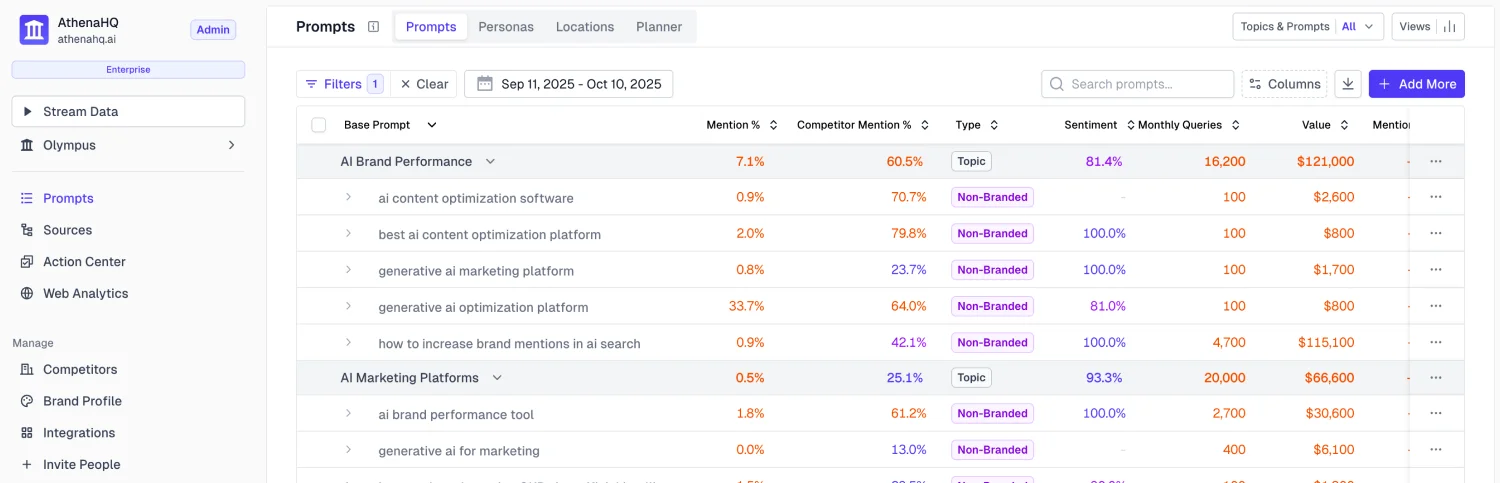
Best for: Marketing teams that want broad AI platform coverage with visibility monitoring and GEO recommendations.
AthenaHQ tracks how brands appear across AI search platforms and connects visibility gaps with on-page, off-page, citation, and content actions. It also supports AI crawler analysis and traditional marketing-data integrations.
Key features
- AI visibility monitoring: Tracks mentions, citations, share of voice, sentiment, competitors, prompt variations, and conversation context.
- Platform coverage: Supports ChatGPT, Perplexity, Gemini, Claude, Google AI Overviews, AI Mode, Microsoft Copilot, and Grok.
- Citation intelligence: Identifies influential domains and pages and highlights authority gaps.
- AthenaHQ Content: Recommends on-page and off-page actions based on the prompts and sources affecting visibility.
- AI crawler tools: Detects inaccessible or hidden website sections and supports robots.txt and llms.txt management.
- Integrations: Connects with GA4, Google Search Console, Shopify, and Webflow. Enterprise adds API and BI-tool support.
- Enterprise agents: Includes deeper content optimization workflows and the Athena Citation Engine on custom plans.
Pricing
- Self-Serve: $295 per month for 3,600 monthly credits, with one AI response consuming one credit. Includes up to eight platforms, unlimited topics, one country, unlimited seats, and basic content optimization.
- Enterprise: Custom pricing with custom credits, multiple countries, advanced content agents, AI traffic analysis, API access, SSO, audit logs, and dedicated support.
AthenaHQ currently advertises the first month of Self-Serve at $95.
Main pros
- Eight major AI platforms on Self-Serve
- Unlimited users and competitor tracking
- Citation, sentiment, and prompt-level analysis
- GA4 and GSC integrations
- Built-in on-page and off-page recommendations
Main cons
- Credit usage increases with every platform and response tracked.
- Self-Serve is limited to one country.
- Advanced content agents, traffic analysis, APIs, and BI dashboards require Enterprise.
- It lacks the broader keyword research and content-auditing workflow of full SEO suites.
Gauge vs. AthenaHQ: How do they compare?
AthenaHQ provides broader self-serve model engine coverage and more citation- and crawler-focused GEO recommendations. Gauge offers substantially higher tracking volume and a more direct article creation and publishing workflow.
Verdict: Choose AthenaHQ for broad platform monitoring and GEO recommendations. Choose Gauge for high-volume tracking connected to content production.
6. Writesonic
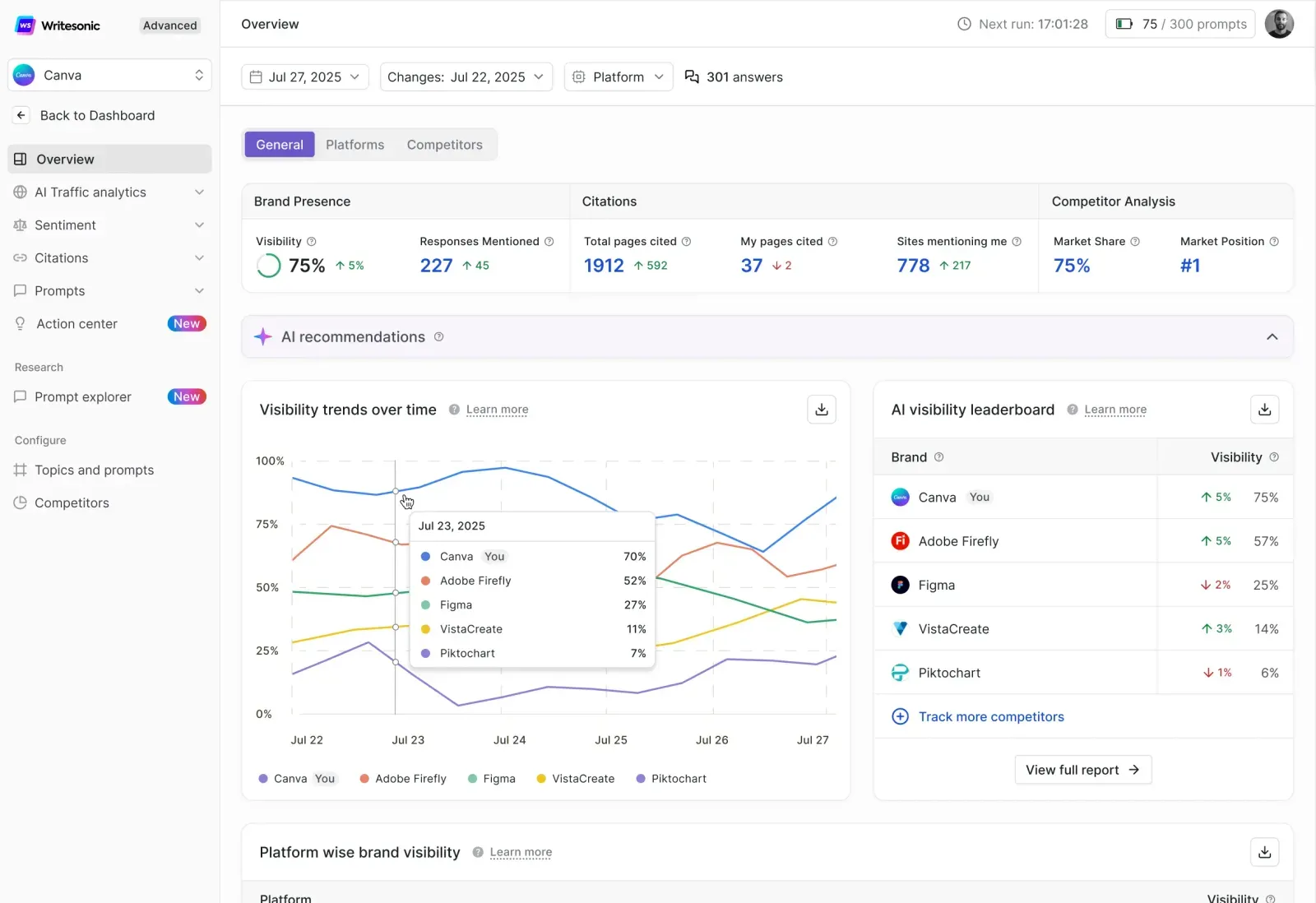
Best for: Marketing teams that want AI visibility monitoring connected to content creation, SEO audits, and prioritized GEO actions.
Writesonic combines daily AI search tracking with article generation, site auditing, content optimization, and agentic workflows. Public plans cover ChatGPT, Gemini, and Google AI Overviews, while wider platform access requires Enterprise.
Key features
- AI Visibility Tracker: Monitors mentions, citations, sentiment, share of voice, competitors, full responses, and prompt-level performance.
- Daily tracking: Runs prompts through supported consumer-facing AI platforms with market, language, and intent filters.
- Action Center: Prioritizes content, citation, and technical fixes by impact, confidence, and effort.
- Content execution: Includes AI article generation, existing-content optimization, and site audits.
- Competitive analysis: Shows where competitors lead across prompts, platforms, citations, and topics.
- Enterprise integrations: Supports Looker Studio, APIs, SSO, custom regions and languages, and an AI search strategist.
Pricing
- Starter: $79 per month annually for 50 ChatGPT prompts, 15 AI articles, and 10 site audits.
- Basic: $199 per month annually for 100 prompts and 300 daily answers across three platforms.
- Growth: $399 per month annually for 200 prompts, 600 daily answers, sentiment analysis, 50 articles, 50 site audits, and limited Action Center access.
- Enterprise: Custom enterprise pricing with all 10 platforms, full Action Center access, integrations, and governance controls.
Main pros
- Daily prompt and answer tracking
- Built-in article creation and site auditing
- Detailed citation, sentiment, and competitor data
- Content, off-page, and technical recommendations
- Up to 10 platforms on Enterprise
Main cons
- Starter only monitors ChatGPT.
- Basic and Growth cover three platforms.
- Full Action Center access requires Enterprise.
- Growth supports three users and two projects.
- APIs, wider regions, and governance controls require Enterprise.
Gauge vs. Writesonic: How do they compare?
Writesonic provides stronger SEO auditing, content optimization, and article capacity. Gauge offers 600 prompts across six platforms on Growth, compared with Writesonic Growth’s 200 prompts across three platforms, and connects tracking with GA4, GSC, Semrush, and Ask Gauge.
Verdict: Choose Writesonic for AI search visibility tied to SEO auditing and content production. Choose Gauge for higher prompt capacity and integrated marketing-data analysis.
Still deciding between Writesonic and Scalenut? Compare Scalenut vs. Writesonic to see which platform better fits your AI visibility, content creation, and SEO workflow.
7. Semrush AI Visibility Toolkit
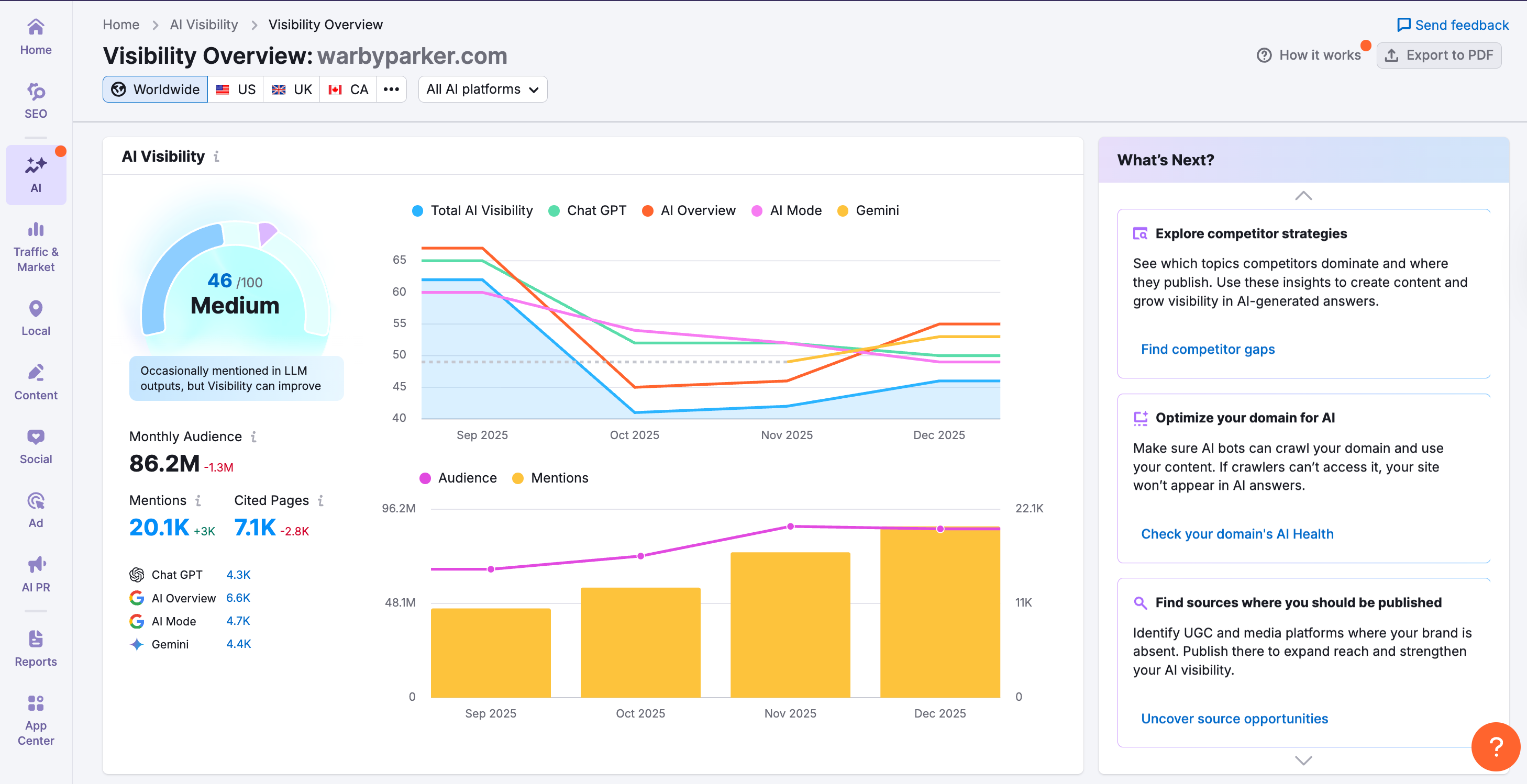
Best for: SEO teams that want AI visibility research alongside Semrush’s established keyword, competitor, backlink, and site-auditing tools.
Semrush’s AI Visibility Toolkit tracks how brands and competitors appear in AI-generated answers. It combines broad-market visibility research, custom prompt monitoring, brand-perception analysis, competitor gaps, and AI-readiness checks.
Key features
- Visibility Overview: Measures AI Visibility Score, mentions, citations, cited pages, estimated audience, and performance by platform and country.
- Competitor Research: Compares up to four competitors and identifies missing prompts, topics, and cited sources.
- Prompt Research: Uses Semrush’s AI query database to surface relevant prompts, intent, topics, and estimated demand.
- Brand Performance: Tracks share of voice, sentiment, narrative themes, cited domains, and questions associated with a brand.
- Prompt Tracking: Monitors 25 custom prompts daily across supported AI search experiences.
- AI Search Site Audit: Checks up to 100 pages for technical issues that could restrict AI crawler access.
- Reporting: Supports CSV and PDF exports, scheduled reports, and shareable dashboards.
Pricing
- AI Visibility Toolkit: $99 per month for one user, one Brand Performance domain, 25 tracked prompts, 300 daily AI Analysis queries, 1,000 daily Prompt Research queries, and 10 CSV exports per day.
- Extra domains or locations cost $99 monthly each.
- An additional 50 tracked prompts costs $60 monthly.
- Each additional user requires another $99 license.
The standalone toolkit does not include a free tier.
Main pros
- Strong competitor, prompt, and citation research
- Daily prompt and market-data updates
- Global and location-specific brand analysis
- AI-readiness checks within Site Audit
- Connects with Semrush’s wider SEO and reporting ecosystem
Main cons
- Only 25 custom prompts are included.
- One domain and one user are included at the base price.
- Additional prompts, domains, and users increase the total cost.
- Brand Performance data refreshes weekly.
- Content creation and optimization require other Semrush products or manual execution.
Gauge vs. Semrush: How do they compare?
Semrush provides deeper SEO research and competitive data at a lower entry price. Gauge offers substantially higher prompt capacity and connects visibility findings directly with marketing data and article production.
Verdict: Choose Semrush for combined SEO and AI visibility research. Choose Gauge for large-scale tracking connected to content execution, especially for large organizations.
Is Semrush’s $99 AI Visibility Toolkit worth adding to your SEO stack? Read our full Semrush AI Toolkit review for a closer look at its features, limits, and overall value.
How should you choose the right WithGauge.com alternative?
Gauge combines daily AI visibility monitoring, marketing-data analysis, and content execution. The right alternative depends on which parts of that workflow you need to retain or improve.
1. Decide whether you need monitoring or execution
Some platforms stop at prompts, mentions, citations, and competitor reports. Others also help create, optimize, approve, and publish content. Choose based on whether your team needs visibility data alone or a complete path from insight to action.
2. Compare the platforms included in each plan
Check which AI platforms are available at the price you can realistically pay. Gauge Growth covers six platforms, while its Enterprise plan adds broader model access. Alternatives may offer more platforms overall but restrict them to higher plans.
3. Calculate the real tracking capacity
Do not compare prompt limits alone. Multiply the number of prompts by the supported platforms and tracking frequency to estimate how many answers the plan collects. Also check limits for countries, projects, topics, and competitors.
4. Inspect the evidence behind visibility scores
Confirm that you can view the individual responses behind each score. Useful evidence includes exact brand mentions, cited URLs, competitor appearances, sentiment, platform differences, and historical changes.
5. Evaluate how insights become actions
Gauge uses Ask Gauge and its Content Engine to turn prompt and citation gaps into recommendations, briefs, drafts, approvals, publishing, and post-publish tracking. Check whether an alternative supports this workflow or leaves execution to separate tools.
6. Review data, workflow, and CMS integrations
Identify which connections your team relies on, including GA4, Google Search Console, Semrush, Slack, APIs, BI tools, and CMS platforms. Confirm whether they are included in the plan or restricted to Enterprise.
7. Test the same prompt set across shortlisted tools
Run the same prompts, platforms, competitors, location, and date range in each tool. Compare the underlying answers rather than expecting proprietary visibility scores to match.
8. Calculate the complete working cost
Include prompts, AI platforms, seats, locations, articles, exports, API access, BI reporting, and any separate content or SEO tools. The lowest starting price may not cover the workflow you are replacing.
Still weighing your options? Explore the best AI tools for SEO and AEO across content creation, optimization, and AI visibility.
How can you transition from Gauge to another platform?
Moving away from Gauge involves more than transferring tracked prompts. You also need to preserve the benchmarks, integrations, and content workflow built around its visibility data.
1. Export your tracking data
Download your tracked prompts, citations, visibility data, competitor findings, and other available exports. Also save any active briefs, drafts, content calendars, and approved articles that still need to be published.
2. Record a final visibility benchmark
Capture your current mention rate, citation rate, competitor position, cited URLs, and performance by prompt, topic, and AI platform. This gives you a fixed baseline for evaluating the replacement.
3. Recreate the same tracking setup
Add the same prompts, competitors, topics, and AI platforms to the new tool. Keep the wording and tracking frequency consistent so differences in the search results are not caused by a changed setup.
4. Reconnect your essential integrations
Rebuild the connections your team uses, such as GA4, Google Search Console, Semrush, your CMS, S3, or API-based reporting. Confirm that the replacement can access the data required for your existing analysis.
5. Run both platforms in parallel
Use Gauge and the replacement simultaneously for a limited comparison period. Check whether both tools detect similar mentions, citations, competitors, and source pages before relying on the new reports.
6. Rebuild the visibility-to-content workflow
Gauge connects visibility gaps with briefs, drafts, reviews, CMS publishing, and post-publish citation tracking. Define how each stage will work in the replacement, especially if several tools are required.
7. Cancel Gauge after validating the new setup
Confirm that your prompts, historical benchmarks, active content, integrations, reporting, and team access are preserved. Review the billing date before ending the subscription.
Final verdict: Which Gauge alternative should you choose?
Choose the platform that solves your main limitation with Gauge. The strategic question is whether it helps your team turn search data and AI outputs into clear priorities for your web properties. Test it using the same prompts, competitors, and content workflow to assess its strategic value before switching.
For teams seeking a wide range of connected capabilities, Scalenut is our strongest all-in-one pick for AI visibility tracking, SEO research, content creation, optimization, and execution.
Book a free strategy call with Scalenut’s experts to identify your visibility gaps and build a practical SEO and GEO action plan.
Frequently asked questions
What is WithGauge.com?
Gauge is an AI visibility platform that tracks how brands appear across ChatGPT, Gemini, Perplexity, Google AI Overviews, AI Mode, and Copilot. It also connects visibility data with GA4, GSC, Semrush, recommendations, content workflows, and reporting.
What are the best alternatives to WithGauge.com for AI search and marketing visibility?
The strongest alternatives are Scalenut, Profound, Peec AI, Scrunch AI, AthenaHQ, Writesonic, and Semrush. Scalenut suits teams needing execution, Profound serves large enterprise organizations, Peec simplifies monitoring, Scrunch adds crawler intelligence, and Semrush connects visibility research with traditional SEO data.
Can you recommend top platforms similar to WithGauge.com for generative engine optimization?
For AI search optimization and generative engine optimization, Scalenut is the strongest all-in-one option because it combines prompt tracking, citation analysis, keyword planning, article creation, optimization, auditing, internal linking, and publishing. Profound and AthenaHQ suit teams prioritizing monitoring depth.
Which WithGauge.com alternatives offer strong features for organic and paid search optimization?
Scalenut and Semrush are the clearest options for organic search and paid search optimization. Semrush provides established keyword, backlink, advertising, and competitive research, while Scalenut connects organic traffic analysis with AI visibility, content planning, optimization, and publishing in one workflow.
Are there competitor tools to WithGauge.com that specialize in AI-driven visibility tracking?
Yes. Peec AI, Profound, AthenaHQ, and Scrunch specialize in AI-driven visibility tracking across major platforms. They monitor prompts, mentions, citations, competitors, sentiment, and source influence, then surface actionable insights for improving brand presence across different AI engines.
Where can I find user reviews and pricing information for WithGauge.com alternatives?
Official pricing pages provide the most reliable plan limits, while G2 and Capterra can help you compare user feedback. Review dates carefully because features change quickly, and confirm final pricing directly with each vendor before choosing the best AI visibility tool.
Are there open-source or free tool alternatives to WithGauge.com for AI search optimization?
Fully open-source replacements are limited because reliable tracking requires repeated access to commercial AI search engines. Semrush offers basic free visibility signals, while some vendors provide trials. A free plan can support testing, but it rarely replaces ongoing multi-platform monitoring.
What is the best Gauge alternative?
Scalenut is the best overall Gauge alternative for growth teams that need monitoring and execution together. It connects prompt and citation data with keyword planning, content generation, optimization, audits, internal linking, and publishing, making it particularly practical for small teams managing SEO and GEO.
Is there a cheaper alternative to Gauge?
Scalenut is a cheaper alternative when billed annually, with plans starting below Gauge’s paid entry point while including visibility tracking and SEO execution. Peec AI may suit monitoring-focused buyers, but compare prompts, platforms, users, countries, and advanced features before deciding.
Which Gauge alternative is best for content creation and optimization?
Scalenut is the strongest option for content creation and optimization because it combines AI visibility data with research, drafting, existing-page optimization, audits, internal linking, and publishing. Writesonic is another capable choice, especially for teams prioritizing AI writing and marketing agencies managing production.
Are there any free alternatives to withgauge.com for generative engine optimization?
Yes. AthenaHQ offers a limited free Essential plan with 300 credits for initial visibility checks. Scalenut offers a 7-day free trial for exploring AI visibility tracking, content creation, and optimization, with a paid subscription required for continued platform access.


.svg)


.webp)